Genesys Cloud migration guide for enterprises: plan discovery, rebuild routing, protect uptime, control cost, and cut over safely without dropping live calls.

Agentic Unconference 2026 - September 19, Chennai
View Event →


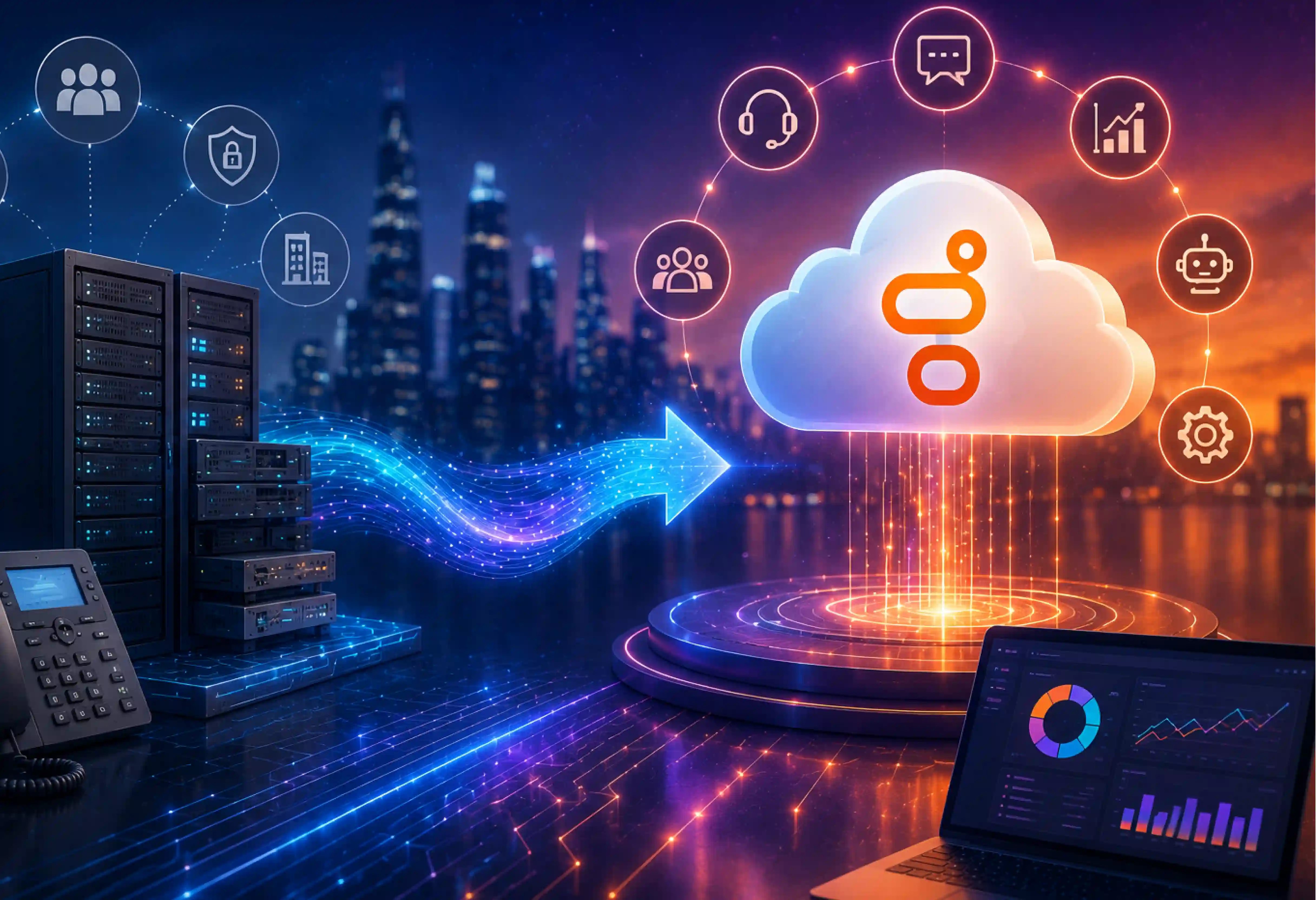


Legacy contact center platforms are facing rapid end-of-support deadlines. AI is becoming a business need, and more enterprises are evaluating Genesys Cloud. They demand careful planning, cost control, and operational continuity.
In this article, we will guide you through Genesys Cloud migration and show how to protect your live operations and avoid costs.
Genesys Cloud Migration refers to the migration of the contact center environment into the Genesys Cloud CX platform. The Genesys Cloud CX Platform incorporates the migration of the voice infrastructure, routing engine, IVR, queues, users, reporting, omnichannel inbound and outbound interactions, and Workforce Engagement Management (WEM).
Generally, it has two common migration motions.
Genesys Cloud is an overall suite of contact centers, from omnichannel routing through workforce engagement, quality management, analytics, AI-based automation, outbound campaigns, and integration using open APIs with third-party solutions. Understanding what comes as native will help in assessing how much technology can be retired during the migration process.
Enterprises are moving towards Genesys Cloud CX to solve distinct pain points across leadership teams. Genesys Cloud migration is more towards improving agility, customer experience, and operational efficiency.
Genesys offers a broad set of capabilities in a single platform. The real benefits we get from Genesys Cloud are
When it comes to businesses that are using older Genesys products like Genesys Engage and Genesys PureConnect, the one key thing to know about migrating to Genesys Cloud is that this is not an in-place upgrade. Rather, it is a modernization effort that involves recreating contact center capabilities in the cloud.
Instead of attempting to migrate features on a one-for-one basis, begin by re-assessing your existing call routing processes, customer journey processes, Workforce Engagement Management (WEM), and any integration processes you have with third-party vendors that do not take into account modern business requirements and what is available within Genesys Cloud. Successful planning requires a ground-up re-architecture:
Not all migration strategies fit every contact center. The right approach depends on current technical debt, timeline, and budget. Below are the five CCaaS Migration Strategies that help you align your business goals

A successful Genesys cloud migration starts with deep discovery. A structured assessment helps organizations understand what they have today, what should move, and what should be redesigned.
To develop a flawless migration strategy, your discovery process must cover the following eight areas in great detail:
A Genesys Cloud contact center migration requires a structured approach that minimizes risk while ensuring continuity.
Start with a review of your current contact center. Review telephony configuration, routing, integration, reporting, WEM, compliance requirements, and user roles. This will help to define the scale of migration and identify areas for simplification of existing configurations. Document all hardware, software versions, and carrier trunking (SIP/PSTN). Identify every system your contact center touches, including CRMs (Salesforce, Zendesk), ERPs, workforce management (WFM) tools, and custom databases. Extract and document existing Interactive Voice Response (IVR) call flows, routing rules, and queue configurations.
Create the future-state blueprint. Instead of copying old processes, map out streamlined customer journeys, define user roles, and design an optimized queue structure. Choose a telephony model (Genesys Cloud Voice vs BYOC) and establish network/security topology. Plan your deployment for digital channels, chatbots, voicebots, and AI-driven agent assist tools to hit efficiency targets early.
Set up Genesys Cloud and create cloud-native call flows, IVR, digital channels, queues, and automations. You can use this stage to update your routing algorithm and leverage AI capabilities natively when applicable.
Integrate Genesys Cloud with the back-end systems that your agents work with daily. These will often include CRM systems, identity providers, workforce management systems, analytics engines, and many others. In cases where native integration is available via AppFoundry, these could save a lot of time on setup and maintenance.
Comprehensive testing is essential before go-live because breaking customer interactions can result in loss of data. Verify that data flows correctly between Genesys Cloud and your external applications. Verify inbound and outbound calls, IVR navigation, routing processes, reporting, CRM integration, recording, AI, failover situations, and security. User acceptance testing with business people will help reveal problems that might not be revealed through technical testing alone.
Before migrating the whole thing to Genesys, begin with a limited group of users, departments, or locations. The test ensures proper operation and identifies problems within the process before going live throughout the organization.
After the pilot proves to be successful, proceed with the production move following a carefully planned cutover process. Ensure number porting, DNS updates, route adjustments, agent training, and communications with all involved parties to avoid disruptions during the transition. This can help large corporations reduce risk.
The migration doesn’t end at cutover. After launch, the upcoming weeks are critical for stabilization and realizing the true value of the investment.
Just lifting and shifting the whole thing in the legacy contact center will not give results; it will result in costly mistakes. To maximize the investment, rebuild your routing and self-service engine from the ground up by using predictive routing, virtual agents, and Agent Copilot.
Conventional IVRs make use of static menus and pre-programmed call paths, which at times may annoy customers and cause call transfers. During the process of migration, it should be assessed whether the interaction flows will still meet the needs of the customers.
Genesys Cloud AI uses intelligent routing that does not solely depend on whether an agent is available or not. In predictive routing, customers are matched with those agents who are most likely to get the right result based on their history, performance, and customer context.
Genesys Cloud AI makes use of intelligent routing, which is not dependent on the mere availability of the agent. Predictive routing is such that the customers are paired up with those agents who have the best chance to provide the correct solution based on their performance and experience.
The most ignored risk in a cloud migration is losing historical context. Securing your historical recordings and interaction data is important, but the real challenge lies in achieving reporting parity. Name the reports, dashboards, and KPIs that your supervisors and executives are currently using. Replicate them within Genesys Cloud, making sure to validate KPIs such as the service level, average handling time (AHT), first contact resolution (FCR), abandonment rate, and occupancy. Identify the difference in the calculation of each metric.
Because Genesys Cloud calculates metrics differently than legacy platforms, you must carefully recreate your legacy KPIs and dashboards within Genesys’s data model to ensure your data remains accurate and comparable over time. Use this checklist to verify your reporting transition:
The biggest risk faced in Genesys Cloud migration is service disruption. A well-planned cutover strategy minimizes downtime while ensuring your team can quickly recover if unexpected issues arise. Choosing the right cutover strategy is the next big thing to be considered.
The operational fear is a migration that drops live customer calls. To eliminate risk, choose between big-bang, phased, or queue-by-queue deployment. A big-bang migration moves all users and workloads to Genesys Cloud at once. A phased migration transitions business units, locations, or channels over time and reduces risk, allowing lessons learnt. The next one is queue-by-queue migration, which provides the greatest control by moving customer queues individually.
Genesys cloud migration should also plan predefined rollback criteria. If critical services fail to meet performance thresholds, the teams should revert to the legacy platform with minimum customer impact.
Security and Compliance should be embedded in every phase of the Genesys Cloud CX migration. Ensure the migration framework addresses data residency requirements and implements end-to-end encryption for both data at rest and transit. Provide granular IAM roles and Single Sign-on (SSO). Configure DTMF masking and recording redaction to safeguard sensitive data and personal information. Use this security checklist to gain CISO approval:
Genesys Cloud migration requires an important investment for a company, and therefore it is crucial to analyze the licensing and future costs before the migration starts. By considering more than just subscription price, organizations can evaluate the TCO and create the business case.
Genesys Cloud offers multiple editions, each designed for different levels of functionality. Organizations should decide on which features are used rather than purchasing it as a whole. Each licensed user has an individual account. Companies that want to evaluate their workforce efficiency should compare named-user prices with other systems used by other vendors.
Subscription plans scale from CX 1 to CX 4 based on voice-only operations and heavy AI and journey orchestration. Genesys offers both named and concurrent licensing models.
In the comparison of TCOs, there should be other factors to consider than just subscription charges. Traditional Genesys systems come with costs associated with infrastructure management, hardware upgrades, upgrade projects, and administration. Genesys Cloud takes care of many of these costs as it relies on cloud computing principles, thus reducing infrastructure costs and software upgrade costs.
Genesys Cloud is different from other solutions like Amazon Connect, which uses a consumption pricing approach, and NICE, which comes with full enterprise-level features and a higher licensing cost. What you need to choose depends on your call volume, AI strategy, customization requirements, and operations approach.
A successful migration timeline depends heavily on seat count and operational footprint. Integrations, customizations, compliance requirements, and organizational readiness have a greater impact on timelines than the number of agents alone.
True transformation happens only when the fine-tuning operations and activating advanced capabilities turn a stable cloud platform into an efficiency engine.
Choosing to handle Genesys Cloud migration works only if your team has more telephone expertise and has handled complex migrations before. But for large enterprises with complex IVRs, multiple integrations, and strict compliance requirements, they often get the most benefits from an experienced migration partner.
Partnering with an authorized specialist such as Entrans will de-risk the entire process by providing pre-built migration tools, proven transition strategies, and immediate access to certified architects who understand the subtle differences in cloud data structures. We provide a deep understanding of legacy architectures, data continuity, and future-ready automation.
The main threat in a contact center cutover is a legacy database or custom API hook forgotten in an old system. Entrans eliminates this blind spot by deploying AI-led assessment tools to thoroughly analyze your environment, backend dependencies, and infrastructure usage before any code is moved.
Chat with us to learn more about it.
A successful Genesys Cloud migration depends on the selection of the right partner. Top-rated Genesys consulting firms distinguish themselves by offering structured methodologies and pre-built code accelerators rather than treating your deployment as an entry-level learning curve.

The completion of a Genesys Cloud migration can take up to 2 to 4 weeks for mid-market deployments. Complex deployments can take 3 to 12 weeks.
It is a complete architectural rebuild because Genesys Cloud operates on a microservices-based API framework. Organizations redesign IVR flows, routing, integrations, and customer journeys to take advantage of native Genesys Cloud capabilities.
Genesys Cloud migration costs vary depending on licensing, implementation scope, integration, AI features, and migration complexity. Conducting a detailed assessment is the best way to estimate total cost of ownership and avoid unexpected expenses.
No. With proper planning and phased execution, downtime can be prevented.
Genesys Cloud is well suited for organizations in an integrated contact center platform; Amazon Connect may appeal to businesses that prefer AWS-native services and consumption-based pricing.
Implement encryption, role-based access controls, DTMF masking, recording redaction, audit logging, and appropriate data retention policies throughout the migration process.

-1.svg)