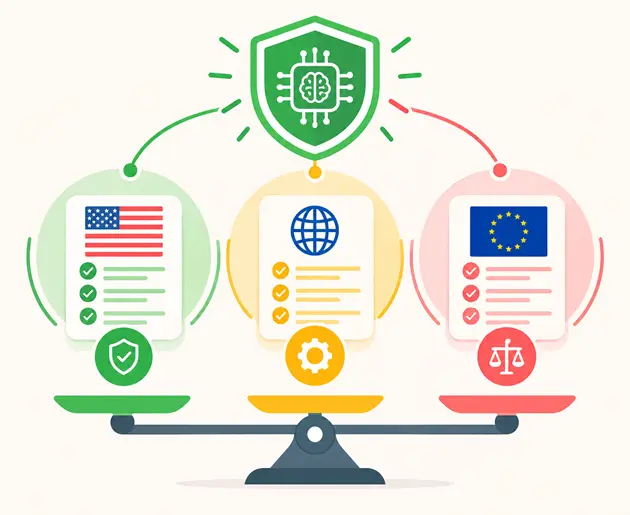
A data lakehouse for banking unifies storage, governance, and AI-readiness. Learn how to build, govern, and migrate one without disrupting compliance.

Agentic Unconference 2026 - September 19, Chennai
View Event →


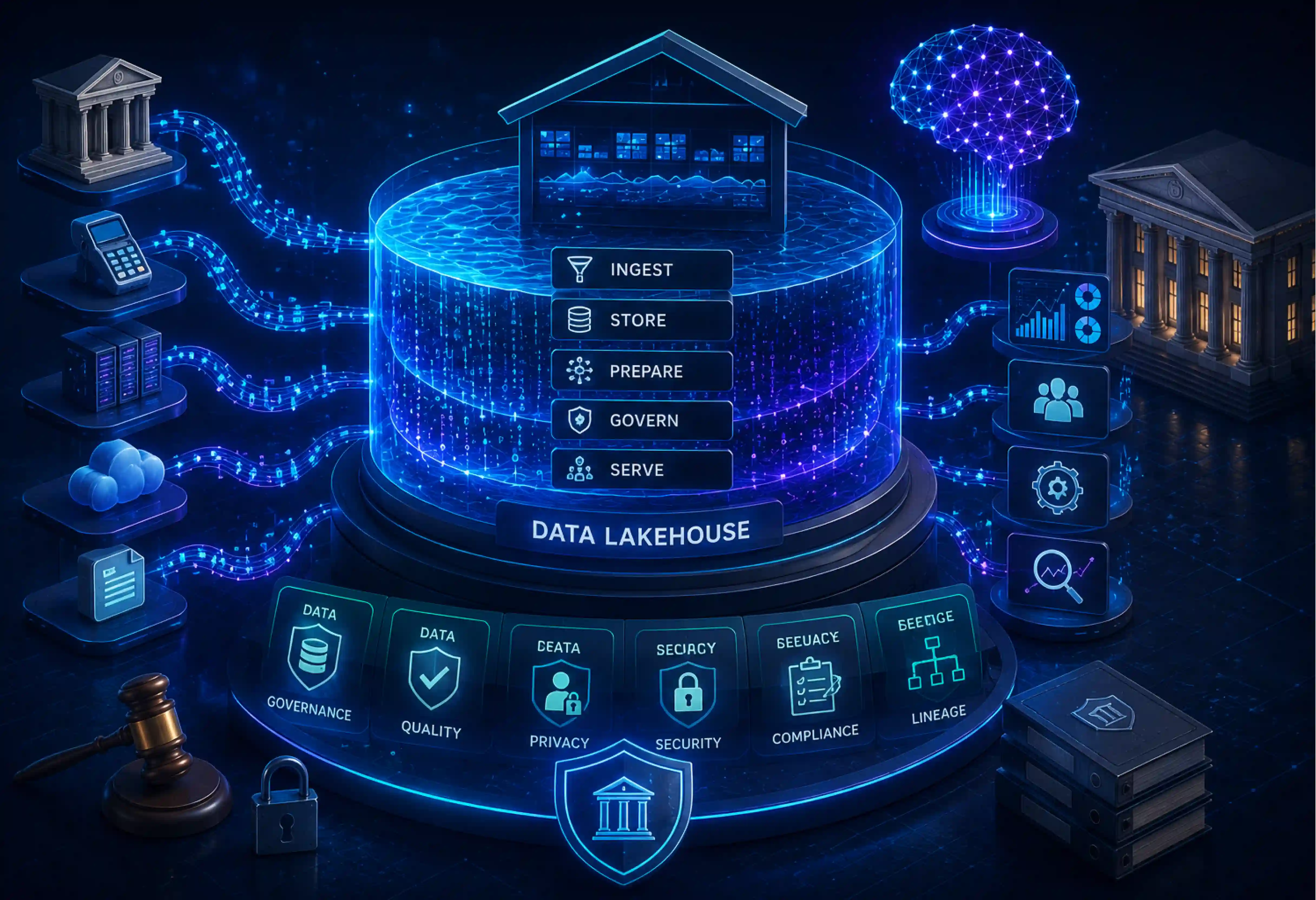


How much of the data budget is getting lost to duplicated storage and broken pipelines? In today’s market, maintaining a separate data lake and warehouse no longer gives measurable results. To build an AI-ready data foundation, financial services require infrastructure that drives predictive modeling without compromising regulatory compliance. Moving on to Data lakehouse for banking fixes, this gap.
In this post, we will examine how banks can modernize their data platforms that satisfy regulatory requirements while moving on to next-generation banking.
Every bank and financial institution currently operates under a massive AI mandate. Leaders want real-time fraud detection, hyper-personalized customer journeys, automated credit risk profiling, and generative AI copilots for compliance teams. The bottleneck isn’t AI models themselves; they work smarter and faster than ever.
The ceiling is your fragmented data infrastructure. Specifically, it is the legacy two-tier architecture that most financial organizations still rely on to manage their data.
We need to understand how data is stored. For the past decade, financial enterprises have been maintaining two entirely separate environments - data lake and data warehouse.
So why is this needed? Because no single system could handle both raw AI data and structured financial data. This two-tier architecture and its associated costs are directly sabotaging the AI strategy.
To train an AI model, data scientists need to combine transactional data with behavioral data. Because the warehouse and lake don't talk to each other seamlessly, teams copy massive datasets back and forth. So the cost of maintaining the financial records multiple times with cloud storage helps in computing bills.
Every data movement introduces latency. By the time travels from source systems to the lake, through transformation pipelines, and into the warehouse, it may already be hours or days behind. An AI model trained on stale data is useless for critical operations.
Each data copy must be secured, monitored, governed, and audited. Security teams must manage access controls across multiple platforms while compliance teams struggle to ensure sensitive information is consistently protected. This fractured security increases the risk of data leaks and regulatory non-compliance.
The most challenging part of AI is explaining where the data came from and how it was transformed. Financial auditors require absolute proof of where data came from and how it was altered. When data is constantly extracted, moved, transformed, and re-uploaded between two independent platforms, the digital paper trail breaks.
Most machine learning projects do not get deployed due to the fact that data engineering teams focus on finding, cleansing, and reconciling data as opposed to developing models. Contrary to expectations, fragmented data environments hinder rather than facilitate progress at all stages of AI development.
Today’s banks handle dozens of systems such as core banking platforms, payment networks, loan servicing applications, credit card processors, fraud detection tools, digital banking channels, CRM platforms, and regulatory reporting systems. The real challenge comes in storing the data in a reliable, secure, and usable way.
In simplest terms, a data lakehouse for banking is exactly a data lake plus a data warehouse built on open storage. Like a data lake, it stores large volumes of raw and processed data in cost-effective storage. Like data warehouses, it provides structure, governance, data quality controls, and high-performance analytics. For a bank, this architecture is powered by four non-negotiable pillars:
Traditional banking data environments often evolve over decades. Data gets copied between operating systems, the warehouse, reporting platforms, and analytics tools. This creates challenges such as
The above challenges are covered in a lakehouse by creating a centralized, governed data foundation.
For banking and financial services firms, data modernization has ceased being merely a tech project. It is an urgent need now. Most companies start by addressing the requirements for scalability, analytics, and artificial intelligence, which means that ultimately, it’s governance and compliance that decide the trustworthiness of the data platform.
Modern banking environments must satisfy a growing list of regulatory and risk-management requirements. These include:
If governance controls are added after the platform is built, organizations often face costly remediation projects, duplicated controls, and compliance gaps.
Accuracy, integrity, and traceability of risk data are paramount under BCBS 239. Authorities will be keen on showing how a figure appearing on the balance sheet was obtained, computed, and approved.
Deploy a lakehouse catalog, for instance, Unity Catalog or Apache Iceberg, that incorporates a single source of truth for metadata capable of recording column-level lineage. The lakehouse must have data cataloging across the enterprise, data lineage, common data definitions, data quality, and transformation capabilities.
Focuses heavily on operational continuity and third-party risk. This impacts your access control and business continuity strategies within the lakehouse. The Digital Operational Resilience Act (DORA) emphasizes operational continuity, risk management, and technology resilience.
Lakehouse design decisions should include:
The goal is to ensure that critical banking functions remain operational even during disruptions.
Reproducibility, versioning, and accountability of results in data science are necessary. It will mean having data contracts, which entail versioned and accountable data inputs and outputs in terms of who owns what. Thus, lakehouses must have mechanisms for managing versioned datasets, reproducibility of training environments, and management of training and reference data access.
Privacy rules mandate that companies must know which data belongs in the sensitive category and then provide role-based permissions.
A lakehouse complying with these regulations must offer fine-grain permissions, data masking and tokenization, encryption, and consent policy management.
Difficulties lie in designing an architecture that would be capable of providing analytics, AI, governance, and compliance functionality, but without relying on one particular vendor. An effective architecture must pay primary attention to principles rather than products. In essence, its ultimate objective is to provide a scalable, governed, and interoperable framework that could adjust to new needs and innovations.
One of the most popular architectural approaches is called the Medallion architecture. Through the combination of architectural patterns and open-source storage options, one can create a truly adaptive infrastructure that will be able to accommodate changes. Therefore, a single system will be able to serve both structured BI and advanced AI workloads.
To incrementally clean and structure data, implement the Medallion Architecture. This logical design pattern focuses on data quality rather than specific tools.
Raw Ingestion → Bronze (Raw) → Silver (Cleansed) → Gold (Curated) → Unified Serving Layer (BI and AI)
This is the initial landing zone for all raw data coming from operational databases. Typical sources include core banking systems, payment platforms, CRM applications, and digital channels. This layer serves as the authoritative record of incoming data.
In this layer, data quality and consistency are improved. Data is obtained from the Bronze layer, deduplicated, enriched, and null values are handled, and schemes are standardized. Almost all of the activities, such as data validation, deduplication, standardization, schema enforcement, and business rule applications, are done.
In the gold layer, there are data sets that have been prepared for operations. The data sets in the gold layer are processed and organized according to business requirements such as aggregation, modeling, and star schema formation. The gold data layer can be used in feature stores.
A vendor-neutral architecture requires a decentralized compute layer, which makes centralized data governance for banking essential. This layer serves as the single registry for table metadata, schemas, and security permissions. The governance catalog acts as the central control plane for data management.
Core functions include:
The primary benefit of an open architecture is its multi-engine compatibility. Because the data lives in open formats managed by a neutral catalog, the serving layer splits into specialized compute engines based on the business use case.
BI consumers typically access dashboards, reports, and ad hoc analytics. The serving layer delivers fast query performance while maintaining governance controls. AI computing systems will use past data stores, feature extraction pipelines, training datasets, and live inference input data.
In this regard, adopting a medallion architecture, open data storage formats, governance, and a common serving layer for BI and AI is a way to design a data foundation for the future that will be able to meet regulatory, analytical, and AI needs without losing agility or ecosystem lock-in.
AI success depends on more than data availability. It requires data that is trustworthy, accessible, governed, and operationalized - AI-ready data.
AI-readiness is the ability of an organization's data foundation to consistently support machine learning, generative AI, analytics, and automated decision-making while maintaining governance, compliance, and business trust.
To be AI-ready, it should be said that below five critical capabilities
In machine learning, models consume features—individual, measurable properties used as inputs. In many companies, teams operate autonomously to build and manage their features. It creates redundancy, a lack of consistency, and confusion around which version is being used. AI-ready organizations need an approach for discovering, managing, and sharing the feature sets.
The absence of an integrated register (called a feature store) causes various data science teams to compute the same metrics (such as "customer lifetime value"), but based on a slight difference in their logic.
AI models are highly sensitive to noise. If duplicate records, corrupted tests, or inaccurate timestamps slip into training data. Data lineage is an immutable audit trail showing exactly where a piece of data originated. So without lineage, model outputs become difficult to validate and trust.
Many AI use cases lose value when operating on outdated information. In cases where the machine learning algorithm is processing whether the transaction was fraudulent or the AI-driven agent is responding to a tech support ticket, it will need to have access to live streams or near-live streams of data. In such instances, the serving layer needs to provide context to the model within milliseconds.
Data is not static; it drifts over time. A machine learning model trained on the consumer behavior patterns of the previous year will slowly start losing its predictive power due to changes in market trends—a process referred to as model drift. In addition, an AI-ready data stack consists of MLOps pipelines that automatically assess the quality of input data and model predictions based on real-time data and initiate retraining if needed.
And that's when the final phase comes into play, that is Human-in-the-Loop (HITL). If the automatic data flows are working fine, you will still need to have internal processes in which the domain experts examine any exceptional cases.
Maintaining separate data lakes and data warehouses is difficult. Duplicate data, complex pipelines, governance challenges, and rising infrastructure costs all point toward a unified architecture.
The goal is not simply to move data. It is to maintain business continuity while proving that new platforms deliver the same results.
Big Bang migrations fail because of reporting inconsistencies, broken downstream dependencies, user adoption challenges, compliance concerns, and extended project timelines.
A more effective strategy is to prioritize business domains.
Select domains based on factors such as:
Starting with a well-defined domain allows teams to establish migration patterns before expanding across the enterprise. Categorize it based on domains by balancing operational risk against business value.
The existing environment should remain operational while the new lakehouse architecture is introduced.
During this stage:
This parallel approach reduces operational risk and provides time to identify issues before business users are affected.
After the target domain is selected, map out its data journey. Re-route a copy of the raw source directly into the Bronze layer of your new architecture. Run both stacks side-by-side in production.
Before you point a single business dashboard to the new architecture, you must definitely prove that the new system produces identical results to the old one. This is reporting-safe validation.
Build automated reconciliation scripts that run every night to compare the outputs of both systems:
If the numbers match consistently for two to four consecutive weeks, you have verifiable proof that the new system is reliable.
The main goals of modernization are to eliminate unnecessary duplication. However, data copies should not be removed immediately after migration. Start decommissioning redundant copies in stages, which prevents accidental disruption while running steadily.
Meanwhile, organizations can eliminate duplicate warehouse tables, legacy staging environments, and unnecessary data pipelines.
The best approach is to evaluate platforms objectively, understand their strengths, and choose a partner that can help you maximize value regardless of the technology selected. Before comparing vendors, establish your requirements around:
The right platform is the one that aligns with your business and operational needs—not necessarily the one with the longest feature list.
Evaluate the major Lakehouse platforms, such as Databricks, Snowflake, Microsoft Fabric, and Amazon Web Services (AWS). Consider the Datalakehouse partners based on platform expertise, governance and compliance, migration capabilities, AI readiness, and knowledge transfer.
Entrans approaches lakehouse modernization from a platform-agnostic perspective. We don’t sell software licenses, and we are not bound to a single cloud vendor.
We design and deliver unified, secure, and highly flexible data foundations across all major ecosystems:
Learn more about how we have built a data architecture that supports analytics, compliance, and AI for many years. Book a consultation with us.
A data lakehouse combines the cheap, scalable storage of a data lake with the ACID transactions and schema governance of a data warehouse. Banks need one to store massive volumes of unstructured data (like customer call logs) while running real-time, audit-ready fraud detection, improving regulatory reporting, and risk reporting on a single platform.
A lakehouse provides high-quality data with lineage and governance. This ensures machine learning models can ingest consistent, high-quality features in real-time while maintaining strict compliance guardrails.
Sometimes AI pilots fail because of low-quality data with inconsistent definitions and no traceable lineage. Without trusted, timely data and clear lineage, models struggle to produce reliable business outcomes.
Data warehouses are ideal for structured reporting. A data lake is well-known for storing large volumes of diverse data, but lacks governance. A data lakehouse is a combination of both a data warehouse and a data lake.
A lakehouse uses a centralized catalog to log every transformation from the raw landing zone down to the final report. This creates a clear audit trail that helps regulators verify data origins, accuracy, and compliance with reporting requirements.


-1.svg)