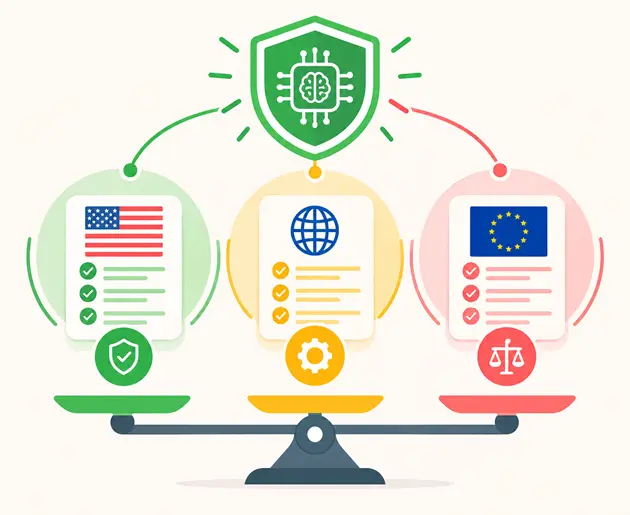
DORA third-party risk management is an architecture problem. Learn to map Nth-party dependencies and auto-generate your register of information.

Agentic Unconference 2026 - September 19, Chennai
View Event →





The dangerous ICT dependency in your organization may be one you've never heard of.
Here is the reality: the third-party pillar is an architecture problem, and the Nth party is where it bites. If you treat DORA third-party risk management like an administrative hurdle, you are missing the point. DORA ICT third-party risk requires organizations to answer these questions with confidence.
In this post, we will explore DORA ICT third-party risk dependencies.
The Digital Operational Resilience Act (DORA) shifted Third-Party Risk Management (TRPM) from a “best practice questionnaire” and treated third-party management directly into operational resilience requirements. The DORA third-party risk management can be summarized through six key areas: contractual provisions, the register of information, ICT third-party risk policy, subcontracting oversight, concentration risk management, and Critical ICT Third-Party Provider (CTPP) oversight.
DORA establishes detailed requirements for contracts between financial entities and ICT third-party service providers. The challenge that arises is in Article 30 because it calls for certain clauses that should be included in every agreement between the financial institution and the ICT provider.
These clauses include the description of the service, performance expectation, security issues, incident reporting, termination terms, and regulatory cooperation. The aim is to make sure that the financial institutions have enough control over the outsourced ICT services despite being performed externally.
The RoI isn’t just an Excel spreadsheet. Organizations must maintain a comprehensive register of information covering all contractual arrangements with ICT third-party providers.
Every single provider must be a provider using an active 20-character Legal Entity Identifier (LEI). If a contract is flagged as supporting a critical function but lacks a corresponding exit strategy ID, it may result in the entire data file failing validation.
DORA requires financial entities to establish a formal ICT third-party risk management policy. This policy must be formally approved by your board of management. The strategy must be outlined.
The policy should define governance structures, risk assessment methodologies, monitoring procedures, and exit strategies. The Risk policy must align with the organization’s broader ICT risk management framework and get approval from senior management.
DORA recognizes that your risk doesn’t stop at your direct provider. Subcontractor Transparency is one of the key principles of DORA. Companies should evaluate whether subcontracting adds any new risks and whether they have proper contract visibility and control mechanisms in place.
DORA Concentration risk is now evaluated at two distinct levels
Among DORA’s innovations, one of the most important is the creation of direct supervision for Critical ICT Third-Party Providers (CTPPs). The ESAs—European Banking Authority (EBA), European Securities and Markets Authority (ESMA), and European Insurance and Occupational Pensions Authority (EIOPA)—will supervise certain critical third-party providers that serve the European financial sector.
However, even though the banks will continue supervising themselves and taking care of their risks, there will be another level of supervision introduced by the ESAs.
Many organizations know their direct ICT vendors. That is a brief about how they host their applications, manage their infrastructure, or provide critical software services. When financial entities first look at DORA ICT third-party risk, they usually head straight to procurement. They round up their primary software vendors, draft some DORA-compliant Article 30 addenda, and call it a day.
This is the Nth-party problem—the hidden network of dependencies that sits behind your contractual relationships. Direct vendors are relatively easy to manage because contracts, risk assessments, and governance processes are designed around them. Subcontractors are different. They operate outside traditional procurement visibility while still influencing the resilience of critical business functions.
If you want to spot the single biggest point of failure in modern financial compliance, then actually draw the technical dependent chain behind a critical function. While a spreadsheet can comfortably log your primary Cloud Service Provider (CSP), it completely drops the ball when that CSP silently subcontracts its log management, DNS routing, or identity verification to three other sub-vendors (your Nth parties).
The spreadsheets fail here for three distinct reasons
DORA makes it abundantly clear that an understanding of subcontracting arrangements, concentration risk, and dependencies involved for critical functions needs to be attained. The requirement is not limited to knowing your vendors. It is about gaining an understanding of the service architecture behind the vendors.
The companies that will make the most of this regulation will go beyond vendor lists and contracts and will start thinking about dependency mapping. Dependency mapping should be seen more as an operational resilience capability rather than procurement because disruption comes from subcontractors that you do not even know exist.
The real challenge with DORA ICT Third-party risk is not about collecting information; it is about understanding how the information connects. To bridge the gap between checking a compliance box and achieving actual operational resilience, you need a paradigm shift. The method is clear: you must stop viewing your ecosystem as a static list and start modeling your ICT dependencies and subcontractors as a graph network.
In this model, business functions, applications, ICT providers, subcontractors, cloud platforms, and infrastructure services become connected nodes rather than isolated records. The relationship between them reveals how services are actually delivered and where resilience risks accumulate.
Building this architecture requires integrating data from multiple sources. Contract repositories provide information about outsourcing arrangements and subcontracting clauses. Vendor management systems contribute supplier profiles, risk assessments, and ownership data. Creating such an architecture will involve the integration of data from various sources. Contracts repositories can give us data on outsourcing contracts and subcontractors.
Vendor management solutions can supply supplier profiles, risks, and ownership details. Configuration management databases, asset management, and cloud management platforms will supply us with data on technical interdependencies. All of these sources together can create the map of our ICT ecosystem.
Therefore, when we have created the map, we can further enrich our graph with more details. We can add risk attributes to each node and linkages, helping us understand not just connections, but also where our operational resiliency risks reside.
Just as important as the creation of the map is its maintenance over time. ICT ecosystems constantly change as new vendors and subcontractors are added, and existing ones are replaced. A dependency map that is done only annually soon becomes obsolete. Organizations should establish a defined update cadence, combining periodic reviews with automated data feeds wherever possible. Changes to contracts, onboarding events, supplier disclosures, and technology environments should trigger updates to the dependency model.
For most compliance teams, compiling the mandatory DORA Register of Information (RoI) is an annual nightmare. A lot of time is put into chasing procurement, harassing IT, and manually copying and pasting data into massive spreadsheets to meet the strict European Supervisory Authorities (ESAs) data models. The dependency model produces the register of information as a seamless by-product of your architecture.
A better way would be for the register to be an output of a dependency structure. If the ICT providers, subcontractors, contracts, services, and business functions were already connected in a dependency relationship, then the register would simply become an output of that process.
Manual registers suffer from three recurring issues:
With more and more ICT providers and subcontracting relationships growing, maintaining accuracy becomes increasingly difficult.
When you model the ICT ecosystem as a graph, compliance shifts from an aggressive data-gathering project to a simple database query. Since the graph possesses all the raw ingredients required to generate regulatory files automatically run relational architecture into a validated registry export, your graph network must natively track three core elements.
The ESAs mandate very rigid, unchangeable data attributes from simple 20-character Legal Entity Identifiers (LEIs) to termination notice periods and flag attributes for important functionalities. Simply put, when you embed all these precise attributes in your graph node properties, it will enable mapping of your own asset to exactly those column headings expected by the regulator.
DORA doesn’t just ask who your vendors are; it demands you prove the path of accountability. A graph database inherently excels at this by maintaining clear data lineage. The system automatically traces and outputs the precise relational chain:
Core Financial Services → Critical ICT Function → Primary Vendor (LEI) → Subcontractor Network
In place of making a scramble each year, the registration is updated dynamically as a result of daily operations.
Managing DORA concentration risk isn't just about ensuring you don't put all your data into a single public cloud provider. It requires an aggressive, multi-layered look at how hidden, shared infrastructure across your entire vendor supply chain can create a systemic point of failure.
Financial institutions also must understand from where dependencies accumulate, whether contractual arrangements meet regulatory expectations, and how critical services can be exited without disrupting operations.
One of the most challenging aspects of DORA is identifying and managing concentration risk across an increasingly complex ICT ecosystem.
At first glance, concentration risk appears straightforward. An organization may have dozens or even hundreds of ICT providers, suggesting that dependency is spread across multiple vendors. However, the reality is often different. Many providers rely on the same cloud platform, infrastructure provider, identity service, cybersecurity vendor, or data center operator.
This is why DORA concentration risk cannot be assessed by a provider. It must be analyzed across the entire dependency chain.
To achieve true compliance and operational resilience, one must align one's risk aggregation, contractual frameworks, and exit planning into a unified strategy.
A graph-based approach will give an evaluation of concentration from multiple perspectives:
Overall, organizations can prioritize remediation efforts based on actual business impact rather than isolated supplier assessments.
Once you have mapped your critical dependencies, you must ensure your legal frameworks provide the necessary authority to manage them.
Most companies view exit strategy provisions in contracts. DORA demands a lot more than that. An effective exit strategy provision needs to have practical knowledge of how the services are provided. In case of unavailability of any key provider company, organizations should know what applications, business processes, integration, subcontractors, and associated technologies would be impacted.
That is where dependency mapping plays its role.
Through the graph, one can see all the dependencies, both upstream and downstream, and thus, organizations can assess:
As organizations mature their DORA third-party risk programs, a practical question arises: should they rely on a Governance, Risk, and Compliance (GRC) platform? Or combine both approaches?
But the answer depends less on compliance requirements and more on the complexity of the organization’s ICT ecosystem. It can be coined as Build vs. Buy.
To understand that one must understand where standard GRC tools fall short, how the regulations have recently changed, and why the data engineering approach is a new weapon.
The data-centric approach begins with a different question: how is the service delivered?
In contrast to seeing the providers as disconnected data entities, the company builds a model of the connections between the various elements, including business processes, applications, ICT providers, subcontractors, infrastructure services, and agreements. This dependency graph is continuously maintained and evolves according to the changing environment.
This methodology offers better insight into:
Contrary to manual creation of compliance documentation, many of the necessary outputs of DORA will be by-products of the underlying data model.
The most effective DORA initiatives tend not to make a choice between governance and data. GRC tools continue to be an important component of governance processes and policy management, risk management, issue management, and audit reporting. On the other hand, a separate framework of dependency and data architecture can provide insight into how ICT services work.
It all comes down to integration. Contracts database, vendor management systems, CMDB, architecture inventory, cloud solutions, and GRC tools must contribute to a unified view of dependencies, instead of being isolated sources of information.
There is no need to replace governance tools; there is a need to link them to a data architecture capable of building operational resilience.
This is where Entrans steps in. Compliance teams and data engineers often drift apart. Compliance teams understand regulatory text, and data engineers understand APIs, pipelines, and cloud architectures.
Entrans helps financial institutions bridge this gap by combining regulatory understanding with data engineering expertise. Rather than treating DORA as a documentation exercise, Entrans focuses on building the data foundations needed to support third-party risk management, dependency mapping, concentration risk analysis, register of information generation, and operational resilience.
The result is a practical approach that aligns compliance requirements with the architecture and data capabilities required to sustain them over time.
Learn more about how we don’t let your compliance strategy rely on outdated drafts or manual spreadsheets. Book a consultation with us.
DORA requires financial entities to establish a formal ICT third-party risk framework. Additionally, firms must evaluate portfolio-level concentration risks and establish clear exit strategies for providers supporting critical functions.
Nth party risk, on the other hand, is the possible operational risks posed by the supply chain of your main vendor. It includes their downstream subcontractors and how they could affect the operational resilience of a firm, as required by DORA.
Third-party risk management fundamental principles and responsibilities are explained in Articles 28 and 29. Articles 28–30 deal with ICT third-party risk management strategy, provider supervision, and contractual relationships. Other articles refer to subcontracting, concentration risks, and supervision of Critical ICT Third-Party Providers (CTPPs).
Under Article 30, contracts must specify the terms concerning services, security obligations, incident reporting, audit and access rights, business continuity arrangements, termination clauses, and regulation coordination.
This is done in order to ensure that the financial institutions retain full control over the ICT outsourcing services.
Entities that meet the description of being Critical ICT Third Party Providers (CTPPs) include those that, in the case of a failure, will bring about great disruption to the entire financial sector of the European Union. The CTPPs are subject to the ESAs' direct supervision; these ESAs include the European Banking Authority, European Securities and Markets Authority, and European Insurance and Occupational Pensions Authority.


-1.svg)