Enterprise AI chatbot development services that build secure, agentic AI systems using LLMs, RAG, and integrations to automate workflows and boost ROI.


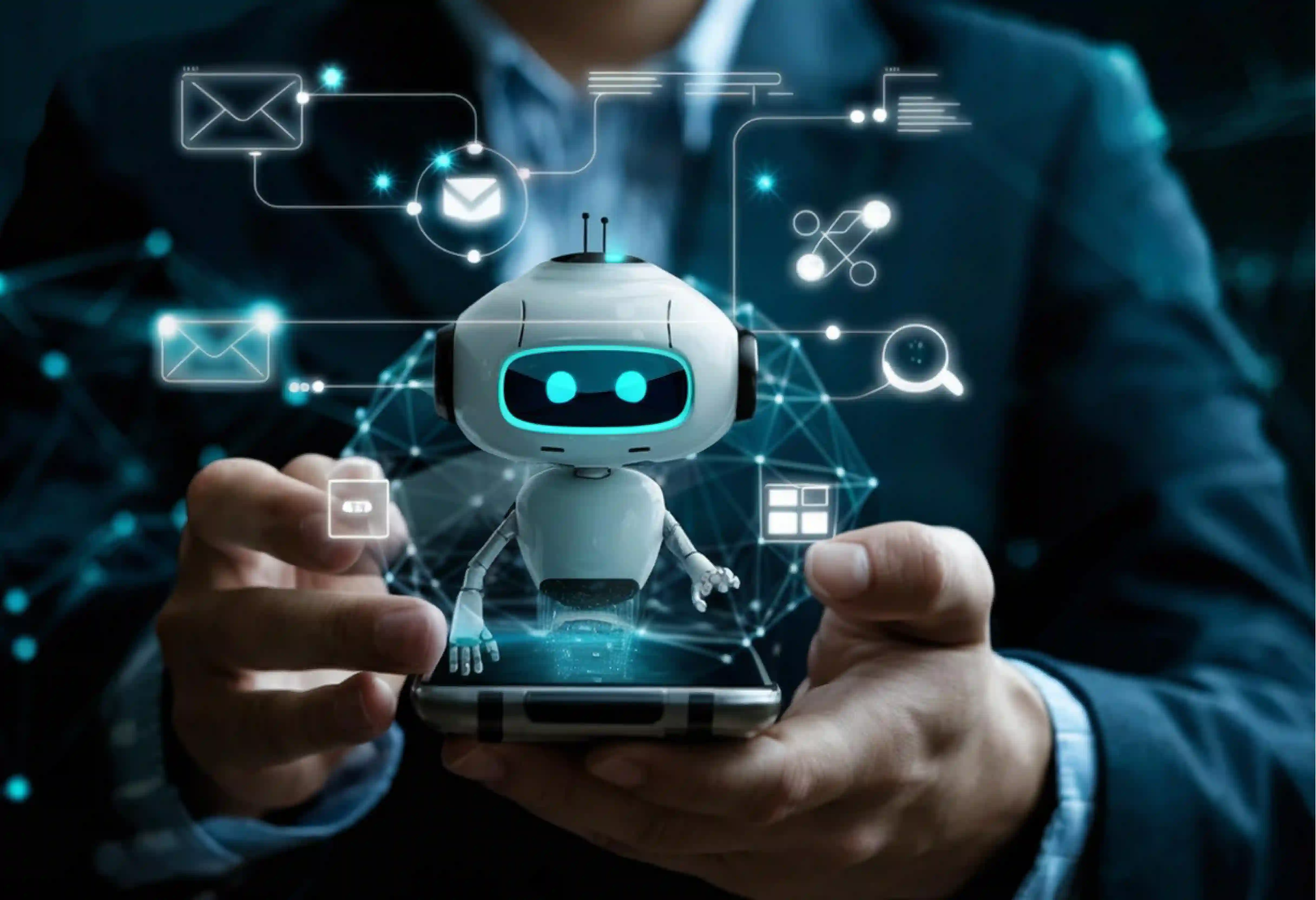


Is your customer support keeping pace with your ambitions? Enterprise AI chatbot development services bridge the gap between massive data silos and provide a seamless user experience. Enterprise AI chatbot development services should not just mimic humans; they should outperform by handling thousands of queries simultaneously. They handle customer service and internal operations. It offers additional advantages, including faster response times, reduced operational costs, and improved customer experience.
In this blog, we will examine in detail what an enterprise AI chatbot development service for websites is and how to create intelligent, context-aware interactions.
An Enterprise AI Chatbot is a software system powered by Large Language Models (LLM) and Retrieval-augmented generation (RAG) to automate complex business workflows across internal and external data silos. Unlike basic bots, it operates as an autonomous agent that is capable of reasoning through multi-step tasks while adhering to strict compliance and security standards.
The term “Chatbot” denotes only a text-only interface limited to rigid scripts. In 2026, enterprises are deploying AI-agents to use them as tools, access APIs, and execute end-to-end business logic. These are termed as autonomous AI agents. Defining in terms of the manufacturing industry, a Chatbot only answers questions about the refund policy, and an AI agent verifies the purchase history, checks the warehouse inventory, initiates the return label, and updates the accounting ledger without human intervention.
Enterprise AI agents sit between traditional automation and full autonomy, combining reasoning, orchestration, and execution. Modern enterprise AI solutions go beyond conversation. Unlike legacy bots, they are goal-oriented, system-aware, adaptive, and multi-modal. Operational efficiencies can be improved by leveraging the enterprise AI agent development services to design goal-oriented workflows that connect directly to legacy systems. They differ in terms of chatbot services such as
The enterprise landscape is currently undergoing a fundamental shift. It has transitioned from a simple reactive interface to agentic systems. These agentic systems are capable of reasoning, planning, and execution.
Reactive chatbots: They are built to respond to user inputs based on predefined logic or trained intent models. One main disadvantage is that they struggle when conversations deviate from expected patterns.
Agentic AI Chatbots: They are designed mainly to achieve goals rather than respond to prompts. They combine large language models with orchestration layers, memory, and tool usage to execute complex, multi-step tasks.
Reactive bots (single) typically operate in a single-turn framework. But when extended, they lack true reasoning across steps. Agentic systems, in contrast, maintain context across interactions, break down complex requests into sub-tasks, and adjust strategies based on intermediate results.
Reactive chatbots rely on static rules and predefined API calls, whereas Agentic AI uses autonomous tool selection. When the user gives a goal, the AI agent decides which tools to use, how to format the data for that tool, and what to do with the result. They also handle exceptions that come along with and retries without human intervention.
Large language models provide strong language understanding and generation. But they are insufficient for enterprise use. They lack reliable execution mechanisms, persistent memory and state management, governance, security, and auditability. To make it function as an enterprise, an LLM must be wrapped in an orchestration layer such as LangGraph, CrewAI, or AutoGPT. This layer provides
This orchestration layer provides a functional member of your workforce.
Enterprise AI chatbots have moved beyond basic automation. High-performing organizations have moved beyond simple chat interfaces to Agentic Workflows that deliver measurable financial results.
One of the most immediate ROI drivers is support automation. Enterprise AI chatbots handle repetitive queries such as order status, account updates, and troubleshooting. Industry leaders are seeing 70 to 85% resolution rates in sectors such as E-commerce and SaaS. By deflecting up to 70% of inbound volume, human agents are freed to focus on high-value, high-emotion cases.
AI chatbots play a critical role in sales by engaging visitors in real time. They answer product-related questions instantly. Responding to a lead within 5 minutes increases conversion rates by 400%. Chatbots act as sales assistants by just collecting emails, and agents conduct discovery and qualify leads based on BANT (Budget, Authority, Need, Timeline).
Nowadays, most of the enterprises are deploying AI chatbots to streamline employee support. Mostly, it is used in IT troubleshooting and access requests, addressing queries about payroll, benefits, and policies, and providing onboarding assistance for new employees.
Every conversation with an AI agent is a data point. Enterprise AI systems analyze these conversations to extract insights such as
In the Finance, Healthcare, and Legal sectors, hallucinations are a liability. ROI here is measured in Risk Mitigation and Audit Readiness. Enterprise AI chatbots are designed with built-in guardrails for regulatory adherence and audit trails for every interaction. These assistants ensure that automation does not introduce compliance risks while improving efficiency. Data-heavy pipelines can be helped by a comprehensive enterprise AI development services overview that manages complex backend workflows alongside conversational interfaces.
Enterprise AI bots deliver the fastest returns when aligned with domain workflows, compliance needs, and customer expectations. Below are the four industries where Enterprise AI is paying off fastest.
The Banking, Financial, and Insurance (BFSI) sector benefits most from automation where speed, accuracy, and compliance intersect. They are used in major use cases such as KYC (Know Your Customer), fraud triage, and agent assist. They mostly do document collection, validation, and onboarding workflows. Chatbot services also find suspicious activity and route the cases for rapid investigation.
Healthcare agents operate under zero-trust architectures. They are the primary interface for administrative efficiency. Agents integrate with EHR (Electronic Health Record) systems to manage complex rescheduling and waitlist automation. AI helps patients understand their bills, checks insurance eligibility before an appointment is fixed. Using PII-redaction layers, these bots provide post-operative care instructions and symptom triage. Through this AI chatbot, patients stay informed without compromising sensitive health data.
Retail enterprises utilize AI bots to manage high customer interaction volumes and drive sales. Core use cases include tracking the order and giving instant updates, simplifying return requests, and policy guidance, assisting customers with product discovery and purchase decisions. E-commerce companies can be helped by deploying a specialized retail solution, such as an enterprise AI chatbot development service for e-commerce, which streamlines high-volume product queries and returns.
The insurance industry lives and dies by its claims process. AI agents have turned a week-long cycle into a days-long experience. It maintains the FNOL (First Notice of Loss), where, when an accident is reported, an AI voice or chat agent guides through photo uploads and damage descriptions. AI agents pre-screen applicants by gathering required data and performing initial risk analysis, which allows human underwriters to focus on high-complexity cases.
Building a production-grade AI agent in 2026 requires more than just an API key and a prompt. The reference architecture for a modern Enterprise AI agent is
At the base of the stack is the Large Language Model. Most of the organizations now adopt a Multi-Model Strategy.
This is an important layer where a chatbot is transformed into an agent. Tools such as Langchain and AutoGen coordinate task decomposition, tool selection,n and chaining, and context management across interactions. This is the layer where static responses are transformed into dynamic goal-oriented workflows.
This layer ensures responses are grounded in enterprise data. Retrieval-Augmented Generation (RAG) connects LLMs to internal knowledge sources using vector databases.
It is the connecting layer. AI agents are useless if they do not act and do nothing. It must interact with a wide range of systems such as CRM, ERP, HRMS, ticketing platforms, and more. Integration layer enables this connectivity through APIs and prebuilt connectors.
With access to 6,000+ connectors, this integration layer allows execution, data synchronization across platforms, and overall gives a seamless user experience.
This layer ensures the system remains compliant and performant.
This governance layer provides access controls and role-based permissions, audit logs, and traceability of actions. Monitoring of performance, latency, and errors. Guardrails to prevent unsafe or non-compliant outputs.
A typical workflow looks like
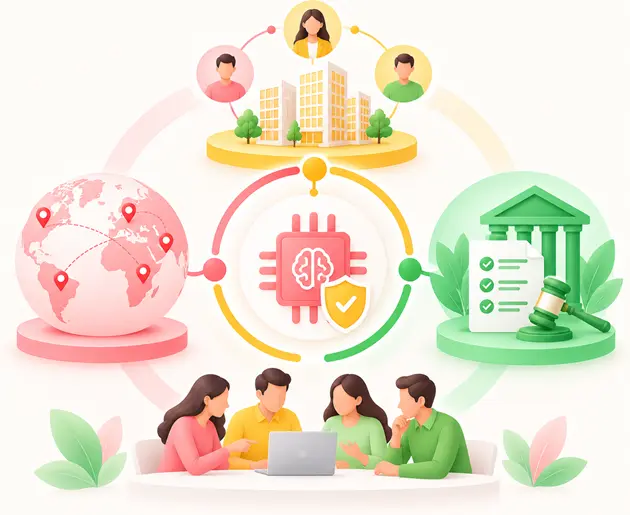
Enterprise AI chatbot adoption is gated by security and compliance. When a product is bought, the customers expect architecture to protect data, enforce policy, and provide auditable, repeatable outcomes.
Any vendor needs to obtain the SOC 2 Type II and ISO 27001 to satisfy minimum entry requirements.
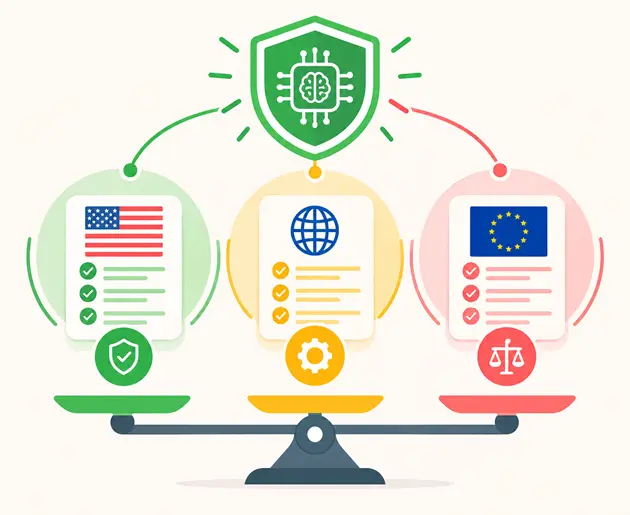
Industry and regional regulations shape how data is handled.
AI systems introduce new attack surfaces. Prompt injection attempts to manipulate model behaviour or extract sensitive data. It involves the user tricking the AI into ignoring its instructions. Mitigation strategies include
Handling personally identifiable information (PII) requires strict controls.
These capabilities are essential for compliance, incident response, and internal governance.
Integration means months of custom API development and middleware. Without integrations, even the most advanced AI remains a surface-level interface. Traditional deployments spend months building a custom API and middleware. A mature integration ecosystem means
Enterprise AI chatbot success depends on a structured process. The step-by-step process for a successful AI chatbot (Agent).
We begin by auditing your business processes to identify high-impact opportunities.
AI is only as good as the data it can access. In this stage, we map your Knowledge Moat. We identify where proprietary data lives and structure the unstructured data, ensuring that AI isn’t learning from outdated manuals.
Choosing the right model and data strategy is critical. First, select LLMs based on performance, cost, and deployment needs. Then design Retrieval-Augmented Generation (RAG) pipelines. Connect models to enterprise knowledge sources.
Effective AI systems require precise interaction design. We define the agent’s personality, its boundaries, and most importantly, its Toolbox.
We turn the agent into a “full-stack” worker by plugging it into the existing ecosystem.
Safety rails must be set before being used by the user.
Rollout is done in a controlled, phased manner.
Launch day is just the beginning. The agent must evolve as your business evolves.
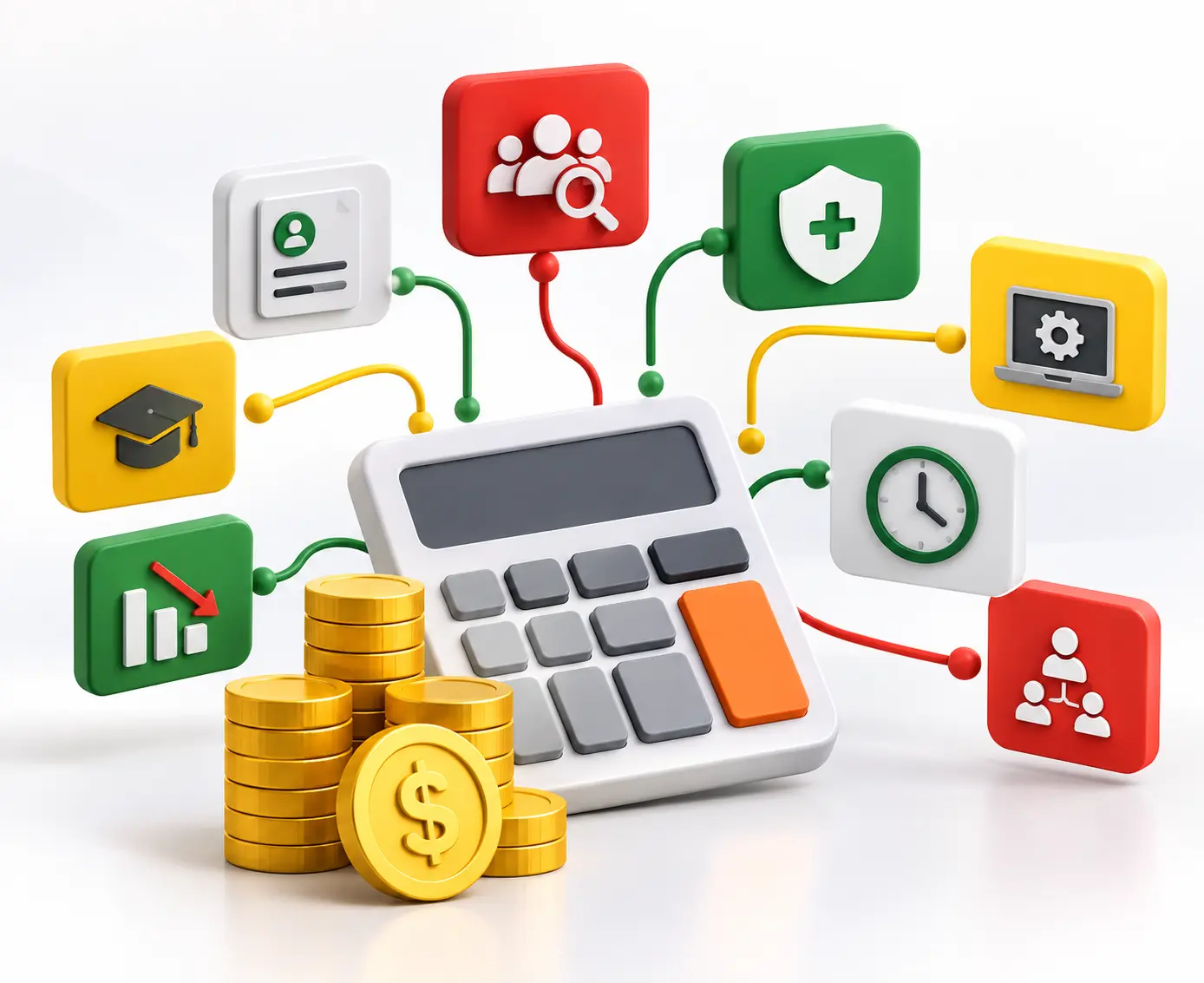
Enterprise AI Chatbot costs may vary widely due to various factors such as complexity, integration depth, and business impact.
It is the first stage where feasibility and business value are validated. This is done by a use case, limited integrations and datasets, basic prompts, and workflows. The main aim is to demonstrate that solutions work in a controlled environment.
In this stage, a small set is introduced to real-world conditions. Multiple use cases are tested with deeper integrations. Initial governance, guardrails, and evaluation frameworks are tested. This stage tests scalability, usability, and ROI in a live environment with actual users.
Production deployments are designed for mission-critical reliability, global scale, and strict compliance. It works for complex cross-system workflows and full internationalization. Final deliverable is a hardened, secure system with advanced observability, PII redaction, and 99.9% uptime guarantee.
Beyond initial costs, many enterprises opt for ongoing support models. So, continuous monitoring, performance optimization, and tuning for model updates with role-based access controls are maintained.
Choosing the right Enterprise AI Chatbot Development Partner will accelerate time-to-value, reduce risk, and ensure long-term scalability.
Look for a qualified partner who demonstrates deep expertise in AI frameworks and orchestration layers such as LangGraph, CrewAI, or Microsoft AutoGen.
Focus on the partner who understands the industry’s specific needs. Look for their past projects and ensure they are compliant with the industry standards.
Ensure that the partner has a proven track record of connecting LLM to SAP, Salesforce, ServiceNow, and Oracle. Procurement timelines can be improved by shortlisting the leading enterprise AI development partners during the initial vendor assessment stage.
Security and Compliance should be built into the partner’s delivery model. Ensure that Certifications such as SOC Type II and ISO 27001 certifications are obtained. Check their proven approaches to data security, governance, and auditability.
A good partner offers ongoing monitoring and performance optimization. They should also do prompt tuning and ensure regular model updates. Clear SLA and support structure should be maintained.
Choosing the right Enterprise AI Chatbot Development partner, such as Entrans, requires a proven ecosystem of proprietary tools and a delivery model that scales with global demand.
Thunai.ai is Entrans' proprietary framework for building autonomous AI bots. It is designed for agentic AI systems capable of thinking like humans, reasoning, planning, and executing. It enables
Security is the primary concern for any enterprise deploying AI. We solve this with Infisign.ai by solving the Identity Gap for non-human entities. It provides
Entrans combines the strategic proximity of onshore consulting with the scale and cost-effectiveness of offshore engineering.
Want to know more about it? Book a consultation call!
The cost for an enterprise AI chatbot depends on complexity, integrations, and compliance needs. Typically, it may cost $15k to $40k for PoC, $40k to $120k for Pilot (MVP), and $120k to $500k for moving the enterprise AI to production.
Enterprise AI is termed as best depending on the existing infrastructure, use cases, and security. Their leading platforms include GPT, Claude, and LLaMA, which is often combined with orchestration tools such as Langchain.
Security in enterprise AI chatbots can be ensured by a platform such as Infisign or Entra ID to ensure only authorized entities have access to sensitive data. They use encryption, role-based access control, and audit trails.
Yes. Enterprise chatbots integrate with platforms like Salesforce and ServiceNow. The integration is achieved through Connectors or direct REST API calls defined in the agent’s Toolbox. This enables automated workflows such as ticket creation, CRM updates, and cross-system orchestration.
Enterprise AI chatbot development depends on data cleanliness and the complexity of the existing legacy system APIS. Typically, PoC may take 3 to 6 weeks, the pilot stage may extend up to 2 to 4 months, and production may take 6 to 12 months.
A chatbot is a reactive interface designed for conversational Q and A. AI agents are goal-oriented systems that plan, execute tasks, and integrate across tools. It does not stop with producing answers alone, but also completes the workflow.


-1.svg)