GenAI COBOL modernization can speed banking migrations, but only with behavior-first testing and human oversight. See what works and what risks to avoid.

Agentic Unconference 2026 - September 19, Chennai
View Event →


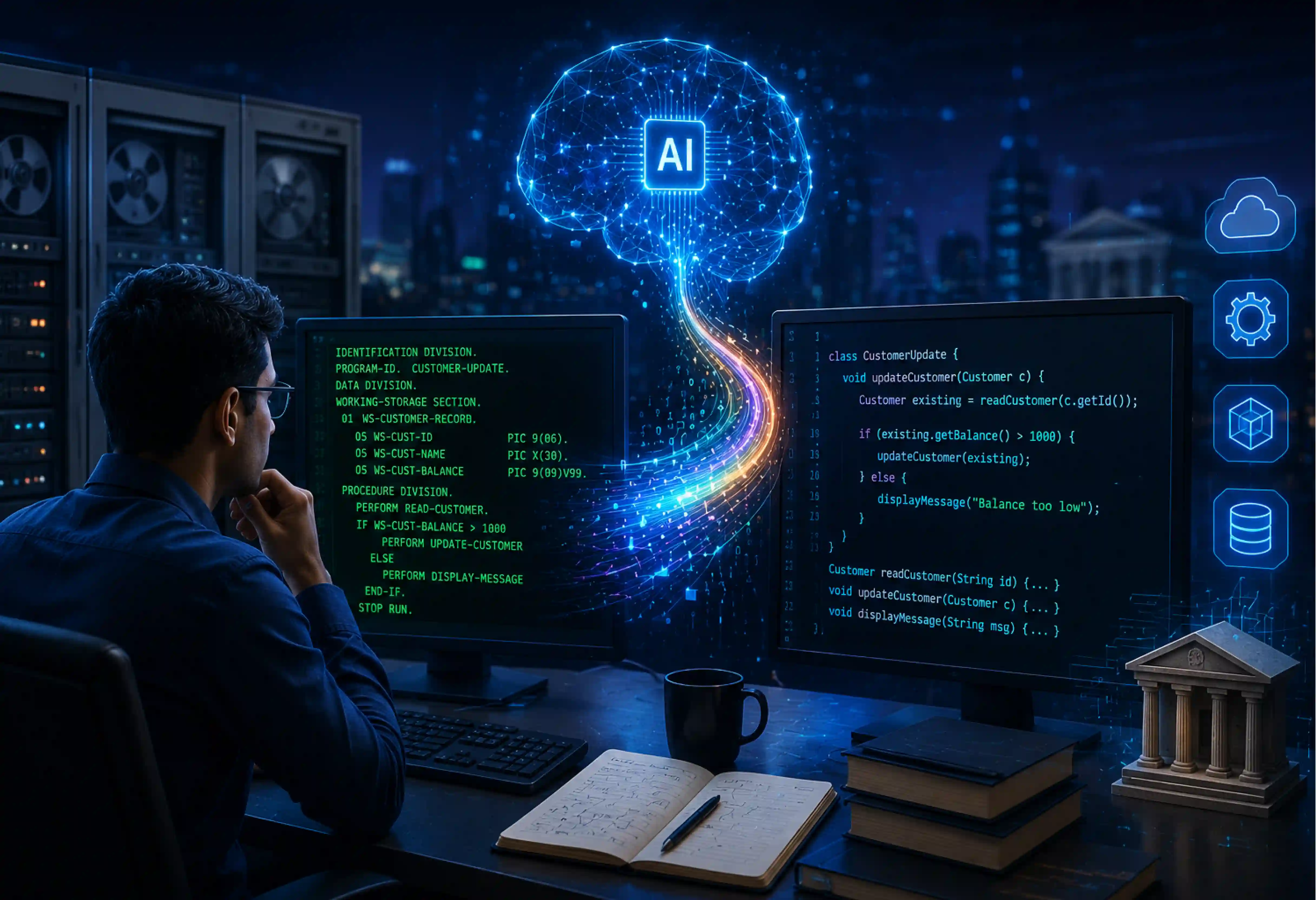


Mainframe modernization remains the final frontier for financial institutions. COBOL has powered the banking systems that move billions of dollars every day. Generative AI development promises faster modernization, and many organizations are asking the same question. However, the reality for banking engineers is vastly more complex than a simple syntax conversion.
This reality check explores where GenAI COBOL modernization delivers real value and where it falls short.
Common Business-Oriented Language (COBOL) has quietly powered traditional banking, financial services, and insurance (BFSI) budgets. These applications are processing billions of transactions silently, but there is a silent threat arising there: the COBOL Talent gap.
Many mainframe applications that are in use today are quite old and are reaching their end-of-life stage much quicker than organizations can update them to new systems. This issue arises since contemporary software developers specialize in new programming languages such as Java, Python, .NET, etc.
Legacy infrastructure is a main source of financial drain. Modern customers expect instant personalized services, such as real-time fraud or mobile loan approvals within minutes. The shortage of COBOL talent often creates a paradox. It is important to have existing experts to support maintenance and also modernization.
Whereas fintech firms that are cloud-native can introduce new capabilities within days, legacy organizations will require months just to test a new capability.
However, on the other hand, there will always be an increase in costs when maintaining the existing system, especially in terms of employing competent COBOL programmers. This can mean higher salaries for experienced COBOL programmers, expensive contractors, time spent on recruiting, and stiff competition.
The cost of maintaining the legacy systems keeps increasing owing to the shortage of COBOL programmers. Some of the factors that could lead to an increase in salaries include: high salaries for skilled COBOL programmers, high costs of contractors, consulting firms, etc.
Legacy systems are not inherently insecure. But complex systems may also turn into vulnerabilities in terms of security. The scarcity of COBOL programmers will lead to late patching of security vulnerabilities, less code review, poor monitoring of the system, and slow remediation of vulnerabilities.
The main cost of the COBOL talent gap is uncertainty. Business leaders must get answers to the following questions in order to continue operations.
Generative AI has sparked enormous interest across the software development industry. Starting from code generation and testing to documentation and modernization, organizations are keen to know that AI can accelerate engineering workflows and reduce operational costs.
Today’s GenAI tools handle COBOL through a structured, multi-phase lifecycle rather than a single bulk translation.
Organizations need visibility into their applications. Gen AI can explain COBOL programs in plain English, generate technical documentation, identify technical documentation, summarize it, and create dependency maps and code descriptions. Here, Gen AI can assist with program analysis, dependency identification, call hierarchy mapping, dead code detection, and impact assessment. This helps the team understand how applications interact and which components should be given priority.
GenAI agents can automatically identify logical boundaries within a massive COBOL application. These are used in identifying certain business rules and then refactoring such business rules into business services.
The most contentious use of AI for software development has been code transformation. By means of AI, you can change your code from COBOL to other languages like Java, C#, Python, and even JavaScript. The system first analyses the logic of COBOL code and its data flow and then transforms it into a modern coding structure.
Testing is often the most time-consuming aspect of COBOL maintenance and modernization. Gen AI can help generate unit test scenarios, functional test cases, regression test scripts, edge-case test recommendations, and synthetic test data.
GenAI can act as a knowledge acceleration tool by explaining legacy code to newer developers, generating onboarding materials, summarizing system functionality, and answering questions about application behaviour. This feature helps in preserving the knowledge and makes it more accessible.
Modernization projects often fail because teams underestimate the complexity. GenAI can support planning activities by helping organizations analyze application portfolios, estimate migration scope, identify dependencies, categorize them, and recommend modernization pathways.
GenAI cannot reliably:
One of the biggest misconceptions about GenAI-powered COBOL translation is that modernization begins with code conversion. In reality, successful banking transformations start with understanding application behaviour. COBOL systems often contain decades of business rules and regulatory requirements. If you want to use GenAI without bringing down the bank, you need a behavior-first, human-in-the-loop framework.
A behaviour-first approach focuses on identifying what the application does before determining how to translate it. Organizations can create functionality requirements, document process flows, map out dependencies, and outline required outputs of key business processes. This provides the basis against which AI-generated code will be measured.
GenAI can be employed for analyzing code, generating documentation, detecting patterns, suggesting translations, and helping engineers get an understanding of legacy systems. Banking operates in a very regulated industry with stringent accuracy and security concerns.
This is where the human-in-the-loop comes into play, in which an expert engineer will perform validation of the AI output, review of business logic, and do functional validation of the code.
By leveraging human-in-the-loop, mistakes, assumptions, and even edge case scenarios that may have been missed by AI algorithms can be identified.
Thus, behavior-first analysis and human-in-the-loop provide a realistic approach to COBOL modernization.
For banks, successfully translating COBOL into a modern language is only part of the modernization challenge. But the question arises, how do you prove it? Auditors, compliance officers, and risk teams are more concerned about whether modernization preserves business outcomes, regulatory controls, and operational reliability.
This proves that equivalence testing is an important component of any AI-assisted modernization initiative. Rather than comparing lines of code, organizations focus on comparing system behaviour for most of the business processes, such as transaction processing, interest calculations, account updates, reporting workflows, and exception handling.
Behavioral validation will involve processes such as the development of a baseline test, regression testing, data reconciliation, performance validation, and edge case analysis. Old production data is especially beneficial, as it can be used to determine how the application will respond to certain conditions that have been experienced by the business during its years in the industry. This information can be documented and verified by stakeholders.
Generative AI technology can be used here to assist in finding appropriate testing scenarios, producing documentation, and identifying possible areas of functional difference. Nevertheless, the validation process still lies within the domain of governance. It requires human review and investigation, as well as approval of any necessary control mechanisms, before implementation.
Proper documentation is also vital for this process. The representatives of risk and compliance teams usually expect proper traceability from the original COBOL code to the transformed pieces of code, as well as the documentation concerning testing results, approval process, and any exceptional situations.
Ultimately, equivalence cannot be proved based on showing how similar the two code bases are; rather, it should demonstrate how they achieve the same results in terms of business. Banks can thus update their existing legacy infrastructure without compromising on security or auditing through testing, audit trails, and human oversight.
Dealing with millions of lines of COBOL needs a strategic modernization approach and a partner to execute. If the approach is wrongly chosen, then it will cause a multi-million dollar failed migration. If the partner is wrongly chosen, then one can end up with a “Java-fied COBOL” monolith. COBOL to Java transformation requires the right balance between automation and good governance, risk management, and engineering skills.
The effective solution is to integrate artificial intelligence in accelerating the process along with validation, testing, and manual examination. It is better to select techniques that emphasize the retention of business functionality, dependency identification, and verifications. It helps minimize the chance of implementing functional errors within systems performing vital banking processes.
Choosing a partner like Entrans brings in experience working with complex legacy environments, regulated industries, and large-scale transformation programs. With our skilled expertise, we do a human oversight wherever it is needed. As a best partner, we combine COBOL knowledge, banking domain expertise, cloud-native development skills, and practical experience by applying GenAI in enterprise environments.
Want to know more about it? Book a consultation call with us.
No. GenAI can greatly speed up COBOL-to-Java conversion processes, but still needs some human supervision. The banks have to realize that AI is not an alternative but only an engineer's assistant.
The biggest risks are silent logical errors, such as a slightly misplaced decimal or an ignored edge-case calculation. Additionally, without strict guardrails, AI will simply generate “Java Monolith,” copying unmaintainable legacy patterns into a modern language.
With equivalence testing, it will become possible for you to compare the output and processes from both your old application and the modern application. Make sure to have complete documentation and test results for controlling purposes.
Transpiling involves the use of very strict compilers in order to transpile COBOL into Java line by line, achieving perfect logic accuracy, albeit at the cost of unmaintainable, “COBOL-flavored” Java. The AI approach involves retranslating the code semantically, which enables the use of modularity and design patterns.
Capture business knowledge, document essential processes, and select applications for modernization as a high priority. Leverage GenAI to speed up analysis and translation while experienced engineers verify results before knowledge is lost.


-1.svg)