Explore slot game development strategies (RNG logic & game design), costs, benefits, features, and trends to build profitable casino games that attract players.





What happens behind every slot spin? A successful slot game retains the players by giving free spins, small wins, or massive jackpots. Slot game development turns simple spins into an engaging digital experience. With the balance of design, math models, and performance, slot games become powerful engagement tools.
In this post, we will explore in detail the process of slot game development, its working, and its pros and cons.
Slot game development is the process of designing, building, and deploying digital versions of slot games for online casinos, mobile, and gaming platforms. They create game mechanics, reels, visuals, payout systems, RNG logic, and sound effects.
A slot game is a digital gambling machine where players spin reels and get prizes according to predefined rules. The patterns are cross-checked and allotted a prize.
The player inserts a coin or tickets into the slot machine and pulls a lever or presses a button to initiate a spin. A complex algorithm runs in the slot machine and generates a Random Number Generator (RNG). This ensures the creation of secure, fair, and engaging slot games for web and mobile platforms.
This software generates number sequences per second by determining the exact position of the reels the moment the spin is pressed. Winning combinations are already set, and payouts are calculated accordingly.
The types of slot games that are built are
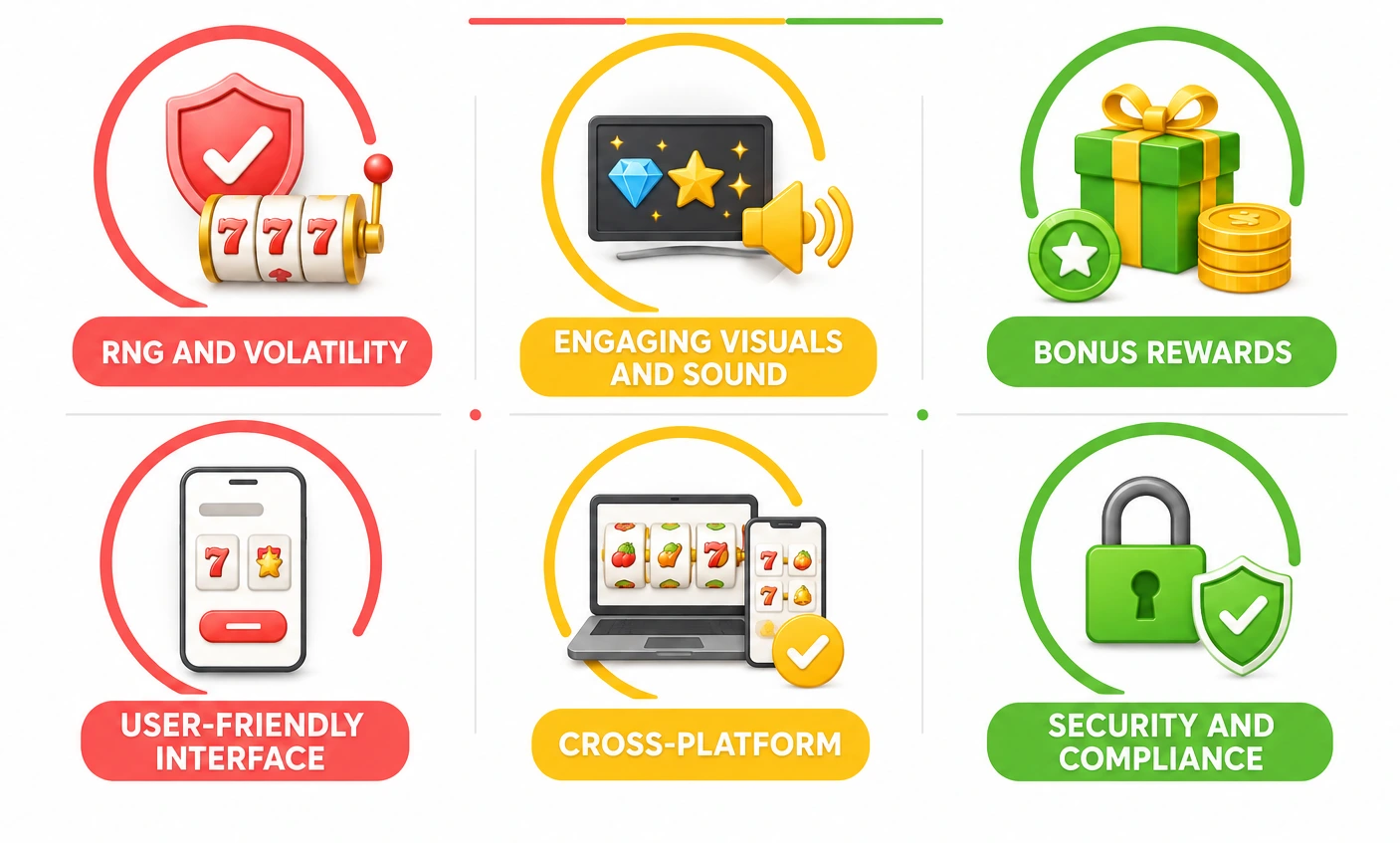
Slot games captivate players with their mesmerizing graphics, visuals, and fairness. The key features are
Slot game development does not mean only casino game development or gambling game development. It is one of the most profitable sectors of the entertainment industry. The primary benefits for businesses are
The slot game development process is categorized into the following key elements:

Start by identifying the current trend in the market and what the audience wants. Then create a Slot Game Design Document (GDD) defining the game concept, theme, target audience, and core mechanics. A successful concept sets your game apart from competitors. Game layout and flow will give a clear picture of the user experience. Then the Minimum Viable Product (MVP) is built to test basic game functionalities and mechanics.
Mathematical modelling is used to balance between revenue generation and a target Return to Player (RTP) percentage. This will ensure the slot game remains profitable and provides fair outcomes. In this step, we start with a Random Number Generator (RNG), calculate the value of every symbol, and determine the Return To Player (RTP) percentage. After that, the hit frequency is calculated depending on how much they win vs. how often a player wins.
Creating software for slot machines serves as the engine of the game. Slot game developers use game engines like Unity or Unreal Engine to code the game and create an engaging user interface. Designers create wireframes, symbols, animations, and sound effects aligned with the game theme.
Slot game developers use HTML5 to ensure they run on any browser or mobile device. All visuals and interactive elements are created in this stage. This layer handles user inputs and real-time feedback.
In the backend, RNG, game logic, handling the real spin results, wallet balances, and player history are calculated.
Functionality testing is performed to validate game logic, payouts, performance, and compatibility. Testing will ensure the game works without any errors across all platforms. The quality assurance team looks for bugs, issues, and inconsistencies, and ensures that the slot game has met all legal and regulatory standards.
Before launching the game, it needs approval from the regions. Different regions have different rules. Next, it is sent to labs such as eCoGRA or iTech Labs. They will ensure that the RNG generated is random and brings fair outcomes.
Once all the approvals are done, the slot game is deployed to online casinos or app stores. Optimize and monitor the performance of the slot game. Get feedback and make changes in the software for slot machines. Regular updates and maintenance help in retaining players.
The technology stack for slot games has shifted towards high-performance, cross-platform compatibility, and real-time data processing.
The defining trends in solt game development are
Slot game development cost varies based on the game complexity. Basic game ranges from $5,000 to 20,000, Mid-tier ranges from $40,000 to $80,000, and premium ranges from $100,000 to 300,000.
Proper selection of a slot game Design company helps in long-term success. The factors to be considered are
Nowadays, slot games give scalable revenue, high player engagement, and global market reach. Choosing Entrans for Slot game development ensures strong game math, creative and intuitive design, and regulatory readiness.
With our AI personalization, we tailor experiences, multiplayer/social features foster community, and blockchain ensures transparency, appealing to modern players. We also ensure quality, scalability, and ongoing support that fuels long-term success.
Want to know more about how we expand the gaming portfolio with confidence? Book a consultation call with us.
The slot game development process begins with the design concept, a math model, and an RNG to ensure fairness. After that, the game’s visuals and animations are made, tested, coded, and the final deployment is done on web and mobile platforms.
Random Number Generator (RNG) is a software algorithm that generates a random numerical sequence for each spin. When a player presses the "Spin" button, the system reads the exact numerical sequence in milliseconds and matches it to symbols' positions on the reels.
The main types of slot games include Classic Slots, Video Slots, Progressive Jackpot slots, 3D or themed slots, and VR Slots.
Slot games are developed using HTML5, C# with the Unity engine, C++ with Unreal Engine, and JavaScript to support cross-platform browser compatibility. Backend programming languages, such as Java, Python, or Node.js, are used to manage secure servers.
The cost to develop a slot game ranges from $5,000 to $3,00,000 depending on the complexity, graphics quality, features, licenses, infrastructure, and regulatory requirements.
It takes 2-3 months to build a basic slot game and 4-6 months to create a feature-rich 3D slot game. The duration may vary based on slot mechanics, graphics, features, integration, and certification.
To choose the right slot game development company, check their proven slot profiles, cross-platform engine expertise, experience with math modeling, and certified RNG integration. Ensure that they provide post-launch support, customization options, and a transparent pricing model.


-1.svg)