Deepfakes KYC fraud is up over 2,100%. See how face swaps and injection attacks break onboarding, and the layered AI defense that stops them.

Agentic Unconference 2026 - September 19, Chennai
View Event →


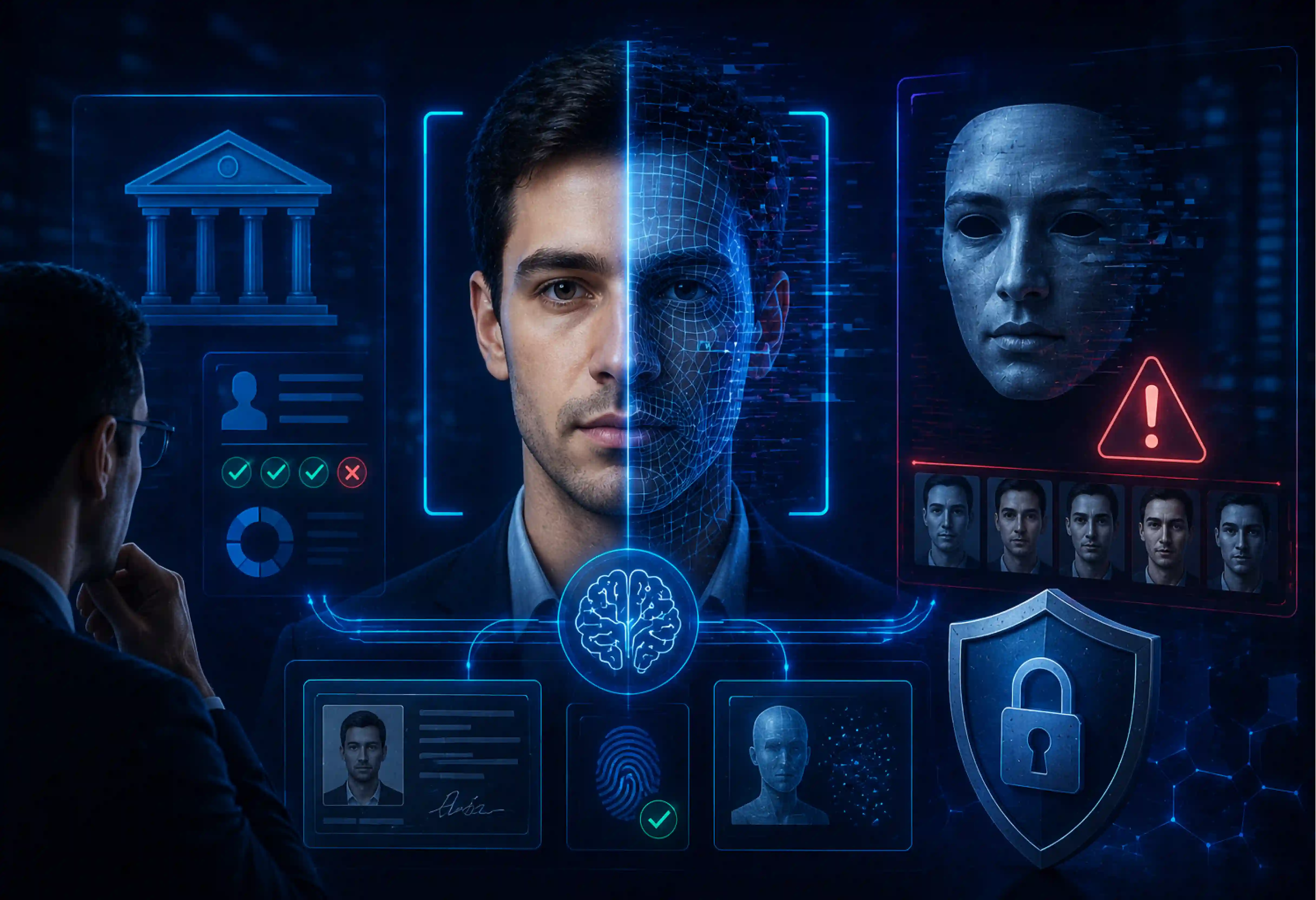


The face on the screen is not real. AI-generated deepfakes are quietly breaking modern security, turning Deepfakes KYC fraud into a massive headache for compliance teams. Standard facial recognition just can’t keep up with today’s hyper-realistic synthetic media. Discover the cutting-edge tools transforming AI deepfake identity verification to lock down your system and outsmart modern cybercriminals.
This blog post will explore the evolving mechanics behind these high-tech scams and dive into robust deepfake fraud detection methods.
We know that financial institutions have strengthened Know Your Customer (KYC) processes to combat fraud, money laundering, and identity theft. Know Your Customer (KYC) verification was designed under a fundamental assumption that a live human being interacting with a camera cannot easily fabricate their physical existence in real-time. However, the emergence of generative AI has brought about a complete paradigm shift in the threat environment. Modern-day cybercriminals don’t have to acquire any stolen passports or use sophisticated forgery kits. They can simply create realistic faces, fake videos, and whole artificial identities that would pass through the entire onboarding process successfully.
The problem faced by the financial services industry, as well as other regulated organizations, is that KYC measures used to counter conventional threats might no longer suffice.
A deepfake is an AI-generated or AI-manipulated media designed to make a person appear to say, do, or look like someone else. Before dissecting the attack vectors, it is essential to define the core AI technologies driving this paradigm shift. The three primary modalities to spoof identity systems are
Together, these technologies create new attack paths throughout the KYC process.
The customer uploads his identity document provided by the government in the form of a passport or driving license, and then uploads a static “selfie” photo. The automated software analyzes the identity document to check its validity and performs facial recognition to match the face from the identification document with the face from the selfie.
Using face swap technology allows fraudsters to place another person’s face onto their own image or video. The attacker would steal an identity card, which would allow him to produce a selfie that matches the holder of the document. In the production of this matching selfie, he does not even have to hold a camera, since he uses one-shot facial re-enactment software to produce a new picture, which completely reflects the picture from the fake identity card.
To ensure the user isn't holding up a photograph or a screen, platforms use liveness detection. Passive liveness scans for micro-textures, depth, and skin reflections. Active liveness forces the user to complete randomized actions—such as nodding, blinking, smiling, or tracking a moving dot on the screen.
This is where real-time face swaps and advanced re-enactment tools shine. When the KYC software demands, "Turn your head to the left and blink," the fraudster acts naturally in front of their webcam. The software running in the background dynamically intercepts the camera feed, overlays the synthetic face onto the fraudster's head shape, and handles the rotation and blink perfectly. Because a real human body is executing the motion, depth sensors and motion trackers register genuine human kinematics.
Many organizations refer high-risk candidates for a live interview with the compliance or onboarding team via video. In the past, this method has been known to be among the best as the interviewer gets to ask questions and observe answers in real-time.
Fraudsters build virtual camera pipelines (using software loopbacks and tools like OBS Studio) that feed deepfake algorithms directly into the video conferencing software. The attacker sits behind their monitor, talking and moving naturally. In real-time, with latencies below 50 milliseconds, the software executes a flawless face swap and maps an entirely different identity—or a completely synthetic persona—onto the speaker. When asked to hold up an ID, they hold up a physically printed counterfeit, and the real-time model renders the synthetic fingers adjusting naturally around the card edges.
While deepfakes certainly get a lot of attention, perhaps the bigger problem is the issue of synthetic identities.
The creation of a synthetic identity is not necessarily an impersonation of someone. Fraudsters use a combination of actual details and fake information to create an entirely new identity.
Presentation attacks have been the main goal of liveness detection specialists for many years. Attackers held paper photos in front of the camera, showed video clips on their phones, or wore masks to trick facial recognition algorithms. In return, vendors provided more advanced solutions that could detect such presentation attacks.
However, now there appears a whole new level of attacks that can easily bypass all the defenses - Digital Injection Attacks.
Instead of trying to trick a camera, digital injection attacks skip the camera altogether and inject synthetic content right into the verification procedure. Due to the improvement in the performance of generative AI, such attacks become some of the biggest threats to KYC, onboarding, and identity verification procedures.
It is essential to understand the difference between presentation attacks and injection attacks for anyone who uses facial biometrics and liveness detection.
Instead of presenting fake content to the lens, the attacker feeds synthetic video directly into the application, browser, operating system, or communication stream.
Earlier organizations relied on trained reviewers to identify suspicious documents, unusual behaviour, and signs of identity fraud. But in today’s generative AI, modern deepfakes can create realistic faces, voices, and video interactions that closely resemble genuine users.
In reality, humans are being asked to distinguish between authentic and AI-generated content that has been specifically designed to deceive them. People struggle to distinguish genuine media from synthetic content. Common visual clues, such as unnatural blinking, distorted backgrounds, or facial artifacts, become less common and less reliable.
Traditionally, there were:
Current AI-based fraud can bypass all of these defenses. Scammers can create high-quality synthetic identities, fake selfies, and even videos that look like genuine proof to both human analysts and computer-based detection programs.
Therefore, traditional measures that were used to prevent fraud are becoming increasingly ineffective.
Organizations most often trust in a single layer, such as document verification, face matching, liveness detection, video interviews, device checks, and behavioral analytics.
A sophisticated hacker could bypass document verification by presenting good-quality fake documents. A deepfake could fool the facial recognition software. An advanced attack could circumvent the liveness detection process. The theft of a device would render the device-based trust signal ineffective.
No individual control is perfect because hackers keep evolving their tactics to exploit the most trusted verification process.
KYC solutions need to accept the obvious truth that people can't detect deepfakes or any individual solutions to prevent each attack. Organizations go in for a layered approach to deepfake fraud detection.

Deepfakes attacks have evolved beyond the point where a single verification step can provide adequate protection. Because fraudsters use sophisticated AI to generate hyper-realistic faces and orchestrate digital injections.
A multi-layered approach to security will include various signals and means of authentication, such as:
Such a combination means that fraudsters will have to circumvent several systems at once, which is significantly more difficult and costly for them.
True identity assurance requires multiple independent security checks working in unison to validate a single transaction. A robust framework stacks the following layers:
Active Liveness checks on challenge-response mechanisms such as head movements, facial actions, or dynamic prompts to predict and reproduce in real time. So by using both approaches, a stronger shield is formed.
Instead of treating each verification step as a separate one, organizations should aggregate signals into a combined risk model. Some of the common examples include additional liveness checks, secondary identity verification, alternative document requests, manual review queues, and video interview escalation.
Human analysts should focus on exceptions, anomalies, and investigations rather than routine verification tasks. If the AI detects a borderline anomaly or a highly sophisticated mismatch, the system automatically routes the case to a trained human reviewer for manual escalation, ensuring no machine error disrupts legitimate business.
The above approach focuses on maintaining business continuity and compliance. Regulatory bodies are actually aware of the deepfake threat, and standard, single-factor onboarding is no longer enough to satisfy strict Know Your Customer (KYC) and Anti-Money Laundering (AML) standards.
A comprehensive AI-versus-AI defense framework automatically generates these audit trails, providing:
Strengthening identity verification strengthens the reliability of the entire AML framework.
Organizations validate their KYC controls by confirming that systems operate as designed. The fraudsters test for the weaknesses and not for compliance.
A KYC process can satisfy regulatory requirements and still be vulnerable to modern deepfake attacks. So here comes Red Teaming - a controlled security test where ethical hackers use real-world criminal tactics to expose weak spots in the system.
The testing process should be done in the categories of attacks used by fraudsters in real-world environments. They include
This allows companies to identify which measures will spot the attacks, which trigger false positives, and which do not work at all. Testing with out-of-date methods of attacking gives companies a false sense of security. Testing with current methods of attacking exposes the risks.
Red teams should test whether the KYC process can identify screen replays, mobile device replays, printed photographs, and high-resolution displays.
Rather than presenting fraudulent content to a camera, an attacker circumvents the use of a camera completely and performs the injection of synthetic video directly into the onboarding process.
A red team exercise must determine the effectiveness of the system's ability to detect:
The surprise most organizations get is the drastic difference in the effectiveness of controls against presentation attacks versus injection attacks.
Do a comprehensive assessment that evaluates document authentication, face matching, passive liveness, active liveness, device integrity, risk scoring, and manual review processes. Organizations should view deepfake fraud detection as an ongoing operational function rather than a one-time process. Evaluate key metrics such as
When organizations think of evaluating defenses against deepfakes KYC fraud, the question that comes to mind is whether to build a solution internally or buy one from a vendor.
The most resilient strategy is a hybrid approach. Instead of building the core AI models yourself or locking into a single vendor, financial institutions should buy specialized, best-in-class point tools (such as separate, expert engines for document verification, injection detection, and passive liveness) and build an internal orchestration layer to glue them together.
Organizations may choose to build:
Building can provide flexibility, ownership of data, and the ability to tailor controls to unique business needs.
Choosing to buy capabilities such as deepfake detection, face matching, passive liveness detection, active liveness detection, document authentication, injection attack detection, and device intelligence services can accelerate deployment and reduce the burden of maintaining detection models internally.
An effective defense framework combines multiple technologies and processes into a single framework. Its core layers typically include
Identity verification
Do a practical starting point to conduct an identity assurance assessment focused on modern deepfake threats.
Building a layered defense against deepfakes KYC fraud requires expertise across identity verification, fraud detection, security engineering, data integration, and compliance operations. This is where Entrans comes in.
As your AI-first digital technology and implementation partner, Entrnas engineers and operates multi-layered identity defense. We act as an extension to your team to
With Entrans, you get the flexibility of a custom, future-proof identity platform without the immense overhead of building and maintaining complex AI infrastructure alone.
Learn more about how we deliver stronger security, better customer experiences, and greater confidence in the integrity of KYC and AML programs. Book a consultation call with us.
Deepfakes bypasses KYC and identity verification by overlaying a target’s face onto a fraudster’s live video feed or by digitally injecting synthetic media directly into the camera data stream. So this allows fraudsters to create fake identities or take over legitimate accounts while appearing authentic to automated systems.
A presentation attack presents fake content to a real camera, such as a printed photo, a screen replay, or a mask. A digital injection attack bypasses the camera entirely and feeds synthetic video directly into the verification stream, making detection much harder.
Yes. Advanced deepfakes can bypass basic liveness checks by mimicking facial movements, blinking, and expressions in real time. So nowadays organizations need multi-layered defenses to bypass liveness detection.
To detect the AI-generated faces, one must implement a multi-layered defense that combines generative artifact analysis. Look for inconsistencies in facial textures, eye reflections, motion patterns,
Deepfakes KYC fraud attempts have increased by over 2,100% over the last few years. Generative tools have become more accessible and realistic. Industry reports show significant year-over-year increases in deepfake-related identity fraud attempts across banking, fintech, and other sectors.


-1.svg)