> Blog >
Digital Modernization Strategy for Enterprises: How to Build Your Legacy-to-AI Transformation Roadmap
Learn how to build a digital modernization strategy that transforms legacy systems into an AI-ready foundation. A complete enterprise roadmap for 2026.

Digital Modernization Strategy for Enterprises: How to Build Your Legacy-to-AI Transformation Roadmap

4 mins
May 22, 2026
Author
Aditya Santhanam
TL;DR
  • 85% of enterprise leaders cite legacy systems as the top barrier to AI adoption. Digital modernization must start at the legacy layer, not the application layer, because running AI over aging infrastructure simply does not work.
  • Digital modernization strategy and digital transformation are not the same thing. Modernization is the IT-owned technical roadmap that makes transformation possible; you cannot have one without the other.
  • The 4 pillars of a successful digital modernization strategy are AI-driven system modernization, data infrastructure modernization, application modernization, and process automation, executed in phases rather than all at once.
  • The most common failure points are big-bang migrations, ignoring data quality before AI rollout, skipping security, and locking into a single vendor's ecosystem. Incremental, cloud-agnostic approaches consistently outperform full-replacement projects.
  • Digital modernization strategy is a need of today’s market as it makes enterprise systems think, adapt, and scale ahead. It acts as a blueprint to solve the budget constraints and slow-down processes. With the right modernization AI transformation roadmap, the enterprise can improve performance, accelerate deployment cycles, and support emerging technologies like Gen AI and real-time analytics.

    This blog will detail the digital modernization strategies, challenges faced, and success metrics needed for the digital modernization program.

    Table of Contents

      Why 'Digital Modernization Strategy' Needs to Start with Legacy Systems

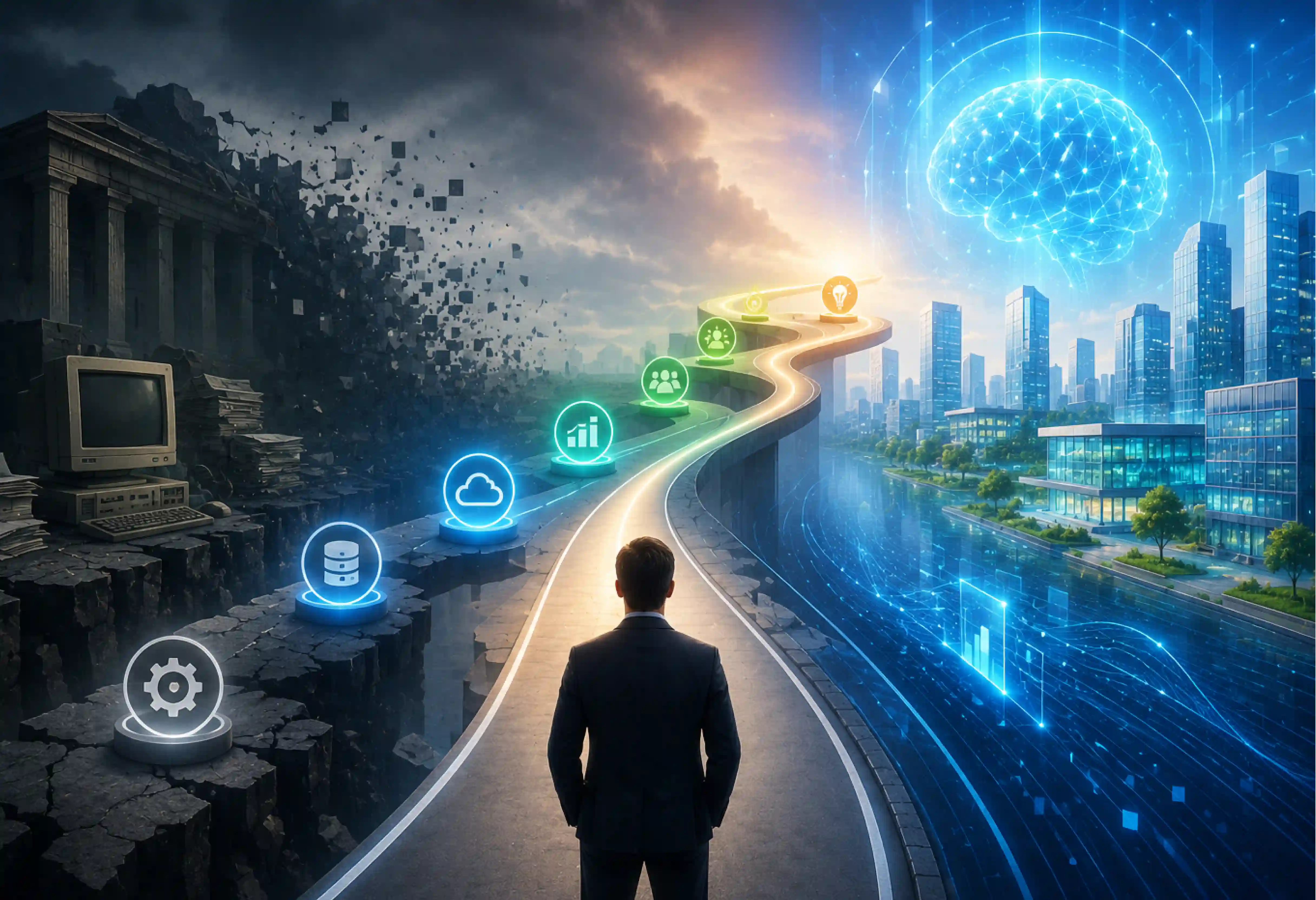
      85% of enterprise leaders cite legacy systems as the top barrier to AI adoption. Digital transformation initiatives fail when they ignore the legacy layer. So, when trying to run cutting-edge AI over a decades-old, rigid codebase is like putting a rocket engine on a tractor; it simply cannot handle the power. True innovation requires fixing the core infrastructure first.

      Digital modernization is more than moving to the cloud. It is often a combination of cloud migration, application modernization, data platform modernization, process automation, and AI integration. If the enterprise still runs on mission-critical workloads on aging applications and tightly coupled architectures, its efforts are built on unstable ground.

      Legacy systems block digital transformation, with some reasons listed below.

      • Limited Integration Capabilities
      • Data silo
      • High Maintenance costs
      • Security and Compliance Risks
      • Skills Shortages

      Future-Proofing

      Starting your digital journey at the legacy layer turns your oldest systems into your strongest assets. A clean, modernized core lets your engineering teams deploy new updates quickly, maintain strict security governance, and accurately predict cloud computing costs.

      What Is a Digital Modernization Strategy (and How It Differs from Digital Transformation)?

      Digital Modernization and Digital Transformation are not the same; they differ.

      A digital transformation strategy provides the vision, whereas a digital modernization strategy provides the technical roadmap to achieve that vision. So one cannot achieve Digital Transformation without executing a digital modernization strategy. 

      Digital Modernization Strategy is a plan to upgrade the systems, applications, data platforms, and infrastructure that power the business.

      Digital Modernization Digital Transformation
      Primary Focus Legacy application modernization, cloud migration and optimization, and data warehouse modernization

      Upgrading the technology foundation
      Launching digital products and services, improving customer engagement, automating workflows, creating new revenue streams, and making data-driven decisions.

      Changing how the business operates and delivers value
      Goal Improve system efficiency, cut tech debt, and enable real-time AI Open new revenue streams
      Ownership IT leaders, CTO, and software engineer CEOs, board members, and cross-functional business heads

      Many enterprise efforts fail because the underlying systems cannot support new capabilities.

      Common challenges include:

      • It is difficult to change monolithic applications.
      • Data trapped in siloed systems
      • Batch-based processes that prevent real-time insights
      • High Maintenance costs

      The 4 Pillars of an Enterprise Digital Modernization Strategy

      A successful digital modernization strategy requires a balanced approach across four core pillars.

      1. AI-driven System Modernization.
      2. Data Infrastructure Modernization.
      3. Application Modernization.
      4. Process and Workflow Modernization.

      Phase 1: AI-driven System Modernization - Assessment and Discovery — Where Are You Now?

      Before starting with a single line of code, we must understand the current landscape. The complete system analysis step must be completed. AI-driven system modernization uses automation and intelligent analysis to assess the legacy codebase. This pillar focuses on transforming the core systems that support business-critical operations.

      • Data Readiness and AI scoring: Audit your data quality and pipelines to see if the system can feed real-time AI engines.

      Phase 2: Data Infrastructure Modernization — Building the Base for AI

      Once the roadmap is clear, build a secure, modern environment. Modern data infrastructure enables real-time data ingestion, unified analytics platforms, data governance and lineage, scalable storage, and compute.

      • Cloud migration: shift core workloads to secure cloud platforms and set up automated deployment pipelines for faster software updates.
      • Microservices decomposition: Break the massive monolithic systems into small, independent microservices and wrap them in secure APIs.

      Phase 3: AI Enablement — Making Systems Intelligent

      With a stable foundation, we need to inject intelligence directly into business workflows. 

      • GenAI integration and real-time data pipelines: Build data pipelines that stream live info straight into generative AI models.
      • Intelligent monitoring: Deploy automated testing tools and monitoring dashboards to track system health and catch model performance.

      The main goal in this phase is to improve agility, performance, and integration while taking care of complexity.

      Phase 4: Scale, Optimize, and Maintain — Long-Term AI Readiness

      Modernization is not a one-time process; it is always ongoing. 

      • Predictive Cost Controls: Monitor cloud consumption closely to eliminate surprise computing costs.
      • Managed Services: Handle ongoing security patching, performance tuning, and engineering support so your internal team can focus on growth.

      Modernizing the workflow reduces manual effort and accelerates business outcomes. DO ongoing activities such as performance tuning, cost optimization, security monitoring, model governance, and provide 24/7 operational support.

      Common Pitfalls in Enterprise Digital Modernization Strategy (and How to Avoid Them)

      Digital modernization strategy fails not because of the technology but because leadership falls into predictable execution traps. The common pitfalls faced in today’s digital modernization strategy are 

      • Big-bang migration: If all the decade-old monolithic systems are replaced massively at once, then it will become an operational risk, as any unexpected bugs may occur at any time. To overcome this, adopt an incremental, modular modernization strategy. Try to use an architecture pattern that wraps old ones in secure APIs, and others run safely in production.
      • Ignoring data quality: Layering advanced Generative AI or automation tools over messy, siloed legacy data is a recipe for disaster. If data is filled with duplicates, formatting errors, or broken relationships, your AI models will simply generate inaccurate outputs. To mitigate this, run a thorough data readiness assessment before choosing or training any models. Build clean, automated data pipelines that extract, scrub, and validate your data in real time before it ever touches an AI application.
      • Skipping security: To speed up the deployment process, engineering teams sometimes cut corners on security compliance and identity management. Security is at the core of risk management. To overcome this, integrate security into your deployment pipelines from day one. Implement strict role-based access control (RBAC), end-to-end data encryption, and automated compliance tracking so that security scales naturally alongside your infrastructure.
      • No change management: If the staff does not know how to handle and operate it, they will just revert to old habits. Forgetting to upskill your staff leads to slow adoption, internal frustration, and a massive waste of budget. To overcome this, modernization requires a cultural shift alongside the technical one. Build hands-on code walk-throughs, comprehensive documentation, and ongoing training programs into your project timeline so your team confidently owns the new system. 
      • Vector lock-in: Locking your entire enterprise into a single vendor's proprietary ecosystem can severely limit your long-term flexibility. Over time, this dependency makes it incredibly difficult and expensive to switch tools, modify features, or control soaring cloud-consumption costs. To overcome this, build an open, cloud-agnostic architecture. Rely on container tools like Docker and Kubernetes, use open-source databases like PostgreSQL, and design flexible microservices that can move between cloud providers without forcing a complete rewrite. 

      Practical warnings

      Watch for these indicators,

      • Scope continues to expand without prioritization.
      • Data issues are discovered late in the project.
      • Security reviews happen near deployment.
      • Business teams are minimally involved.
      • Unclear success metrics.

      KPIs and Success Metrics for Your Digital Modernization Program

      Digital Modernization strategy is a major investment. To measure that and justify that, we need clear metrics that demonstrate business impact. Here are the essential key performance indicators (KPIs) to track. 

      Business and Operational KPIs:

      Business KPIs show how modernization improves cost efficiency, agility, and customer outcomes.

      • IT spend reduction: It gives the measure of the decrease in infrastructure, licensing, and maintenance costs after modernization. To lower your total cost of ownership (TCO), you should shift from rigid monoliths to cloud-native platforms significantly.
      • Deployment frequency: It is the measure of how often the team successfully releases new features, bug fixes, or updates to production. Moving to modern CI/CD pipelines allows organizations to jump from releasing a few times a year to multiple times a day.
      • MTTR (Mean Time to Resolution): It is the average time required to restore service after an incident has occurred. Lower MTTR reflects stronger observability and operational resilience. 
      • Customer satisfaction (CSAT): This is the measure of customer feedback, application uptime, and system responsiveness. A modernized backend directly reduces app crashes, system lag, and operational friction for your end users.

      AI KPIs

      If your modernization program is designed to support Generative AI or machine learning models, your success depends entirely on data health and model performance. 

      • Data pipeline SLAs (Service Level Agreements): Measure the freshness, accuracy, and availability of data flowing through your pipelines. Your real-time AI tools are useless if the underlying data pipelines suffer from frequent lag, processing bottlenecks, or system dropouts.
      • Model accuracy: Track how precisely your AI models make predictions, automate tasks, or parse unstructured data over time. Monitoring this metric helps your engineers catch and fix model drift before it impacts business operations. 
      • Inference latency: Calculate the exact time it takes for an AI model to process an incoming query and deliver an output. High latency slows down user experiences and frustrates teams, while optimized cloud infrastructure keeps responses fast and cost-effective. 

      How Enterprise IT Consulting Services Accelerate Your Modernization Roadmap

      Digital shift will not alone add velocity; one needs enterprise IT consulting services to bring in the high-velocity spark that the roadmap needs. External consultants such as Entrans bring in the expertise and advanced AI tooling to fast-track your architecture design. Consulting partners help reduce technical debt, mitigate migration risks, modernize legacy infrastructure, and improve execution timelines across cloud, data, and application environments. 

      • We support AI-first modernization strategies, cloud-native and scalable digital transformation solutions. 
      • With our proven methodology frameworks, our AI consultants predict bottlenecks early, which gives a precise risk mitigation needed to keep your daily operations running smoothly. 

      Want to know more about it? Book a consultation call with us to tackle the risks.

      Share :
      Link copied to clipboard !!
      Build Your Legacy-to-AI Modernization Roadmap
      Get a phased digital modernization strategy that cuts technical debt and prepares your infrastructure for AI.
      20+ Years of Industry Experience
      500+ Successful Projects
      50+ Global Clients including Fortune 500s
      100% On-Time Delivery
      Thank you! Your submission has been received!
      Oops! Something went wrong while submitting the form.

      FAQs

      1. Why do enterprises need a digital modernization roadmap?

      A digital modernization roadmap prevents expensive, uncoordinated IT spending that is aligned with core business goals. It gives a clear picture of how to eliminate technical debt by keeping daily business operations running smoothly.

      2. What are the first steps in developing a digital modernization roadmap?

      Digital modernization roadmap starts with an assessment of the existing software, data silos, and operational bottlenecks to see what needs fixing. Create goals and map out step-by-step timelines and actions to be done based on budget and urgency.

      3. What modern approaches are available for digital modernization?

      Digital modernization strategy includes cloud migration, application replatforming, and microservices adoption, AI-driven decision making, or completely replacing systems with modern SaaS products. The current trend is to use vibe coding nowadays and low-code platforms to rapidly build and deploy new applications.

      4. How long does it take to complete the digital modernization program?

      A digital modernization program typically takes anywhere from 12 to 36 months. The timeline depends on system complexity, application size, data migration requirements, and organizational readiness. Since it is executed in phases, it may take multiple years to complete.

      5. What role does AI play in digital modernization?

      AI plays a major role in code analysis, detecting bugs, testing, migration planning, operational monitoring, and workflow optimization during modernization initiatives. Once deployed, it introduces automation and predictive analytics to make business workflows much more efficient.

      Hire Engineers Who Specialize in Digital Modernization
      Senior engineers with proven expertise in legacy modernization, cloud migration, and AI-ready infrastructure.
      Free project consultation + 100 Dev Hours
      Trusted by Enterprises & Startups
      Top 1% Industry Experts
      Flexible Contracts & Transparent Pricing
      50+ Successful Enterprise Deployments
      Aditya Santhanam
      Author
      Aditya Santhanam is the Co-founder and CTO of Entrans, leveraging over 13 years of experience in the technology sector. With a deep passion for AI, Data Engineering, Blockchain, and IT Services, he has been instrumental in spearheading innovative digital solutions for the evolving landscape at Entrans. Currently, his focus is on Thunai, an advanced AI agent designed to transform how businesses utilize their data across critical functions such as sales, client onboarding, and customer support

      Related Blogs

      Legacy App Modernization with GenAI: How Enterprises Are Using AI to Modernize Faster and Cheaper

      Discover how legacy app modernization with GenAI cuts costs by 70% and speeds delivery by 50%. Explore the 5 core use cases for enterprises in 2026.
      Read More

      Digital Modernization Strategy for Enterprises: How to Build Your Legacy-to-AI Transformation Roadmap

      Learn how to build a digital modernization strategy that transforms legacy systems into an AI-ready foundation. A complete enterprise roadmap for 2026.
      Read More

      How to Evaluate an AI Consulting Company for Legacy System Modernization: A Complete Decision Framework

      Learn how to evaluate the AI consulting company focused on legacy system modernization with a 6-criteria framework, RFP questions, and red flags to avoid.
      Read More