Discover how legacy app modernization with GenAI cuts costs by 70% and speeds delivery by 50%. Explore the 5 core use cases for enterprises in 2026.

Agentic Unconference 2026 - September 19, Chennai
View Event →


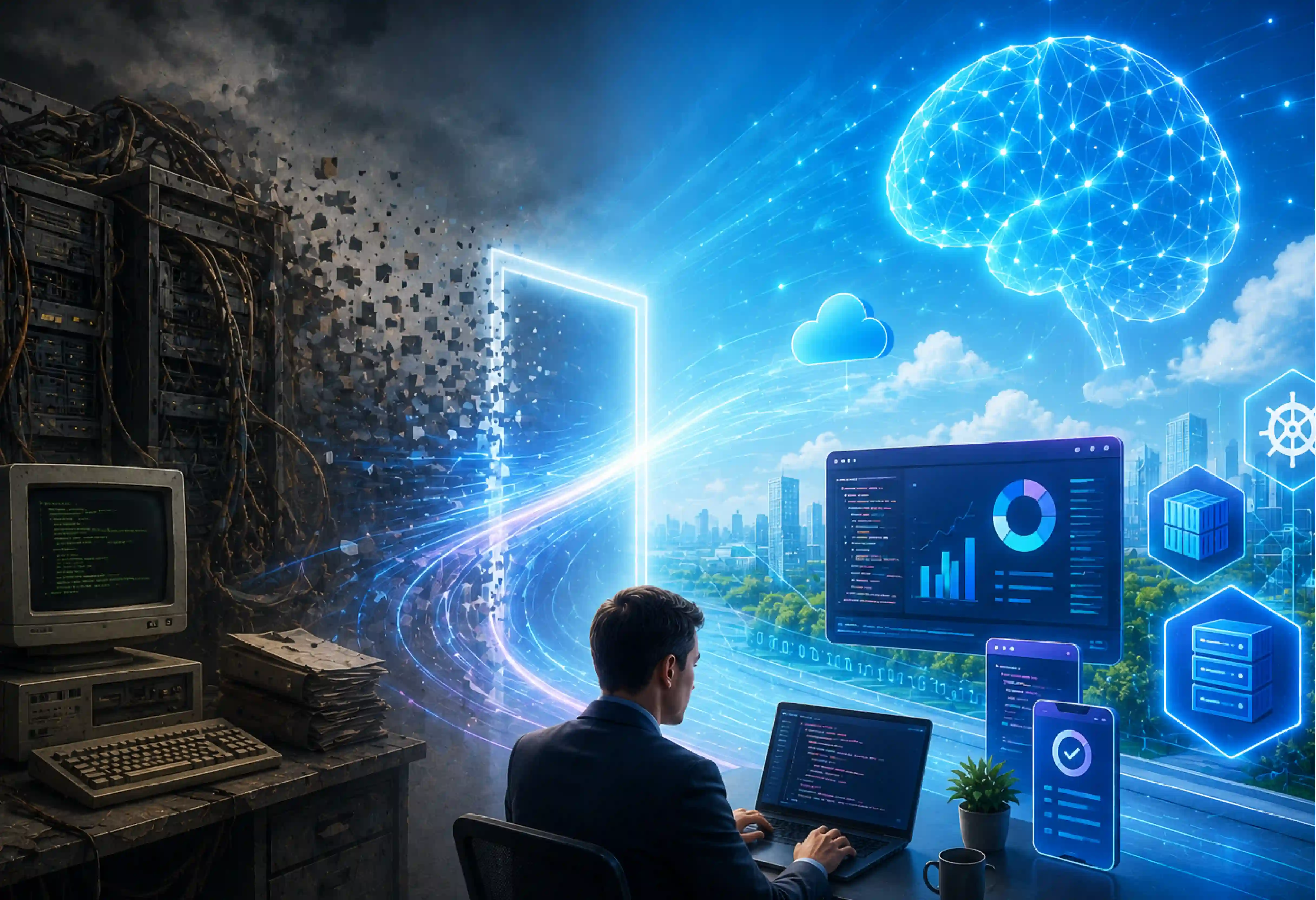


Legacy applications are draining up 80% of your IT budgets. Enterprises are in a phase of using AI-assisted code analysis, automated refactoring, and intelligent testing. This helps to modernize faster and at a lower cost. Manual work can be avoided when mapping dependencies. Organizations now use Large Language Models (LLMs) to scan entire codebases and generate automated test cases. This actually reduces the infrastructure consumption run rates by 70%.
In this blog, we see in detail how to carry out legacy app modernization with GenAI. That will help in fast-tracking your enterprise digital transformation today.
As stated by NTT DATA, AI-augmented modernization accelerates project timelines by 40% to 50%. GenAI is no longer just a tool for generating simple code snippets. The transition from manual refactoring to AI-assisted transformation is rewriting the rules of software evolution. Traditional modernization programs have historically been expensive, slow, and resource-intensive. More time is spent analyzing the code bases, documenting dependencies, rewriting applications, and validating migrations manually. Generative AI (Gen AI) is transforming how enterprises modernize legacy applications. Comprehensive AI-driven legacy modernization solutions can help to streamline this overall transition.
Traditional modernization initiatives often face several common problems.
So what is Legacy App Modernization with Gen AI? It makes use of large language models (LLMs), AI agents, and ML systems. They analyze, transform, refactor, document, and optimize legacy applications. AI systems can now analyze millions of lines of legacy code. Generate modernization recommendations and convert legacy language into modern frameworks. They can accelerate cloud migration workflows.
Enterprises often manage massive codebases built over decades using technologies such as COBOL, PL/SQL, PowerBuilder, VB6, and older Java frameworks. This is not an easy job. It involves uncovering hidden business rules, undocumented dependencies, fragile integrations, and outdated infrastructure assumptions. Generative AI (GenAI) is changing this process completely. It takes the help of AI for legacy code modernization, analyzes legacy environments, understands application behaviour, and generates equivalent modern code at a significantly higher speed. So let’s understand how the GenAI works by following these steps.
The most significant barrier to updating a legacy system isn’t writing new code; it is maintaining it. Decades of hotfixes, forgotten patches, and departed developers leave behind undocumented applications.
GenAI ingests the entire legacy codebase alongside application logs, runtime configurations, runtime behaviours, database interactions, dependency relationships, and schemas. AI can also detect dead code, redundant modules, unused APIs, and outdated libraries. They can also generate technical documentation, API summaries, dependency maps, architecture diagrams, business workflow explanations, and code annotations.
This saves time in hours as the manual engineering effort can now be completed in hours. This accelerates modernization planning, improves migration accuracy, and reduces operational risk. The baseline approach to moving from legacy to AI modernization can be improved by establishing this foundational level of deep codebase visibility first.
Transition of mainframe languages such as COBOL, RPG, or PL/SQL, or Legacy Java frameworks and Visual Basic into object-oriented, cloud-native languages like Java or Python is traditionally slow and highly error-prone. Since rule-based conversion tools often fail. Maintaining these systems becomes increasingly difficult due to shrinking talent pools and aging infrastructure. Gen AI enables organizations to modernize without rebuilding applications entirely from scratch. The modernization workflows typically include
Step 1 - Legacy code Ingestion: Recent benchmark studies show that hybrid AI pipelines combining static program analysis with Large Language Models (LLMs) achieve up to 93% translation accuracy while retaining original business logic.
Step 2 - Semantic understanding and Modern code generation: GenAI models interpret the intent and behaviour of code and help in preserving functionality during transformation.
Step 3 - Code generation: AI generates equivalent implementations in modern technologies such as Java Spring Boot, Python, microservices architecture, and REST APIs.
To ensure enterprise safety, a strict Human-in-the-Loop architecture is required. The translation runs through a "Compiler-Linter Loop" to fix syntax automatically. But human developers must act as the final validation layer, auditing the output for architectural compliance and complex edge cases.
A relatively modern framework (like an older Java or .NET version) can still suffer from extreme technical debt, bloated design patterns, and unoptimized queries. That degrades cloud performance. According to NTT Data research, AI-assisted modernization can reduce technical debt costs by up to 40%.
GenAI identifies Technical Debt: AI-powered refactoring tools analyze codebases to detect code smells, inefficient logic, redundant workflows, and security vulnerabilities. Gen AI systems assist with code simplification, framework upgrades, dependency modernization, API restructuring, and modularization.
A modernization project is only as safe as its test suite. If you cannot prove that the new application behaves identically to the legacy system under every possible condition, you cannot safely deploy it to production. Enterprises must validate that modernized applications preserve business functionality, data integrity, security controls, performance standards, and regulatory compliance.
GenAI de-risks migrations by analyzing legacy inputs, database states, and historical transaction logs to automatically generate comprehensive tests such as unit testing, regression tests, integration tests, API validation scripts, synthetic test data, and edge-case scenarios. Modern AI-assisted QA systems integrate directly into CI/CD pipelines, enabling continuous regression testing, automated validation during deployments, and faster release cycles.
Application modernization is incomplete without data modernization. Legacy architectures often rely on rigid, on-premise relational databases or flat file systems tied together by slow, batch-processed ETL (Extract, Transform, Load) pipelines. They still rely on mainframe storage systems, legacy reporting architectures, and data warehouses.
AI-powered modernization platforms help organizations map legacy schemas, identify data relationships, validate migration logic, and optimize data transformations.
GenAI assists data engineers by automatically mapping legacy schemas to modern cloud data platforms. It translates complex, legacy SQL stored procedures into optimized SQL dialect variants and transforms outdated ETL logic into modern, real-time ELT (Extract, Load, and Transform) data flows.
Entrans helps enterprises modernize legacy data architecture using platforms like Databricks and Snowflake, and it includes real-time data pipeline modernization, legacy warehouse redesign, cloud-native analytics architecture, and streaming data platform implementation.
Legacy system modernization is not about rewriting applications or moving workloads to the cloud. We need to enhance the release cycles, operational visibility, improve reliability, and continuous delivery capabilities. Traditional modernization follows outdated deployment and operational practices. That is why DevOps and Generative AI (GenAI) are increasingly being combined as part of modern legacy transformation programs. Treating GenAI as a standalone assistant will not give the desired results. AI agents are straight into the CI/CD (Continuous Integration / Continuous Delivery) pipeline. This creates a closed-loop system where code is translated, tested, reviewed, and deployed with minimal friction and maximum safety.
Many legacy systems were built using traditional, old waterfall methodologies, which require manual deployments, siloed operations teams, long release cycles, and limited testing automation. These operational bottlenecks slow modernization efforts even after applications are refactored. Companies combining DevOps and generative AI for legacy system modernization address this problem by introducing Continuous integration and Continuous delivery (CI/CD), infrastructure as code (IaC), automated testing by continuous monitoring, containerization, and cloud-native deployment workflows. This is where Gen AI becomes transformative. Navigating this cultural and technical shift with targeted agile transformation consulting and legacy software modernization workflows can help to minimize organizational resistance.
GenAI adds intelligence across the entire software delivery lifecycle. Instead of relying only on predefined automation scripts, AI systems can now analyze deployment risks, generate infrastructure configurations, detect code vulnerabilities, recommend optimizations, create automated test cases, and assist incident resolutions.
Enterprises delayed modernization initiatives because traditional transformation programs were expensive, risky, and difficult to justify. Generative AI fundamentally alters this return on investment (ROI) equation. By shifting from slow, manual code manipulation to high-velocity, automated transformation pipelines, GenAI strips away the cost and time barriers that once stalled digital transformation.
To build an enterprise-level justification for a GenAI-driven modernization project, execution savings, Debt elimination, and Run-Rate optimization. Today, organizations are seeing measurable ROI across engineering productivity, infrastructure efficiency, and operational resilience.
In a standard manual modernization project, up to 60% of the entire budget is burned during the initial discovery, dependency mapping, and documentation phases. The risk of project failure has been lowered due to shifting market dynamics or business requirements during long development cycles.
Technical debt creates substantial hidden costs across enterprise IT environments. Legacy applications may require constant maintenance, specialized support resources, manual operational processes, and repeated workaround development.
Many legacy systems still rely on mainframes, on-premises data centers, overprovisioned hardware, expensive licensing models, and inefficient storage architectures. Rather than copying old structures into a new environment, GenAI facilitates automated semantic translation into optimized, containerized microservices or cloud-native serverless functions. Leading cloud architectures analyzed by Accenture demonstrate that an inefficient legacy environment can reduce the infrastructure consumption costs up to 70%.
Generative AI (GenAI) is rapidly changing how enterprises modernize legacy systems. AI-assisted code analysis, automated refactoring, documentation generation, and testing acceleration are helping organizations modernize applications faster than traditional approaches allowed. However, GenAI is not an autonomous modernization solution.
Legacy environments are highly customized, deeply interconnected, and business-critical. So, depending on AI can introduce new security and compliance risks. In some cases, legacy systems can be simply old codebases; they can contain decades of business logic, regulatory workflows, and industry-specific rules, which can cause challenges for both humans and AI systems. Some of the limitations and risks are listed below.
One of the biggest limitations of GenAI modernization is accurately interpreting highly specialized business logic. Gen AI excels at identifying standard code patterns and translating syntax. However, legacy enterprise systems are rarely standard.
The thing is that LLMs struggle with highly non-linear, nested logic that spans multiple interconnected legacy programs. For example, if the COBOL paragraph relies on a specific memory buffer trick, it may need an old IBM mainframe; generic AI models will fail to understand the underlying infrastructure context. The risk is that AI may generate code and get compiled, but it may forget a low-frequency business rule. It needs human validation as the logic requires domain expert review, functional validation, regression testing, and user acceptance testing.
Hallucination is another major concern in GenAI-assisted modernization. LLMs are trained to predict the most statistically significant token of the ancient database protocol. Hallucinations may include incorrect API usage, nonexistent library references, invalid infrastructure configurations, and inaccurate code translations.
A legacy environment may become problematic when codebases are fragmented, documentation is missing, architectures are highly customized, and frameworks are involved. Some consequences may include application failures, security vulnerabilities, data corruption, compliance violations, and performance degradation. That is why the enterprise AI modernization pipeline must include automated testing and human review stages.
Security and IP protection are major considerations when using GenAI platforms for modernization. Legacy applications often contain deeply proprietary trade secrets. They may use incoming prompts and source code inputs to continuously train future iterations of their networks.
There might be data leakage, IP infringement, and amplified vulnerabilities. To mitigate risks, many organizations are adopting private AI environments, on-premises AI deployments, secure virtual private cloud (VPC) architectures, and data isolation policies. So, following security governance becomes especially important in regulated industries. A structured digital modernization strategy, an enterprise legacy AI roadmap can be improved to safeguard assets while scaling these technologies safely.
Modernizing legacy applications requires more than code conversion. To support this, Entrans accelerates enterprise digital transformation by leveraging Generative and Agentic AI to breathe new life into legacy codebases. We integrate GenAI in various phases of the lifecycle.
Ready to explore GenAI for your legacy systems? Start with a free modernization assessment. Call us to know more about it.

Legacy app modernization with GenAI means using generative AI tools to upgrade, refactor, or rewrite outdated software systems into a cloud-native architecture using an agile approach. It reduces the manual effort to analyze the codebase as AI itself takes care of the transformation.
GenAI moves the process away from risky manual rewrites by automating the most tedious part of software engineering. It analyzes the code to find out hidden system dependencies, dead code, and extracts embedded business rules. Then it automatically translates those into modern code templates and assists engineers in breaking down rigid software blocks into flexible microservices.
Yes. But it cannot be done autonomously. It requires human oversight to do so. Business logic, security validation, architectural designs, and performance optimization still require oversight.
The overall time and cost taken for legacy app modernization with Gen AI depend on the size, complexity, and dependencies of legacy systems. GenAI typically reduces assessment, coding, and testing effort, which reduces the modernization costs and accelerates delivery.
Yes. GenAI induces security risks as the whole sensitive code is exposed. But to mitigate this, organizations should adhere to governance policies, secure an AI environment, and ensure a human review of the generated code.

-1.svg)