Build enterprise AI chatbots for ecommerce that automate workflows, recover carts, and boost AOV. Scalable solutions for Shopify, Salesforce, and SAP.

Agentic Unconference 2026 - September 19, Chennai
View Event →


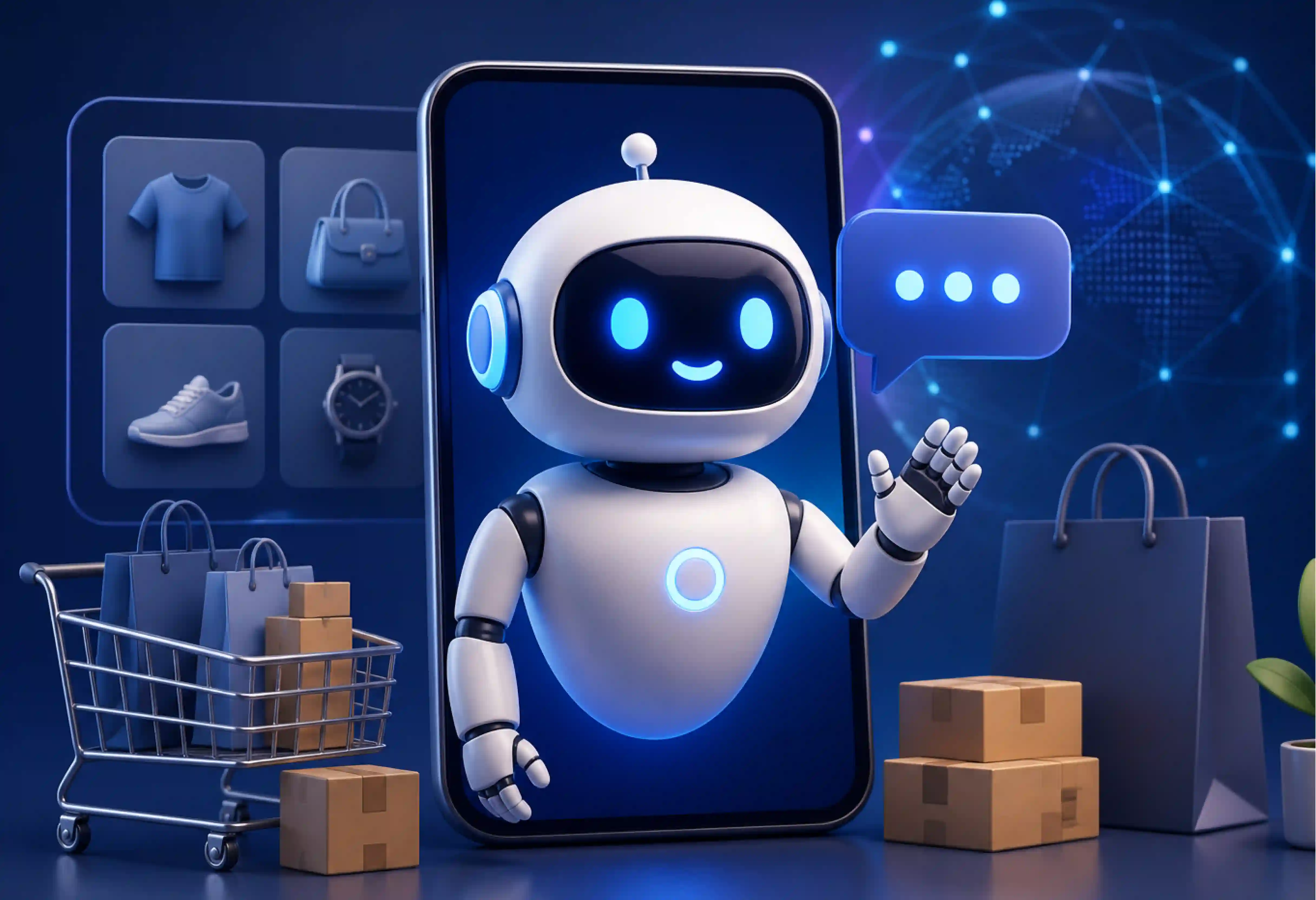


Generic chatbots are relics of the past; the current market needs Autonomous AI agents that think, reason, resolve, and generate revenue. Our specialized enterprise AI development services can help to bridge the gap between legacy data and future growth. Enterprise AI development services bridge the gap between legacy data and future growth. Enterprise AI chatbot development services for e-commerce focus on building scalable systems that help in automating workflows. With the help of advanced AI models, RAG pipelines, and workflow orchestration, enterprises move beyond static bots to intelligent systems that drive measurable outcomes.
In this post, we will discuss the enterprise AI chatbot development service for e-commerce that delivers robust systems and improves retention.

Traditional chatbots followed rigid decision trees. In the current trend, e-commerce leaders are adopting AI agents that use large language models to understand intent, manage complex multi-step reasoning, and handle nuances in human conversation without manual programming. Shift is towards deeper personalization, real-time decision-making, and end-to-end automation.
Traditional chatbots were designed to provide basic support, such as answering FAQs and tracking orders. But when it comes to complex queries, multi-step tasks, and dynamic decision-making, they need human interaction and oversight.
AI agents are autonomous systems that can understand context, make decisions, and take actions across systems. AI agents are used in e-commerce to process returns, manage carts, or trigger personalized campaigns.
The key needs of moving from chatbots to AI agents are
Reduced costs: AI agents significantly reduce dependency on large support teams by simply automating them. In this way, they improve efficiency while scaling customer interactions without proportional cost increases.
AI chatbots have moved from basic FAQ bots to sophisticated AI agents. According to Gartner, by 2026, 80% of customer service organizations will have moved away from native apps toward platforms that leverage generative AI to manage end-to-end customer journeys. This adoption is driven by the need for scalability.
Almost 91% of the businesses use chatbots in some part of the customer journey. According to Salesforce’s State of Commerce, AI is now the top priority for commerce leaders, though implementation maturity is still evolving.
AI chatbots are no longer viewed merely as cost-cutting tools but as significant revenue drivers. The Salesforce State of Commerce report highlights that 45% of commerce leaders are prioritizing AI to help them personalize the shopping experience at scale. Results have shown that AI-driven interactions have contributed to billions in online sales and increased usage by 42%.
Modern buyers expect autonomy, 67% prefer self-service over sales interactions, and 73% research online before engaging with sales. Buyers now expect real-time personalization. Intelligent product discovery, which gives seamless omnichannel journeys. Forrester research indicates that customers increasingly value "self-service transparency," expecting AI interfaces to provide immediate, accurate answers regarding order status, inventory, and return policies.
The e-commerce AI chatbot market in 2026 is defined by scale and also keeps a growing expectation of measurable outcomes. So overall, from all insights of Forrester, Gartner, and Salesforce, we will get to know the revenue impact, buyer expectations are rising faster, and AI adoption is getting widespread. Partnering with the trusted enterprise AI development firms is a step that can be improved to scale these operations effectively.
In 2026, there is a clear distinction between “chatbots” and “AI agents” as a defining factor in e-commerce success. They integrate real-time data, think, and reason to automate tasks across the customer lifecycle. The AI agents' workflows can be split into up to eight parts, which helps with automation.
The "Where Is My Order?" (WISMO) inquiry is no longer a ticket for your support team. Enterprise AI chatbot development agents provide real-time data by connecting directly to your OMS (Order Management System), logistics, and carrier APIs. AI agents also notify the shipment details, any delays in the order, shipment milestones, and give delivery confirmations without any manual effort.
Agentic AI for retail handles the end-to-end return workflows by doing eligibility checks, validating return eligibility based on purchase date, checking item condition, label generation, and refund initiation. It also prevents refunds by suggesting a one-click exchange for a different size or color that is in stock.
Using Retrieval-Augmented Generation (RAG), AI agents read the entire product catalog in real-time and pull relevant product data from catalogs, reviews, and inventory systems. They deliver context-aware recommendations based on user intent, behavior, and real-time availability. This behaviour gives semantic shopping assistance.
Modern AI agents use behavioral intent scoring to engage customers at the moment of hesitation. If the user adds the product to the cart and leaves without ordering, then an alert message is sent via SMS or WhatsApp. Basically, AI agents detect the cart abandonment signals and optimize timing, messaging, and incentives to improve conversion rates.
To reduce return rates, AI agents act as "Size & Fit Guardians." By analyzing a customer’s past purchase history and cross-referencing it with specific brand size charts and reviews, the agent provides tailored advice. It answers detailed product questions, including specifications, comparisons, and sizing guidance. They reduce uncertainty and return ratio by helping customers choose exactly what they want.
AI agents act as proactive account managers for the customers. AI agents can message a customer when they are running low on a product and notify them accordingly. They also maintain loyalty points, explaining how more “stars” are needed for a reward, and apply them during checkout. They also enable one-click reorders based on purchase history, improving retention and lifetime value.
AI agents offer native-level support in 70+ languages using advanced language models; they not only translate text but also understand the local market and regional shipping policies. They ensure global scalability while maintaining context and accuracy across regions.
Every interaction is a data point. AI agents automatically categorize and tag customer sentiment, common pain points, and feature requests. Instead of waiting for a monthly report, e-commerce managers get a live "Voice-of-Customer" dashboard to improve products, marketing strategies, and overall customer experience.
The evolution of conversational tech has created a clear divide between "First-Gen" bots and the "Agentic" systems used by modern enterprises in 2026. A basic differentiation is that enterprise AI chatbots focus on automation and business outcomes, whereas traditional chatbots are suited for high-volume queries, which can handle complex workflows.
The value of the AI agent is measured by how deeply it is integrated into your commerce engine. Enterprise AI chatbot development service for e-commerce is oriented towards enabling real-time actions and not just conversations. Leveraging an expert enterprise AI chatbot development services provider can help to establish these intricate connections smoothly.
Salesforce has pivoted entirely to the Agentforce 360 platform. In 2026, integration means more than just a chat window on a storefront; it involves access to unified customer profiles to provide "hyper-personalized" service based on cross-channel data (Marketing, Sales, and Service).
An AI chatbot in e-commerce gives personalized product recommendations using unified customer data, automated customer service via AI agents, and intelligent upsell and cross-sell workflows.
A platform built for complex B2B and B2C commerce scenarios with deep enterprise system integration. Seamless integration with SAP ERP, supply chain, and finance systems gives strong support for complex catalogs and workflows.
An AI chatbot in e-commerce gives real-time order management and inventory queries, B2B ordering flows, and customer-specific pricing and contract-based interactions.
Shopify has democratized enterprise-grade AI with its Winter Edition 2026 updates. Shopify Plus integration gives an extensive app ecosystem and API access. It gives easy interaction with AI chatbot platforms and marketing tools.
An AI chatbot in e-commerce gives conversational product discovery and guided selling, recovers abandoned carts, provides order tracking, and offers customer support.
Adobe Commerce is a highly customizable, open platform suited for businesses requiring tailored commerce experiences. Its integrations give strong support via APIs and extensions.
An AI chatbot in e-commerce gives advanced personalization and content-driven commerce, custom workflow automation across checkout and support.
BigCommerce is known for its Headless strengths; it now prioritizes AEO (Answer Engine Optimization). By providing clean, API accessible data, BigCommerce stores ensure they are “top pick” when autonomous personal shopping agents scan the web for the best deals.
WooCommerce utilizes the massive WordPress ecosystem that surges in AI plugins. Both of them are widely used for mid-market businesses.
An AI chatbot and Agent use cases give customer support automation, product recommendations, and upselling, as well as basic conversational commerce workflows.
In 2026, the "one-size-fits-all" approach to AI will vanish. To build a high-performing retail agent, we deploy a multi-modal strategy where different LLMs are selected based on their specific strengths. Utilizing advanced agentic AI for retail can be improved to handle the nuanced logic required for these models.
GPT-4o remains the first choice for customer-facing interface. Its multimodal capabilities allow it to process text, voice, and images simultaneously, making it ideal for "Visual Search". Its major advantage is exceptionally low-latency responses that keep shoppers engaged.
Claude is well-suited for processing large amounts of context, making them ideal for catalog-heavy retail environments. Its major strength is to handle long product catalogs and documents efficiently. They give better reasoning across large datasets.
For high-volume, repetitive tasks, we leverage open-source powerhouses like Llama 3 and Mistral. They provide flexibility, customization, and cost control for enterprise deployments. Its major advantage is that it gives lower inference costs at scale and full control over deployment.
RAG enhances model accuracy by retrieving real-time data from product catalogs, inventory systems, and knowledge bases before generating responses.
Choosing the right model ensures retail bots are accurate, scalable, and cost-efficient. They tend to provide personalized experiences that modern customers expect.
By making a shift from reactive chatbots to proactive AI agents, brands are seeing a fundamental shift in their unit economics. Below are the five core metrics we track to measure the success of an AI-driven commerce strategy.
AI agents act as digital personal shoppers, using RAG (Retrieval-Augmented Generation) to understand context better than a simple "frequently bought together" algorithm. Average Order Value (AOV) increases driven by AI-assisted recommendations, bundling, and upsell flows.
So by this AI-driven approach, higher basket sizes with typical AOV lifts ranging between 15 to 35%.
AI agents trigger real-time, two-way conversations on high-engagement channels like WhatsApp or SMS.
So by conversational recovery flows, an incremental value of 20% is obtained.
AI agents allow brands to scale without linear headcount growth and resolve upto 80% of routine Tier 1 inquiries. Reduction in customer support costs through automation of high-volume queries and workflows.
So the enterprise often see 50% cost reduction while maintaining or improving service quality.
Customer Satisfaction (CSAT) scores before and after implementing conversational commerce. AI agents provide instant, accurate resolutions 24/7, eliminating the "wait for an agent" friction that kills brand loyalty.
Improved CSAT scores have helped in obtaining customer experiences and have a direct impact on business.
Conversational commerce builds a "continuous relationship" rather than a series of one-off transactions. This is measured by returning customers. By managing loyalty points within chat, AI agents significantly boost Repeat Purchase Rate.
Higher repeat purchase rates translate into stronger customer lifetime value (CLV).
Deploying a high-performance AI agent in 2026 requires a five-stage methodology designed to ensure data accuracy, system reliability, and measurable return on investment.
The first step is identifying where AI will have the highest impact. We evaluate potential workflows using an Impact vs. Feasibility Matrix. Map customer journeys and identify friction points across pre-purchase and post-purchase stages. Use cases are stored based on revenue impact, automation potential, and technical feasibility. The outcome is a roadmap of use cases such as cart recovery, product discovery, and support automation.
An AI agent is only as smart as the data it can access. This phase focuses on the "sanitization" and structuring of your backend systems. We ensure the product catalog (Shopify, Salesforce, etc) has clean metadata, including technical specs, compatibility, and “vibe” tags. A high-quality data foundation that enables accurate search, recommendations, and responses.
Choosing the right mix of models (LLMs, open-source, or domain-specific) based on performance, cost, and use case requirements. We might use GPT-4o for its conversational "empathy" while utilizing Claude for deep technical catalog reasoning. Retrieval-Augmented Generation (RAG) connects AI models to real-time data sources like product catalogs, FAQs, and policies. The outcome of this layer is scalable, accurate AI systems that minimize hallucinations and maximize relevance.
We deploy your AI agent as a "headless" entity that maintains context across every touchpoint. We deeply integrated widgets that can access the user’s cart in real-time. AI bots are expected to support an omnichannel strategy for consistent experiences. Native deployment on WhatsApp, Instagram, and SMS using official APIs, allowing customers to buy products directly within their favorite messaging apps.
Deployment is just the beginning. Continuous testing is essential to improve performance and ROI. We conduct testing for conversation flows and prompts, timing of interventions, and provide recommendation strategies. Data-driven optimization that continuously improves business outcomes.
As e-commerce brands move from simple deflection to autonomous agentic commerce, the way we measure Return on Investment (ROI) has shifted from purely saving costs to driving measurable revenue growth.
ROI is calculated by comparing the financial gains from chatbot-driven outcomes against the total cost of ownership.
To capture the efficiency of the AI agent, we measure ROI across three distinct pillars
Imagine a real-time command center showing the following widgets:
[Top Row: The Big Wins]
[Middle Row: Efficiency & Accuracy]
[Bottom Row: Customer Sentiment]
Enterprise AI chatbot development is a core driver of e-commerce efficiency and revenue. Entrans is your partner in this transformation, specializing in bridging the gap between legacy systems and modern, AI-first architectures. With our deep expertise in RAG, Agentic frameworks, and Salesforce/Shopify integrations, we turn every customer interaction into a measurable growth opportunity. We specialize in deploying Agentic AI for complex enterprise architectures.
Thunai.ai is Entrans' proprietary framework for building autonomous AI bots. It is designed for agentic AI systems capable of thinking like humans, reasoning, planning, and executing. It enables
Security is the primary concern for any enterprise deploying AI. We solve this with Infisign.ai by solving the Identity Gap for non-human entities. It provides
Want to know more about it? Book a consultation call with us!.
The cost to build an AI chatbot for e-commerce depends on integrations, platform subscriptions, maintenance, AI complexity, and scale. Typically, it can cost $5,000 to $30,000 for basic bots and can go up to $50,000 for enterprise-grade solutions.
Popular options include Shopify Inbox, Gorgias, Drift, and Intercom for strong integrations and automation. For enterprise use, platforms like Salesforce Einstein Bots and Ada are widely adopted.
AI chatbots for e-commerce are on average 340% ROI in the first year. It reduces customer service operational costs by 30 to 40%. AI chatbots for e-commerce also boost revenue by 15 to 35% through 24/7 lead qualification and personalized product recommendations.
Conversational commerce uses AI chat interfaces to guide users through product discovery and recommendations. The process streamlines the funnel by allowing shoppers to ask questions, receive suggestions, and complete payments without leaving the chat interface.
Yes. AI chatbots integrate with ERPs like SAP, Microsoft Mcirosoft Dynamics, using secure APIs or middleware to fetch real-time data. This enables real-time updates, automation, workflows, and seamless backend synchronization.


-1.svg)