Forward deployed engineer vs software engineer, solutions engineer, and technical consultant: how the four roles differ and which to hire for your team.

Agentic Unconference 2026 - September 19, Chennai
View Event →


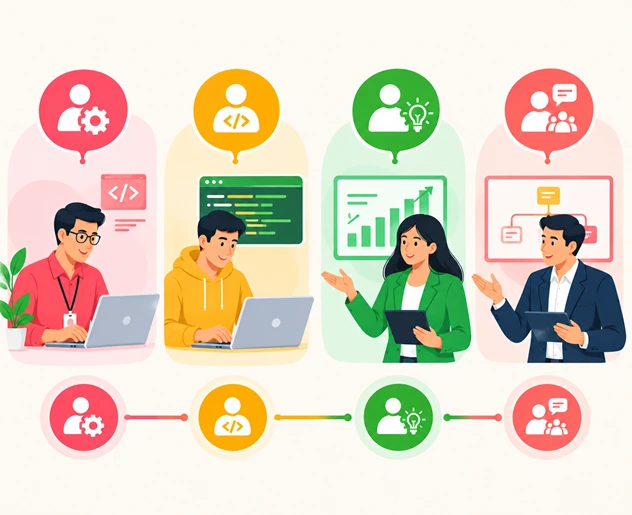


For years, organizations have treated engineering as a single function; when the specification is said, the software comes out. But as products grow more complex, the lines between building a product and implementing it have changed. If you put a pure Software Engineer, a Forward-Deployed Engineer, and a Solutions Engineer in the same room, they all speak code, but they live in entirely different universes. Choosing them correctly will lead to success.
In this post, we will see Forward-Deployed Engineer vs Software Engineer, Forward-Deployed Engineer vs Solutions Engineer, Forward-Deployed Engineer vs Sales Engineer, and Forward-Deployed Engineer vs Technical Consultant to make the right hiring or staffing decision with confidence.
Sometimes technical roles seem similar on paper, but each one is for a different purpose. So a better understanding helps in hiring the right people, setting clear expectations, and choosing the best engagement model for complex projects.
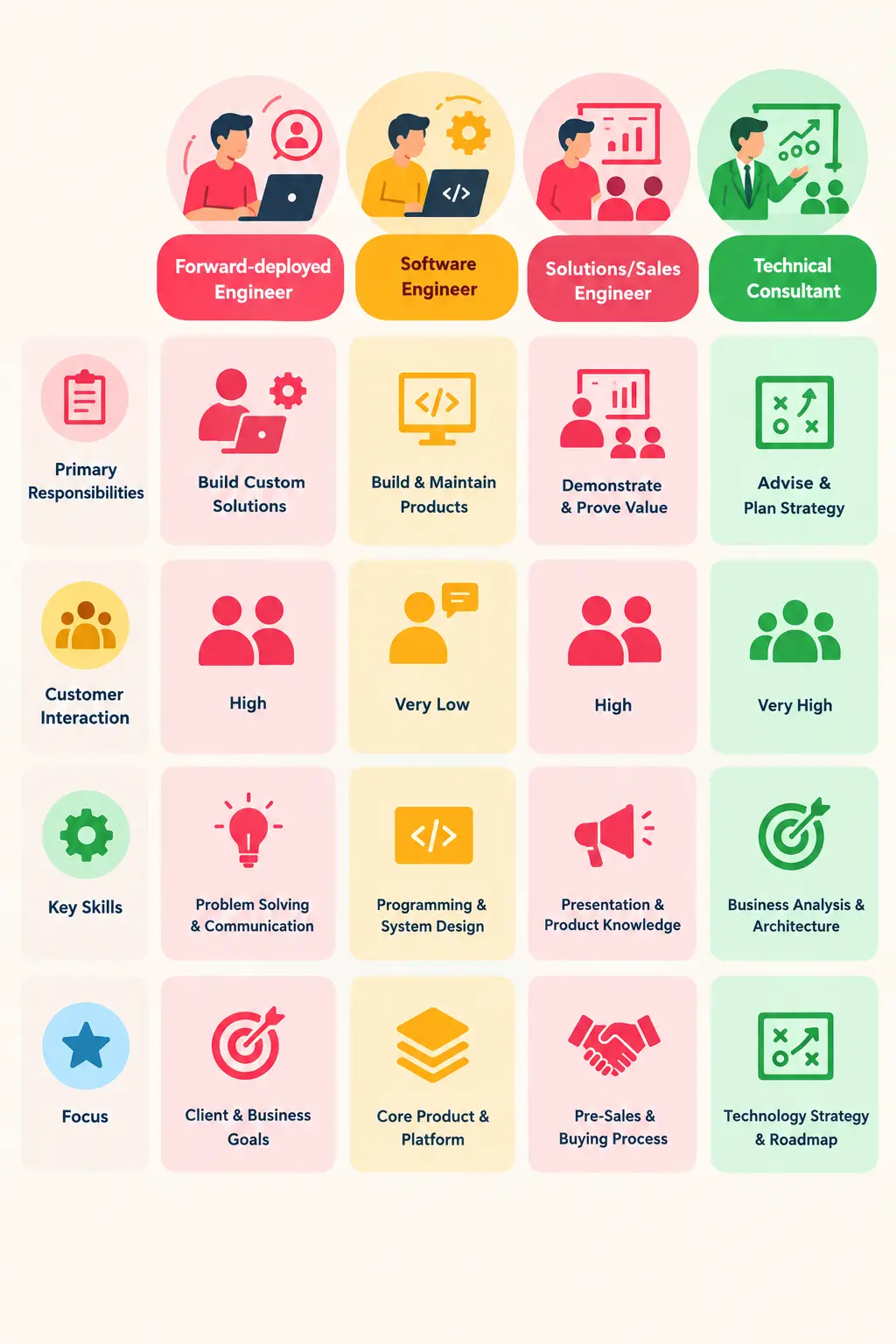
A forward-deployed engineer is a combination of software engineering with deep client-oriented requirements, popularized by Palantir. They work directly with customers to solve technical challenges using a company’s product or platform.
The way FDEs differ from traditional engineers is that they spend significant time with customers, understand their requirements, build custom solutions, and help them achieve business goals.
High - they are the technical face of the company, sitting side-by-side with the client’s team.
Good software engineering knowledge base, fast prototyping, problem-solving under pressure, and superb communication skills.
A software engineer is the quintessential heart of the technology ecosystem. The main role of a software engineer is to build, maintain, and test products and/or platforms sold by a company or used internally.
The work of most software engineers revolves around coding, reviewing merge requests, debugging, performance tuning, and developing features. Software engineers are more effective in product companies, SaaS companies, internal engineering organizations, and platform-building organizations.
Very low interaction with customers. Their customers are usually the product managers or end-users of the software.
Programming language (Java, Python, C++, etc.), data structures, algorithms, and system architecture.
While some companies separate these two, they are incredibly similar and often used interchangeably. They sit squarely at the intersection of Engineering and Sales. Their job is to prove the technical value of a product to a prospective buyer during the sales cycle. Unlike FDE, they typically work before a customer signs a contract.
Sales Engineer (SE)
Sales Engineers are highly concerned with the pre-sales process. They collaborate with the Account Executives in providing technical demos, responding to difficult security questionnaires, and convincing the technical people at the client company that the software is capable of doing what the sales representative claims.
Their primary duties involve conducting product demos, responding to technical questions in the sales process, and designing proofs-of-concept (POCs).
Solutions Engineer:
Solutions Engineer is involved in pre-sales activities; they focus slightly more on how the product integrates into the customer’s overall environment. They may create customized PoCs (Proofs-of-Concept) for the product to work with the customer’s data.
Both Sales Engineers and Solutions Engineers help customers evaluate and purchase the solution.
High. They are mainly responsible for buying the product but also step away once the contract gets signed.
Public speaking, deep product knowledge, basic coding/scripting (for APIs and demos), and high emotional intelligence.
The Technical Consultant helps in the planning, execution, and improvement of a technology solution for the organization. The consultant’s main aim is to solve the business problems rather than developing a software solution.
The technical consultants usually deal with various technologies, which can be recommended differently according to customer needs. They don’t just focus on one specific software product; they advise clients on their overall technical strategy, architecture, and implementation roadmaps. It is primarily suited for consulting firms, system integrators, enterprise IT projects, and digital transformation programs.
Very high. They act as trusted advisors to stakeholders, helping them to align with business goals.
Enterprise architecture, business analysis, project management, and a broad understanding of various technologies.
Both Software Engineers and Forward Deployed Engineers (FDEs) write code, solve technical problems, and create software. The distinction here lies in how they spend their time, whom they interact with, and what success looks like to them. Whereas Software Engineers work on creating the actual product, FDEs operate at the nexus of engineering and delivery.
As technologies grow more complex, a distinct divide has opened up between the teams building core platforms and the teams getting those platforms to actually work inside massive organizations.
To understand how these roles differ, we need to understand how they both write code and look at where, why, and how they spend their working hours. A forward-deployed engineer vs. a software engineer can be compared based on the following factors.
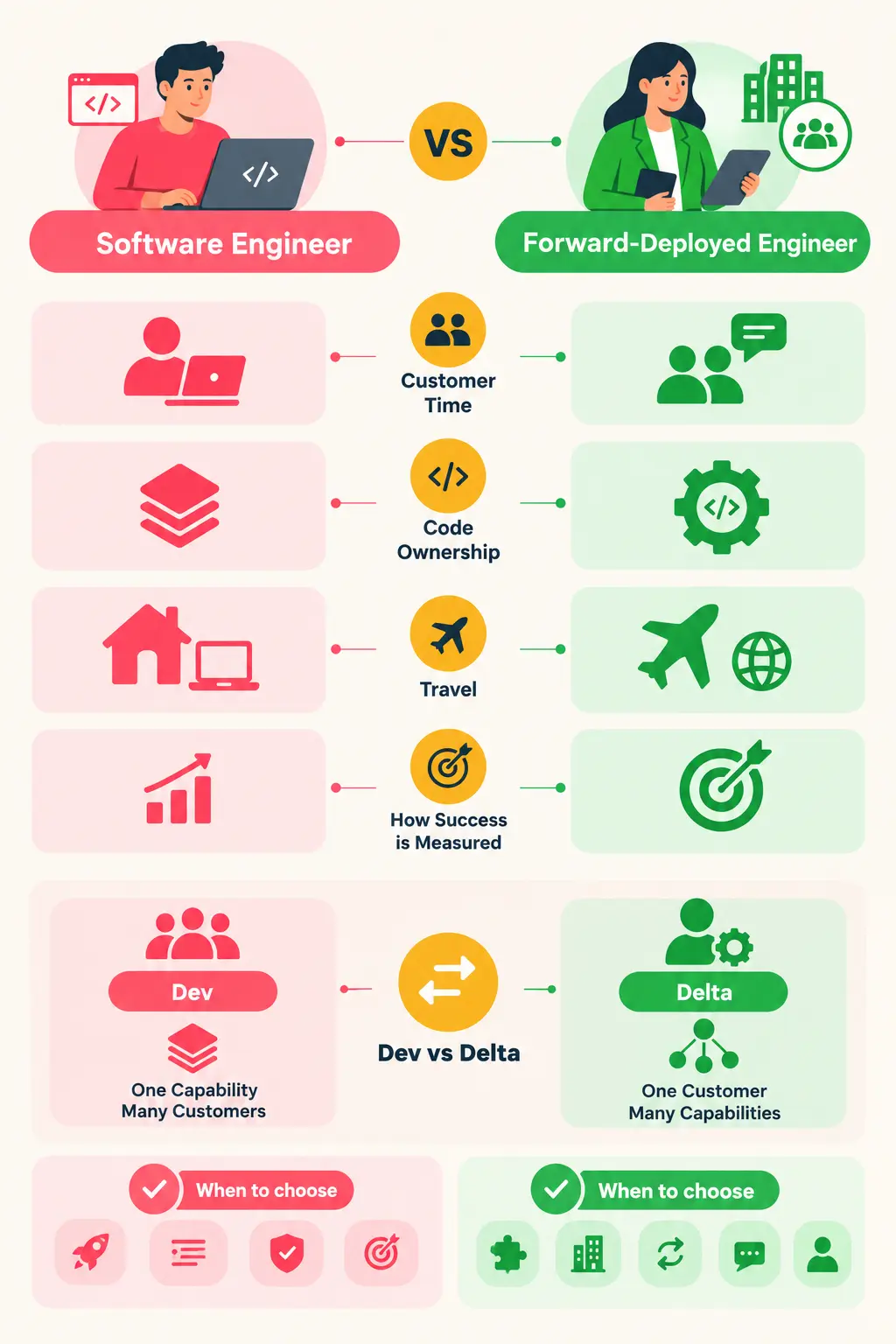
Software engineers mostly don’t interact with customers. Their work is oriented towards product roadmaps, engineering priorities, and internal collaboration.
Forward-deployed engineers spend a significant portion of their time directly within client environments, working face-to-face with end-users and enterprise operators. They gather requirements, solve technical problems, participate in architecture discussions, and guide implementations.
To sum it up, software engineers primarily focus on serving the product, while FDEs primarily serve customer success through engineering.
Software engineers own the underlying application architecture, core platform APIs, and scalable foundational features. They don’t write code specifically; it is written once and deployed across the entire market to thousands of customers.
FDE owns the custom data pipelines. They build customer-specific integrations, automation, APIs, deployment tooling, and extensions. Their work often runs in production within customer environments and may also influence future product features.
To sum it up, software engineers develop code that can be reused, while FDEs develop technical solutions specific to meet customer needs.
Software engineers mainly work from a desk or a remote home office, as they occasionally go to internal engineering offsites or corporate events.
FDE may travel to customer locations, especially during project kickoffs, workshops, architecture sessions, or major deployments. Extensive travel is a fundamental part of their job.
Software Engineer: Velocity and System Health. Success metrics lean heavily on technical and procedural outcomes. They are evaluated on sprint feature completion, code quality, architectural elegance, and overall platform uptime or scalability.
Forward-Deployed Engineer: Operational Impact and Adoption: A forward-deployed engineer’s success is measured by customer deployments, customer satisfaction, implementation speed, adoption of technical solutions, and long-term customer success.
Forward-deployed engineering is nothing without looking at Palantir, the enterprise data firm that pioneered the function over a decade ago.
A simple way to understand the distinction is through the idea of "Dev vs. Delta."
Here, the Software Engineers mainly develop the platform, whereas the Forward Deployed Engineers assist in converting this platform into real business outcomes for their customers. Through this process, many new product requirements get identified through the customer’s feedback.
Choose a Software Engineer in case of
Choose a Forward-Deployed Engineer in case of
Writing the code alone is not the full part; we need to ensure software actually survives in a real-world data ecosystem. To bridge this gap, tech companies deploy specialized, client-facing technical experts. However, titles like Forward-Deployed Engineer (FDE), Solutions Engineer (SE), Sales Engineer, and Technical Consultant are frequently mixed up.
Though both roles require high customer interaction, they differ completely on opposite sides of the customer journey line.
Solution engineers operate almost exclusively in the pre-sale phase. Their primary objective is to prove to a prospective buyer that the software can solve their business problems.
Typical activities include:
FDE gets involved after the contract is signed. To mention clearly, they step in after the deal is closed to turn high-level promises into working reality. They embed deeply within the client’s office for months at a time to handle the actual live deployment.
Typical activities include:
The main difference between them is that Solution Engineers help customers make a decision and buy, and Forward-Deployed Engineers help customers succeed after buying.
Although both roles solve technical problems, the depth of engineering work differs.
Solution Engineers focus on “Value translation”. They spend their time giving technical solutions, answering security questionnaires, and building lightweight proof-of-concept (POCs).
Forward-Deployed Engineers write way more actual code than any other role. FDEs are responsible for creating custom integrations, APIs, automation, and technology extensions that will be part of the customer’s environment.
Overall, to sum up, the Solution Engineer explains what the product does, while FDEs build what customers need.
Sales also takes the main responsibility in separating both roles.
Solution Engineers normally work in revenue generation. Although they might not necessarily have any personal targets to achieve, their performance could be linked to the success of the deals they close or technical success.
Forward-Deployed Engineers do not carry a sales quota or revenue targets. Their performance is measured by engineering milestones. Their focus is technical delivery, successful implementations, and long-term customer outcomes.
To sum up, the Solution Engineer contributes to closing the details while FDEs focus on delivering value after the sale.
FDEs and Technical Consultants look identical because both of them are post-sale technical experts who work directly with clients to solve problems.
Technical Consultants are usually brought in to solve a specific challenge or guide a major digital transformation roadmap. They specialize in high-level strategic workshops, gap analyses, and system blueprints. After they deliver technical recommendations, their service ends.
FDE takes long-term technical ownership of the outcome. They are keen on improving customer solutions by solving new technical challenges and working alongside product teams to refine the platform based on customer experiences.
To finalize, Technical consultants often deliver recommendations, while FDE maintains ongoing technical ownership.
A Technical consultant’s primary job is to make a specific project succeed for the client. If they hit a limitation in the software tool they are configuring, they typically build a localized workaround or write an isolated patch just to get that specific client across the finish line.
FDEs regularly communicate customer pain points, feature requests, and implementation lessons to product and engineering teams.
To sum up, FDEs serve as a direct link between customers and product development, while Technical Consultants primarily advise customers.
Choosing the right engineering or technical role usually comes down to two variables: where the code lives and who the engineer talks to.
If your challenge is building a new product from scratch or adding core platform features, fixing deep architectural bugs, or adding features to your core platform that everyone will use.
They focus on designing, developing, testing, and maintaining software products.
Software engineers mainly focus on internal building and core product development.
If your challenge is customizing a product for a specific enterprise while working closely with customer teams.
They build customer-specific solutions, integrate systems, and turn business needs into working software.
Forward-Deployed engineers mainly focus on custom engineering directly on the front lines.
If your challenge is helping prospects evaluate a solution before purchase.
They demonstrate products, create proofs of concept, answer technical questions, and support the sales process.
Solutions engineers mainly focus on bridging the gap between sales, business logic, and code.
If your challenge is assessing technology, defining strategy, or recommending the best approach.
They advise on architecture, technology choices, migration planning, and digital transformation initiatives.
Technical Consultants mainly focus on strategy, process optimization, and expert advice.
To summarize all and say in simple terms
Effective forward deployment of engineering begins with the selection of engineers having the right blend of technical skills, business acumen, and communication ability. At Entrans, staffing is determined not only by an open position but also by considering the customer’s objective, existing tech stack, the industry, and complexity of the task at hand. That is, we match the right engineer to the right customer.
Our staffing model centers on immediate client integration. We map our engineering talent using a structured three-pillar framework:
Learn more about how we do faster implementation, better collaboration, and solutions that can fit in real-business workflows. Book a consultation call with us.

No, their core execution is entirely different. While both write production-grade code, a traditional software engineer focuses internally on building scalable features. A forward-deployed engineer operates as an embedded problem-solver, writing custom code on-site to force that core product to work within a client’s chaotic legacy environment.
No. Forward-deployed software engineers don’t carry a sales quota or revenue targets. They measure their performance by engineering metrics, deployment success, and actual technical value delivered to the client.
No. Both are at the same level, ranging from junior to principal levels. However, forward-deployed software engineers feel more senior because it demands a more extensive skill set compared to others.
Yes. Software engineers already have the foundational engineering skills required to master the underlying product. If the software engineer likes to work for the customers and has strong communication and problem-solving skills, then they can really transition to either a solutions or forward-deployed role.
No. Solution engineers do coding for demos, prototypes, APIs, scripts, and PoC demos that help close deals. Software engineers do coding for the actual production software.
It would be wise to consider forward-deployed engineers since they perform the most difficult architectural work to integrate such systems into operations.
Obviously yes. Forward-deployed engineers require strong communication skills as they need to face customers to understand their requirements and deliver the products.

-1.svg)