What is a forward deployed engineer? A clear guide for enterprise leaders on the FDE role, why demand is surging, and when to use FDEs in your organization.

Agentic Unconference 2026 - September 19, Chennai
View Event →





As businesses move towards AI experimentation and enterprise-wide deployment, companies face a new challenge. Traditional delivery models often leave a gap between product teams and customers. Forward Deployed Engineers are specialized units that are changing the game and act as a bridge between internal teams and customers. For enterprise leaders looking to accelerate time-to-value and ensure mission-critical software actually works at scale, understanding the FDE model is not an operational advantage.
In this post, we will learn what a forward-deployed engineer is, why most innovative tech giants rely on them, and how enterprise leaders use this model to reduce the cost of failed rollouts.
A forward-deployed engineer is an individual whose primary work is to interact with clients and help them implement their solutions using complex software. The term may be abbreviated as Forward Deployed Software Engineer (FDSE), and they serve as a link between software development and implementation in the actual environment.
FDE methodology is a tool to speed up the implementation process of the product by getting feedback directly from the users. In layman’s terms, a Forward Deployed Engineer is someone who identifies the problems, understands the workings of the business, changes the workflow, trains people, and solves all problems that stand in his way to provide a solution.
The forward-deployed engineer (FDE) model gained attention through Palantir two decades ago. These engineers did not just develop the software, but immersed themselves with the customer teams to understand the issues they were facing and design solutions for those issues.
The FDE engineers broke away from the traditional separation between engineering, consulting, and customer support.
When Palantir was founded in the early 2000s, its primary clients were national security and intelligence agencies. Palantir’s forward-deployed engineers, often referred to internally as Deltas. A Delta could analyze customer workflows, write production-grade code, configure data pipelines, create integrations, and work alongside stakeholders to refine requirements. On a whole, a single engineer could handle multiple responsibilities throughout the engagement taking all the responsibilities throughout the engagement. It created shorter feedback loops, faster deployments, and products.
Large enterprises often have unique systems, legacy applications, security requirements, and business processes. Standard software implementations address every requirement out of the box.
Forward-deployed engineers helped bridge this gap by:
The global demand for Forward Deployed engineers is surging over 700% year-over-year. When generative AI and autonomous AI agents became available to the market, many businesses realized that using AI was much more complicated than just calling an API. Each user had their own data sources, security policies, governance rules, workflows, and business goals.
Top artificial intelligence firms resorted back to the concept of forward-engineers because of the need for engineers who can integrate AI into customers' environments. Rather than selling an off-the-shelf AI system, they used engineers on-site to integrate the model into customers' data, set up retrieval systems, coordinate AI agents, and optimize the process.
This particular role proved to be extremely useful since most AI projects require experimenting and iterating with technical teams and business units working together.
Forward-deployed software engineer (FDSE) typically combines software engineering with AI engineering and customer-facing problem-solving.
The responsibilities of a forward-deployed engineer are
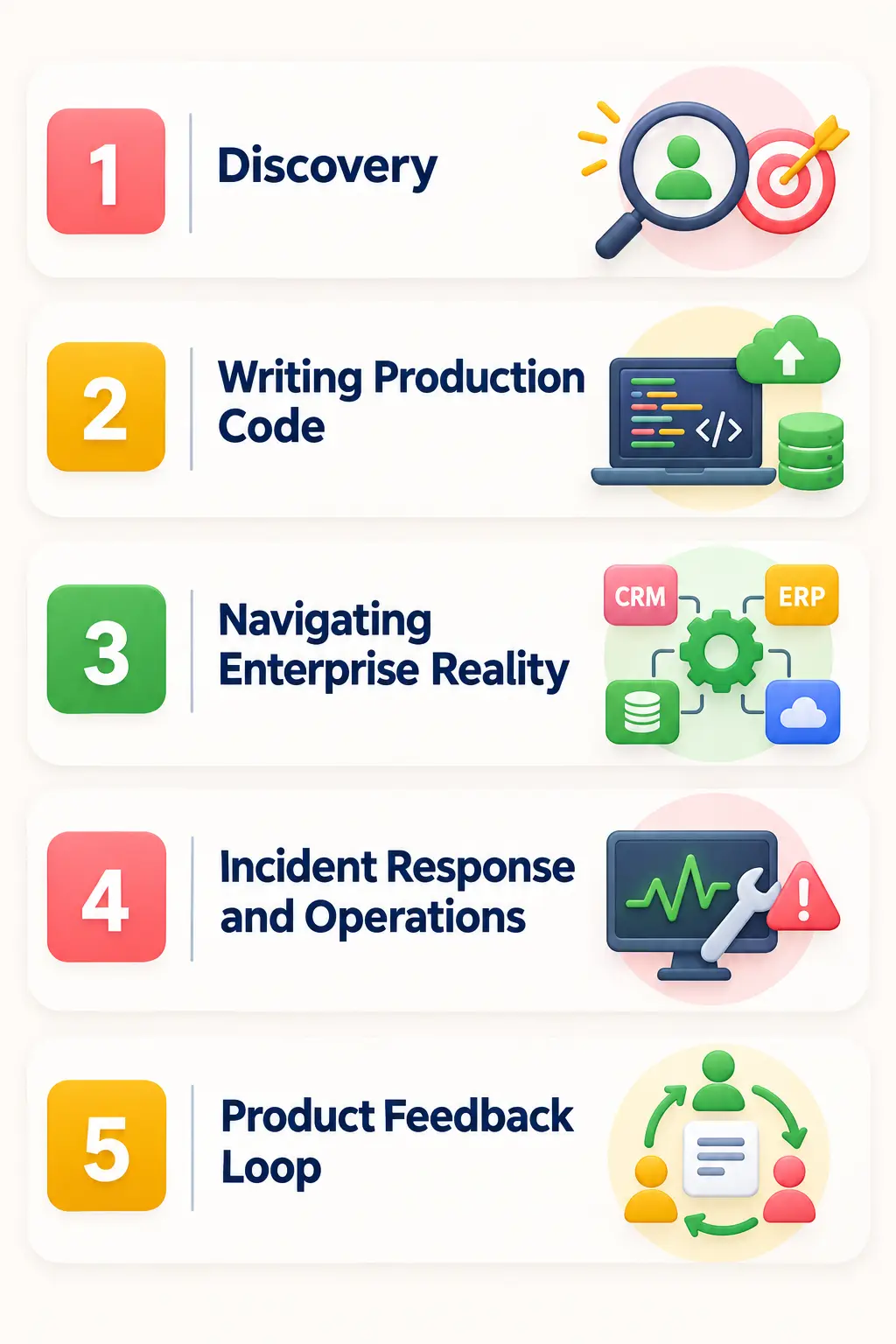
FDEs discuss with line-level analysts, VPs, stakeholders, and CTOs to uncover what operational bottlenecks actually exist. First, they start with understanding business goals, workflows, pain points, and technical requirements before designing a solution. They define how success is measured by reviewing hundreds of real-world edge cases with domain experts.
A forward-deployed engineer develops, tests, and deploys production-grade software directly in the customer environment rather than creating prototypes that can never reach production. Mainly, they connect applications, APIs, databases, cloud platforms, and third-party systems while adapting to existing enterprise architecture.
The main responsibility of FDE is to handle the custom integrations between the company’s product and customers’ internal systems such as CRM, ERPs, data warehouses, and business applications.
Forward-Deployed Engineers debug live code directly in the field, often while the customer’s operational teams are waiting on a resolution. They monitor application behavior, identify bottlenecks, and improve reliability, scalability, and user experience.
Forward-Deployed Engineers act as the primary intelligence channel for the main core product team. They work with product managers, software engineers, solution architects, and customer success teams to deliver measurable outcomes. Mostly, they focus on delivering technical solutions according to the customer’s operational and business objectives.
Forward-deployed engineering is a delivery model where engineers work closely with customers. A FDE stays involved throughout the project by building production-ready software and refining it based on customer feedback. Below is a typical high-impact week for an FDE tasked with deploying an autonomous claims-processing engine.
The start of the week involves meeting with business stakeholders, technical teams, and end users. They make a plan of current workflows, identify operational bottlenecks, and define the success criteria. So by the end of the day, the forward-deployed engineer comes up with an engineering plan.
The FDE assesses the client’s architecture, analyzes the APIs, security policies, databases, and cloud, and determines how the product will integrate within this environment. The FDE identifies any potential technical issues in advance to prevent problems in the future. They also configure secure, role-based access controls (RBAC) to bridge the new software engine.
So with all the roadmap and security finalized, now it is time to code. The forward-deployed engineer develops integrations, configures workflows, builds APIs, and connects enterprise systems. Each feature that is developed is well-designed for reliability, scalability, and long-term maintenance.
It is time to carry out the testing. The FDE deploys the code into a small sandbox environment. The solution is tested with real customer data and business scenarios. If any issues arise, FDE’s fixed, optimized security controls are added, and the FDE works with customer teams to deploy updates into production environments.
The week ends with customer review sessions. Feedback is provided, new requirements arise, and performance is measured. Lessons learned are documented by the FDE, enhancement priorities are set, and requests are communicated to the product engineering team, resulting in an ongoing feedback cycle that improves the customer solution and core product.
The growing demand for forward-deployed engineers (FDEs) denotes that AI models alone do not create business value. The real challenge lies in connecting those models with systems, processes, security policies, and finally end users. This is the main reason for forward-deployed engineering to become one of the fastest-growing functions in enterprise AI.
Large language models can summarize documents, answer questions, generate code, and automate tasks. But a clear understanding of what an AI model is is not captured. Forward-deployed engineers close this gap by integrating AI into real business environments and developing production-ready workflows.
Data from early 2026 shows that job postings for forward-deployed engineers have increased more than 1,000%, with continued acceleration into 20206 as AI adoption expands across industries. This sudden demand has made it one of the fastest-growing technical job titles in the industry.
According to Andreessen Horowitz (a16z), forward-deployed engineering is the missing link between cutting-edge AI technology and success for the end-customer. Organizations that deploy forward-deployed engineers to customers experience quicker deployments, bigger deals, and greater adoption rates.
As the FDEs help drive platform adoption, consumption, and expansion, their pay in 2026 will be about 10 to 25 percent above regular product-engineering bands.
Most teams within organizations have software developers, solution architects, consultants, customer success managers, and DevOps engineers. The role of the Forward Deployed Engineer (FDE) includes all the above roles, but the way these tasks are combined is very much oriented towards the customer’s result and production delivery.
The comparison table below gives a clear picture of how the Forward-deployed engineer differs from other roles in the industry.
AI and cloud platforms become more sophisticated, customers expect solutions that fit their existing technology landscape. Forward-deployed engineers help companies deliver faster time to value by one person getting involved from discovery through deployment, feedback loops, and better customer outcomes.
Forward-deployed engineers do not suit every project. This position provides maximum value when success is based on customer collaboration, technical expertise, and iterative development.
Use forward-deployed engineers in cases where your business falls into one or several of the following categories.
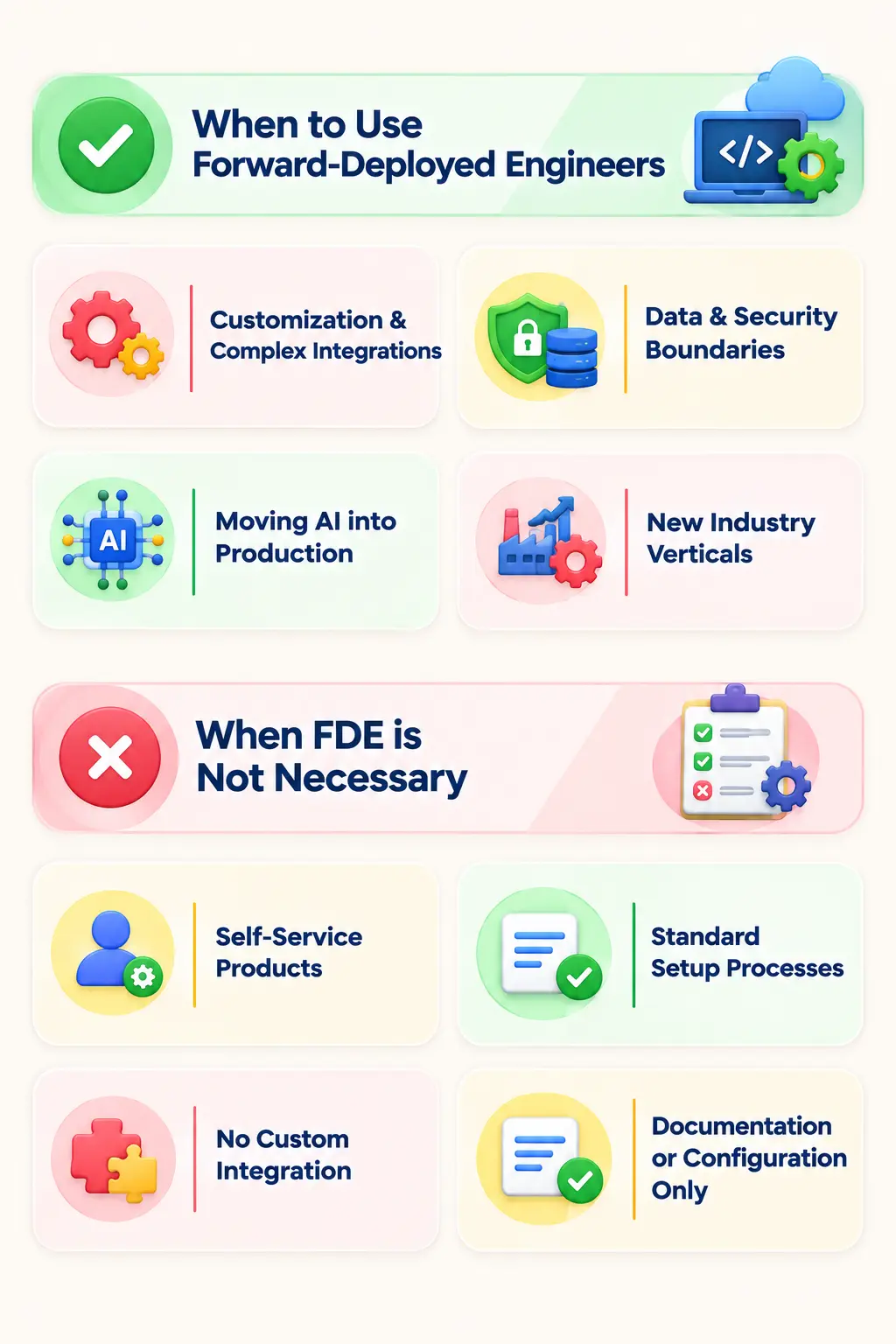
A forward-deployed engineer may not be suitable for you if:
For an enterprise leader looking to utilize the Forward Deployed Engineering model, there is always confusion about whether to build an internal team, hire the talent, or partner with some vendor.
If you already have high-performing product engineers who possess strong communication skills, you can transition them into an internal FDE unit. This will function in the long term. The benefits the FDEs get are the knowledge of your core technology stack, building strong customer relationships, and creating a direct feedback loop with engineering and product teams. But this process requires time to recruit and train the right people.
Hiring means aggressively recruiting specialized FDE talent directly from the market. This approach seems good when you need customer-facing technical expertise quickly. Experienced personnel can help with enterprise-level installations and mentor internal engineers. FDE recruitment can prove to be time-consuming and costly due to fierce competition for qualified FDEs.
When purchasing complex enterprise platforms, especially in the enterprise AI, data infrastructure, or cloud transformation spaces, make the deployment model a core part of contract negotiation. When teaming up with an FDE as a Service partner, they help you scale customer delivery without waiting to build a full internal team. This approach will be extremely useful when you are entering new markets or supporting large customer implementations.
Success can be achieved only when engineers understand business objectives. Entrans provides forward-deployed engineers who partner with your team from discovery through deployment and ongoing optimization.
At Entrans, we deliver Forward Deployed Engineers (FDEs) who bridge between implementation and customer support. We deploy elite, client-ready developers directly into your secure environment to design, integrate, and scale your mission-critical tech stacks from day one.
We have restructured the deployment pipeline to prioritize speed, deep technical capability, and client-facing diplomacy. Here is how we deliver Forward Deployed Engineers to your ecosystem:
We pull from our pre-vetted, certified talent pool to match your exact technical needs. We arrange interviews and ensure you get the right FDE talent on board within 48 to 72 hours.
In week one, FDE clears your internal background checks, obtains security credentials, and embeds within your virtual private cloud (VPC) or local servers. They help map your complex legacy databases and align on technical deliverables.
Our FDEs immediately begin writing production-grade code directly inside your live environment. They build data ingestion pipelines, configure secure automated CI/CD workflows, construct custom API wrappers, and fine-tune model orchestration to prove value rapidly.
Our FDEs integrate continuous testing, monitoring dashboards (such as Datadog or Prometheus), and self-healing automation before transitioning ownership seamlessly back to your internal team.
The workflow for Entrans FDEs involves working directly with the business and the technical team before development begins. They try to understand how things work, where there are problems, and what it takes to succeed.
Entrans engineers build, test, and deploy production-grade applications, integrations, APIs, and AI workflows. Each solution is designed to operate reliably within your existing technology ecosystem.
Entrans FDEs link applications through cloud-based platforms, data warehousing, CRM, ERP, identity provider services, and third-party systems. These systems also cater to enterprise needs like security, compliance, and scalability.
Entrans helps move projects from experimentation to production. Our engineers integrate AI models with enterprise data, automate workflows, and optimize performance based on real-world usage.
Interacting directly with customers generates insights that improve future deployments. Our FDEs work closely with product internal teams to refine the solution over time.
Learn more about how we achieve measurable results with faster deployments and smoother enterprise adoption. Book a consultation with us.

A forward-deployed software engineer (FDSE) works directly with customers to design, build, integrate, and deploy production-ready software. They bridge the gap between vendor core products and complex legacy systems.
A forward-deployed engineer is also a software engineer but with strong customer-facing skills. Unlike a traditional consultant, they write production code and stay involved throughout deployment and optimization.
Staff augmentation is adding engineering capacity to a customer’s team, while forward-deployed engineering delivers end-to-end ownership of the product. They mainly focus on solving business problems, not just completing assigned tasks.
FDEs require a rare mix of advanced coding skills and enterprise communication; they demand premium market rates. Senior FDEs at global AI labs or enterprise firms frequently command base packages between $200,000 and $500,000.The cost mainly depends on experience, location, and project complexity.
Internal engineering teams usually focus on maintaining daily operations or building proprietary core products. Whereas FDEs complement internal teams by bringing product expertise and handling complex integrations, customer-specific requirements, and production deployments.
A forward-deployed engineer’s need depends on the complexity of the project. A standard deployment can range from a few weeks for targeted, rapid prototyping to a year or more for massive, multi-phased digital transformations at global enterprises.
The forward-deployed engineering approach entails engineers working close to customers through all phases of discovery, development, deployment, and continuous improvement. The process ensures that solutions provided satisfy business requirements.

-1.svg)