When Factory projects stall, the reason is not the technology.
It’s because the architecture underneath was never built to last.
Why? Well, IT teams and OT teams have two completely different points of view!
This is why plant leaders, automation engineers, and enterprise architects need to understand what IT/OT integration architecture actually takes to build.
It’s not just what vendors promise - but an actual plan built for how plant floors operate.
So to help you with this, our guide walks you from scattered, siloed shop-floor data to a full integration layer.
One that supports AI, predictive maintenance, and real-time ERP connections across every site you run.
What IT/OT Integration Architecture Actually Means
IT/OT Integration refers to the process of connecting your factory systems with the actual IT systems stakeholders need for other decisions.
That said, connecting your factory to your office isn't as simple as plugging a network cable into a machine.
For decades, the factory floor (OT) and the corporate office (IT) have been intentionally isolated from each other. An IT issue in the office environment, like an update, can simply bring down your email for some time.
However, in a factory setting, even one IT problem could shut down an entire production line, destroy costly equipment, and, even worse, harm someone:
- Operational Technology is comprised of PLCs, DCS, SCADA, and Industrial Robots. This technology is designed to last decades without ever coming into contact with anything
- On the other hand, Information Technology is designed to work at high speed, be updated frequently, and be connected to the cloud. They are worlds apart.
- Integration actually has to securely pull high-speed information out of your machine, label it correctly at the factory floor level, and transfer it to the business team instantly.
- But to do this, your IT department must build secure digital pathways, while your factory team retains total control over how the physical machines actually operate.
Why IT/OT Data Silos Exist and What They Cost
Data silos were never intentional. Why do they happen? Well, historically, factory machines were built by different companies using their own digital languages.
They were designed to run locally, and not with the intention of sharing information with the corporate office.
- Such a lack of communication is incredibly costly. In fact , according to statistics, bad data quality drains an average business of up to $13-$15 million each year. Analysts spend up to one-third of their weekly working time searching for and cleaning data, rather than performing the analysis itself.
- A manager can spend a lot more money for an express delivery of a part without realizing that there is an excess of this same part in another factory that he himself owns.
- If a machine breaks down, figuring out exactly how much that breakdown costs the business is incredibly difficult. Factory computers and office computers record time and store data in completely different ways.
- Unexpected machine failures cost anywhere from $200,000 to $2 million each. But to handle this, modern smart maintenance can prevent these issues, but only if the machines can actually share their data.
The Hidden IT/OT Integration Architecture (Layer by Layer)
In order to tear down the walls and silos without endangering the data factory, it is imperative to develop your IT/OT integration architecture in strict layers.
But if one layer is missed, then the entire system will become unstable, and this is why you must adhere to the following layers in your IT/OT integration architecture:
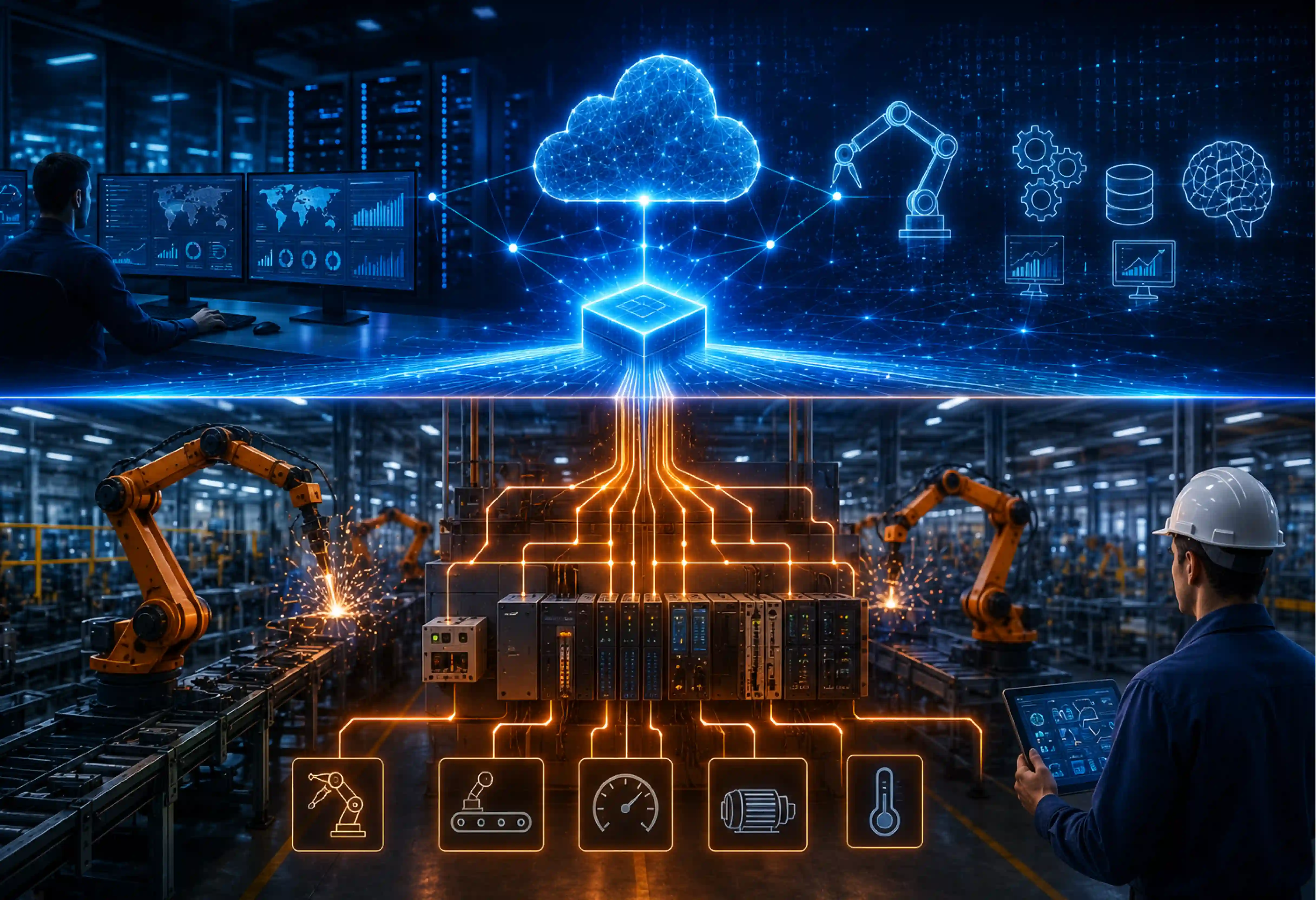
Layer 1: Edge & Connectivity (PLCs, SCADA, Sensors, Gateways)
This is the physical world of motors, sensors, and the computers that control your factory machines at lightning speed. This can also be a messy environment where brand-new systems often sit right next to 20-year-old legacy machines.
- To get information out of this chaotic mix, companies install special devices called Edge Gateways. These devices act as universal translators.
- They quietly read the raw signals from all the different machines and turn them into a standard digital language that the rest of the company network can understand.
- This bottom layer is the heartbeat of the factory. Above all else, there is one strict rule: if the corporate internet or office network crashes, the physical machines on the factory floor must be able to keep running safely without interruption.
Layer 2: Contextualization and Broker
Raw data pulled from a PLC means nothing on its own. A register value tells a cloud analytics platform nothing unless the platform knows whether that number is a temperature, a pressure reading, or an error code.
- Layer 2 adds meaning to data as close to the machine as possible. The edge gateway adds labels to raw values. These labels define the unit of measure, the asset name, and the safe operating range. In doing so, a plain number becomes a self-describing data object.
- Once labeled, data moves to a central message broker using a Publish/Subscribe model. Edge devices send state changes to the broker.
- The broker then handles all routing to the right downstream systems. This replaces the old model where apps had to query gateways directly, creating fragile one-to-one links.
Layer 3: Integration and the Unified Namespace
This is where the biggest change in smart factory design happens in your IT/OT integration architecture. The Unified Namespace, or UNS, is a central data structure built on an MQTT broker.
Every system, device, and application in the plant connects to one shared data hub. Meaning, there is one place where all data lives and updates in real time.
- The UNS uses a strict, layered topic structure that maps to the physical layout of the company. Think Enterprise, then Site, then Area, then Line, then Cell, then Device. A new sensor publishes to the namespace. Any historian, analytics tool, or dashboard that needs that data simply subscribes.
- How does this help? Well, this removes the need for thousands of custom API connections and creates one trusted source for the current state of the business.
- Deployment experience has taken this architecture to support more than 400,000 structured variables, showing that this architecture will work even for massive operations.
Layer 4: Enterprise and IT (ERP, Analytics, Cloud, AI)
The data collected by machines can be used by the traditional IT layer once it reaches the Unified Namespace.
This in IT/OT integration architecture typically involves such components as MES, ERP, quality management, and AI clouds.
But with this, the integration layer guarantees that all data is tagged, normalized, and synchronized in real-time according to a report-by-exception approach.
This allows the enterprise layer in your IT/OT integration architecture, which helps you trust the information your system gets.
- When a production order finishes on the shop floor, the MES sends a confirmation to the UNS. The ERP system is subscribed to that topic.
- So the ERP immediately updates finished goods inventory, removes the used raw materials, and calculates the real cost of production.
- But also, predictive AI models pull in historical patterns alongside live vibration data. These models then trigger automated maintenance work orders before a machine breaks, with no manual data pulling needed.
Layer 5: The Security Boundary (IDMZ)
The Industrial Demilitarized Zone, or IDMZ, sits at Level 3.5 in the Purdue Model. This is the most important security layer in the whole IT/OT integration architecture.
The IDMZ creates a buffer network that physically and logically separates the trusted operations network from the enterprise and cloud networks.
- The main rule here is simple. No direct network connections can cross the IDMZ. If an ERP system needs production data, that system cannot open a direct connection to a PLC.
- Instead, the OT system pushes data outbound into a data broker sitting inside the IDMZ. The IT system then opens a separate inbound connection to pull that data from the IDMZ.
- This setup uses two separate firewall layers. In doing so, a breach in the corporate IT network cannot reach the control environment on the plant floor.
The Four Architecture Decisions That Determine Success
Building this layered setup requires industrial architects and CIOs to make four key decisions before any integration begins.
Getting any one of these wrong creates systems that cannot scale, piles of technical debt, or serious security gaps.
Decision 1: Integration Pattern — Point-To-Point vs Broker or ESB vs Unified Namespace
In the past, connecting software to a machine meant writing custom code for every single connection.
If five different apps needed data from one machine, you had to build five separate connections or sets of code.
This created a fragile web of connections where upgrading just one machine could accidentally break dozens of office applications.
Companies tried to fix this in IT/OT integration architecture by using heavy corporate software (called Enterprise Service Buses) to route the information.
- However, these systems were built for standard business transactions, making them far too slow to handle real-time, high-speed factory data.
- To deal with this, one choice is to use a central data hub (a Broker or Unified Namespace). Instead of everything connecting directly, machines simply post their data to this central board.
- Any app that needs the data just reads it off the board. Because systems don't need to communicate directly with each other here, you can plug in new AI tools or dashboards in minutes without breaking the rest of the network.
Decision 2: Protocol — OPC UA vs MQTT and Sparkplug B
You don't have to choose between OPC UA and MQTT - they can actually work together!
Firstly, OPC UA is a strong language, which is well-suited for operating complex machines, such as robotic welding machines, directly from the factory floor.
- That said, OPC UA is a rather resource-intensive language that consumes much bandwidth. Moreover, any attempts to transfer data into the cloud would lead to the compromise of your factory’s security firewalls.
- MQTT is a highly secure, lightweight internet messenger. This language is much safer because it only pushes data out, meaning your factory firewall stays completely closed to hackers trying to get in.
- Moreover, A special add-on called Sparkplug B acts as a strict rulebook for MQTT. What it does is it compresses the data and constantly tracks whether a machine is online or offline.
- The best approach uses OPC UA to handle the heavy lifting on the factory floor. Then, a smart device translates that information into the lightweight MQTT language so it can be sent safely and securely up to the corporate office.
Decision 3: Security Boundary — IDMZ, IEC 62443, NIST 800-82, Zero Trust
Manufacturing is the most attacked industry in the world for cyberattacks. IEC 62443 is the main security framework here. The standard breaks networks into zones connected only through tightly controlled paths.
- The IDMZ is the most important of these paths. The zone keeps physical separation between IT and OT in place at all times.
- Modern security also calls for Zero Trust. But traditional IT Zero Trust assumes the endpoint can run an identity agent and support multi-factor login. A legacy PLC running on a twenty-year-old operating system cannot run a security agent.
- In an OT environment, Zero Trust works at the traffic level instead. Trust is given to network packets and sessions, not to hardware.
- In doing so, the setup enforces strict segmentation between production cells and requires identity-checked jump-server access for all outside vendors and engineers.
Decision 4: Data Governance — Ownership, Contextualization, Asset and Ontology Modeling
Technology alone won't fix a messy company. If you connect all your systems without a strict organization plan, you just end up with a massive, useless pile of raw numbers.
- Label Data at the Source Data must be labeled right where it is created—on the factory floor. If a machine simply sends a random string of numbers up to the corporate office, your data scientists will waste months trying to guess what it means.
- Use a Strict Naming System Every piece of data needs a clear, standard name tag before it moves. It should include exactly what machine it came from, the time it was recorded, and the unit of measure. If you do this, the data makes sense instantly the second it reaches the business team.
Unified Namespace vs the Purdue Model: What Actually Changes
People often debate whether the traditional factory security model (the Purdue Model) is dead now that we have modern data hubs (the Unified Namespace). The short answer? The old model is still needed for security, but the way data actually moves has completely changed.
- The Old Way (The Ladder): In the past, a piece of data—like a temperature reading—had to climb up a strict ladder. It passed step-by-step through three or four different factory software systems before finally reaching the business office. Every step required custom coding, which caused major delays, errors, and lost information.
- The New Way (The Central Hub): The modern setup works like a giant digital bulletin board. A sensor on the factory floor posts its temperature reading directly to this central hub. The office software can then grab that data instantly, completely skipping all the messy, slow middle steps.
A Phased Migration That Protects Legacy Investment
A common myth about digital transformation is that old equipment must be thrown out. That approach wastes money and creates serious operational risk.
Successful IT/OT convergence layers modern connectivity on top of existing brownfield equipment. In doing so, the manufacturer safeguards their earlier investment and continues towards integration one step at a time.
The company monitors its advancement through a five-stage maturity roadmap that involves:
- Stage 1 — Manual Planning: Data is very siloed. Paper records, spreadsheet, and reactive maintenance are the norm here. Next step: Install basic edge IIoT sensors and establish basic network connectivity.
- Stage 2 — Connected and Visible: Data is now collected in real time. Availability and downtime metrics appear on centralized dashboards. Next Step: Standardize data and introduce edge labeling and the UNS broker.
- Stage 3 — Analyzed and Predictive: AI/ML algorithms use historical data for predictive maintenance and simulation using digital twins. Next Step: Activate automated workflow triggers and connect MES/CMMS for bi-directional data sharing.
- Stage 4 — Automated and Optimized: Systems start to self-adjust. Production scheduling and cross-plant supply chain decisions happen without manual input. Next step: bring in Agentic AI to handle routine, rules-based production decisions on its own.
- Stage 5 — AI-Autonomous: The Factory operates as an autonomous optimizing system where people do nothing but strategize and innovate. Next Step: Fine-tune continuous federated learning loops across all locations worldwide.
Why IT/OT Integration Projects Fail, and How To De-Risk
Despite the clear benefits, 65% of digital upgrades in manufacturing fall short of their goals. The surprising part?
The technology itself is rarely to blame! Most projects crash because of culture clashes, weak leadership, and rushed planning.
For example, if IT tries to force standard office rules (like automatic software updates or routine security scans) onto older factory machines, it can accidentally shut down the whole production line.
3 Hidden IT/OT Integration Traps (and How to Avoid Them)
Beyond the culture clash, projects usually fall apart for these three reasons:
- The Spaghetti Code Trap (Technical Debt): A small test project might work perfectly in one facility. But if it were built using custom, fragile connections between systems, it would completely break when you try to expand it to fifty global factories. And in doing so, it becomes a tangled web that is impossible to maintain.
- Bossing Instead of Partnering (No Shared Governance): Success requires IT and factory leaders to sit at the same table and share responsibility. Corporate IT shouldn't hand down security rules without ever setting foot on the plant floor. Policies must be created together so the network stays safe while the machines keep running.
- Rigid Data Connections (Hard-Coded Integrations): Never build rigid, direct links between software systems. Instead, build flexible data networks from day one. And most importantly, strong digital security borders must be locked in before any real factory data is allowed to cross into the office network.
Build vs Partner: When To Bring In An Integration Partner
Connecting your office technology (IT) with your factory floor machines (OT) requires a very rare mix of skills.
You need someone who understands both decades-old factory equipment and modern cloud software and security. Most internal teams are only good at one or the other.
About 40% of industrial companies struggle to find workers with this exact background.
But even worse, trying to build these complex connections yourself usually leads to major delays, security risks, and abandoned projects.
Which is why, often, you need to bring in an external integration partner when any of these apply:
- Your IT and Factory Teams Don't Get Along: If your office staff and factory floor teams have a history of clashing or working in separate bubbles, a neutral outside expert can bridge the gap and get everyone on the same page without office politics getting in the way.
- You Have Old, Complicated Machines: Connecting older equipment from various brands to modern cloud systems requires specific data translation skills. Most standard IT teams simply don't know how to do this.
- You Want to Take AI Global: If you have a small AI or analytics test working well on a single machine, expanding that to your entire global operation requires heavy-duty software engineering. The skills needed to roll it out everywhere are much more advanced than the skills needed to build the first test.
Partnering With Entrans for IT/OT Integration
Our team at Entrans has worked hands-on with operations and OT teams across the full convergence stack. This covers edge connectivity, Unified Namespace architecture, ModelOps, security compliance, and change management. We do not hand over strategy decks and leave.
Our work is built around the exact friction points that stall industrial digital transformation:
- AI-Led IoT Analytics: We pull data from machine telemetry systems and build strong, real-time IoT data pipelines. Using our Agentic AI frameworks, including Thunai, we move manufacturers past static dashboards and into predictive maintenance and automated quality control.
- Risk-Mitigated Legacy Modernization: We focus on upgrading what already exists without tearing anything out. We build real-time cloud streaming pipelines and use AI-driven testing to refactor legacy code. In doing so, on-premise silos are migrated safely without stopping production.
- Enterprise-Ready Delivery: We use pre-built connectors that work with over 6,000 enterprise applications. This enables fast, scalable connections across ERP, MES, and SCADA layers without building custom integrations from zero.
Want a partner who gets IT/OT integration across the finish line and keeps it running? Entrans is built for that. Book a free consultation call with our team.






-1.svg)