MLOps model governance in banking turns audit fire drills into automated evidence. Map SR 11-7 to pipelines, shift left, and stay audit-ready.

Agentic Unconference 2026 - September 19, Chennai
View Event →


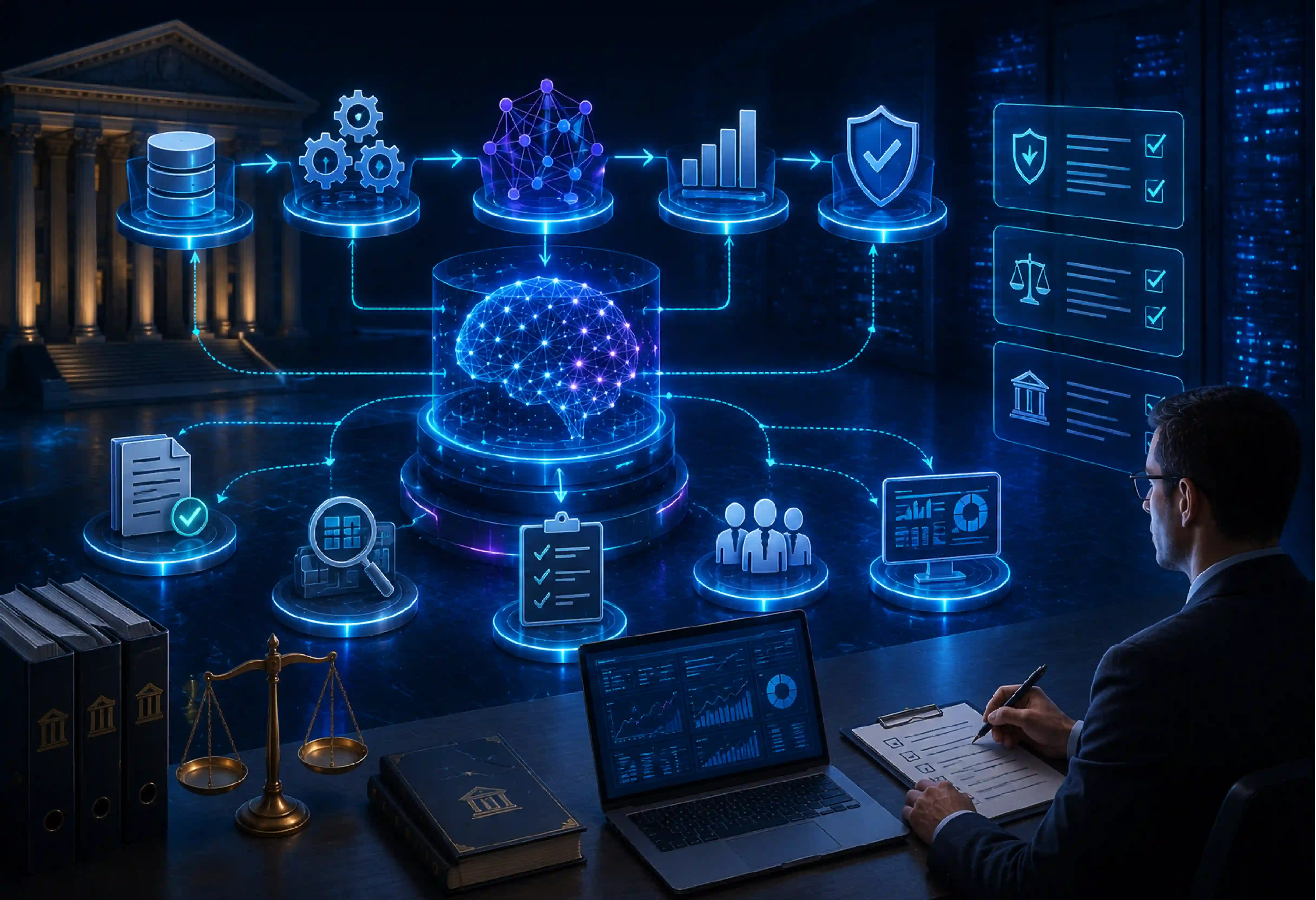


When the examiner asks, “What data trained this model?”, “Who validated it?”, “How has it drifted?” and “Which decision used it?” Can you answer in one query?. Most banks experience a chaotic fire drill. Implementing modern MLOps model governance in banking turns regulatory stress into an automated process. By intentionally tying MLOps for model risk management directly to your deployment pipelines turn manual editing into a continuous, verifiable green light.
This post will guide how to utilize MLOps for model risk management by answering the auditor’s toughest questions without disrupting production momentum.
Artificial Intelligence has moved from experimental projects to critical banking operations. Yet both Model Risk Management (MRM) and Machine Learning Operations (MLOps) work in different ways.
MRM focuses on governance, documentation, and regulatory compliance. Most banking model governance frameworks are rooted in the principles established by regulatory guidance, such as SR 11-7 (Supervisory Guidance on Model Risk Management). Model developers produce model documentation. Validators review methodologies and assumptions. Risk teams keep track of their inventories, approvals, validations, monitoring data, and governance documents.
Such an approach tends to work well in cases where there is no regular change in models. Conventional credit risk models, stress testing, and capital plans tend not to change for many months or years.
The process of governance relies on the idea that models can be reviewed, approved, and monitored relative to a fairly stable baseline.
MLOps emerge from the software engineering world, borrowing heavily from DevOps and Agile methodologies. Models should be treated as software products rather than static analytical assets. Performance monitoring runs automatically, and deployment pipelines promote new versions with minimal human intervention. For MLOps teams, documentation is the main thing rather than a central mechanism of control.
The disconnect between both begins at the handoff in development and governance. The scenario is that model developers complete their work in technical platforms, and then governance teams request documentation after development is finished. The handoff between MLOps and MRM typically breaks down in three specific places:
A model can reflect multiple updates happening in it, but governance records still reflect an earlier version of it. When a model is finished, the MLOps pipeline might have it ready for deployment in minutes. But it needs to be documented in a word and reviewed to satisfy SR 11-7 compliance. By the time documentation reaches validators, the production system already looks significantly different and needs a model change.
MRM speaks the language of conceptual soundness, institutional bias, and economic capital. MLOps speaks the language of latency, memory utilization, data drift, and throughput. When a model misbehaves, MRM asks for a theoretical reassessment while MLOps looks at the server logs.
The corporate “Model Inventory” system is often glorified as a manual internal database. The actual models live dynamically in registries like MLflow or Hugging Face. The risk inventory represents what the organization thinks it has running; the MLOps registry represents what is actually running.
When ML practitioners hear about regulatory demands for model inventories, independent validations, effective challenges, and ongoing monitoring, they believe they pertain to the compliance department. The auditors are examining the policies, validation reports, and governance materials, which do not take into account the way contemporary ML systems work. It has resulted in a communication gap. Risk teams speak in regulatory language. Engineering teams speak in code, pipelines, repositories, and deployments.
The reality is that most regulatory expectations can be translated directly into engineering controls. When viewed through an MLOps lens, requirements are more practical and easier to operationalize.
It is widely believed that the role of an auditor lies in assessing the accuracy of a model. There can be risks involved with the usage of the model, even if no one knows where the model was developed from, who has approved the same, how it was trained on certain data, or how it evolved with time.
The regulated guidelines, for example, SR 11-7, have always considered the entire life cycle of a model. The more recently developed supervisory expectations also highlight this fact.
Auditors are considering the model as a governed business process.
Auditors expect a complete inventory of models used across the organization. In engineering terms, this means maintaining a reliable model registry.
Every production model should have:
So finally, a centralized Model Registry (e.g., MLflow, Weights and Biases). Every model version must be tagged with metadata indicating its tier. Each model should be tagged with metadata indicating its tier. Access controls and deployment permissions are then dynamically tied to these registry tags.
Many organizations interpret it as a validation report written before deployment. Effective challenge means that someone other than the person who built the model has critically evaluated it and has the authority to block its release. In MLOps terms, this translates into structured review processes.
SR 11-7 machine learning breaks validation into three pieces - evaluation of Conceptual Soundness, Ongoing Monitoring, and Outcomes Analysis.
MRM demands evidence of control while MLOps builds automated pipelines. Engineering groups are responsible for managing the repositories, pipelines, experiment logs, model registries, deployment processes, and observability tools.
This difference causes the illusion that governance and engineering are two distinct tasks. But in truth, the majority of data needed for model governance already exists during the machine learning life cycle. The only thing left to do is to make this data visible and accessible.
The organizations that do it best no longer consider compliance a paperwork exercise and see it as an output of good engineering practices.
Traditional governance still relies on manually created documents after the development is completed. This approach creates several problems.
What works better is the idea of creating governance evidence directly out of the systems for the creation, verification, deployment, and monitoring of models.
In that case, governance is an ongoing process as opposed to one that occurs periodically.
The table below translates common MLOps practices into the types of evidence auditors, validators, and model risk teams typically expect to see.
Organizations need visibility into:
Strong lineage allows validators to reconstruct how data influenced model outcomes and assess whether source data remains appropriate over time. Without lineage, reproducibility becomes extremely difficult.
Feature versioning provides evidence that:
For auditors, feature controls help demonstrate that model behavior can be explained and reproduced. For engineering teams, they reduce operational surprises. Organizations need clear evidence showing:
Controlled retirement ensures inventories remain accurate and that retired models can still be reconstructed if required during audits or investigations.
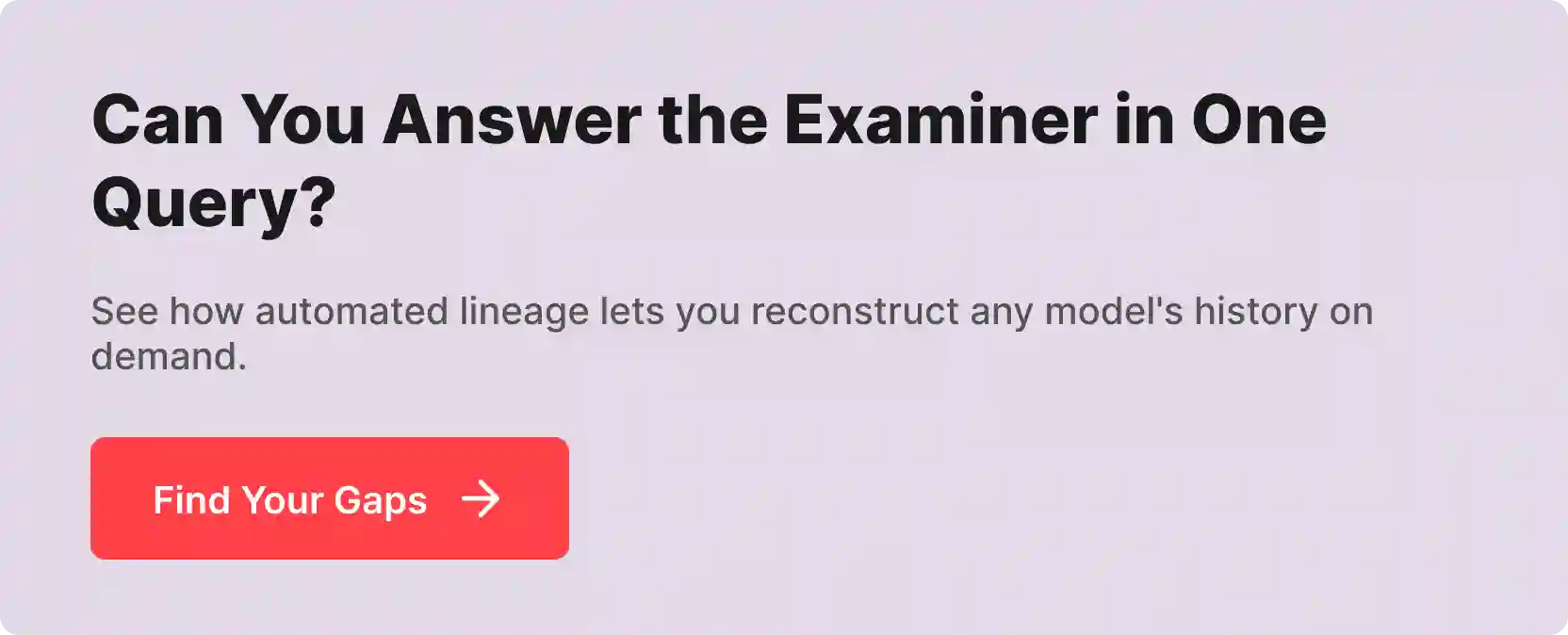
Model governance for auditors followed the same pattern for many years. Data scientists built the models and went to the engineering teams to deploy. Risk and compliance teams review it, and evidence was collected manually. This approach was manageable when models changed infrequently, but it breaks down when an organization deploys machine learning systems that evolve continuously. The answer is moving controls earlier into the lifecycle, so governance becomes part of the engineering process itself.
This is the essence of shift-left governance. By embedding risk checks directly into the continuous integration and continuous deployment (CI/CD) pipeline, compliance changes from a subjective manual review into a series of automated software tests.
In software engineering, "shift left" means moving testing and quality controls earlier in the development process. The same principle applies to model governance. Rather than treating governance as a separate activity performed after model development, controls are embedded directly into pipelines and workflows.
The result is governance that scales with modern machine learning rather than slowing it down.
Traditional governance often relies on manual checkpoints.
A model is developed → Documentation is created → Validators review the package → Approvals are collected → Deployment occurs.
Only afterward does monitoring begin.
This creates several challenges:
Most importantly, governance becomes reactive rather than proactive. By the time a problem is identified, the model may already be influencing business decisions.
One of the most common audit findings involves data quality. Companies tend to specify data needs; however, they do not always enforce such specifications.
The shift-left approach makes sure that all such needs are built within the workflow. All checks ensure that data satisfies certain expectations prior to model training or deployment.
Instead of proving data quality through documents, organizations can demonstrate that controls were executed successfully before model development continued.
Model risk management has, for a long time, been guided by the concept of independence of review. Regulatory standards, such as SR 11-7, have stipulated that the process of model validation should give an independent challenge to model development and model use.
Internal audit, on the other hand, should be independent of both lines. However, it becomes harder and harder for manual governance processes to work. Models are often updated. Data keeps changing. The proof is found across multiple systems. It takes validation teams a huge amount of time to gather all the evidence before they can start evaluating the risk.
Modern MLOps for model risk management does not eliminate the three lines of defense. It simply changes how evidence flows between them.
The first line owns the model risk. In an automated world, they are responsible for ensuring that their training pipelines natively emit clean telemetry, metadata, and validation artifacts into the centralized repository.
The second line must remain completely independent of development. They do not write production code. Crucially, while they use the automated metrics generated by the pipeline, they maintain absolute control over the grading criteria, thresholds, and final sign-off authority.
The third line evaluates the effectiveness of the first two lines. In automated MLOps, they don't look at individual models; they audit the infrastructure logs to verify that no model bypassed the second-line approval gate.
In many cases, validation teams have to make significant efforts to gather information prior to performing validation.
Some examples of such efforts are:
All these efforts represent additional operational costs with minimal risk insight. Validation specialists' time should not be spent on finding artifacts but on assessing risks. The solution lies in automation that makes evidence accessible automatically. The task of the validator stays the same. Administrative burden becomes significantly lower.
One of the most important questions when organizations start to adopt generative AI is whether they require an entirely different approach to governing it.
The brief answer is that no, there is no need.
Even though generative and agentic AI models bring new challenges, the existing approach to governing the risks associated with classical machine learning is becoming more and more relevant when applied by analogy to these models. It is still about knowing the model, validating it, monitoring it, documenting decisions, and holding people accountable.
There is no need to develop a different governance program; the same life cycle should work.
Classic machine learning systems generate structured predictions in the form of risk scores, classifications, or forecasts. Generative AI solutions create content, recommendations, actions, and increasingly autonomous decisions.
However, despite the different outputs, both types of technologies need data, algorithms, assumptions, and controls for operation. Both classic ML systems and generative AI systems can generate risks.
The governance challenge stays the same: Does the organization understand how the system operates, perform as designed, and mitigate risks?
The good news is that most MLOps and MRM primitives already apply.
It is most prudent for the most effective enterprises not to establish discrete governance silos for ML and GenAI but to use one framework to govern both.
The core processes of inventory, lineage, versioning, validation, monitoring, workflows, documentation, and retirement must continue to be the bedrock. Generative and agentic models merely add more controls and artifacts to the existing processes.
The future will not be two governance regimes. The future will be a unified governance lifecycle that spans from predictive models to fully autonomous AI systems.
When a bank decides to unify MLOps and MRM, the one question that arises in mind is: Do we buy a platform or build it ourselves?. If you are thinking of buying, it may lead to vendor lock-in, but it promises fast deployment. On the other hand, building a whole new thing will take a lot of time.
The most successful approach is a hybrid strategy. Instead of tearing down your existing setup, keep your core tools (like Git, your model registry, and your databases) and write lightweight integration scripts to bridge the gaps.
Don't try to automate your entire governance pipeline overnight. Instead, start with one high-impact area:
But wait ! You don’t need to do this alone. Entrans is a specialized partner that engineers compliant MLOps directly on your bank’s existing technology stack. We write the underlying code, build the automated pipelines, and configure the security guardrails necessary to satisfy auditors using the infrastructure you already own. By integrating governance, risk, and engineering workflows, Entrans helps institutions create audit-ready model governance without disrupting the tools and platforms they already trust.
Learn more about how we optimize audit-ready model governance without a costly rip-and-replace program. Book a consultation with us.
MLOps Model Risk Management ensures that there is governance, monitoring, documentation, and control built into the lifecycle of the models, making it easier for the bank to manage model risk throughout the lifecycle of the model.
The updated guidance expands oversight beyond traditional models to include AI and machine learning systems. Model risk guidance expects banks to actively manage the unique risks of non-linear algorithms rather than just relying on traditional validation methods.
MLOps pipelines can automatically generate validation reports, performance metrics, testing results, approval records, and audit trails as models move through development and deployment. This creates consistent, readily available evidence for validators and auditors.
Shift-left governance embeds compliance and risk checks directly into the early stages of model development instead of waiting until final validation. This reduces remediation time costs, accelerates approvals, and helps prevent governance issues from reaching production.
Make use of version control for your code, data sets, features, configurations, and models so that you can reproduce each of your training runs identically. MLOps solutions streamline the process of lineage tracking and documentation.


-1.svg)