Learn how agile transformation consulting for legacy software modernization cuts risk, compresses timelines, and enables AI adoption without big-bang disruption.

Agentic Unconference 2026 - September 19, Chennai
View Event →


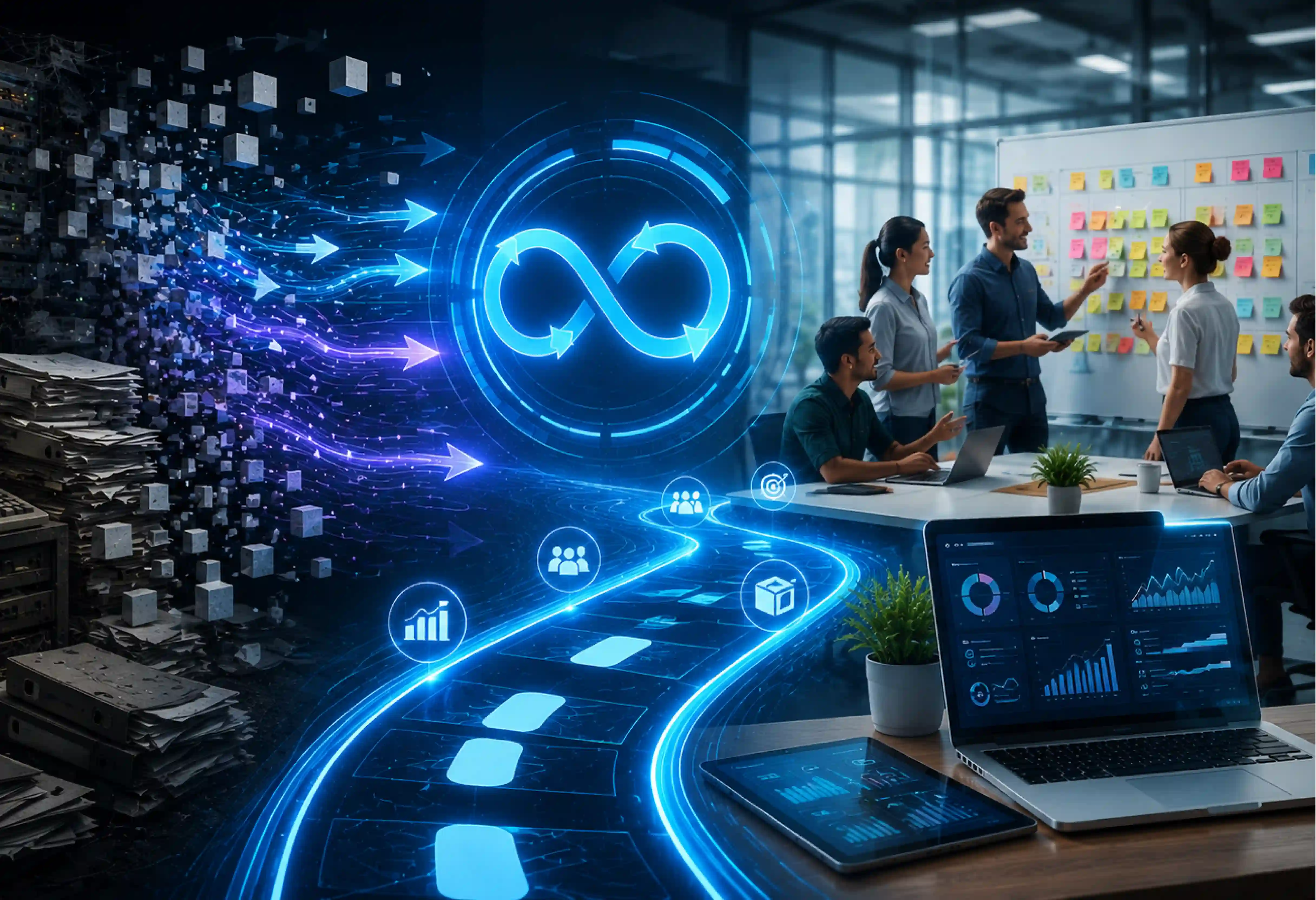


Imagine this: your decade-old legacy system is trying to run an AI model on a flip phone. It is a true example of a disaster about to happen. That is where Agile modernization consulting steps in. Instead of a risky, stressful "big bang" release, an expert partner helps you systematically break down your software monolith into bite-sized, microservice updates. Agile transformation consulting for legacy software modernization provides a structured, low-risk framework for your enterprise architecture.
In this article, we will discuss what enterprise IT consulting services are for legacy system modernization. Comprehensive solutions like an AI-driven legacy modernization framework can help to smoothly transition outdated systems into high-performance architectures. It also says how we can build an adaptable, cloud-ready foundation with next-generation AI utilities.
Legacy modernization directly impacts business agility, customer satisfaction, compliance, and operational efficiency. The waterfall method has been the default blueprint for large-scale IT initiatives at large enterprises. By establishing a clear digital modernization strategy, an enterprise legacy AI roadmap can be improved to navigate away from these rigid, outdated planning methods. As organizations move towards cloud-native platforms, AI-driven workflows, and continuous delivery models, the limitations of the waterfall modernization method suggest that we change.
The main reason for waterfall modernization failing is the big-bang migration” strategy. To explain clearly, the waterfall method carries out the entire legacy system modernization as a single, massive transformation effort. This leads to
The risks associated with using sequential, big-bang methodologies for complex IT transformations are well-documented by industry researchers and academic studies.
Agile transformation consulting for legacy software modernization is the practice of applying agile principles to the unique constraints of overhaul programs. It differs from general agile consulting, which focuses only on improving software delivery processes, whereas legacy-focused consulting addresses technical debt, undocumented systems, and high-risk data dependencies. These specialized consultants embed core agile principles directly into the migration strategy.
The ultimate goal is to modernize legacy systems faster and more safely while ensuring alignment between engineering teams.
Replacing a legacy system is tricky as it involves hidden code and critical dependencies. But using a step-by-step approach leads to high costs and broken software. This can be eliminated by applying agile methodologies. Depending on the scale and nature of legacy systems, teams can use different agile frameworks such as
Scrum is one of the most commonly used agile frameworks for modernization initiatives. It helps to break large transformation efforts into manageable components. The work is divided into short, time-boxed works lasting for two to four weeks, known as Sprints.
Scrum team structures are usually cross-functional and may include application developers, cloud engineers, QA specialists, DevOps engineers, business analysts, and product owners.
The Scrum team dedicates a Sprint to migrating a single feature, like the "User Login" or "Invoice Generation" service.
By following the Scrum methodology, we can achieve
Kanban uses a continuous-flow model that focuses on visualizing work, limiting multitasking, and optimizing efficiency. The differences between them are that Scrum works for new features, but legacy systems often require ongoing maintenance, security updates, and technical debt extraction.
A dedicated legacy engineering team maps their workflow on a Kanban board with distinct columns (e.g., Backlog, Code Analysis, Refactoring, Testing, Done).
By following the Kanban methodology, we can achieve
The Scaled Agile Framework (SAFe) helps large enterprises coordinate agile practices across multiple teams, departments, and systems. It scales agile principles up to the enterprise level by aligning multiple teams toward a shared strategic goal.
SAFe organizes multiple agile squads (typically 5 to 12 teams) into a collaborative unit called an Agile Release Train (ART).
By following the SAFe methodology, we can achieve
The traditional big bang approach to replacing old software starts from scratch is notoriously risky, expensive, and disruptive. By applying iterative, flexible agile principles to software upgrades, businesses can transform their outdated systems without the chaos. The five key benefits of taking an Agile approach are
The traditional waterfall method requires massive upfront investment and months to see a working product. The projects carry a high failure risk because even small issues can affect the entire deployment. With incremental modernization, validate functionality continuously, detect issues earlier, roll back changes, and minimize operational disruption. Agile modernization minimizes these risks through controlled, phased implementation.
An agile-led approach focuses on delivering a Minimum Viable Product (MVP) and continuous feature releases. By prioritizing high-impact features early in the modernization roadmap, stakeholders and users start experiencing the benefits of the new systems in weeks rather than years. Faster ROI may bring reduced infrastructure costs, improved system performance, better customer experience, faster development cycles, and lower operational overhead.
True success depends on user adoption. Legacy modernization affects not only technology systems but also people, workflows, and business processes. Forcing employees to switch overnight to a completely unfamiliar system often breeds resistance and drops productivity.
Agile naturally eases this transition through its gradual nature. Because changes are introduced incrementally, users have the time to adapt to new interfaces and workflows at a reasonable pace.
Provide continuous training for the users. Agile involves continuous feedback from frontline users, making them feel heard and valued throughout the transformation process.
Downtime during legacy modernization is one of the greatest fears, as it disrupts critical business processes. So instead of replacing entire platforms at once, organizations can migrate services gradually, run hybrid environments, validate integrations continuously, and deploy features incrementally. An Agile approach safeguards your business continuity. By modernizing the system piece by piece, the legacy platform and the new architecture run in parallel. Data bridges and APIs ensure that the old and new systems talk to each other seamlessly during the transition.
AI adoption is becoming a major driver of legacy modernization initiatives. However, integrating AI capabilities into outdated systems can be extremely difficult without incremental modernization.
Agile delivery models simplify AI adoption by modernizing systems in manageable phases. Agile modernization provides the perfect playground for AI adoption. Because the system is broken down into iterative phases, you can introduce AI capabilities strategically where they make the most sense. Utilizing a structured legacy app modernization with GenAI Enterprise Guide can help to successfully deploy intelligent automation across existing platforms.
Real challenges are not deciding what to modernize, but also how to modernize it. Both traditional modernization and agile legacy modernization differ in their own approaches.
Following the best practices, migrating legacy processes to AI-driven workflows can be improved to ensure that data integrity and operational continuity remain intact during the shift.
The biggest problem in legacy modernization projects is managing decades of codebase, hidden dependencies, and undocumented features. By applying an Agile framework specifically tailored for technical transitions, enterprises can systematically extract information and convert it into a modernized, functional architecture. Here is how to manage information and execution seamlessly throughout your modernization journey.
Before starting to write a single line of code, uncover what exactly legacy systems do. Start the project with a dedicated Assessment Sprint (Sprint 0) through which we can gather information and conduct discovery.
A modernization backlog is a prioritized list of transformation tasks that says about the system’s architecture and business logic. Unlike a standard product backlog that focuses purely on new user features, a modernization backlog balances technical debt, business logic replication, and architectural upgrades. Not all legacy components need modernization immediately.
Agile teams should prioritize:
This ensures modernization delivers measurable business outcomes early.
Prioritization Strategy: Organize backlog items by balancing business value against architectural risk. Upgrading a high-value, low-risk module early establishes momentum and proves the migration concept to stakeholders.
Strangler fig pattern is a design pattern in which old system components are gradually replaced by new microservices until the legacy systems are completely strangled and can be decommissioned. This design pattern reduced risk by enabling phased migration, preserving operational continuity, supporting continuous testing, and simplifying rollback procedures.
Testing is an important phase in agile modernization. It must be integrated into CI/CD pipelines from day one of development. Start doing automated test suites that run the same data inputs through both the legacy and modernized systems. By means of continuous testing, we can increase faster release cycles, reduce regression risk, achieve more stable deployments, and safer incremental modernization.
Legacy modernization can sometimes feel invisible to non-technical stakeholders since a lot of the work happens under the hood. To maintain executive support and funding, you must align business stakeholders in every Sprint Review. Regular sprint reviews remain involved in prioritization decisions, feature validation, operational impact discussions, risk evaluation, and adoption planning. Gather regular feedback from users to show an evolving system regularly to ensure that business logic is rebuilt into the modern platforms.
Modern enterprises are now combining agile methodologies, DevOps automation, and generative AI capabilities to accelerate transformation while reducing operational risk.
Agile + DevOps + GenAI = the modern legacy modernization stack
Agile serves as an operational foundation of modernization programs. Agile teams modernize systems in manageable phases, and it has helped to achieve faster releases, reduce migration risk, and provide continuous business feedback. They actually ensure the monolithic system is broken down into small, low-risk, value-driven sprints.
DevOps gives the delivery engine that turns those sprints into continuous automated deployments.
Generative AI (GenAI) acts as the cognitive accelerator that cuts down the manual effort required for code extraction, documentation, and translation.
Making a small change can require days of manual build configurations and risky code cutovers. Integrating a Continuous Integration and Continuous Deployment (CI/CD) pipeline fixes this. By automating the integration and deployment layers, teams can merge code changes into a central repository. Automated build gates validate the code and deploy it seamlessly to staging or production environments.
CI/CD automates
AI-assisted tools can identify legacy dependencies, detect code smells, recommend refactoring opportunities, highlight security vulnerabilities, suggest modernization patterns, and generate missing documentation. AI code assistants can analyze legacy monolithic codebases instantly to map dependencies and explain business logic in plain language.
Testing is often one of the largest bottlenecks in modernization initiatives. Generative AI improves testing efficiency by generating test cases automatically, creating regression test suites, identifying edge-case scenarios, and automating API testing. AI-assisted testing helps in detecting issues earlier, validating business logic consistency, and accelerating deployment cycles. This is especially valuable during phased migration strategies.
Agentic AI can assist with sprint backlog refinement, dependency analysis, ticket generation, code migration workflows, and test execution planning. They act as a productivity layer that accelerates repetitive modernization activities.
Instead of project managers manually updating backlogs or tracking engineering blockers, autonomous AI agents operate across enterprise layers like Jira, Slack, and GitHub.
At Entrans, we embed an AI-first, engineering-led DNS directly into the enterprise fabric. Our balance modernization stack combines industry-standard DevOps tools to accelerate delivery timelines while reducing technical debt.
Upgrading an enterprise legacy system is one of the most high-stakes journeys an organization can undertake. While evaluating an Agile transformation consulting for legacy software modernization, we need to consider these four non-negotiable criteria.
Look for an Agile transformation consulting partner who has certified scrum masters, SAFe aglists and enterprise coaches who understand greenfield SaaS applications with the relationships of a 15-year-old monolithic database or undocumented business logic. Confirm their direct experience with mainframe migration, ERP modernization, API transformation, legacy database modernization, cloud migration programs, and hybrid architecture transitions.
Consult an Agile transformation partner who has successfully modernized a retail e-commerce platform, not automatically equipped to restructure an outdated core banking system or a legacy healthcare claims processing app.
AI and automation are becoming central components of modern legacy modernization programs. Top-tier modernization partners should embed an AI-augmented software development lifecycle (SDLC) directly into their transformation strategy.
Review the case studies of the agile transformation partner. They provide the clearest indicators of modernization capabilities. Check out their successful modernization programs involving large-scale enterprise systems, incremental transformation, hybrid cloud migration, operational continuity, and agile delivery execution.
At Entrans, we replace the risk of traditional "big-bang" migrations with a phased, agile approach designed to protect your operational continuity while maximizing innovation.
Our lifecycle systematically routes information and deployment across four agile phases:
System analysis → Incremental Execution → AI-Driven Testing → Continuous Optimization
By following zero-trust security architecture, we ensure that your transition from a legacy monolith to an AI-ready ecosystem is secure, compliant, and optimized for long-term business agility. Want to know more about it? Book a consultation with us to start your modernization journey.

The biggest challenges in a legacy modernization project are undocumented code dependencies without breaking active operations, undocumented business logic, integration complexity, outdated infrastructure, and operational risk.
Scrum, Kanban, and SAFe are widely used agile frameworks in legacy and modernization programs. Scrum and Kanban are preferred for managing day-to-day team-level development sprints, while the Scaled Agile Framework (SAFe) is widely used to coordinate complex transitions across large enterprises.
Agile handles interconnected monoliths by using the Strangler Fig Pattern to incrementally extract isolated features into modern microservices. These new services run in parallel with the legacy system via an API gateway until the old software is completely phased out.
The timelines for a typical agile legacy modernization project depend on the size, complexity, and business priorities of legacy environments. Initial assessment takes 2 to 4 weeks, working project takes 3 to 6 months, and a full modernization typically spans 12 to 24 months.
It is a specialized advisory service that assesses an organization's outdated tech stack, uncovers hidden architectural dependencies, and designs a phased, low-risk roadmap to transition the system into modern, cloud-native software.

-1.svg)