Bluetooth-based EV charger authorization enables secure offline charging, local billing, and reliable uptime even when cellular connectivity fails.

Agentic Unconference 2026 - September 19, Chennai
View Event →




Is your EV charging network losing sessions every time cellular drops out?
More operators deal with this than you'd expect!
When authorization depends entirely on a live cloud connection, a single dead zone can lock out drivers, cut off revenue, and put your uptime metrics in breach of NEVI requirements.
That's why this walkthrough breaks down exactly how bluetooth EV charging authorization works covering the aspects you need to know.
The charging reliability numbers are worse than most operators realize. A study covering more than 100,000 sessions across 2,400 chargers found that nearly one in three public charging attempts fails, even at stations reporting close to 97% electrical uptime.
Over 55% of those failures trace back directly to cellular connectivity problems, not hardware faults.
For Charge Point Operators, bluetooth EV charging authorization is not a premium feature. In 2026, it is the architecture that keeps the First-Time Charge Success Rate from dropping the moment the signal degrades.
In subterranean car parks, dense urban zones, and remote fleet depots, cellular dead zones are a baseline operating condition:
Pairing Model: App, Phone, Charger, CSMS
A bluetooth EV charging authorization or a BLE-enabled charging network runs across four connected nodes. Understanding how authority and data flow between them is the foundation of the whole architecture:
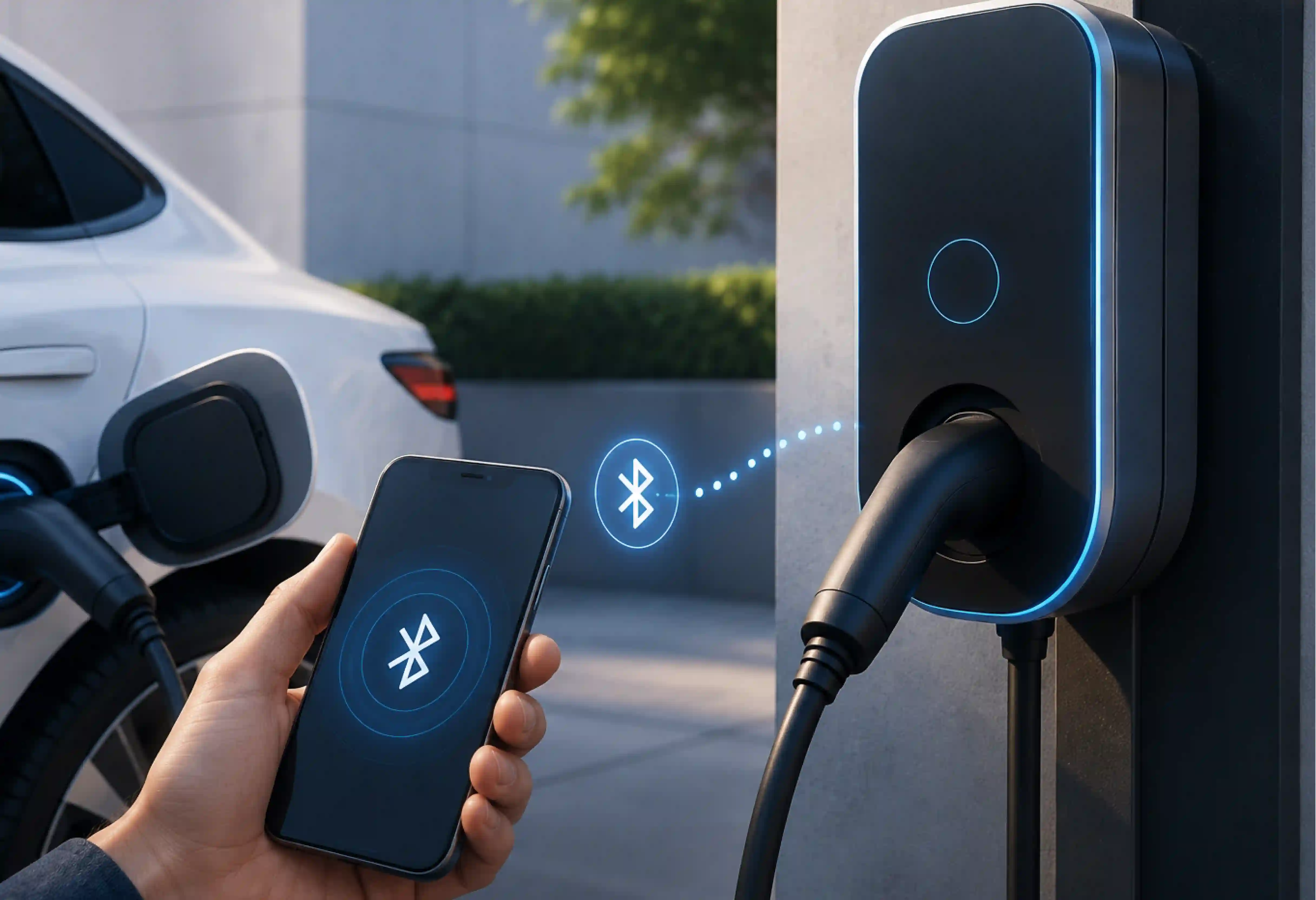
When the phone is in range, it scans as a BLE Central device while the charger advertises as a Peripheral. Modern builds skip PIN-based pairing entirely, using BLE Secure Connections with Out-of-Band or Just Works methods to set up an encrypted channel in the background without any action from the driver.
Once the bluetooth EV charging authorization or BLE link is up, the phone becomes a secure mobile bridge. If the charger has no cellular connection, the phone relays OCPP messages to the CSMS over its own cellular radio. If both are fully offline, the phone passes a pre-signed token to the charger over BLE and the charger starts the session locally by checking the signature against a stored public key.
For multi-charger facilities, Bluetooth Mesh supports up to 32,767 nodes using managed flooding, keeping message delivery working even when individual stations go down, with latency per hop around 141 milliseconds.
Taking authorization off the cloud and onto a local BLE connection or bluetooth EV charging authorization creates a target. Without continuous CSMS oversight, the local handshake needs its own security model built to hold up against attackers who are physically present.
Many deployed bluetooth EV chargers run on low-power microcontrollers like Cortex-M3 or M4 chips. These handle basic state machine logic but lack the memory headroom for full TLS 1.2 or 1.3 stacks.
A TLS handshake alone can need 50 to 100 kilobytes of memory overhead for certificate chains and encryption contexts. Forcing heavy asymmetric encryption onto these chips leads to memory exhaustion, watchdog resets, and frozen equipment.
The trust model has to work within these constraints using lightweight cryptographic methods.
The foundation is Elliptic Curve Cryptography using the P-256 curve inside the BLE Secure Connections framework. The phone and charger generate session keys through an Elliptic Curve Diffie-Hellman exchange, so an attacker capturing the initial pairing packets cannot work out the session keys.
The CSMS acts as the certificate authority, issuing signed tokens to validated users before they go offline. Each token carries the user's identity, an expiration timestamp, and an authorized energy limit.
The bluetooth EV charger checks the CSMS's root public key to confirm the token is genuine, keeping authorization and execution separate: a compromised charger cannot start sessions on its own.
At the start of each bluetooth EV charging authorization, the charger generates a unique nonce and sends it to the phone.
The phone signs that specific nonce alongside its token. Because the nonce changes every session, any previously captured packet gets rejected instantly. Key threats and countermeasures:
All data exchange in BLE or bluetooth EV charging authorization runs through the Generic Attribute Profile (GATT). The GATT server lives on the charger's microcontroller and organizes data into Services and Characteristics. A Service groups related functions.
A Characteristic is a single data point, sensor reading, or command register within that service.
Standard Bluetooth SIG services use 16-bit UUIDs. The Device Information Service (0x180A) covers manufacturer name (0x2A29), model number (0x2A24), and serial number (0x2A25).
The Battery Service (0x180F) exposes the battery level characteristic (0x2A19) for tracking backup power. These standard services are not enough for EV charging.
Dynamic load adjustments, offline cryptographic authorization, and real-time metering need custom services with 128-bit UUIDs, generated fresh and checked against the Bluetooth Base UUID space to avoid conflicts.
A working GATT layout for an offline-capable EV charger:
The Notify permission on the Real-Time Meter Characteristic matters for battery life. The charger pushes updates only when values change, so the app gets live readings without polling continuously. This cuts RF usage and preserves battery on both the phone and the charger terminal.
A bluetooth EV charging authorized or BLE charging session moves through a deterministic set of states that connect digital authorization to the physical analog Control Pilot signal governed by SAE J1772 and IEC 61851.
A failure at any point triggers an immediate safe transition and opens the physical contactors.
This state machine keeps authorization and physical execution strictly separate. An attacker cannot alter the Control Pilot signal to pull power without the matching BLE token passing the signature check first.
Offline payment introduces direct financial risk. In a normal online session, an authorization hold of roughly $10 to $68 goes onto the driver's account right away. In a subterranean garage with no internet, the operator extends an unsecured micro-credit line to every driver who plugs in.
The phone does not pass a raw credit card number to the charger. That would break PCI DSS requirements. Instead, the app carries an encrypted, short-lived cryptographic proof of account standing, fetched from the CSMS the last time the phone had connectivity.
The token certifies that the user had a valid payment method and enough funds at the time of the last sync. Modern builds use OpenID Connect and OAuth 2.0 to let drivers use express checkout without setting up a full account, with credentials cached locally before entering the dead zone.
After the bluetooth EV charging authorized session ends, recovery runs across two paths at the same time:
For fleet and enterprise deployments, pricing rules including time-of-use rates and per-kWh fees can be pre-loaded onto the charger's memory.
The charger works out the exact cost locally based on actual power delivered, with no cloud dependency at billing time.

The bluetooth EV charging authorization architecture works well in controlled conditions. Real-world deployments run into mobile OS restrictions and radio frequency congestion that can silently break the user experience in ways that are hard to trace.
Android's power management is built to shut down background tasks aggressively. Since Android 8.0, the OS has killed BLE scans running in the background after around 30 minutes. Android 9 added scan throttling that blocks apps attempting more than five scans in a 30-second window, causing silent discovery failures.
CoreBluetooth on iOS is OS-managed and cooperative, not a continuous loop. Apps must declare the correct background modes in the Info.plist file or BLE connectivity or bluetooth EV charging authorization drops when the app leaves the foreground.
Apple's Find My network runs across over a billion devices constantly broadcasting and scanning BLE payloads. In a dense urban car park filled with iPhones, AirTags, and AirPods, the 2.4 GHz band becomes heavily congested.
RFID has been the default authentication method for public and fleet charging for over a decade. Legacy low-frequency proximity cards and technologies like MIFARE Classic are now highly vulnerable to cloning, sniffing, and replay attacks.
The industry is moving toward mobile-first credentials using BLE or bluetooth EV charging authorization with encrypted NFC, but a full rip-and-replace is not realistic. A phased approach that keeps legacy users working while building toward full security compliance is the only practical path.
Install multi-technology readers, such as ELATEC's TWN4 MultiTech family, that handle legacy LF and HF RFID alongside BLE and NFC from a single unit. These go into new EVSE builds or retrofit into existing enclosures.
Legacy card users carry on without any change. Early adopters start testing smartphone access. No disruption, no forced behavior change when adding bluetooth EV charging authorization.
Update the CSMS backend to issue Public Key Open Credential (PKOC) tokens or signed JWTs to the mobile app. Roll out support for secure BLE authorization, NFC, and high-frequency encrypted RFID such as MIFARE DESFire EV3.
Encourage drivers to move to the app by giving them live charging stats and auto-authorization features that physical cards cannot match. The open Aliro specification and PKOC standards keep the setup interoperable across platforms.
Push an over-the-air firmware update to the EVSE that stops accepting unsecured low-frequency RFID standards. BLE, NFC, and secure encrypted RFID are the only accepted credentials from this point.
Vulnerable legacy cards are retired on a timeline the operator controls. Full security compliance against cloning and replay attacks is reached without stranding users during the transition.
Moving beyond the just basic offline capabilities of standard OCPP, Entrans implements advanced edge solutions utilizing a four-state charging model: Online, Degraded, Offline, and Recovering
This goes especially considering we implemented this for a leading EV charger manufacturer and helped the company migrate from OCPP 1.6 to OCPP 2.0.1.
Entrans protects operator revenue during outages through localized caching, allowlists, and BLE-assist technologies
In doing this, we guarantee seamless driver experiences and accurate billing even when regions go dark.
By using the driver's smartphone as a secure mobile bridge, Entrans helps networks maintain critical uptime and continuous revenue generation.
Better yet, Entrans also helps teams with a highly secure migration path from vulnerable legacy RFID to modern, offline-capable BLE authorization or bluetooth EV charging authorization.
This goes especially considering we implemented this for a leading EV charger manufacturer and helped the company migrate from OCPP 1.6 to OCPP 2.0.1.
Want to see what this would look like? Book a free consultation call!

Yes. According to users on Reddit, chargers from manufacturers including Wallbox, Autel, and Emporia support local access control through BLE without any cloud connection. The owner uses their phone's BLE link to lock or unlock the station through the manufacturer's app while standing next to the unit.
Standard AC charging runs on the SAE J1772 protocol, which uses analog PWM signals and does not carry digital identifiers over the physical pins. The charger cannot tell which vehicle is plugged in on its own. To work around this, some operators use BLE proximity detection through local smart home platforms like Home Assistant on an ESP32 or Raspberry Pi.
The charger stores start time, end time, and kWh data locally for every session. A property manager or driver approaches the station with an authorized phone, the app connects over BLE, downloads the accumulated logs in a compressed format, and clears the station's buffer.
The charger holds the transaction record in its own non-volatile memory independently of the phone. The state machine blocks any new session from overwriting that record until it has been sent upstream. When the charger's own connection comes back, it forwards the full transaction backlog to the CSMS for processing. The driver's payment goes through based on the local record.
At the start of each authorization attempt, the charger generates a fresh nonce unique to that session. The phone must sign that nonce alongside its authorization token before the charger accepts it. A packet captured from a previous session carries the old nonce and gets rejected immediately.

-1.svg)