Best Legacy System Modernization Service Providers in IT Consulting (2026 Guide)
Top 10 legacy modernization IT consulting firms for 2026. Compare services, pricing, and find the right partner for your stack.
Best Legacy System Modernization Service Providers in IT Consulting (2026 Guide)
4 mins
May 15, 2026
Author
Kapildev Arulmozhi
TL;DR
Picking the wrong modernization partner for your legacy profile is the most expensive mistake enterprises make. A firm that excels at mainframe migration may be a poor fit for AI-led data modernization.
The best legacy modernization services in IT consulting now use AI and GenAI to automate code analysis, dependency mapping, and refactoring, cutting timelines by 70-80% compared to manual approaches.
Pricing models matter as much as vendor selection. Time and Materials works for complex scopes, Fixed-Price for defined rehosting tasks, and Outcome-Based for large strategic transformations with clear business goals.
The delivery model (onshore, offshore, or hybrid) affects cost, governance, and execution speed as much as the technology stack. Regulated industries almost always need onshore or hybrid setups.
Legacy systems hold back in moving towards AI and Cloud ambitions. But to survive in this current digital world, we need the best legacy system modernization service providers who bring proven methodologies, specialized expertise, automated refactoring, and industry-specific blueprints. The operational roadmap of an enterprise can be improved significantly through a structured AI-driven legacy modernization strategy. With the best IT consulting firms for legacy modernization, it is just more than a technical upgrade, but it becomes a foundation for growth, agility, and AI readiness.
In this article, we will see the best consulting firms for modernizing legacy IT systems that ensure the modernization initiative delivers measurable results and not just a technology stack.
Table of Contents▾
What Makes a Great Legacy System Modernization IT Consulting Service Provider?
Legacy often means a barrier to agility, scalability, and AI readiness. Selecting an IT consulting partner for modernizing mission-critical systems will reduce technical debt, cloud migrations, and help unlock new digital capabilities. The process of AI-driven legacy modernization for companiescan be improved significantly when firms prioritize automated discovery and code extraction.
AI and GenAI-Powered Tooling: The best consulting firms for modernizing legacy IT systems use AI and generative AI to analyze code, extract business rules, and find out their dependencies. They also automate testing and validation to reduce manual effort, improve accuracy, and shorten timelines significantly. Automated refactoring tools can translate COBOL or legacy Java into cloud-native microservices with 70 to 80% automation.
Modernization methodology: The best legacy modernization service provider must offer a structured framework referred to as 7s (Retire, Retain, Rehost, Replatform, Refactor, Rearchitect, and Replace. Top providers follow a phased methodology of discovery, business case and modernization, target architecture, migration, and transformation. The exact alignment of this methodology can be helped by learning how to evaluate an AI consulting company for legacy system modernization frameworks before kickoff.
Industry experience: The best IT consulting firms for legacy modernization possess strong domain expertise in industry-specific workflows, compliance obligations, operational constraints, and common integration patterns.
Cloud Capabilities: Legacy System Modernization Service Providers help in redesigning applications for microservices architecture, containers, and Kubernetes, Serverless services. They also possess strong expertise with platforms such as AWS, Azure, Google Cloud, and Red Hat OpenShift.
Security/Compliance: Legacy System Modernization Service Providers integrate DevSecOps and ensure that modernized architecture meets modern standards such as GDPR, HIPAA, or SOC2.
Client reviews: Check out the Legacy System Modernization Service Providers’ relevant case studies, verified client reviews, industry analyst recognition, and quantified outcomes.
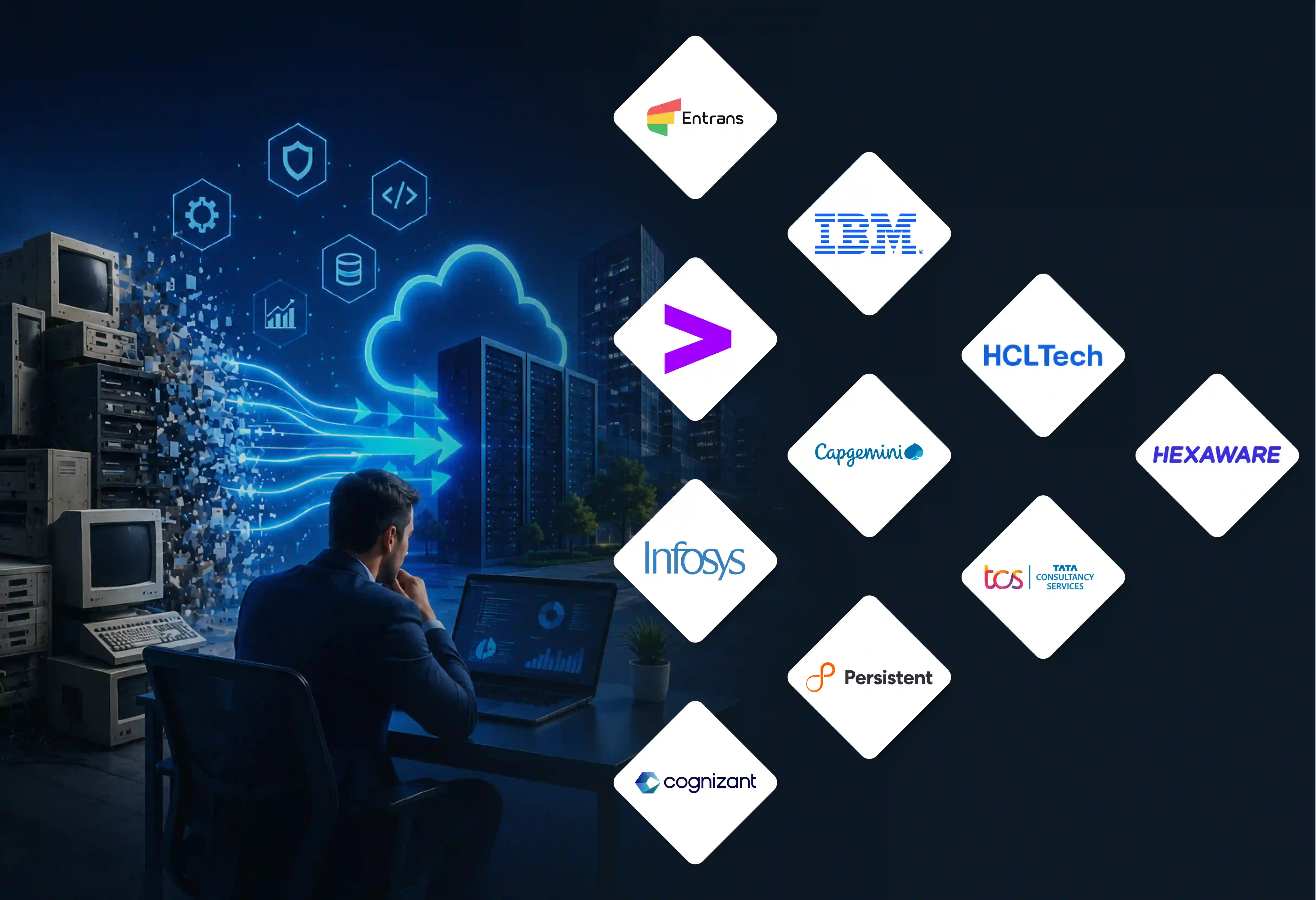
Top Legacy System Modernization Service Providers in IT Consulting (2026)
We specialize in AI-driven discovery to map dependencies and assess cloud readiness, followed by automated refactoring and re-architecting monolithic systems into microservices using technologies such as Kubernetes, Terraform, Snowflake, and Databricks.
Entrans integrates Agentic AI frameworks into enterprise layers (CRM/ERP) and implements automated CI/CD pipelines, ensuring high-performance, secure, and compliant transitions that significantly reduce technical debt and governance to ensure scalable, compliant, and total cost of ownership.
We deliver enterprise AI and automation capabilities spanning generative AI consulting, agentic AI development, and Retrieval-Augmented Generation (RAG). With our Thunai.ai and Infisign.ai, we help organizations automate support, sales, operations, and compliance workflows.
This includes automated code refactoring for legacy systems, AI-driven predictive analytics for supply chain and finance, and deployment of autonomous AI agents within CRM and ERP platforms.
Through robust RPA (Robotic Process Automation) and AIOps, we automate IT maintenance and data processing by reducing manual errors and accelerating time-to-market for digital products.
Best suited for
AI-driven code refactoring
Transition to Agentic Workflows
Legacy-to-Cloud Database Modernization
Cost-effective, high-scale engineering
Reducing technical debt in specialized sectors
For enterprises looking to refactor monolithic applications into microservices.
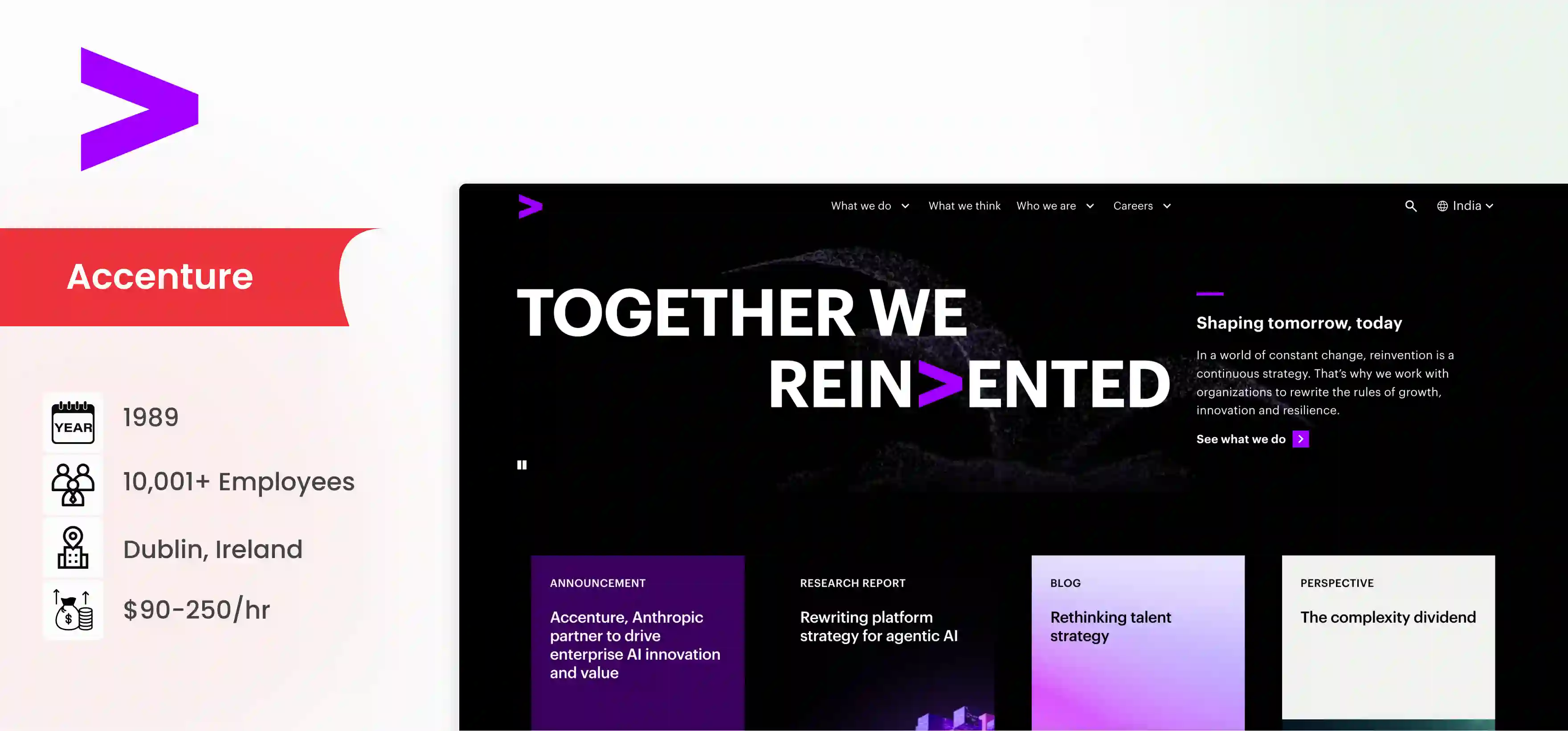
2. Accenture
Accenture is a leading Indian IT giant that provides legacy system modernization Consulting services. Accenture’s Center for Advanced AI helps enterprises build custom Large Language Models (LLMs) and integrate generative AI into business workflows, specifically for content creation, code generation, and customer service.
Core Modernization Services and AI/automation capabilities of Accenture
Accenture provides end-to-end modernization through its Cloud-First and Digital Core initiatives. Key services include AI-led application refactoring, mainframe-to-cloud migration, and data estate modernization.
They also implement Agile, DevSecOps, and AI-powered accelerators to reduce technical debt and speed delivery.
Accenture ensures its best legacy modernization services in IT consulting and helps enterprises rebuild legacy systems into secure, scalable, cloud-native platforms aligned with business goals.
Using the GenWizard platform, Accenture automates the software development lifecycle, including legacy code analysis, automated refactoring, and unit testing to accelerate modernization projects.
Strong in combining cloud migration, application refactoring, data modernization, and AI-driven automation.
3. Infosys
Infosys is one of the major IT giants in India. They provide comprehensive “Experience Design” and “Digital Interaction” services focusing on personalized and omni-channel customer experience. Using automation and AI-powered accelerators, they modernize mainframes, custom applications, and data platforms to improve agility.
Core Modernization Services and AI/automation capabilities of Infosys
Infosys modernization services include legacy-to-cloud refactoring, mainframe modernization, and microservices re-architecting. They utilize the Infosys Modernization Suite to automate discovery and code conversion, reducing project timelines significantly.
Their AI capabilities focus on generative AI integration consulting, predictive analytics, and autonomous IT operations. By leveraging Topaz, Infosys provides pre-built industry AI models and intelligent automation (RPA) to streamline business processes.
Infosys's combined approach ensures enterprises achieve a scalable "digital core" with automated testing and data-driven decision-making. They help enterprises modernize legacy systems by embedding AI-driven insights and workflow automation.
Best suited for
Large-scale legacy modernization programs with strong automation and global delivery.
Through the Infosys Topaz platform, they have the ability to combine application modernization, testing, and managed services in a single engagement.
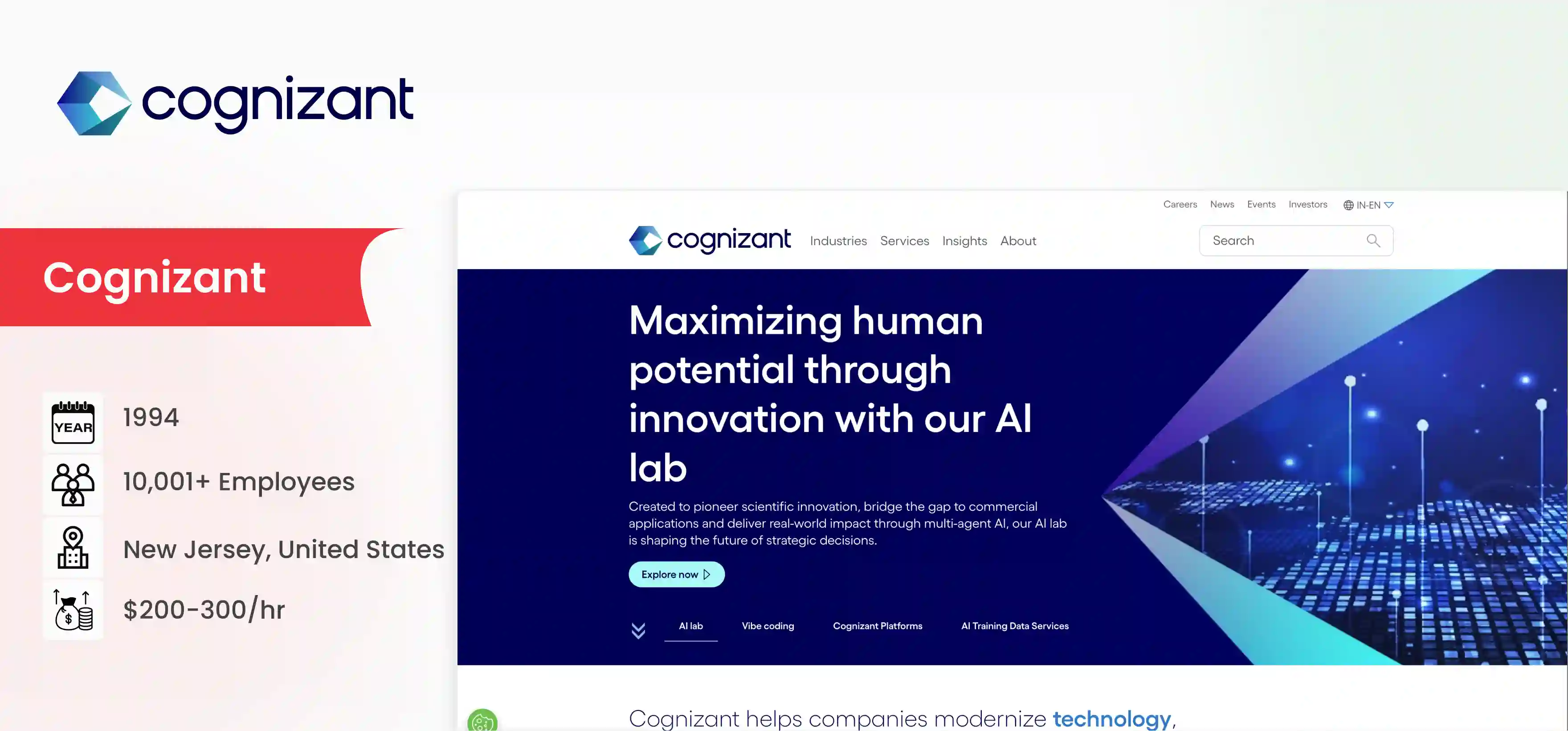
4. Cognizant
Cognizant is a global professional services company providing legacy modernization services. One of Cognizant’s key strengths is its "Neuro IT Operations" platform; they focus on transforming legacy systems into “AI-fueled innovation engines”.
Core Modernization Services and AI/automation capabilities of Cognizant
Cognizant provides end-to-end legacy modernization services, including application portfolio assessment, cloud migration, mainframe modernization, and DevOps automation.
Cognizant offers generative AI consulting, intelligent process automation, AIOps, custom LLM development, RAG, and agentic AI solutions. Platforms such as Cognizant Neuro IT Operations and Flowsource help automate software engineering, IT operations, and business workflows at enterprise scale.
By combining AIOps with autonomous engineering, Cognizant helps enterprises reduce technical debt and accelerate the transition to a cloud-native, AI-ready digital core.
Best suited for
Mainly used for regulated industries such as banking, healthcare, insurance, and life sciences.
Used for organizations seeking an AI-led approach using accelerators like Cognizant Skygrade and Neuro to automate code analysis.
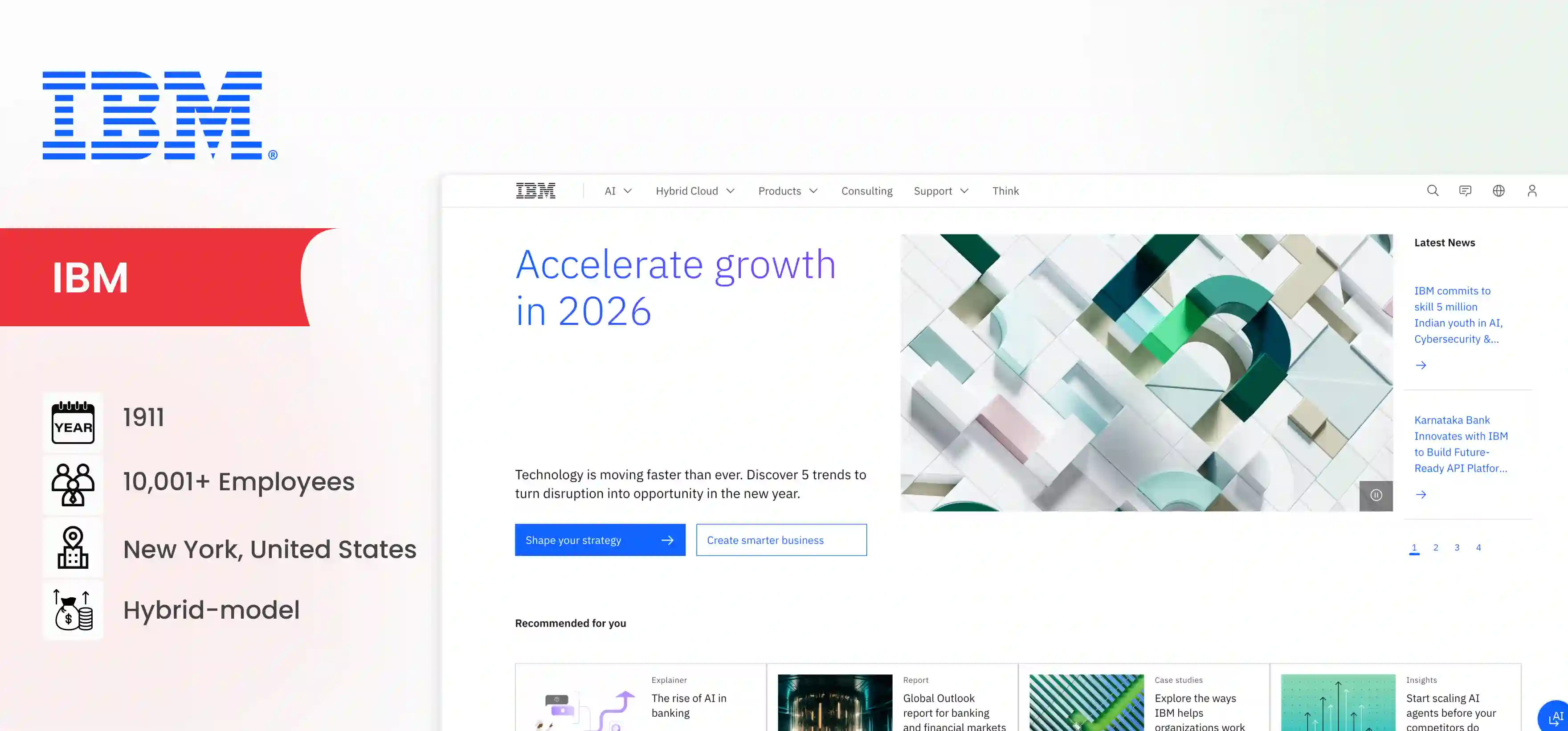
5. IBM Consulting
IBM is a global technology and consulting company known for supporting mission-critical systems and managing hybrid cloud environments. They are well-recognized for an AI-first operating model that utilizes WatsonX-powered agents and IBM Sovereign Core to automate legacy refactoring.
Core Modernization Services and AI/automation capabilities of IBM
IBM Consulting provides an end-to-end modernization suite through its IBM Consulting Advantage and Enterprise Advantage platforms, emphasizing a "Hybrid by Design" architecture.
Their legacy modernization services include application portfolio assessment, mainframe and COBOL modernization, application refactoring, API enablement, and hybrid cloud migration services.
Their AI capabilities are centered on Agentic AI and the WatsonX suite. Key tools include IBM Bob, an autonomous AI coding agent that automates the full SDLC, and IBM Concert, an agentic operations platform for predictive AIOps.
Best suited for
Complex, mission-critical transformations where data security and zero-downtime are non-negotiable.
Highly regulated global industries.
AI-Augmented Engineering at scale.
6. Capgemini
Capgemini is a global leader in business and technology transformation that allows organizations to navigate the digital economy through consulting, legacy modernization services, digital engineering, and cloud services. Their legacy modernization services focus on reducing technical debt, improving agility, and transforming core systems into future-ready platforms.
Core Modernization Services and AI/automation capabilities of Capgemini
Capgemini provides modernization through its CAALM (AI-Assisted Legacy Modernization) platform and Cloud Infrastructure Services. Core services include legacy-to-cloud refactoring, mainframe modernization, and SAP code transformation.
They provide end-to-end legacy modernization services, including application portfolio assessment, mainframe modernization, cloud migration, monolith-to-microservices transformation, API enablement, and data modernization.
Capgemini differentiates by embedding sustainability metrics into modernization, ensuring new digital cores are energy-efficient and compliant with "Green IT" standards.
Best suited for
Business-led transformations for industrial and automotive companies.
Sustainable and Green IT modernization.
Particularly strong in mainframe modernization, SAP transformation, cloud migration, and AI-assisted application modernization.
7. Persistent Systems
Persistent Systems is an AI-led, platform-driven Digital Engineering and Enterprise Modernization partner, combining deep technical expertise and industry experience. They provide legacy modernization services using microservices, API-first architectures, Kubernetes, and DevSecOps. With over 30 years of product engineering experience, Persistent accelerates modernization while reducing technical debt, improving scalability, and enabling continuous innovation.
Core Modernization Services and AI/automation capabilities of Persistent Systems
Persistent Systems provides core modernization through its AI-led "SaaSification" and Product Engineering services, focusing on transforming legacy monolithic software into cloud-native, multi-tenant platforms.
They specialize in refactoring, data estate modernization, and mainframe-to-cloud transitions using iAURA and Cloud MS frameworks.
On the AI and automation side, they automate code analysis, test generation, data modernization, and business workflows to accelerate transformation and improve operational efficiency.
Best suited for
Product engineering-led modernization and modern SaaS platforms.
Banking and Financial Core Transformation.
Monolith-to-microservices transformation, API-first integration, Kubernetes migration, DevSecOps, and AI-assisted engineering.
8. HCLTech
HCLTech is a global technology company. Their legacy modernization services are described as an AI-powered approach to transform outdated applications into agile, scalable, and cloud-ready systems. By this, they improve operational efficiency and accelerate business innovation by minimizing risk and disruption.
Core Modernization Services and AI/automation capabilities of HCLTech
HCL Tech includes application portfolio assessment, legacy application modernization, mainframe and midrange modernization, application migration, process modernization, and cloud-native engineering.
They offer rehost and replatform services from moving workloads to cloud-managed services such as AWS or Azure. They also do automated refactoring by converting legacy code into modern Java or .NET stacks.
A GenAI and Agentic AI platform that automates the entire software lifecycle—from code analysis and refactoring to testing and deployment—improving productivity by up to 60%.
Best suited for
Large enterprises run complex legacy environments such as mainframes, midrange systems, and heavily customized business applications.
Mainly used in banking, insurance, healthcare, and retail.
9. Tata Consultancy Services
Tata Consultancy Services is a global leader in IT services, consulting, and business solutions as a part of the Tata Group. Their legacy modernization services include an automation-led approach that helps enterprises understand, transform, and modernize legacy applications with minimum business disruption.
Core Modernization Services and AI/automation capabilities of TCS
TCS delivers core modernization through its "Modernization Propeller" framework, focusing on transforming legacy monoliths into cloud-native, microservices-based architectures. Main services include Cloud Migration, Mainframe Modernization, and Data Estate Transformation.
Through its proprietary platform, TCS MasterCraft, they support an Analyze-Strategize-Execute approach to transform COBOL, RPG, and other legacy systems into cloud-native microservices-based applications.
With the help of TCS MasterCraft and TransformPlus, Cognix, and AI WisdomNext platforms, they use GenAI to automate code analysis, extract business rules, and refactor legacy languages. They use Agentic AI and ML to orchestrate autonomous business operations and accelerate decision-making across the SDLC.
Best suited for
Business-critical legacy environments such as mainframes, AS/400, and monolithic applications.
Organizations need industrial-scale modernization with strong governance, predictable delivery, and minimal disruption to ongoing operations.
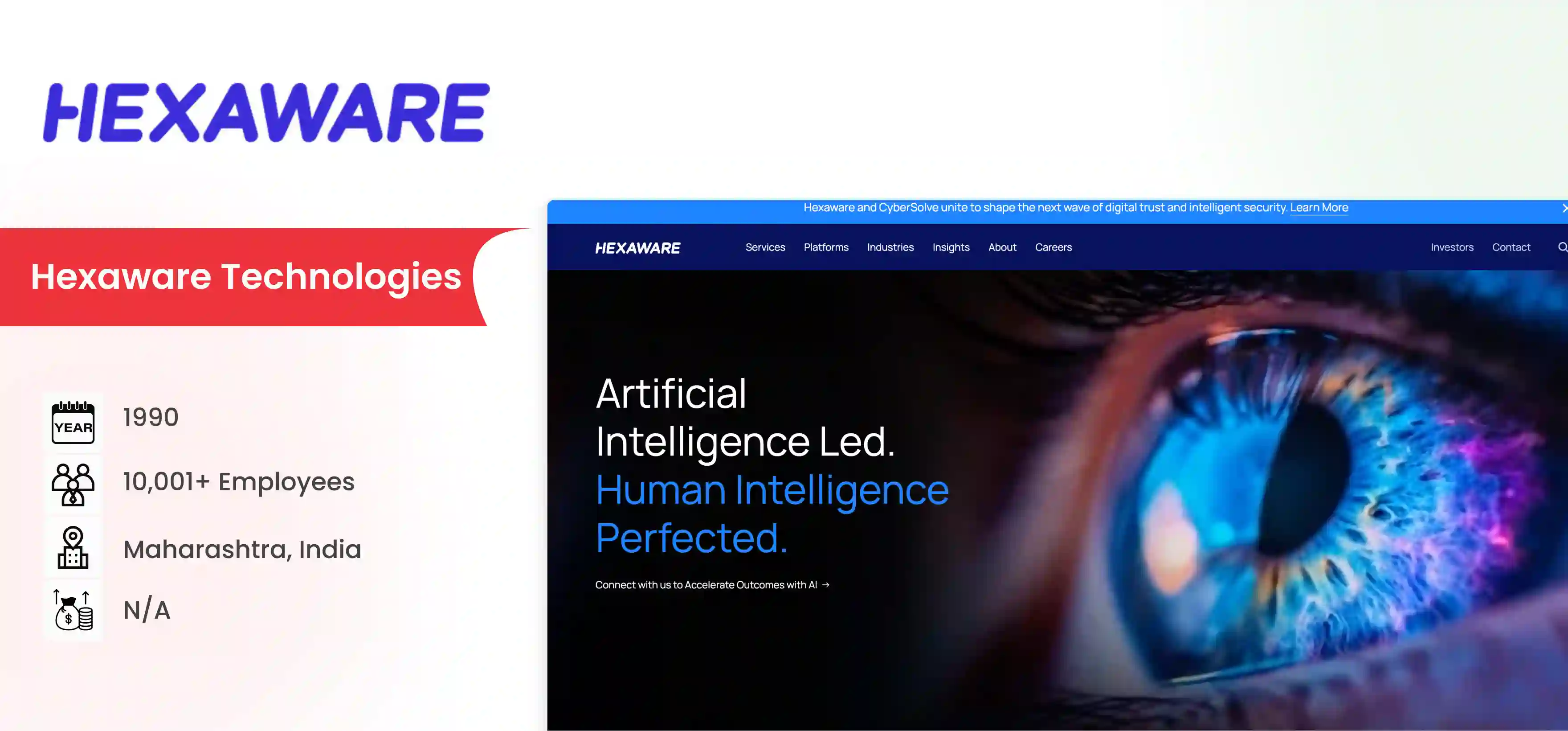
10. Hexaware Technologies
Hexaware Technologies is a global technology and business process services company. Their legacy modernization services are oriented towards a “automation-first” approach, primarily driven by their Amaze and RapidX platforms. Hexaware typically aims to reduce migration timelines and costs by over 50%.
Core Modernization Services and AI/automation capabilities of Hexaware Technologies
Hexaware provides core modernization through its "Automation-First" strategy, utilizing its amaze® platform to replatform Java, .NET, and legacy databases into cloud-native architectures in just 6–8 weeks.
By using proprietary platforms such as RapidX, Amaze, and Tensai, which leverage the Agentic AI platform to analyze undocumented legacy code and extract business rules to create modernization blueprints.
Its AI and automation capabilities include GenAI-driven code intelligence, business rule extraction, automated documentation, code conversion, cloud migration automation, autonomous testing, and DevSecOps acceleration.
Best suited for
Speed, automation, and cost-efficiency over massive, multi-year manual re-engineering.
High-Volume and Mid-Sized Portfolios.
Reducing TCO by 50% via open-source tools.
Types of Legacy Modernization Services Offered by IT Consulting Firms
Legacy modernization is not a one-size-fits-all initiative. Some applications can be moved to the cloud with minimal changes, while others require extensive redesign or replacement. Depending on your budget, timeline, and technical debt, consulting firms will recommend one of the following six strategies:
1. Rehosting (“Lift and Shift”):
It is the fastest way to move the application from an on-premise server to a cloud environment such as AWS or Azure without changing the code or architecture.
Best for:
Reducing data center costs quickly.
Data center exit programs
2. Replatforming (“Lift and Reshape”)
This method moves the code to the cloud with minor adjustments. Activities such as database migration, containerization, and legacy to cloud database service can be carried out.
Best for:
Improving performance without a full rewrite.
Applications that need scalability and performance
3. Refactoring
Refactoring restructures application code to improve maintainability without changing core business functionality.
Best for:
Reducing technical debt and improving system speed.
4. Re-architecting (Shift to Microservices)
Re-architecting redesigns the application to use modern architectural patterns.
Best for:
Mission-critical systems
5. Rebuilding (the Clean Slate)
When legacy code is outdated, legacy system modernization service providers will recommend rebuilding the application from scratch using modern languages and frameworks.
Best for:
Applications with obsolete technologies or server technical debt.
6. Retiring (Decommission)
Rewriting eliminates applications that no longer deliver business value.
Best for:
Low-value applications.
Enterprise Modernization Delivery Models: Onshore vs. Hybrid vs. Offshore
A legacy consulting partner should also possess technical expertise and take responsibility for selecting the delivery model. Delivery model plays a major role in project cost, communication, governance, and overall execution speed. The delivery model affects cost structure, time-zone overlap, communication efficiency, access to specialized talent, governance, oversight, security, compliance, and speed of execution.
Onshore Delivery Model
In this model, the entire team (architects to developers) is located in the same country. This is best for highly complex legacy systems where original documentation is missing, and internal stakeholders need to collaborate daily with consultants.
Best suited for:
Highly regulated projects
Programs requiring extensive business collaboration
Executive-sensitive initiatives
Offshore Delivery Model
Offshore delivery involves moving the bulk of the modernization work to a global delivery center. This is best for standardized modernization tasks such as Rehosting or large-scale automated testing.
Best suited for:
Large-scale modernization factories
Well-defined requirements
Cost-sensitive transformation programs
Hybrid Delivery Model
A hybrid model combines onshore leadership with offshore engineering execution.
Best suited for:
Enterprise modernization programs
Multi-year transformations
Organizations seeking both quality and cost efficiency
Decision Factors for Enterprise Buyers
When evaluating a firm's delivery structure, keep these three factors in mind to determine which model fits your specific project:
Data Security and Compliance
Complexity of Legacy
Speed vs. Budget
Pricing Models for Legacy Modernization IT Consulting Services
Legacy modernization is a strategic investment, and understanding how consulting firms price their services is essential for budgeting and vendor selection. Pricing structures vary based on project complexity, scope definition, risk allocation, and desired business outcomes. Enterprise buyers must choose a pricing model that balances financial predictability with the flexibility needed for technical discovery. The three pricing models offered by IT consulting firms are
1. Time and Materials (T and M)
Here, the actual hours or days worked by the consulting team are calculated and paid, plus any approved expenses.
Best suited for
Early-stage assessments.
Agile Modernization programs
Complex initiatives where the scope evolves.
2. Fixed-Price Model
The consulting firm agrees to deliver a specific set of requirements for a set price and within a set timeframe.
Best suited for
Standardized, well-defined tasks such as Rehosting (Lift and Shift) or migrating a specific database.
3. Outcome-Based Pricing
This is the most modern and "SERP-differentiating" model. Instead of paying for hours or tasks, you pay based on the business value achieved.
Best suited for
Strategic transformations where the goal is clear.
Large-scale transformation programs.
The factors that influence pricing are the number and complexity of applications, the technology stack, the degree of automation used, cloud migration requirements, security, and compliance obligations.
How to Match Your Legacy System Profile to the Right IT Consulting Firm
Choosing a modernization partner isn't about finding the "best" firm in the world; it’s about finding the best firm for your specific technical debt profile. A provider that excels in mainframe modernization may not be the best fit for AI-led data modernization. A firm known for advisory services may not offer the engineering depth needed to execute large-scale cloud-native transformations. This decision framework helps you map your legacy system profile to the type of IT consulting firm best suited to deliver results.
1. Mainframe-Heavy Environments → IBM or Accenture
If the core business logic is locked inside an on-premise mainframe, then one needs industrial-strength partners.
IBM owns the hardware and the stack, giving it unparalleled insight into legacy systems. Accenture has the massive global workforce required to handle "Big Bang" migrations for Fortune 500 banks and insurers.
Best for: High-risk, massive-scale infrastructure shifts where stability is the only priority.
2. Data & Analytics Modernization → Entrans or Hexaware
When legacy transformation is driven by data modernization, AI readiness, and cloud analytics, engineering-focused firms provide strong value. The best fit is Entrans and Hexaware Technologies.
Entrans and Hexaware specialize in breaking down monolithic data structures and migrating them to modern cloud warehouses like Snowflake or Databricks. They focus on the "Data Estate" transformation, ensuring that your modernized system is ready for real-time reporting and BI.
Best for: Companies moving from legacy Oracle/SQL environments to modern, scalable data architectures.
3. GenAI-First Transformation → Entrans
For organizations that want to leapfrog the competition by building Agentic AI and Generative AI into the core of their new system, a "modern-first" boutique or specialist is essential.
Entrans wins here by integrating AI-driven automation into the very first step of the modernization process (automated code analysis and refactoring).
Best for: Firms that don't just want a "cloud version" of their old app, but a completely reimagined, AI-powered platform.
4. Highly Regulated Industries → Cognizant or Deloitte
If you are in Healthcare, Life Sciences, or Government, compliance is your biggest hurdle.
These firms have massive legal and regulatory departments that bake HIPAA, GDPR, and FedRAMP compliance into every modernization sprint. They understand the "paperwork" as well as the "code."
Best for: Projects where security audits and regulatory sign-offs are as important as the migration itself.
Why Entrans Is the Right Legacy Modernization IT Consulting Partner
Entrans is an AI-first digital engineering partner that mainly does legacy modernization. Our key strengths are listed below
We use a 6-step methodology, starting from deep assessment to continuous optimization. We build on leading technologies such as Snowflake, Databricks, AWS, and Azure with zero-trust security built in by design.
We build every migration and modernization in a zero-trust security architecture, providing end-to-end delivery that minimizes risk and maximises business agility.
Entrans delivers end-to-end delivery capabilities to modernize confidently.
Entrans delivers AI-driven legacy modernization with zero-trust security and cloud-native transformation built in.
FAQs
1. What is legacy system modernization consulting?
Legacy system modernization consulting involves expert assessment and strategic planning to create a roadmap to upgrade, replatform, refactor, or replace with modern technologies. These consultants align their modernization services with business goals, reducing technical debt and improving scalability by selecting the right approach, such as rehosting, refactoring, or rebuilding legacy software.
2. How much does legacy modernization cost?
Legacy modernization costs typically range from $50,000 for a small application and can go up to several million dollars for new enterprise-wide digital transformations. Pricing varies based on complexity, modernization strategy, and total volume of data.
3. Why should companies hire a legacy modernization consulting firm?
Legacy software modernization consultancy provides proven frameworks, automated testing, and ensures zero downtime. By this, they reduce risk, accelerate delivery, and minimize disruption.
4. How long does it take to complete legacy modernization?
Timelines depend on system complexity, integration requirements, testing effort, and organizational readiness. Typically, it might take 3 to 6 months to complete a focused modernization, while large enterprise programs take 12 to 36 months or more.
5. What technologies do legacy modernization providers use?
Legacy modernization providers commonly use AWS, Microsoft Azure, Google Cloud, Kubernetes, Docker, Terraform, Snowflake, Databricks, and Red Hat OpenShift.
Hire Legacy Modernization Consultants Built for Enterprise
Get engineers skilled in cloud migration, microservices refactoring, and AI-led legacy modernization for large enterprises.
20+ Years of Industry Experience
500+ Successful Projects
50+ Global Clients including Fortune 500s
100% On-Time Delivery
Thank you! Your submission has been received!
Oops! Something went wrong while submitting the form.
Free Project Consultation
Trusted by Enterprises & Startups
Top 1% Industry Experts
Flexible Contracts & Transparent Pricing
50+ Successful Enterprise Deployments
Kapildev Arulmozhi
Author
Kapil is the Co-founder and CMO of Entrans, bringing over 20 years of experience in SaaS sales and related industries. He is responsible for creating and overseeing the revenue-driving systems at Entrans. Having collaborated extensively with tech leaders and teams, Kapil possesses a keen understanding of the decision criteria and ROI-justifiable initiatives essential for business growth.
Related Blogs
Generative AI Governance: How to Govern Models You Did Not Build
Learn how gen AI governance helps you control third-party models you didn't build. Protect your prompts, data retrieval pipelines, and app workflows today.
The AI Governance Audit: What Gets Inspected, What Evidence You Need, and What to Do If You Do Not Have It
Passing an AI governance audit takes real proof, not just policies. Learn what auditors inspect, the evidence you need, and how to fix missing records.








-1.svg)