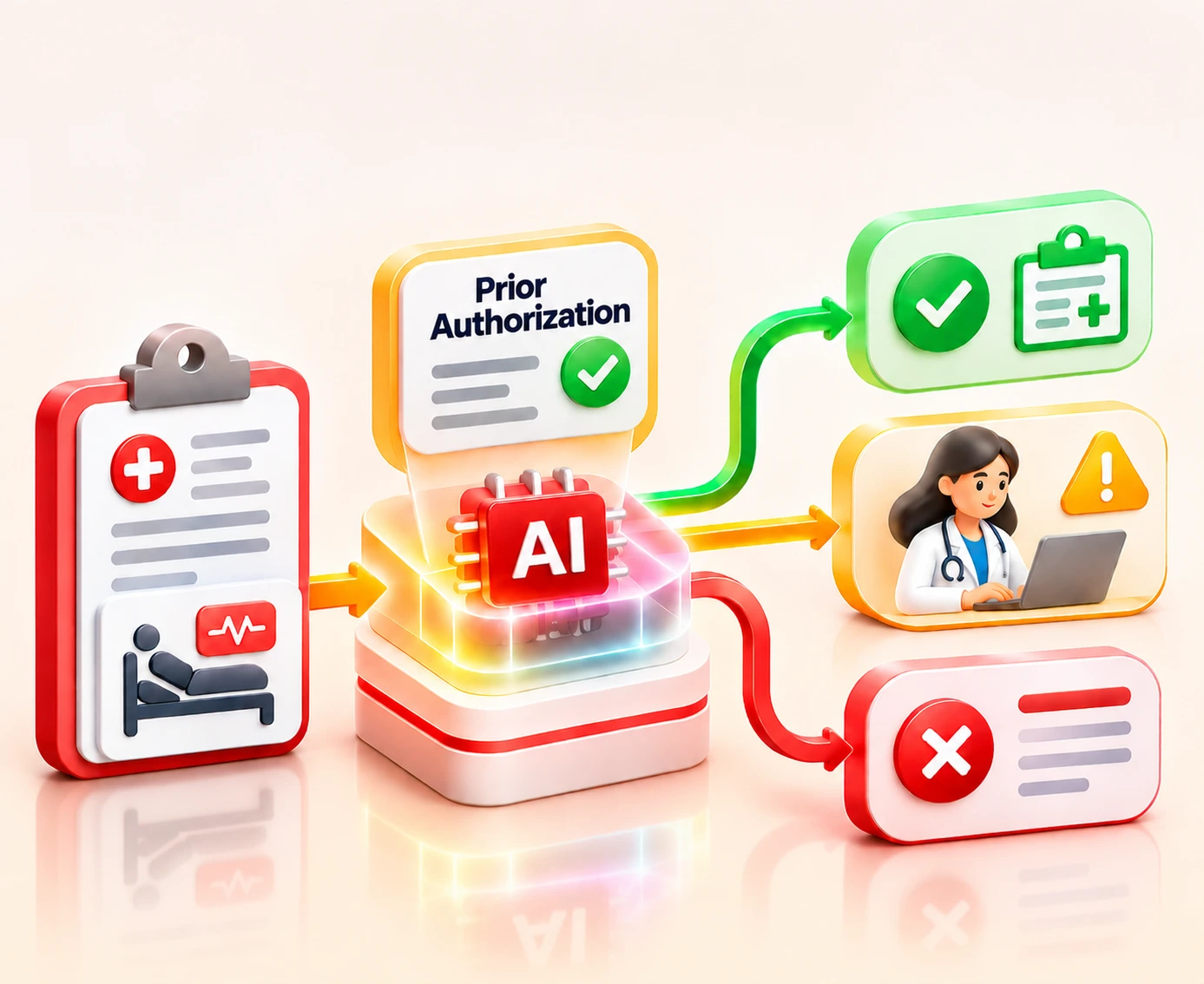
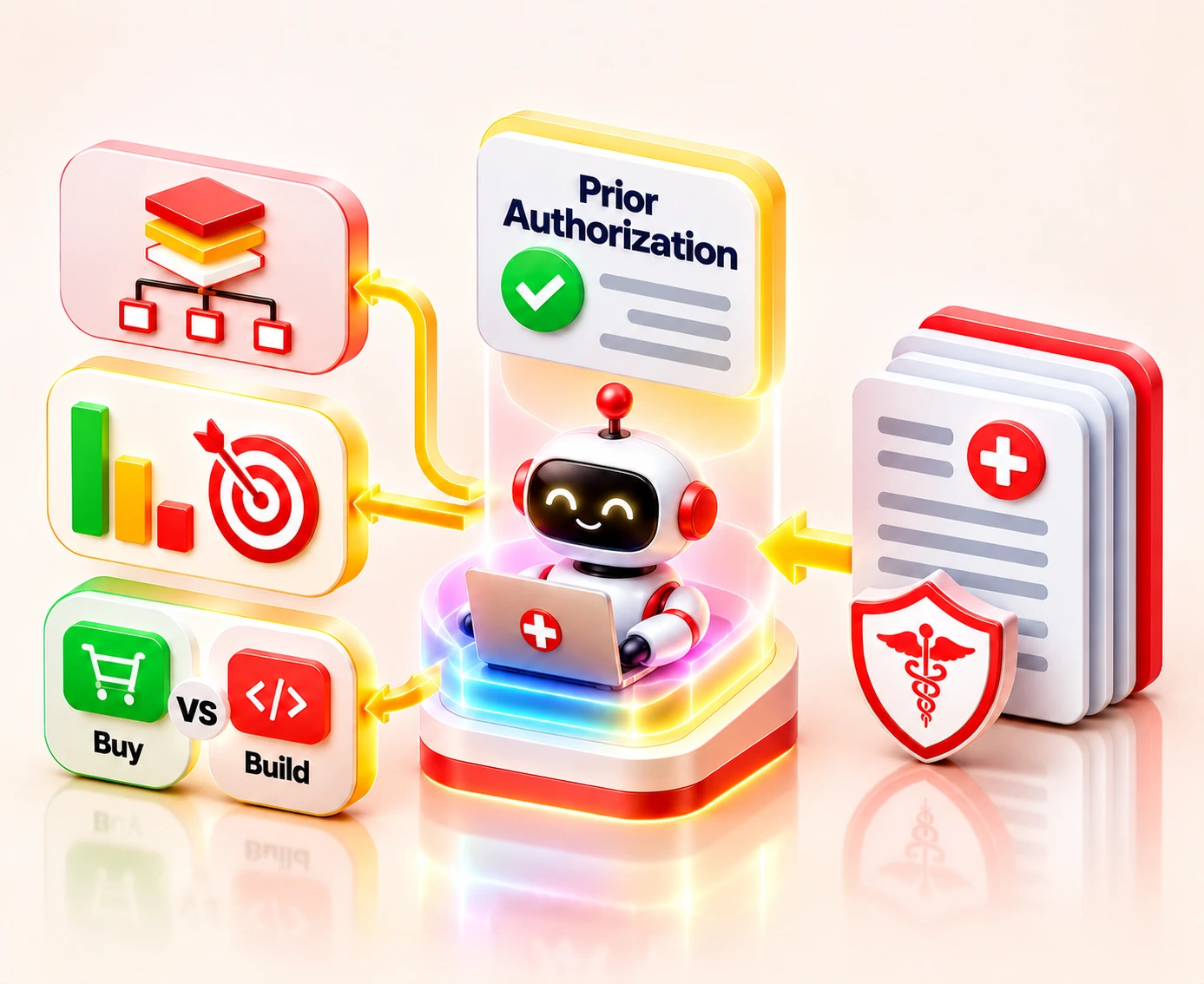
> Blog >
AI Prior Authorization: How It Works, Where It Helps, and What Clinics Must Decide
Build smarter AI prior authorization workflows with OCR, LLMs, and FHIR APIs. Explore automation benefits, compliance requirements, and implementation options.

AI Prior Authorization: How It Works, Where It Helps, and What Clinics Must Decide

4 mins
November 6, 2026
Author
Jegan Selvaraj
Talk To Our Experts
TL;DR
  • AI prior authorization takes over the admin work. That means pulling proof into one place, checking payer rules, and tracking requests. The care call to approve or deny should stay with people.
  • The pressure is real. A practice handles about 39 requests per doctor each week and spends about 13 hours on them. A paper request costs a practice $10.97. Meaning, the same request sent fully online costs just $5.79.
  • 2026 brings new payer deadlines under CMS-0057-F, the WISeR pilot, and state laws like California SB 1120. Each one draws a line between AI help and AI denials.
  • The setup that works is hybrid. AI pulls and checks the written rules and shows the source for each. With this, licensed humans still own every medical necessity call.
  • AI prior authorization uses optical character recognition (OCR), language models, and rules engines. These tools work as a set to gather, check, and send the proof a payer needs before it pays for a service.

    This is not the same as an AI ruling on whether a patient gets care.

    This guide walks through the workflow, the 2026 rules, and where AI helps and falls short.

    On top of that, the guide will also show you how to choose between building, buying, and hiring a partner.

    Table of Contents ▾

      What Is AI Prior Authorization?

      Prior authorization is a payer review step. Health insurance payers want sign-off before they cover a service, drug, test, or treatment. 

      A paper request costs a practice $10.97, per the CAQH Index. The same request costs $5.79 when sent fully online.

      Add that up over a year, and prior authorization stops being a side task. In the grand scheme, the work turns into a standing staff cost.

      Three terms get mixed up often. The mix-up leads to poor buying choices:

      • Electronic prior authorization (ePA): Moves the request through an API or portal instead of a fax. The sending goes online, yet a person still gathers and formats the proof.
      • Prior authorization automation: The broad group of software that handles steps like rule checks, sending, and status tracking. Some of these tools use AI. Others don't.
      • AI prior authorization software: Takes on the hard part. The software reads free-text records and matches proof to payer rules. Meaning, the tool also builds the packet.

      Why does the gap matter? A tool that only replaces the fax fixes a sending problem. The notes problem stays put.

      AI can point out that the notes lack a required item. In doing so, staff know what to chase.

      All that said, AI prior authorization cannot (and SHOULD NOT) decide whether the patient needs the treatment.

      This matters most to office heads, billing leads, and legal teams since they take on both the workload and the legal risk. 

      Suppose an AI system sends a partial request because of a data error. On the whole, the denial that follows belongs to the sending practice, not the vendor.

      Why Prior Authorization Is Changing in 2026

      2026 is the year rule makers stopped asking payers to improve and started setting deadlines. Three forces are landing at once: a U.S. data-sharing rule, a Medicare pilot that uses AI, and state laws on AI tools.

      Meaning, these rules cover public programs and certain states, not every private plan. Revenue cycle management (RCM) teams are also watching the new denial stats. For the first time, those numbers give clinics data to push back on payer tactics in contract talks.

      1. CMS-0057-F in Plain Terms

      The CMS Interoperability and Prior Authorization Final Rule covers a few payer groups. These include Medicare Advantage, state Medicaid and CHIP programs, their managed care plans, and Qualified Health Plan issuers on the federal exchanges. Drugs are left out.

      • Ruling deadlines: Since January 1, 2026, payers must rule on standard requests within 7 days, weekends counted. Urgent requests need a ruling within 72 hours. With this, every denial must come with a clear reason.
      • Public stats: Payers had to post prior authorization stats by March 31, 2026.
      • FHIR-based APIs: By January 1, 2027, payers must set up four Fast Healthcare Interoperability Resources (FHIR) APIs. These are the Prior Authorization, Provider Access, Payer-to-Payer, and Patient Access APIs.

      Keep the two dates apart. The ruling deadlines already apply. The API deadline lands in 2027.

      2. AI Review in Original Medicare (the WISeR Model)

      The WISeR Model brings prior authorization to Original Medicare. The pilot started on January 1, 2026, in six states. 

      The targets are care types prone to waste, like incontinence control devices and sacral nerve stimulation. But by doing this, CMS has handed part of the review to AI vendors.

      • Even so, these tools cannot make final coverage calls. Licensed humans make those calls.
      • Clinics with steady, high sign-off rates can earn gold carding waivers. With this, they skip prior authorization for some items, though post-service medical review still applies. WISeR is a targeted pilot, not a full rollout.

      3. State Rules on AI in Utilization Review

      California SB 1120 took effect on January 1, 2025. The law bars health plans from denying, slowing, or changing care for medical necessity based only on an AI tool.

      • Licensed doctors must review any denial. Meaning, each ruling must rest on the one patient, not on group data alone.
      • Texas SB 815 and Colorado SB24-205 push the same way. What links these laws? A licensed human owns the ruling. On the whole, the AI checks behind it are written down and on file.

      Where AI Helps in the Prior Authorization Workflow

      The AI prior authorization workflow breaks down into eight steps. The first checks whether a request needs prior authorization. The last looks at denials. So where does AI save time?

      AI earns its place in the routine steps: rule checks, pulling data from the electronic health record (EHR), packet building, and status tracking. 
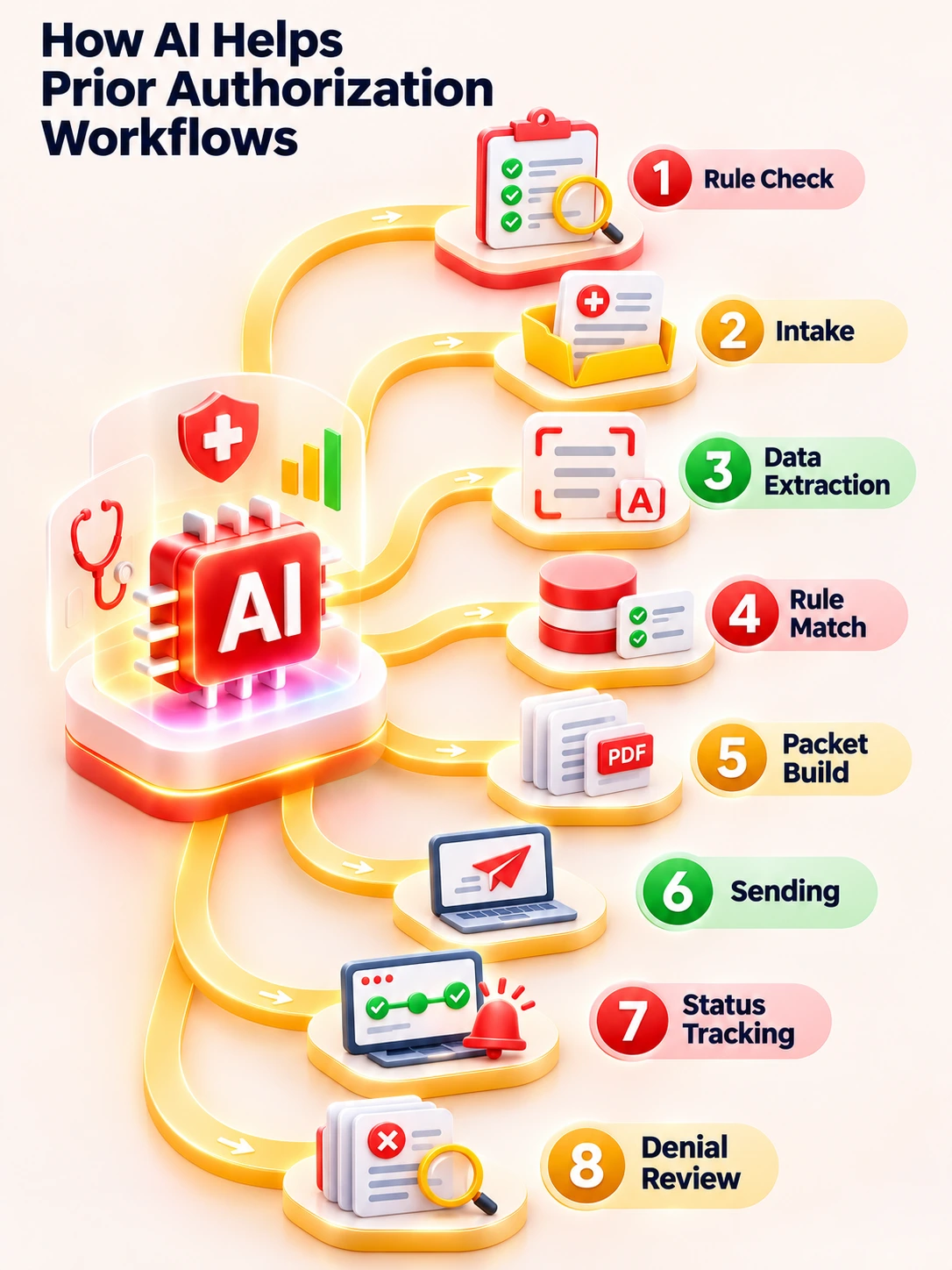
      How AI Helps Prior Authorization Workflows

      The AI prior authorization table below shows a steady pattern.

      Workflow Step What AI Handles What Humans Need to Handle
      Rule Check Looks up payer rules Confirms the rule fits the case
      Intake Sorts and routes new requests Handles edge cases
      Data Extraction Pulls out patient details Checks unclear details
      Rule Match Checks written rules Judges medical necessity
      Packet Build Gathers the backup files Signs off on sending
      Sending Sends requests online Handles portal issues
      Status Tracking Tracks payer replies Follows up on late requests
      Denial Review Spots denial trends Picks the appeal plan

      Look at where the human column bunches up: edge cases, unclear details, and sign-off. 

      Here's a real case. CMI, a high-volume scan center, saw requests climb from 800 to 2,200 a month. The center then moved order intake online with Infinx. With this, 40% of orders now arrive online. Staffing stayed flat.

      • Vendor figures show up to 80% less time spent finding rules. Packet building drops from about 45 minutes to 15.
      • Status tracking brings steady gains. API polling replaces phone calls on hold. In doing so, alerts flag requests that are close to legal deadlines.
      • One rheumatology practice saw first-pass sign-offs rise from 62% to 94%. The jump came once AI built the case write-up.
      • Treat these numbers as a rough guide. They come from vendor data, not outside studies.

      How AI Reads and Checks Patient Records

      Most patient proof does not sit in neat data fields. The proof lives in doctor notes, 50-page discharge notes, and scanned faxes.

      Reading it takes a few tools working in order: OCR, natural language processing (NLP), large language models (LLMs), and machine learning. With this, checks are absolutely required to keep the output correct.

      1. OCR Plus LLMs for Free-Text Records

      OCR turns scanned records into text. LLMs then pull diagnoses, past drug use, lab results, and dates from that text. Each field gets a confidence score. Meaning, anything below the cutoff stops and waits for a human check.

      Here's the problem. LLMs without firm controls mix up patients. They confuse past and current health issues. 

      On top of that, they misread dates. Peer-reviewed work suggests LLMs checking each other can reach 94 to 95% accuracy in pulling data. Even so, AI can't invent what isn't there. If the proof is missing from the record, someone has to get it from the treating doctor.

      2. Payer Rules in a Rules Engine

      GenAI should not read payer rules on its own. Those rules belong in rules engines that your team can edit, with start dates, version control, and testing. 

      The engine takes the structured LLM output and checks it against payer logic.

      In the grand scheme, that step turns a guess into a pass-or-fail check. Then the engine writes an audit trail. Old rules produce wrong filings right away. That makes rule versions a must, not an extra.

      Sources Staff Can Trust

      What should staff see before signing off? At the least, they need:

      • What the AI pulled out
      • Which file and page the data came from
      • Which payer rule was checked
      • What proof is still missing
      • Whether a human needs to step in

      That trail makes audit logs useful. The trail also helps head off denials before sending. Meaning, each pulled fact comes with its source. Without one, a doctor who signs off on an AI-built packet cannot see what backs it up.

      The AI prior authorization processing case study from Entrans shows the full chain. OCR scans in referrals. LLMs sort the patient data into fields. With this, a payer-rules engine checks that data. Check reports then show staff the source behind each flagged rule.

      Electronic Prior Authorization Standards That Matter

      Standards decide how systems swap data. As a result, they decide how much of the workflow AI can truly take over. Four matter most: NCPDP SCRIPT, X12 278, the HL7 Da Vinci guides, and the FHIR APIs that carry the data. On the whole, get this layer wrong, and even the best AI ends up pasting data into a portal.

      1. The Pharmacy and Older Compliance Standards

      NCPDP SCRIPT

      NCPDP SCRIPT covers e-scripts and pharmacy prior authorization. The standard links prescribers, pharmacies, and pharmacy benefit managers (PBMs). Pharmacy ePA is mature and well built, since drug lists are well built too. 

      Meaning, medical prior authorization is the harder problem. Requests for surgeries and procedures rest on long patient write-ups.

      X12 278

      X12 278 is the older electronic data interchange (EDI) format that HIPAA requires for prior authorization requests and replies. 

      The format is rigid and often sent in batches. Patient files are hard to attach through AI prior authorization. With this, modern FHIR APIs often need converters to talk to older payer clearinghouses that still run on X12.

      2. The HL7 Da Vinci Guides

      The HL7 Da Vinci Project lays out the modern workflow through three guides:

      1. Coverage Requirements Discovery (CRD): Tells doctors inside the EHR whether a service needs prior authorization. Nobody has to log into a portal to find out.
      2. Documentation Templates and Rules (DTR): Pulls payer forms and fills them in from EHR data.
      3. Prior Authorization Support (PAS): Sends the request online and returns the payer's ruling.

      These guides are the advised route to meeting CMS-0057-F. Linking them to older systems is still hard, though.

      3. FHIR APIs

      FHIR APIs carry the data. They use distinct data types such as Coverage, Claim, and Task. These types support real-time, detailed exchange. Meaning, small API calls replace opaque, batched EDI. Cloud-native FHIR setups can handle both the traffic load and the data-quality work.

      • One split trips people up. FHIR is the standard. The CMS Prior Authorization API is the mandate that pushes payers to use it. On top of that, expect hurdles along the way: older EHRs, uneven data mapping, payers that are not all API-ready, and secure sign-in.
      • What happens when a payer doesn't support FHIR? Clinics fall back on X12 converters, screen-scraping, or fax.
      • Screen-scraping breaks each time a portal changes. In the grand scheme, that fallback is where steady filing starts to break down.

      The Risks of AI Prior Authorization: AI Denials, Bias and Human Checks

      Every gain in AI prior authorization space carries a matching risk. Here are five risks to plan for, in the order most teams run into them.
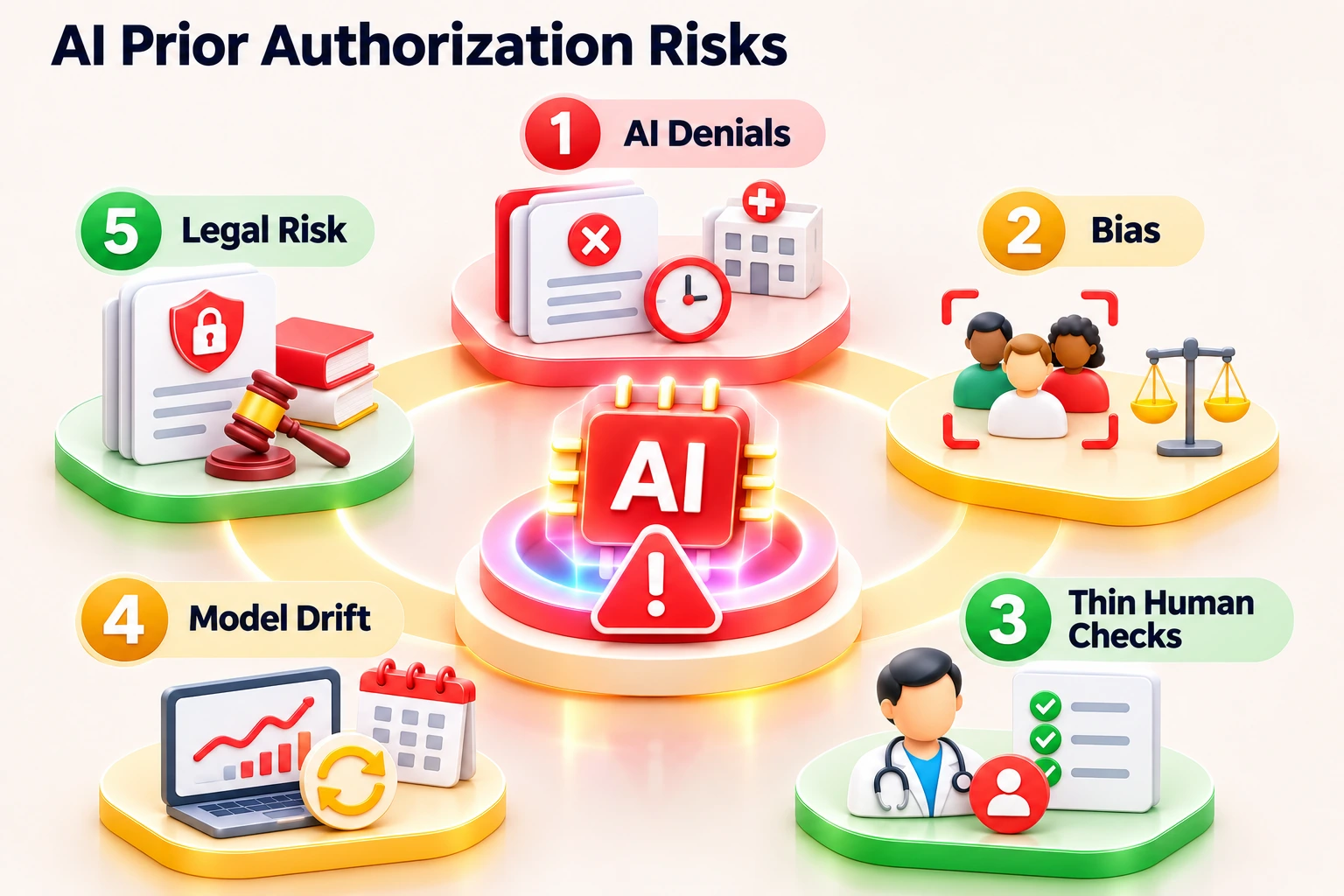
      Risks of AI prior authorization, including denials, bias, and human oversight
      1. AI denials. Models without controls lean on group norms instead of the one patient. The AMA survey shows what delay costs. 94% of doctors report care delays. With this, 29% report grave harm, and 78% report patients giving up on treatment. The OIG looked at Medicare Advantage prior authorization denials. 13% of those denials met Medicare coverage rules. Meaning, those requests should have been approved. About 80% of appealed denials end up reversed.
      2. Bias. A 2019 Science study looked at a cost-scoring model. The model rated the health needs of Black patients too low. Uneven access to care had led to lower past spending. In doing so, the model read lower spending as lower need. In a care model, bias skews a forecast. In a payer model, bias turns into a denial. Subgroup fairness testing belongs on your launch checklist.
      3. Thin human checks. Who answers for a denial that no doctor looked at? Any ruling that delays, changes, or denies care needs a licensed doctor. California SB 1120 and WISeR both write that rule in. On the whole, human review also leaves a paper trail when someone contests a ruling. Complex appeals then get judged on the facts of the case.
      4. Model drift. Care guidelines, payer rules, and patient mix change over time. A model left unwatched will keep filing against last year's rules. Meaning, version your rules and test them on a schedule. Watch confidence scores closely. Model retrains are a standing task, not an extra.
      5. Legal risk. Health plans and clinics answer to HIPAA, Section 1557 of the Affordable Care Act (ACA), and state insurance law. Vendors that touch protected health information (PHI) need business associate agreements (BAAs). The mean cost of a healthcare breach is $6.64 million. Still, a breach only becomes an AI problem if it started in the AI pipeline.

      How to Set Up AI Prior Authorization: Build, Buy, or Partner

      The right choice for AI prior authorization hinges on your size, your payer mix, and how much tech work you can keep up. None of the three options removes the need for human review.

      • Buy: The fastest route for standard workflows. Availity, Waystar, Infinx, and Rhyme serve clinics and health systems. Cohere Health is a payer-side platform. Outside reviews flag known trade-offs. Free tiers can mean re-typing by hand. Large setups can be too much for small clinics. Touchless results hinge on payer buy-in.
      • Build: Full control, but you carry OCR and LLM hosting, rules engines, EHR and payer API links, and drift tracking for good. This path only suits large systems with big tech teams.
      • Partner: A dev partner builds custom workflows on your terms. You keep source code and data control without a full-time in-house team. Even so, you still supply doctors and nurses who turn payer rules into engine rules.

      Which one fits? Ask three questions. Do your payers need workflows no vendor supports?

      Larger systems with odd payer mixes tend to land on a partner for AI prior authorization.

      Option Best Fit Watch Out For
      Buy Standard workflows Vendor limits
      Build Custom payer workflows In-house tech costs
      Partner Niche custom builds Hookup work and code control

      Custom FHIR architectures or builds often start around $15,000 to $60,000+ for the first design. Most take a few months. 

      On the whole, ask who holds the rules, the data, and the source code if you ever leave.

      Explore how cloud-native FHIR architecture is changing alongside prior authorization automation for a deeper look at design, build costs, and tech choices.
      Open Popup

      Where AI Prior Authorization Has Limitations

      No honest guide skips this part. AI is strong at routine, file-heavy work. AI is weak where the source data is missing, hidden, or open to debate.

      1. Missing clinical documentation. AI can't check proof that doesn't exist. Absent notes, missing test results, and slow doctor replies hold up requests. Meaning, the fix is to flag the gap to staff right away instead of failing in silence. A system that stops and says what's missing beats one that sends and hopes for the best.
      2. Partial EHR records. Sometimes a patient's past care is spread across a few systems. Someone still has to track down the missing files.
      3. Payer portal limits. Closed logins, CAPTCHAs, and shifting rules break tools that lack formal APIs. Scraping fails the day a portal changes. So every missing API means more human edge cases.
      4. Fax-based filings. About 70% to 75% of health messages still run on fax. OCR then has to deal with faxes copied many times over and hard-to-read handwriting. With this, staff end up re-typing the data. Poor file quality is where OCR struggles most.
      5. Unclear medical necessity. AI can check written rules, such as a failed trial of conservative therapy. Unclear cases with contraindications or rare symptoms need a doctor.
      6. Model drift and legal risk. Stale rules lead straight to denials. Steady tracking helps only if someone acts when confidence scores drop. On the whole, using AI to deny care also invites close review under laws like California SB 1120.

      How Entrans Builds AI Prior Authorization Workflows

      Entrans builds the software layer, not the coverage calls. The design goal is to support care judgment, never replace it. In practice, a health platform can cut down the time staff spend reading referrals and coverage details. With this, the final say stays with people, not software.

      Entrans reports a steady 95%+ accuracy in pulling data. How should you read that number?

      The figure measures field-level data capture across many kinds of free-text files. In doing so, the number reflects long-running live use, not a one-time demo on clean files. The backing proof includes:

      • Machine-run unit, cross-module, and system tests on every release.
      • Prior authorization work moving 3X faster than the hand-run workflow.
      • A 70% drop in hands-on work and errors.

      Some teams see prior authorization as one piece of a wider upgrade. Learn more about how Entrans handles healthcare digital transformation services.

      For them, the same design carries over. With this, data pulls, rules, and checks apply to other file-heavy health workflows too.

      Want to know what this looks like for you? Book a free consultation call with our team to find out!

      Share :
      Link copied to clipboard !!
      Automate Prior Authorization With AI
      Reduce manual work and speed up healthcare authorization workflows with AI.
      20+ Years of Industry Experience
      500+ Successful Projects
      50+ Global Clients including Fortune 500s
      100% On-Time Delivery
      Thank you! Your submission has been received!
      Oops! Something went wrong while submitting the form.

      Frequently Asked Questions

      1. Can AI do prior authorizations?

      AI prior authorization can handle most of the admin work, from rule checks to building and sending the packet. Still, a human should review each request, and licensed doctors must make every medical necessity call.

      2. Will AI replace prior authorization specialists?

      No, but AI prior authorization will change where these staff spend their time. Meaning, the work moves from data entry and portal checks to flagged gaps, edge cases, and appeals.

      3. What is the new CMS rule on prior authorization?

      CMS-0057-F tells Medicare Advantage, Medicaid, CHIP, and federal exchange plans to rule on standard requests within 7 days and urgent ones within 72 hours, starting January 1, 2026. By January 1, 2027, those payers must also set up FHIR-based prior authorization APIs.

      4. Which companies offer AI-powered prior authorization solutions?

      Availity, Waystar, Infinx, and Rhyme sell tools for clinics and health systems, while Cohere Health serves health plans. Dev partners like Entrans build custom workflows for teams with odd payer needs.

      5. Is ChatGPT HIPAA compliant for prior authorization work?

      Consumer ChatGPT plans are not HIPAA compliant, so typing patient data into them breaks HIPAA rules. OpenAI signs a BAA only for some business plans, such as ChatGPT Enterprise, ChatGPT for Healthcare, and its API, and the setup still decides whether use stays compliant.

      6. How does Medicare use AI for prior authorization?

      Under the WISeR Model, which started January 1, 2026, in six states, vendors use AI prior authorization to help review prior authorization requests for chosen Original Medicare services. Licensed humans make every final coverage call.

      Hire AI Developers for Healthcare Projects
      Build secure healthcare AI solutions with experienced developers who understand complex workflows.
      Free Project Consultation
      Trusted by Enterprises & Startups
      Top 1% Industry Experts
      Flexible Contracts & Transparent Pricing
      50+ Successful Enterprise Deployments
      Jegan Selvaraj
      Author
      Jegan is Co-founder and CEO of Entrans with over 20+ years of experience in the SaaS and Tech space. Jegan keeps Entrans on track with processes expertise around AI Development, Product Engineering, Staff Augmentation and Customized Cloud Engineering Solutions for clients. Having served over 80+ happy clients, Jegan and Entrans have worked with digital enterprises as well as conventional manufacturers and suppliers including Fortune 500 companies.

      Related Blogs

      Best Cloud Data Warehouse in 2026: Snowflake, BigQuery, Redshift, Databricks, and Fabric Compared

      Compare the best cloud data warehouse options in 2026. Explore real costs, performance, and features across Snowflake, BigQuery, Redshift, and Databricks.
      Read More ↗

      Prior Authorization Automation: Architecture, Build, and Accuracy Metrics

      Explore prior authorization automation using AI, OCR, and payer rules. Learn about system architecture, accuracy metrics, EHR integration, and implementation.
      Read More ↗

      AI Prior Authorization: How It Works, Where It Helps, and What Clinics Must Decide

      Build smarter AI prior authorization workflows with OCR, LLMs, and FHIR APIs. Explore automation benefits, compliance requirements, and implementation options.
      Read More ↗