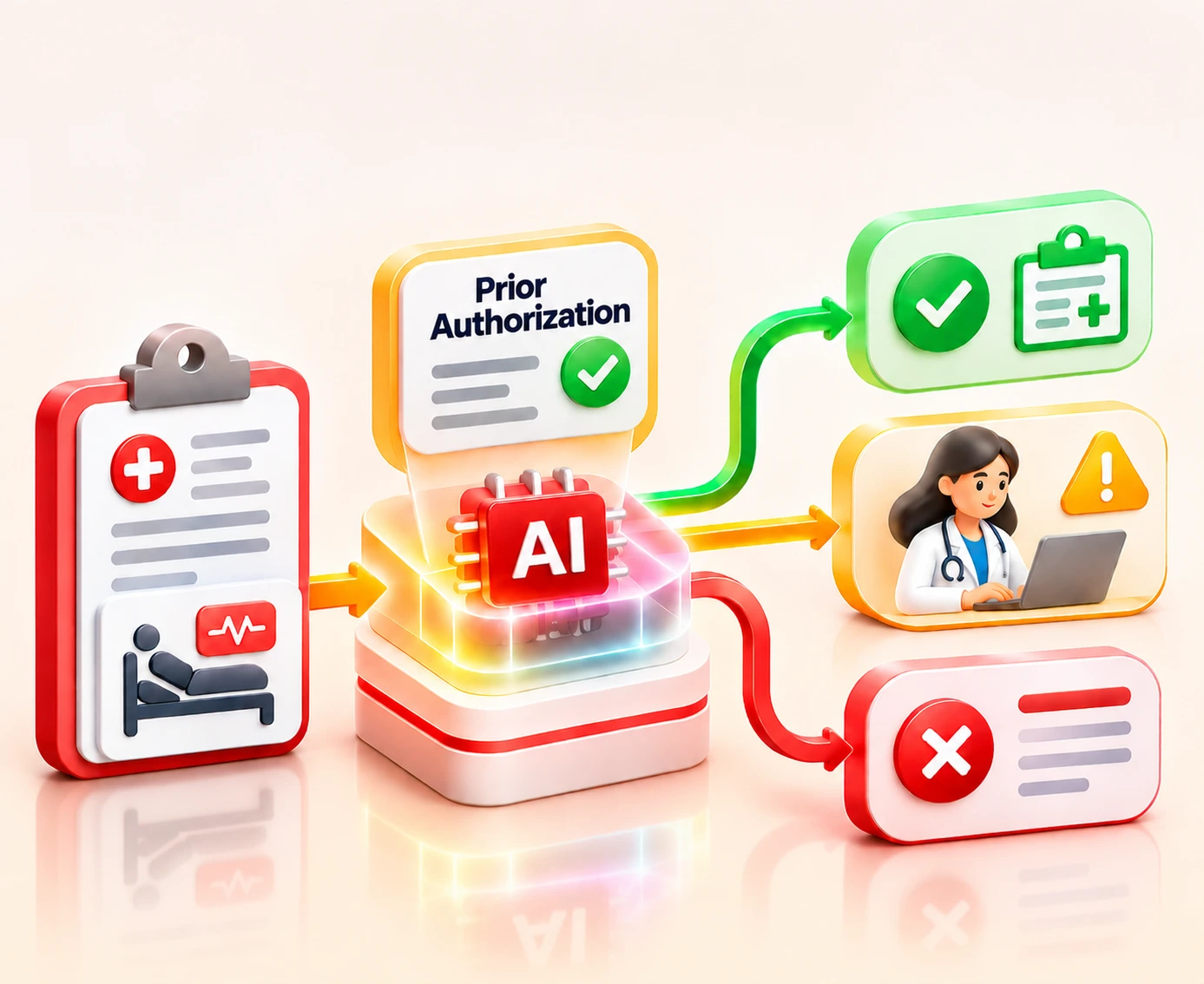
Explore prior authorization automation using AI, OCR, and payer rules. Learn about system architecture, accuracy metrics, EHR integration, and implementation.

Agentic Unconference 2026 - September 19, Chennai
View Event →




According to the CAQH Index, a manual prior authorization costs a healthcare provider $10.97 per transaction and costs the payer just $3.52.
Because the administrative burden lands on practices instead of payers, requirements keep growing while revenue cycle management (RCM) teams absorb the cost.
Prior authorization automation is the engineering answer.
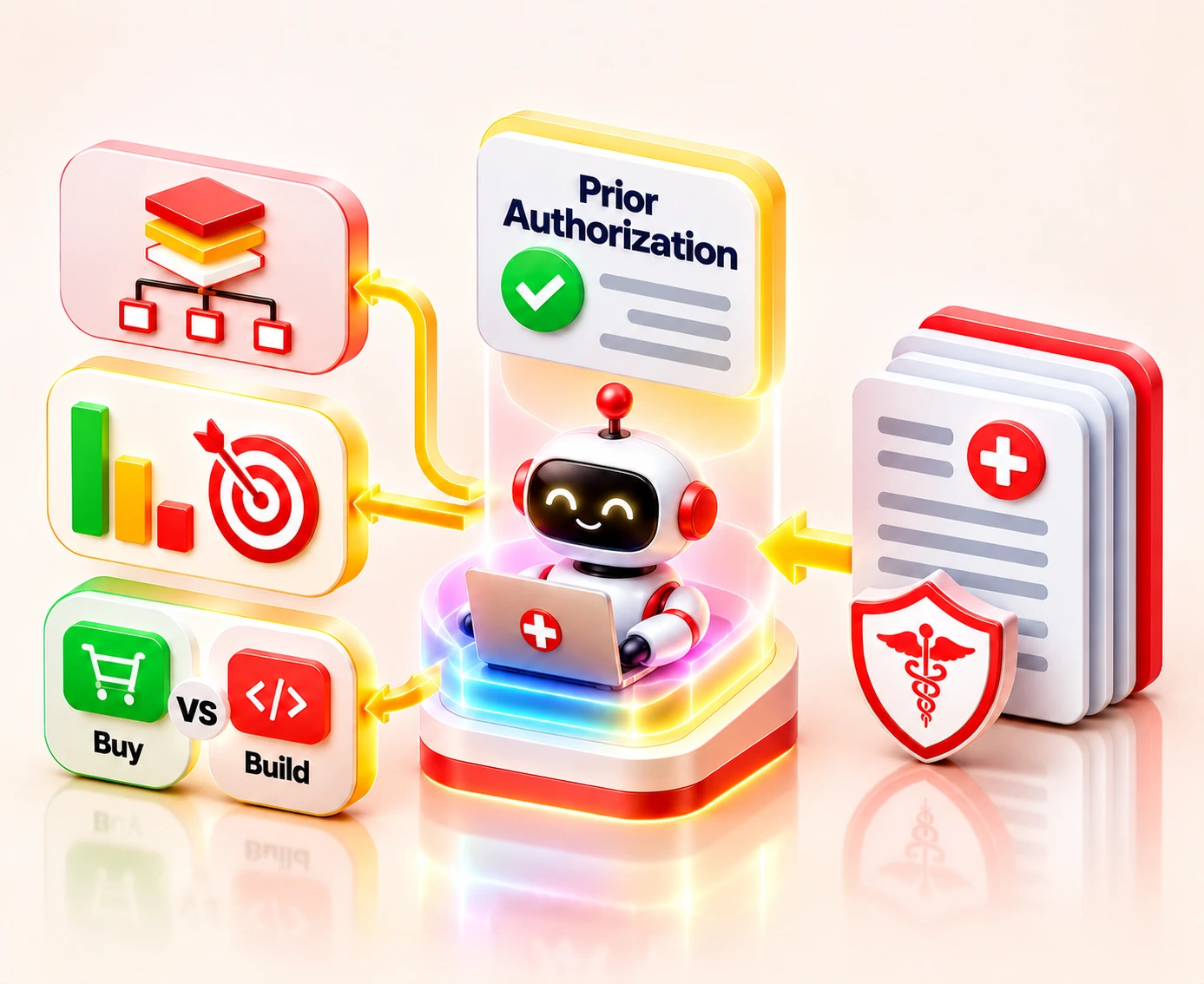
But even with this, the build-versus-buy decision right is the difference between a pilot that impresses and a system your revenue cycle can trust.
But by using it, you can help solve revenue leakage, slower patient access to care, and better compliance in an increasingly slow environment.
Prior authorization automation is software that runs payer sign-off from start to finish. Rules engines, file tools, and AI check if an order needs sign-off and pull in the chart proof. In doing so, they send the request and track it until the payer answers. No one has to retype data by hand.
The labels get blurred. Electronic prior authorization (ePA) often means the online channel. That channel could be a portal or an X12 278 request. Meaning, ePA says nothing about the logic behind the channel.
AI prior authorization goes further. The automated prior authorization software reads free-text notes and maps them to payer rules. Prior authorization management is the layer over both. With this layer, teams handle queues, owners, status, and audit.
The AMA reports that physicians and staff spend an average of 13 hours per physician per week on authorizations, 94% of physicians report care delays, and 78% report treatment abandonment.
What automation looks like depends on which side of the transaction you sit on:
Prior authorization automation runs as a string of handoffs. Each poor handoff turns up later as a denial. Mapping the steps end to end shows two things. With this map, you see where automation helps most. You also see what data each step needs.
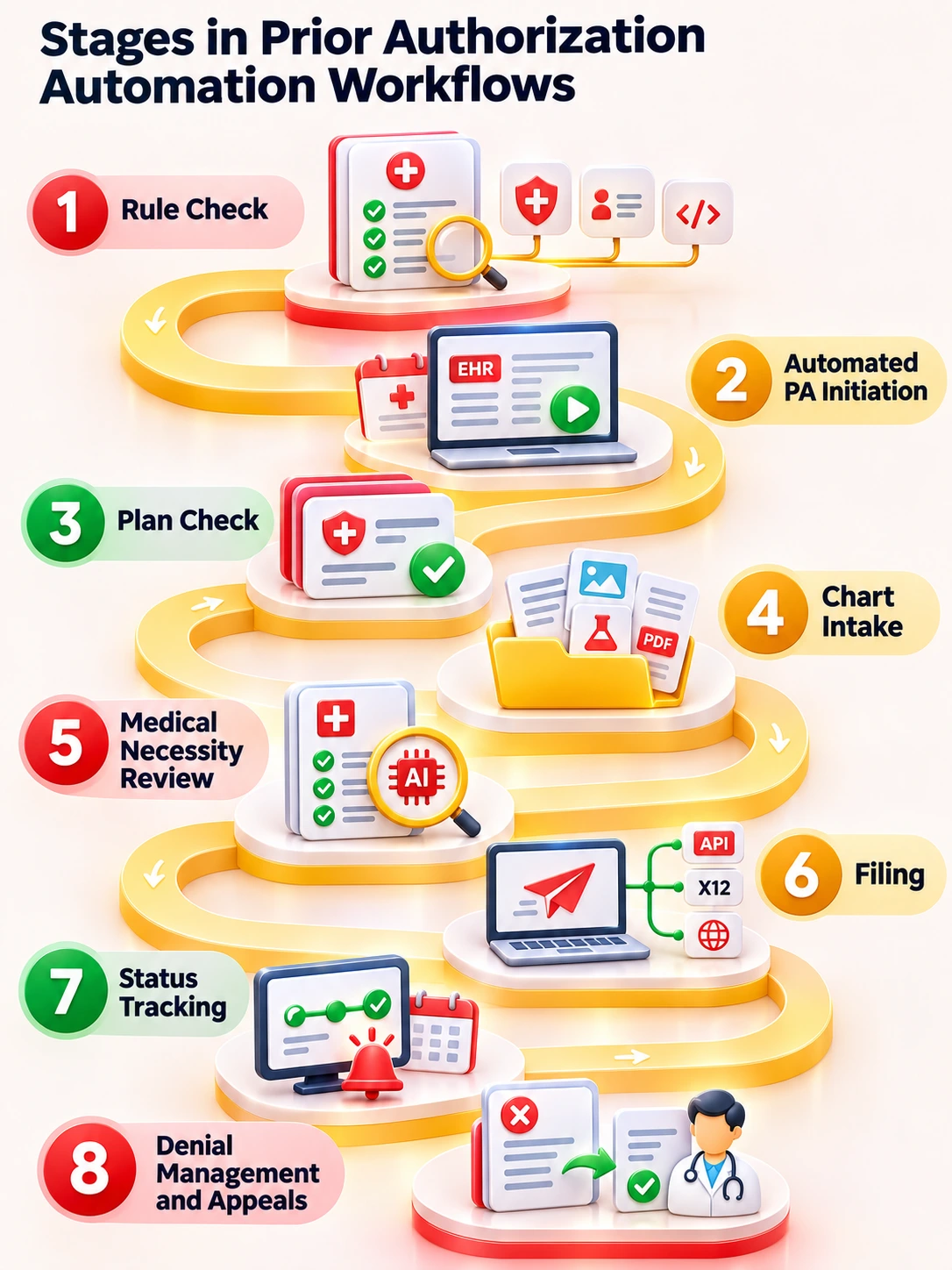
Where does most of the delay come from? Steps four and five. Files arrive with gaps, and staff checks rules by hand. With automation, the fastest return shows up here.
The Prior authorization automation system is a set of loosely linked services. Each service has one job. Combined, they turn messy files into a payer-ready request. But if one layer is weak, every layer that depends on it suffers.
Each layer links to the EHR through standards like FHIR. In doing so, data sharing is part of the build from day one, not patched on later
Intake pulls from fax, payer portals, EHR attachments, and API payloads. Standard optical character recognition (OCR) struggles with degraded faxes and handwriting, so modern pipelines classify each document and recognize its layout before extraction starts.
Automated prior authorization intake has to treat bad scans as the norm.
Language models read the notes and write a structured JSON record: member eligibility, ordering provider, service codes, diagnosis codes, and clinical evidence.
Schema validation rejects malformed output, and deterministic checks, like confirming a lab value appears verbatim in the source text, catch hallucinations. Every field should link back to its place on the original page.
Payer authorization requirements change constantly, so hardcoding them guarantees failure.
A configurable engine stores medical necessity criteria as versioned policy rules with effective dates, owned by clinical analysts instead of developers.
When a payer moves conservative-therapy proof from three months to six, the rule updates without a automated prior authorization software release.
Separating OCR, extraction, the rules engine, and the submission gateway means one failure doesn't stop the rest.
If a payer portal update breaks a submission bot, intake and extraction keep running and queue structured payloads. Tightly coupled monoliths tend to go down hard on minor external changes.
Unit tests cover individual functions, integration tests cover handoffs between services, and system tests run full authorizations end to end.
Regression testing against a golden dataset of annotated, de-identified clinical documents catches extraction drift before a release reaches production, so accuracy is measured rather than assumed.
The output should be a structured PDF report, not a raw data dump.
This type of report should show validated fields, flags missing information, list the medical necessity evidence found with source links, and route exceptions to a human reviewer — so staff spend time on judgment calls, not hunting for page numbers.
For one Entrans healthcare client. High-volume manual processing was creating bottlenecks and delays.
To fix this, Entrans paired OCR and LLM extraction with a rules engine the team could update. The team moved the platform from one codebase to split services.
In doing so, they also added test scripts that run on each release, plus structured PDF review reports.rts.
The end result? Processing ran 3X faster, and clinical judgment stayed with human reviewers.
How do you improve a number you only guess at? You can't!
Extraction scores are often measured at the field level using precision and recall (F1). Meaning, each field gets scored as right or wrong against a labeled file.
Clinical NLP research reports scores above 90%.
Turnaround time deserves special attention because it is now a regulatory measure as well as an operational one.
On the whole, a fast request that draws a payer asking for more records ends up slower than a slightly later, complete one.
With Prior authorization automation, you need to track every metric by service line and by payer.
Auto-approval rate applies to payers only. The metric flags requests that clearly meet the rules. Meaning, denials stay with doctors.
Clinic-side metrics measure something else. They show how well your own team and systems prepare and send each request.
Prior authorization automation only works where it links up. For most health systems, that means three links. The first is the EHR. On top of that, there is the payer's channel. The third is the CMS standard that is slowly taking over from the portal.
At Entrans, we handled linking payer to patient PA for a payer software integration.
SMART on FHIR launches an outside app inside the EHR with patient context. CDS Hooks fires on events like order-select or order-sign. The service checks the order against the rules engine.
Then the service returns a card in the doctor's workflow. With this, rules show up before the order is signed, not after the denial. Doctors stay in one system. Staff stop chasing orders that nobody flagged.
What happens when a payer has no API? Vendors fall back on X12 278 requests or portal bots. Bots break often. Meaning, multi-factor login and screen changes shut them down.
Olive AI raised $902 million on RPA bots and screen-scraping, then went bankrupt. That collapse shows the cost of using screen-scraping in place of real systems. In the grand scheme, keep filing in its own service. A broken bot then never holds up extraction or rules when it comes to prior authorization automation.
CMS-0057-F set payer deadlines of 72 hours for urgent requests and seven calendar days for standard ones. Those deadlines took effect January 1, 2026. The rule also requires covered payers to expose FHIR Prior Authorization APIs by January 1, 2027.
With this, the HL7 Da Vinci PAS standard maps X12 278 requests to FHIR Claim and ClaimResponse bundles. CMS-0062-P is a proposed rule. The rule would extend the same kind of rules to drug requests.
As these rules take hold, AI prior authorization stops being a choice for clinics that need to keep up with payer APIs.
From the payer's view of the same exchange, this payer-to-patient prior authorization case study shows how payer software and clinic systems pass data end to end.
One of the major issues with automate prior authorization is that packets are full of PHI, the patient data HIPAA protects. So data safety has to be part of the design, not a final checkbox.
In 2024, HHS OCR settled with Montefiore Medical Center for $4.75 million. The case turned on weak risk reviews and audit controls. With this case in mind, would your current setup hold up to that kind of review? The controls below help keep your system out of that kind of payout:
With this, treat the written answers as pass or fail. Write down your AI use rules too. Those rules of your Prior authorization automation workflow should spell out who signs off on rule changes and who reviews edge cases. The rules should also spell out how model updates get tested before release.
You have three real options with prior authorization automation: Buy a single-purpose prior authorization product. Extend your EHR or RCM platform.
Meaning, you build on tools you already own. Or build a custom automation layer, often with a tech partner.
Three factors decide the call: depth of EHR linkage, control of the rules, and your full cost over time at your volume.
But even with this, check that a vendor's AI is more than screen-scraping bots renamed as AI.
When you automate prior authorization, it removes clerical work, not clinical responsibility. Several scenarios still need a person, and pretending otherwise is how pilots stall.
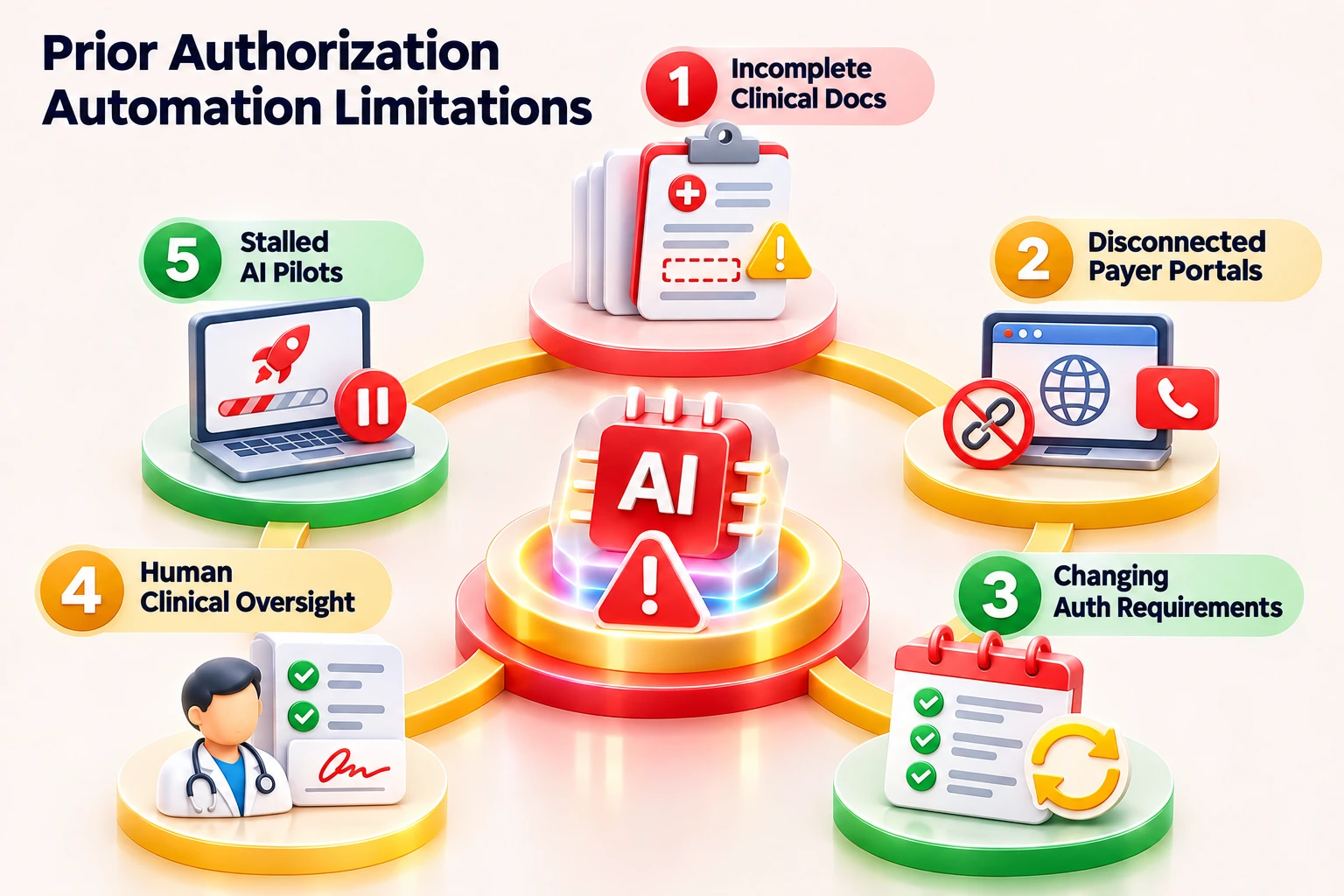
Can a model fill in what a doctor never wrote? No, and no model should try. Say the note never mentions failed conservative therapy.
Meaning, the proof does not exist. The Prior authorization automation system should flag the gap. Then the system should send the gap back to the doctor before filing, not after a denial.
Not every payer has an API. The CAQH Index found that 43% of requests still moved through web portals and phone systems.
With this in mind, any honest design keeps a queue for staff to work edge cases by hand.
Even a configurable engine needs analysts to keep it current. A stale rule produces confident, wrong answers, so assign clear ownership for every payer policy.
AI validates completeness; But AI cannot decide medical necessity.
HHS OIG found that 13% of denied Medicare Advantage requests met Medicare coverage rules. With this finding, denial management and appeals need a doctor's review. Prior authorization automation drafts the packet. A doctor signs off on it. Over-automation carries its own risk.
In fact, one such Cigna PxDx lawsuit states that 300,000 claims were batch-denied in two months with no real medical review.
Pilots stall when teams build them as one-off scripts. Nobody owns the rules, the testing, or the tracking. For the pattern and the fixes, read our post on why AI pilots stall.
None of these gaps is a reason to avoid automation. Each gap is a reason to design the manual path first. In doing so, the Prior authorization automation system hands work off to a person cleanly instead of failing silently.
Entrans builds and links healthcare workflow automation, from OCR through live rollout. The work starts small on purpose:
The proven result: 3X faster prior authorization handling in a published Entrans case study. Entrans builds and links the automation.
Want to know how? Book a consultation call with our team!

The Prior authorization automation workflow runs through seven stages: rule check, intake, data extraction, checks against payer rules, filing, status tracking, and appeals when needed. Automation shortens each handoff. The system pulls data from the EHR and checks the data against payer rules before anything goes out. Meaning, staff get an alert when a request nears its deadline or comes back denied.
Prior authorization automation cannot be fully done. Admins need to ensure steps can run end to end. Those steps include rule checks, extraction, data checks, filing, and status tracking. But medical necessity stays a doctor's call. RPA and ePA move data faster. They don't replace payer rules or a doctor's judgment.
Common options include CoverMyMeds for drug plans and Availity for multi-payer portals. Waystar covers end-to-end RCM, and Infinx serves clinics with a single care line. Experian Health handles upfront plan checks. On top of that, Epic's built-in tools suit health systems set on Epic.
Well-built systems for prior authorization automation report field-level precision and recall above 90%. Those scores hold only with checks in place. In clinical NLP research, the gains came from few-shot prompts, source lookup, and checks that confirm values exist in the source text. With this, measure your own scores with field-level F1 on a fixed test set built from your files.
Automated PA initiation means the request starts on its own when a doctor places an order. An EHR trigger, such as a CDS Hooks order-sign event, sends service codes, ICD-10 codes, and patient context to a rules service. The service checks the member's plan. With this, the service flags if prior authorization is needed.
The answer rests on volume, EHR mix, and how much of the rules you want to own. Buy if your plans are standard. Extend your EHR if you're set on one vendor. In short, build or partner if you run more than one EHR or want to move off per-request fees at scale. Expect weeks for products and 6 to 12 months for builds.