Why AI pilots stall before production, and how to fix it. Six blockers, a diagnostic, and a 9-point gate to move your AI pilot to production.

Agentic Unconference 2026 - September 19, Chennai
View Event →


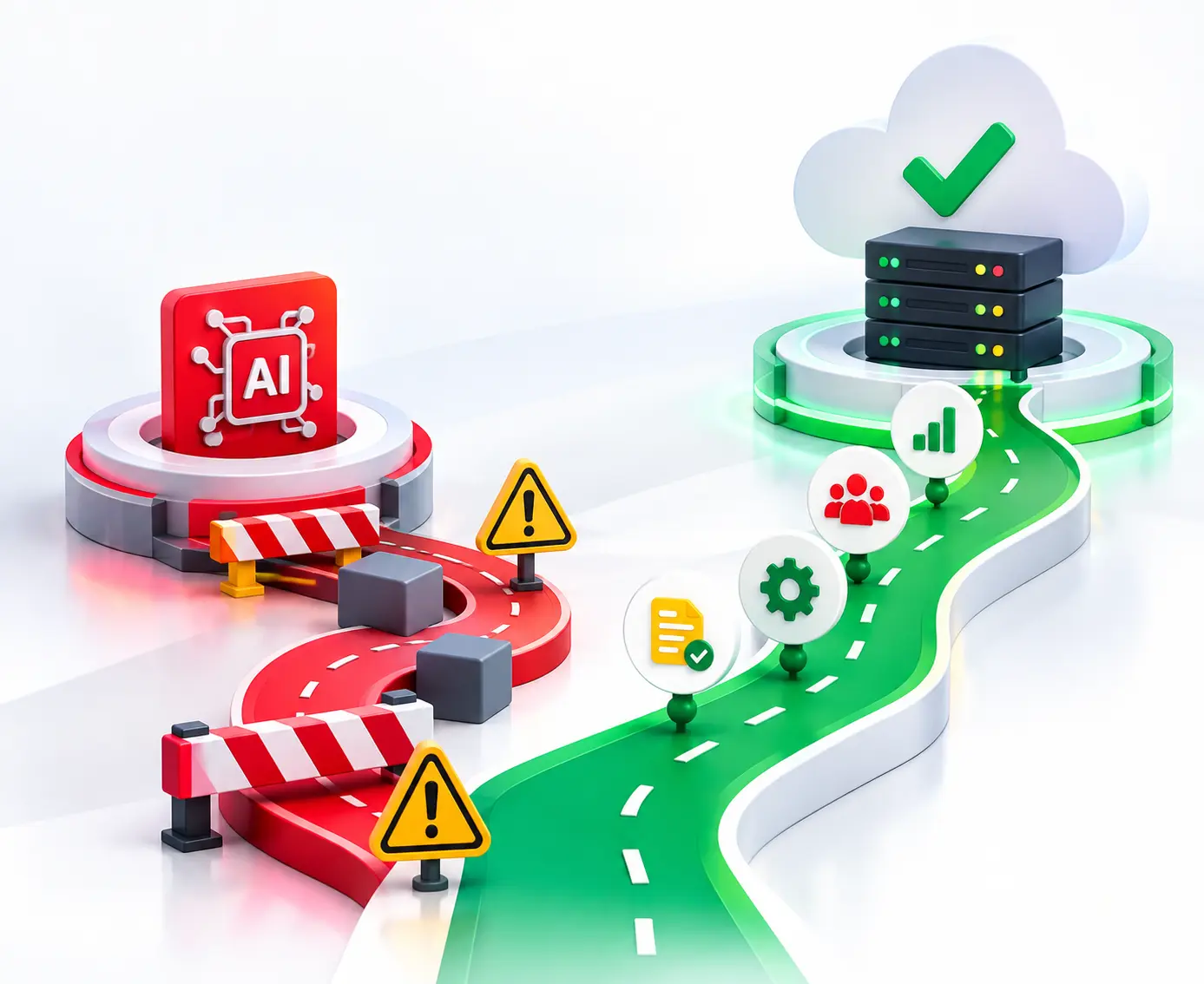


A PoC or MVP runs on clean data with a small group of testers.
Production, however, runs on real enterprise data, real users, and systems that have to keep working without anyone watching.
Those are two completely different problems, and most companies lose their AI investment somewhere between the demo and go-live.
Luckily, understanding exactly why pilots stall makes it possible to fix the right things first. Below is how this productionization framework helps you get an AI pilot to production.
According to Stanford, Generative AI hit 53% consumer adoption in under three years. Enterprise deployment, however, getting an AI pilot to production a very different story.
The AI pilot-to-production gap is the distance between a proof of concept on clean data with limited users and a live system running in real workflows, governed by security controls, measured against business results, and owned by a named team.
McKinsey research puts the model's contribution to overall AI success at just 15%. What that means is the other 85% comes from everything outside the model: data pipelines, workflow fit, governance, and organizational ownership.
A pilot proves something can work. Production proves it does work, reliably, at scale, under conditions no one chose in advance.
Production runs on thousands of users who never check outputs at all. Edge cases in a pilot are rare because scenarios were picked deliberately. In production, they turn up without warning.
Due to this difference, Gartner forecasts 60% of AI projects will be abandoned through 2026 because of poor AI-ready data. Most of those projects had data that worked fine in the pilot. The problems only show up when live systems take over from clean spreadsheets.
Six blockers appear when you attempt to get an ai pilot to production. Each looks manageable alone. Together, though, they create the friction that keeps production out of reach.
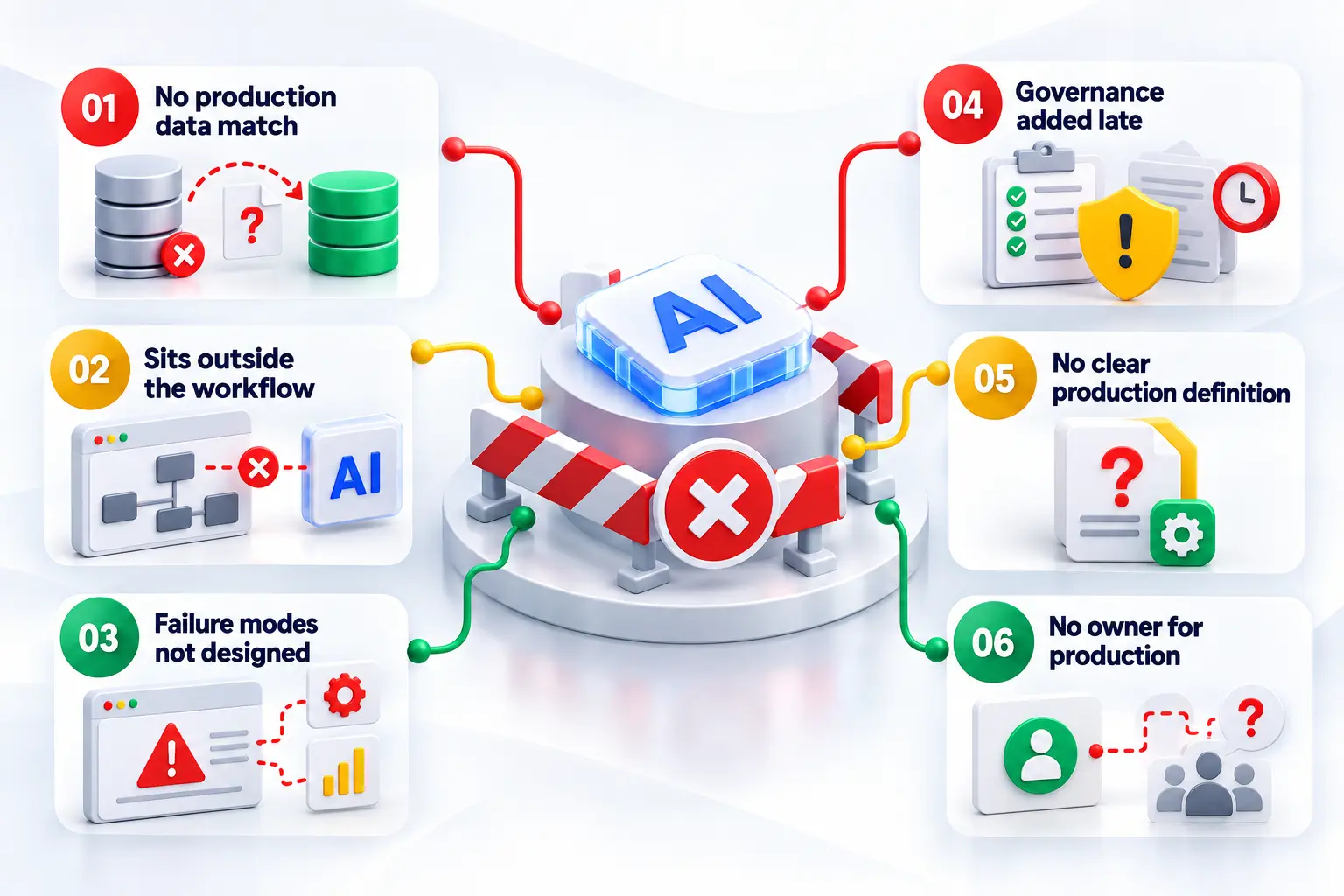
When an AI pilot stalls, the model is rarely the problem. McKinsey puts the model's share of overall AI success at 15%. Meaning, the six blockers for getting an AI pilot to production below account for the other 85%.
Pilot data is selected carefully. Clean, complete, and structured to show the model at its best. However, live enterprise data looks nothing like that. Real data is fragmented, locked behind access controls, and arriving in real time.
Gartner predicts 60% of AI projects will be abandoned through 2026 because of poor AI-ready data. Due to this, the fix for getting an ai pilot to production treating data quality as a Service Level Objective rather than a one-time cleanup task. Measure freshness, completeness, and access latency before the model reaches any live system.
Getting an ai pilot to a production ready model that asks users to leave their platform and open a separate tool will not get used. That is an architecture problem, not a training problem.
McKinsey's 2025 State of AI survey found workflow redesign has the largest impact on generative AI's EBIT contribution.
Meaning, connecting the AI to the systems where the actual process runs matters far more than the model itself. Build it into the application where users already spend their time, not alongside it.
Pilots test for success. Production, however, exposes failure. MIT and Stanford research showed that a 99% per-step accuracy rate falls to 36.6% end-to-end success across a 100-step workflow. At 1,000 steps, it approaches zero.
Production also brings up context pollution and model drift that never appear in a controlled demo. Standard software testing cannot catch these, so continuous evaluation and AI monitoring need to be built in from day one, not added after the first failure.
Governance added at the end of a project blocks deployment. Every time. A pilot that tries to connect to live data hits residency rules, access controls, and audit obligations. None of those were built into the design, and retrofitting them often costs more than rebuilding from scratch.
The NIST AI Risk Management Framework requires governance throughout the AI lifecycle, across four functions: Govern, Map, Measure, and Manage. However, most teams treat it as a final approval step. Due to this, security teams that arrive at launch block production because the architecture left them no other option.
Getting AI pilots to production stall in what some call pilot purgatory because stakeholders never agreed on what ready actually means.
Demo accuracy is not a production metric. Hard thresholds for latency, cost per transaction, hallucination rate, and escalation frequency need to be agreed in writing before testing starts. Without them, every stakeholder applies a different standard, and the debate keeps going.
Anthropic's Bloom framework shows automated behavioral evaluations are needed to catch problems before deployment. Define the gate before you build toward it.
Scaling AI is an organizational design problem. AI that lives inside one IT team does not have the cross-functional support it needs to reach production. Legal, compliance, data engineering, and product ownership all need to be brought in. Without a named team in charge, nobody is responsible for the last-mile work.
Only 45% of high-maturity organizations keep AI models running for more than three years. The ones that pull it off have someone clearly responsible after the demo ends.
Every stalled AI pilot to production shows symptoms before anyone finds the root cause. Applying a technical fix to an organizational problem wastes months. The map below connects what you are seeing to the most likely source so you can get to work on the right thing.
Data readiness is almost always the cause here. The AI pilot to production model is fine. The production data environment, however, is not what the pilot was built against.
Start by auditing live data access, schema consistency, and permissions across every system the model needs to query. Measure freshness and completeness as SLOs, not one-time assumptions.
Accurate outputs no one acts on point to a workflow integration problem. Count how many steps a user must take to do anything with the AI result. A tool that requires leaving a core platform or copying results by hand will see adoption drop off fast. Embedding the AI inside the existing system of record is how you fix this, not retraining users to change their habits.
Gradual degradation means production monitoring was never set up. Deploy continuous behavioral evaluations and monitoring. Track output quality and escalation rates against launch baselines. MIT and Stanford's 2026 research identified three types of agent drift: semantic, coordination, and behavioral. Each needs to be actively detected before users start to notice.
A compliance block just before launch almost always means governance was deferred until after the architecture was set. Start by auditing against the NIST AI RMF core functions. Find where data provenance, access controls, and data residency were left out. Going forward, pilots need governance sign-off at the design stage, not at launch.
Disagreement about readiness almost always means no criteria were ever written down. Get stakeholders to agree on hard thresholds before any further testing: hallucination rate ceiling, latency limit, cost per transaction, minimum task completion rate. Once those are written down, readiness becomes a factual question rather than a back-and-forth.
Broad support with no ownership agreement means the blocker is the operating structure, not the technology. Name who is accountable after production: the run team, the business owner, the escalation path, and the on-call model. A system without a named owner will slowly fall apart and get quietly retired.
Once the binding blocker is identified, moving past it means working through six conditions in order. Skip one and the next failure is already lined up.
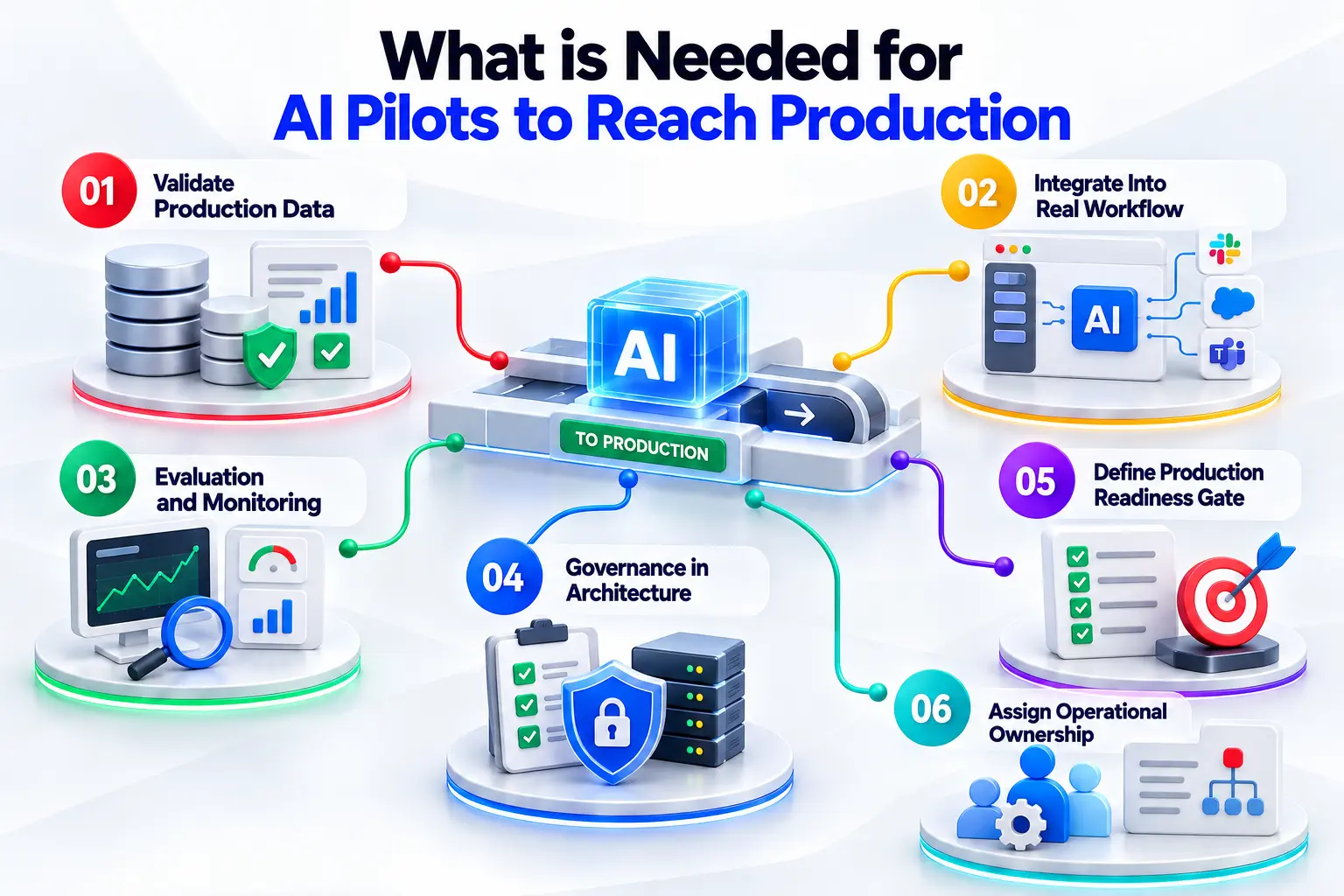
Confirm the data the ai pilot to production model needs actually exists and can be pulled under production permissions. Test real pipelines against real access controls, not staging environments. A production system that relies on manually refreshed data already has a fragility built in.
Key steps include:
Connect the AI to the systems and interfaces where actual work happens. Not a parallel tool. The application where users already spend their time. McKinsey research is consistent: workflow redesign is the single largest driver of generative AI EBIT contribution. Due to this, getting the integration right matters more than getting the AI pilot to production model right.
Key steps include:
Agree before deployment on how accuracy, hallucination rate, latency, and escalation frequency will be measured. Then build the tools to track them continuously after launch. In practice, evaluation is not a pre-launch checklist. Ongoing operational function is the right way to think about it.
Key steps include:
Governance that arrives after the design is set blocks deployment. Security, access controls, auditability, and compliance requirements all need to be built into the architecture before any production code is written. Due to this, governance is an engineering decision, not a compliance formality.
Key steps include:
A production-readiness gate is a written set of criteria a pilot must meet before moving forward. Without one, every launch decision turns into a negotiation. Make the thresholds quantitative, assign an owner for each one, and treat the gate as a contract between engineering and the business.
Key steps include:
Before deployment, name the run team, the business owner, the escalation path, and the on-call model. Gartner confirms nearly 60% of high-maturity organizations centralize AI governance and infrastructure under defined ownership. Due to this, the pattern is clear: systems without named owners fall apart without anyone noticing until it is too late.
Key steps include:
The right ai pilot to production delivery model depends on what the binding blocker is and what capacity already exists. None of the four options below is universally better. Each one closes a different kind of gap.
An organization with strong engineering and ML operations capacity can take on the transition internally. That builds institutional knowledge and avoids handoff risk. However, the constraint is talent.
Building internal ai pilot to production engineering capacity takes years, and the market for those engineers is tight. This model works best for organizations with existing MLOps infrastructure and a clear process for moving models from experimentation into production support.
Systems integrators bring scale and ready-made frameworks for connecting AI to complex legacy environments. For large programs that span multiple platforms and regulatory constraints, an SI can help speed up integration work considerably.
However, SI engagements often leave behind rigid designs. Internal knowledge for managing drift and incidents after go-live is usually thin.
Due to this, governance over the long-term operating model needs to be defined contractually before work gets started.
Bringing in experienced contractors can close specific technical gaps, particularly in MLOps pipeline construction or security design.
However, ai pilot to production model breaks down when the gap is organizational rather than technical. Adding engineers to a team that lacks clear production ownership does not resolve the ownership problem.
The Forward Deployed Engineering model places senior AI engineers directly inside the customer's environment. They build against real data, real APIs, and real security requirements from day one.
They do not hand off a design and leave. They build what actually ships. McKinsey research frames AI as a collaboration between engineering and the business, not a siloed IT project. FDE is built around that finding.
A technically successful pilot does not automatically justify production investment.
McKinsey research confirms high performers stop underperforming AI projects and move budget to better use cases. A pilot that does not clear the bars below should go back to experimentation, not push forward.
Strong engineering results without someone accountable for the business outcome are not enough reason to deploy.
No named owner means no one to drive adoption or validate ROI. Due to this, ai pilot to production systems without business owners tend to become orphaned infrastructure that nobody maintains and nobody kills.
A working AI system can still be a poor investment. MIT and Stanford identified the Verification Tax: downstream human review costs for agentic systems frequently exceed the cost of generating the output.
Meaning, total cost of ownership must account for MLOps pipelines, data engineering, human oversight, and security compliance, not just API spend.
Some enterprise data is genuinely inaccessible due to contractual limits, regulatory rules, or legacy system fragmentation.
When the data the model needs cannot be pulled under production governance, more engineering investment creates debt without closing the gap. The data problem has to be solved first.
Deploying AI into a process that is scheduled for redesign or system replacement wastes integration effort. Stage the deployment to kick off after the new workflow is stable. Rebuilding integrations against a changed architecture almost always costs more than waiting.
Most of the roadblocks for getting an ai pilot to production need a structured diagnosis, a prioritized backlog, and engineers who build against production constraints.
At Entrans, the first question is always: what is the binding blocker? Rebuilding before identifying that wastes the next six months ending up in the same position.
That pattern recognition helps teams stop wasting months fixing the wrong thing.
Want to know how Entrans FDE developers can get your project on the right track?
Book a free consultation call with our team!

The answer depends on how production is defined. Gartner reports 41% of generative AI prototypes reach technical deployment. 95% of enterprise GenAI deployments produced zero measurable profit and loss impact, even among those that technically launched. These numbers measure different finish lines, not the same one.
Pilots rarely fail technically. They stall organizationally. The six blockers are: data that does not exist in production, AI not embedded in the actual workflow, failure modes never designed for, governance that arrived too late, no agreed definition of ready, and no named owner. Gartner forecasts poor AI-ready data will account for 60% of project abandonments through 2026. The model is rarely the problem.
Gartner notes the average is around eight months from prototype to production. That assumes blockers are being worked through in parallel, not discovered one at a time. Teams that validate production data, integration requirements, and governance needs at the start of the pilot tend to move fastest.
A proof of concept tests a technical question under controlled conditions: static data, limited users, sandboxed environment. A pilot, however, integrates the model into a limited live environment where real users and real data test workflow fit and edge cases. However, a successful POC or pilot does not prove production readiness. Production readiness requires quantified criteria that neither one is designed to test.
A pilot built on staging data or bypassed governance controls may not be recoverable at acceptable cost. Look clearly at data quality, integration debt, and governance gaps. Sunk cost is not a reason to push forward with a system that will break in production. Rebuilding correctly is sometimes faster than retrofitting incorrectly.
Four roles need to be named before deployment: the engineering run team for day-to-day operations, the business owner accountable for the outcome, the escalation path for failures and compliance incidents, and the on-call model for after-hours issues. Gartner shows nearly 60% of high-maturity organizations centralize AI governance and infrastructure. Systems without named owners degrade without anyone catching it.
A production-ready system has met pre-agreed thresholds across nine areas: live and governed data, embedded workflow, tested evaluations, reliability under load, verified security controls, real-time drift monitoring, a tested escalation path, acceptable unit economics, and named owners confirmed in writing. NIST's TEVV framework treats this as an ongoing operational discipline, not a one-time gate.

-1.svg)