Forward Deployed Engineering Services Companies: How to Choose the Right Partner
Learn how to choose the right forward deployed engineering partner, compare providers, evaluate vendors, costs, engagement models, and key red flags.
Forward Deployed Engineering Services Companies: How to Choose the Right Partner
4 mins
September 28, 2026
Author
Aditya Santhanam
TL;DR
FDE providers are not all the same. The market includes hyperscalers, large consulting firms, specialist AI engineering companies, and staffing platforms.
Look for proof they can work in real enterprise systems. Ask for production code, named engineers, similar customer references, post-launch support, and experience with security, legacy systems, and live data.
Ask questions that expose how they really work. Find out what they refused to build, what happens when access is delayed, what they leave behind, how they measure success, and what happens after launch.
Test the vendor before signing a large deal. Run a paid scoping exercise, compare their technical plans, test how they handle your real environment, and check references from companies with similar systems and constraints.
MIT's Project NANDA found that 95% of firms see no return from their generative AI pilots.
The model is rarely the problem. The gap is. What an AI system does in a vendor sandbox is not what it does inside a real enterprise.
Legacy data, strict security rules, and rigid compliance frameworks break deployments. Forward Deployed Engineering exists to close that gap.
In 2026, the FDE market has grown fast. Gartner predicts 40% of agentic AI projects will be canceled by the end of 2027.
Picking the wrong partner is one of the costliest mistakes an enterprise AI program can make. This guide tells you how to tell them apart.
Table of Contents▾
Who Actually Sells Forward Deployed Engineering?
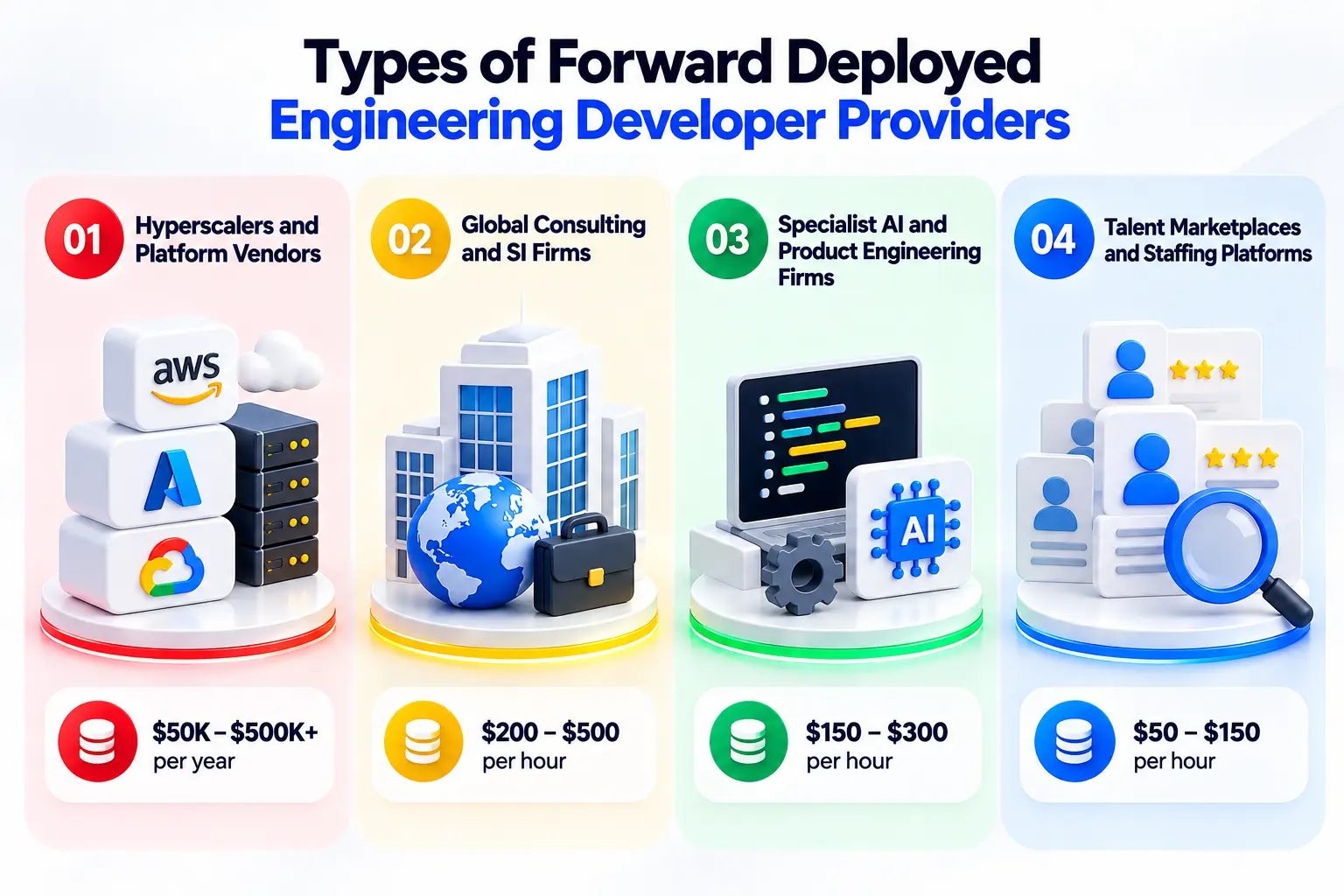
Search for forward deployed engineering services and you will find four very different types of providers.
Hyperscalers that run internal FDE teams to drive platform use.
Global consulting firms that partner with AI labs and call the result embedded engineering.
Specialist firms that treat shipping production code as their core offering.
And talent marketplaces selling hourly contractors under a forward deployed label.
Here, a Forward Deployed Engineer embeds with one customer to solve many problems, rather than building one solution for many customers. That is what separates a real FDE deal from everything else.
FDE Services vs. FDE Careers
A large share of interest on FDEs come from engineers seeking FDE roles at OpenAI, Anthropic, or Databricks. Not from buyers. That matters. OpenAI pays FDEs between $185,000 and $300,000 in base salary.
Anthropic pays $280,000 to $320,000. These are senior full-stack engineers with strong judgment and a proven track record. When you assess a vendor, that is the caliber you should ask for by name before you sign.
The Four Types of Forward Deployed Engineering Providers
Provider Type
Typical Engagement Size
Price Range
Best Suited For
Hyperscalers and Platform Vendors
$500K – $5M+
$50K – $500K+ per year
Core infrastructure, foundational model access.
Global Consulting and SI Firms
$2M – $50M+
$200 – $500 per hour
Large, multi-year digital programs.
Specialist AI and Product Engineering Firms
$150K – $2M
$150 – $300 per hour
Custom agents, production AI, legacy systems.
Talent Marketplaces and Staffing Platforms
$20K – $200K
$50 – $150 per hour
Short-term gaps, specific task work.
Hyperscalers and Platform Vendors
OpenAI, Anthropic, Databricks, AWS, Google Cloud, and Microsoft Azure all run internal FDE teams. Their goal is consistent: drive use of their own platforms. OpenAI's FDEs own delivery from prototype to stable production. Databricks FDEs build reference setups and close the feedback loop with product teams. Salesforce routes Agentforce work through a certified partner network.
These teams are real and elite. But their goal is platform consumption. Access is reserved for strategic accounts at high spend levels.
Global Consulting and Systems Integrators
Global SIs like Accenture and Deloitte run large project-based programs. Accenture has expanded its Palantir deal to deliver AI programs at scale. But the model stays rooted in planning and documentation. Not day-one code shipping.
SIs produce strategy docs over months. FDEs map real workflows in weeks and connect with live APIs to solve a defined problem. Need a multi-year ERP program? An SI is right. Need an AI agent running against real data within weeks? Go elsewhere.
Specialist AI and Product Engineering Firms
This is the category where owning the production outcome is the core product. Specialist firms embed engineers inside a client's network or private cloud. They work under existing access rules. They set up agent pipelines, configure RAG against real data, and add safety gates where action needs human sign-off.
The trade-off is scale. A specialist firm cannot field 500 engineers across 12 countries. For firms that need a small, elite team that owns the result end to end, the specialist firm is the faster path.
Talent Marketplaces and Staffing Platforms
Staff augmentation provides capacity. Not ownership. A contractor executes tickets managed by the client's own leads. The design, the plan, and the final criteria stay with the buyer. That works when a manager needs extra hands on a clear backlog. Calling a contractor forward deployed because they work on-site does not make the deal FDE.
How to Evaluate a Forward Deployed Engineering Company
Evaluation Criterion
What to Check
Why It Matters
Production-Code Ownership
Ask to see code shipped to a client repo, not demos.
Sandbox demos do not predict production success.
Outcome Accountability
Confirm the vendor owns the full loop from discovery through stabilization.
Partial ownership shifts deployment risk back to the buyer.
Enterprise Environment Experience
Verify work inside real networks with SSO and least-privilege access.
Sandbox-only experience fails on contact with real security rules.
Ownership After Deployment
Ask whether post-deployment monitoring and support are in scope.
Most failures surface in the first 30 to 60 days after go-live.
Minimum Engagement Size
Assess whether the vendor scales to your pipeline, not just one contract.
Scope and capacity mismatch causes mid-deal breakdown.
Engineering Staffing Model
Ask for named engineers cleared on both a technical bar and client-judgment scenarios.
Junior engineers sourced post-contract are a bait-and-switch.
Handover and Knowledge Transfer
Confirm the vendor codifies working patterns into playbooks and reusable tools.
An deal that leaves nothing behind creates permanent vendor dependency.
Willingness to Challenge the Scope
Ask what they refused to build and why.
A vendor that agrees to everything is billing everything, not solving the right problem.
AI Evaluation and Monitoring
Ask how they measure errors, token cost, speed, and reliability under load.
Without structured testing, there is no way to know if the system works.
Here is what each of those nine criteria means in practice.
Production-Code Ownership. An FDE vendor that cannot show code shipped to a client repo is not an FDE vendor. Proof of concept work and live production work are not the same thing.
Outcome Accountability. Who owns the risk if the build fails? In a real FDE deal, the vendor does. Ask for a written definition of what done means, and check whether post-go-live support is in scope.
Enterprise Environment Experience. Most AI systems that work in sandboxes fail in real enterprise networks. Ask for references in your industry with a similar compliance setup. Then verify the stories directly.
Ownership After Deployment. Go-live is where things actually break. Edge cases surface. Token budgets drift. Post-go-live monitoring should be in scope, not sold as an add-on.
Minimum Engagement Size. FDE engineers at OpenAI and Anthropic earn $185,000 to $320,000 in base salary. A dedicated team at that level is a real investment. Compare FDE cost to the cost of a failed build, not to hourly staff.
Engineering Staffing Model. Ask for named engineers before you sign. Vendors who cannot name them are building the team after you pay. That is not embedded engineering with real ownership.
Handover and Knowledge Transfer. The handover should include runnable assets: playbooks, prompt libraries, and testing configs your team can run without the vendor. Anything that forces the vendor to return for every change is a dependency, not a result.
Willingness to Challenge the Scope. The best FDE vendors push back. They flag when a simple rule-based system beats a complex AI workflow at a fraction of the cost. Ask what they refused to build for a past client. The answer tells you who they work for.
AI Evaluation and Monitoring. AI systems degrade without ongoing testing. A vendor with no structured testing framework, like the CLEAR model (Cost, Latency, Efficacy, Assurance, Reliability) or OpenAI Evals, is building without a dashboard.
Questions to Ask a Forward Deployed Engineering Vendor
Question to Ask
What a Strong Answer Should Address
Show me code you shipped into a client repo.
Production code in a real client setup. Should show live API access, real data, and working security controls.
Who specifically will work on this deal?
Named engineers with verifiable backgrounds. Should be accessible before you sign.
What did you refuse to build for a client and why?
A specific case where they chose a simpler path or no AI at all, and stood behind that call.
What happens if environmental access is delayed?
A defined backup plan. Strong vendors stay productive during security review delays.
What does your handover package contain?
Runnable assets: playbooks, prompt libraries, and testing configs your team can use without the vendor.
What happens after the system goes live?
A defined support model with monitoring tools, a review cadence, and a process for fixing issues.
How do you measure success?
Production metrics: task success rate, token cost, speed under load, error rate. Not just go-live milestones.
Tell me about a deal that failed.
A specific, honest account of what went wrong and what changed after. No failure stories means no track record.
Red Flags When Choosing a Forward Deployed Engineering Provider
Outcome-based pricing in marketing, hourly contracts in practice. A contract built around hours worked is a consulting contract. The label on the proposal does not change that.
No named engineers before signing. A team not named before you commit will be built after you pay. That is staff augmentation with better branding.
Unclear code or IP ownership. Every line of code built in your environment against your data should belong to you. Ambiguity here is not an oversight.
Provider accepts the full scope without pushing back. A vendor who agrees to build everything you ask for is focused on contract value, not your outcome.
Rate cards are the main commercial document. FDE deals are scoped to outcomes. A vendor whose first document is a rate card is not offering FDE.
No plan for delayed environment access. Security reviews take time. A vendor with no backup plan has not run enough deals to know that.
No defined handover plan. A vendor who cannot describe what they leave behind is not planning to leave anything. That is a dependency model, not a delivery model.
No post-go-live support or monitoring model. Going live without post-deployment monitoring is not a finished FDE deal.
Book a Free Consultation
Share your details and our experts will reach out to discuss your goals.
How to Run a Forward Deployed Engineering Vendor Evaluation
A strong process separates vendors who can describe FDE from those who can execute it. The sequence matters as much as the criteria.
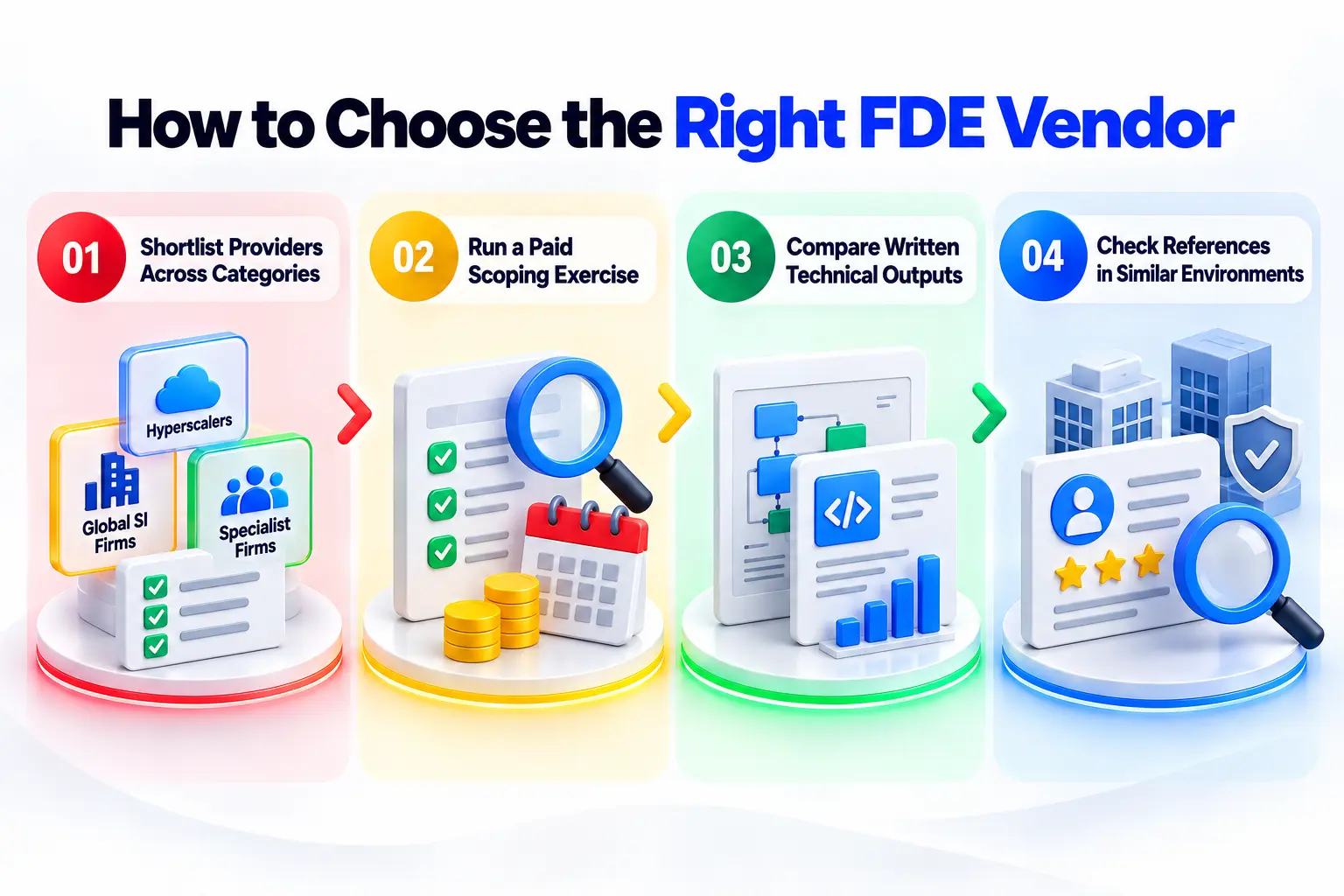
1. Shortlist Providers Across Different Categories
Include at least one provider from each relevant category. A hyperscaler if you have a primary platform deal. A global SI if scale or change management is a key need. One or two specialist firms to set a baseline for what real outcome ownership looks like.
Evaluating only within one category makes it hard to understand the trade-offs. Aim for three to five vendors with proven FDE methods, not staffing firms dressed up as embedded engineers.
2. Run a Paid Scoping Exercise
The most reliable signal is how a vendor behaves during a paid scoping exercise against your real systems. Do they ask sharp questions or assume answers? Do they push back on scope?
Can they work inside your network on day one? Scope the exercise to three to five high-value outcomes. The output should be a clear plan, defined success criteria, and a go-live timeline. That is what you compare across vendors.
3. Compare Written Technical Outputs
Ask each shortlisted vendor to produce a written technical output. An architecture diagram. A working prototype against a live API. A data plan. Quality and specificity tell you more than any reference call.
Vendors who produce generic plans without addressing your legacy systems or compliance needs have not read the brief.
4. Check References in Similar Enterprise Environments
Ask for references in your industry, with a similar compliance setup, at a similar stage of AI maturity. A reference from a cloud-native startup does not predict success in a regulated bank with on-prem systems.
Verify that the deal reached live production, not just a proof of concept. Ask directly: what broke, and how did the vendor respond?
Compare Engagement Models and Costs
Engagement Model
Typical Use Case
Accountability
Cost Consideration
Hourly / Staff Augmentation
Burning down a defined backlog under internal management.
None. Risk stays with the buyer.
Lowest per-hour cost. Highest total cost when ownership is missing.
Fixed Project
Scoped build with clear criteria and a defined end date.
Vendor owns delivery to the defined scope.
Predictable. Cost overruns are vendor risk.
Dedicated FDE Team
Ongoing production work inside a client environment.
Full outcome ownership including post-go-live support.
Higher per-month cost. Lower total risk cost across the build.
Milestone-Based
Phased builds where payment gates align with progress.
Shared at each milestone. Full ownership at final go-live.
Aligns incentives with delivery progress.
Outcome-Oriented
High-trust deals defined by measurable business impact.
Vendor assumes maximum risk. Buyer pays for results.
Only viable with a strong track record on both sides.
When You Should Not Hire a Forward Deployed Engineering Partner
FDE is not the right answer to every AI problem. There are five cases where a different model fits better.
When the problem is still unframed. FDE is an execution model. When the problem is not yet defined, a strategy consultant should come first. An FDE team arriving with no clear target will spend its first weeks on work that should have been done before procurement.
When you only need engineering capacity. When a manager has a clear backlog and just needs more hands, staff augmentation is the right call. Paying for outcome ownership you are not using is waste.
When the capability should be built internally. When the AI build is the firm's core competitive function, internal hiring is the right path. An FDE deal is designed to transfer knowledge and exit. That is not the right model for a capability you must own forever.
When you cannot provide environment access. FDE is live production work inside your real network. When access is blocked for 8 to 12 weeks, what is happening is a planning exercise billed at FDE rates.
When a platform vendor already covers your use case. When the build follows a documented platform path, the vendor's partner network is the right resource. Specialist FDE firms earn their place when the problem is custom and the stakes are high.
Where Entrans Fits, and Where It Does Not
Entrans runs an FDE as a Service model. Engineers embed inside a client's network or private cloud under existing access rules. The delivery loop runs in four stages. Enter the environment and map how work happens.
Entrans has shipped AI agents and RAG pipelines inside client environments. Deals span ERP integrations, strict SSO controls, and compliance frameworks including ISO 42001, HIPAA, and SOC 2.
Every deal produces reusable playbooks, prompt libraries, and testing configs the client's team can run alone after the embedded team exits.
Forward Deployed Engineering Services That Reach Production
Our engineers embed in your environment and own the AI build through go-live.
20+ Years of Industry Experience
500+ Successful Projects
50+ Global Clients including Fortune 500s
100% On-Time Delivery
Thank you! Your submission has been received!
Oops! Something went wrong while submitting the form.
Frequently Asked Questions
1. What companies provide forward deployed engineering services?
The market divides into four categories. Hyperscalers and platform vendors, including OpenAI, Anthropic, Databricks, and Palantir, run internal FDE teams focused on platform adoption. Global SIs like Accenture execute large AI programs through platform partnerships. Specialist firms like Entrans treat shipping production code as their core service.
2. How do I choose a forward deployed engineering partner?
Start with production-code ownership. Ask to see code shipped to a real client repo. Verify real enterprise experience in a comparable industry. Confirm that post-go-live monitoring is in scope. Ask for named engineers before you sign. Run a paid scoping exercise and compare outputs. The vendor who asks the sharpest questions about your real environment during scoping usually builds the most useful thing.
3. When should a company use forward deployed engineering?
FDE is right when the gap is the core problem. That gap comes from three places. Fragmented enterprise data. Security rules the model was never tested against. Legacy integrations no vendor sandbox can replicate. When a sandbox build fails on contact with real data, that is an FDE problem. Not an AI capability problem.
4. How much do forward deployed engineering services cost?
Specific costs are not publicly disclosed by any major provider. The talent data gives a useful proxy. FDE engineers at OpenAI earn $185,000 to $300,000 in base salary. At Anthropic, $280,000 to $320,000. A dedicated team at that level is a real investment. Compare FDE cost to the total cost of a failed build.
5. What questions should I ask a forward deployed engineering vendor?
Some questions cut through the noise. Ask to see code shipped to a client repo. Ask who will work on the deal by name. Ask what they refused to build for a past client. Ask what happens when environment access is delayed. Ask what the handover package contains. Ask what post-go-live support looks like.
Hire Forward Deployed AI Engineers
Named, senior FDEs who have shipped AI agents and RAG pipelines in enterprise systems.
Free Project Consultation
Trusted by Enterprises & Startups
Top 1% Industry Experts
Flexible Contracts & Transparent Pricing
50+ Successful Enterprise Deployments
Aditya Santhanam
Author
Aditya Santhanam is Co-founder & CTO of Entrans Technologies, spearheading AI-driven cloud and data solutions. A 13-year tech veteran, he leads innovation in generative AI, AI agents and MLOps. He also co-founded Infisign (identity security) and Thunai.AI (enterprise AI agents)
Related Blogs
Forward Deployed Engineering Services Companies: How to Choose the Right Partner
Learn how to choose the right forward deployed engineering partner, compare providers, evaluate vendors, costs, engagement models, and key red flags.






-1.svg)