> Blog >
How to Hire Forward Deployed Engineers: Engagement Models and Vetting
How to hire forward deployed engineers: engagement models, vetting questions, contract terms, and what FDEs cost.

How to Hire Forward Deployed Engineers: Engagement Models and Vetting

4 mins
September 28, 2026
Author
Aditya Santhanam
TL;DR
  • Hiring an FDE is different from hiring a regular engineer. You need someone who can find unclear problems, work inside messy customer systems, ship to production, and stay responsible for the outcome.
  • Pick the engagement model based on the work. Direct hire fits long-term FDE needs. Contractors fit short projects. Staff augmentation fits known backlogs. Outcome-based partners fit complex work.
  • Vet for judgment, not just technical skills. Look for real production experience, customer discovery, scope control, clear communication, adaptability, and ownership after launch.
  • Set the rules before work starts. Define the outcome, system access, code ownership, internal owner, handover, and exit terms upfront. Most FDE problems start when these are left unclear.
  • According to Gartner 60% of enterprise AI pilots never make it to production. And on top of that, 50% of PoC projects get dropped before they create any real value!

    But the tech is rarely the problem. Deployment is.

    That is where forward deployed engineering service companies come in. They sit inside your systems, find the real problem, and ship code to fix it.

    This guide walks you through all of it: whether you need an FDE, which model fits, where to find one, how to vet them, and what it costs.

    Table of Contents ▾

      What Does It Take to Hire a Forward Deployed Engineer?

      Hiring an FDE is not like hiring a regular engineer since their job profile is rare - this means vetting works differently, with a different setup to work and tasks. Also, hiring an FDE or FDE team requires you to have a clear understanding of their tasks, the engagement model you need to pursue, and a realistic idea of how much an FDE costs.

      Palantir built this model first. But OpenAI, Anthropic, Databricks, and Scale AI all run FDE programs for the same reason. They use FDEs to close the gap between what their models can do and what customers need live in production.

      How FDEs Differ From Regular Software Engineers

      Traditional Software Engineer Forward Deployed Engineer
      Works against an internal product roadmap Works against customer or business problems
      Works in a controlled dev environment Works inside customer or enterprise systems
      Requirements are mostly defined Requirements are often unclear
      Answers to internal stakeholders Answers to customers and technical leads
      Ships a product or feature Delivers a production outcome

      FDE vs. Solutions Engineer vs. Customer Engineer

      Role Main job Owns production? Talks to customers?
      Forward Deployed Engineer Build and ship against customer problems High High
      Solutions Engineer Technical review and solution design Variable High
      Customer Engineer Help customers get the tech working Variable High
      Implementation Engineer Deploy and set up a known solution Medium to high Medium to high

      A Solutions Engineer at Google Cloud or AWS wins the sale and moves on. A Customer Engineer at Microsoft runs the trial, then hands off. An Implementation Engineer at Salesforce follows a set playbook. 

      However, none of them own the outcome the way an FDE does - the FDE stays until it works. They are on the hook if it does not.

      Should You Hire a Forward Deployed Engineer?

      The FDE model does not fit every case. It is built for one kind of problem: getting tech to work inside a complex system where the needs are not yet clear, and the cost of failure is high. 

      So be honest about what you are dealing with before you start the search.
      should-you-hire-forward-deployed-engineer

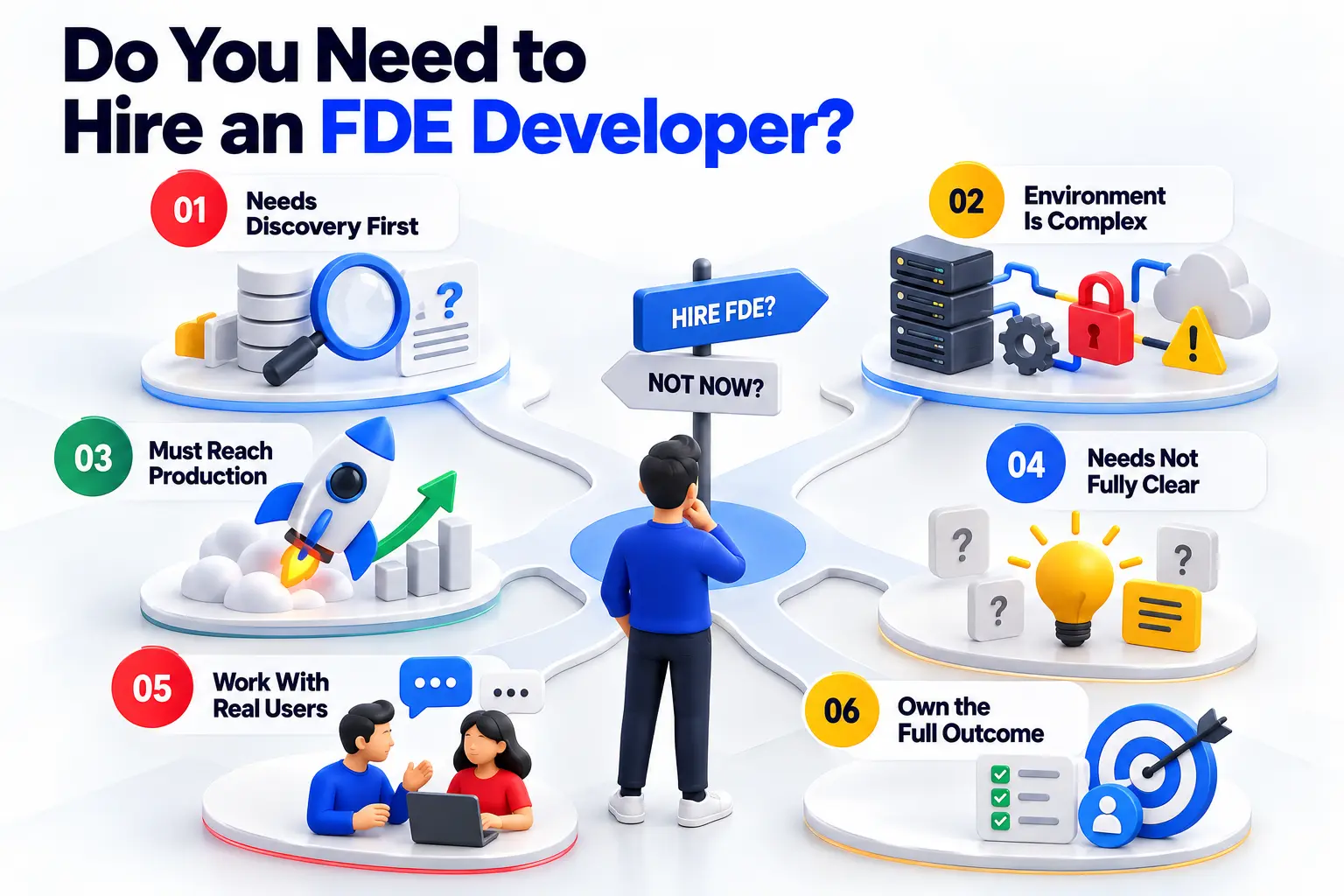
      When an AI implementation Partner is the Right Call

      • The problem needs discovery first. No one can define what to build until someone looks inside the system. Meaning, the build cannot start until that work is done.
      • The environment is complex. Old systems, locked-up data, or strict rules are blocking standard ways of shipping.
      • It has to reach production. A proof of concept is not the goal. A system the business uses every day is.
      • The needs are not fully clear yet. The business problem is known. But the right way to solve it is not.
      • The engineer must work with real users. Feedback between the builder and the people using it is what makes it work.
      • Someone must own the full outcome. Not just the code, but the adoption too.

      When an AI Implementation Partner Is the Wrong Call

      • The problem is already fully defined. If the spec is done, you need someone to build it. A regular hire or contractor fits better.
      • You just need more hands. Staff augmentation works better here.
      • You have a known backlog. A set list of tasks is better handled by a delivery team, not an FDE.
      • No one will own the system after. FDEs hand over to someone. If there is no one there, the work will not last.
      • You cannot give access to the real system. An FDE who cannot see the live environment cannot solve the live problem.
      • The problem still needs scoping. Start with a discovery phase. Then bring in an FDE once there is something to build.

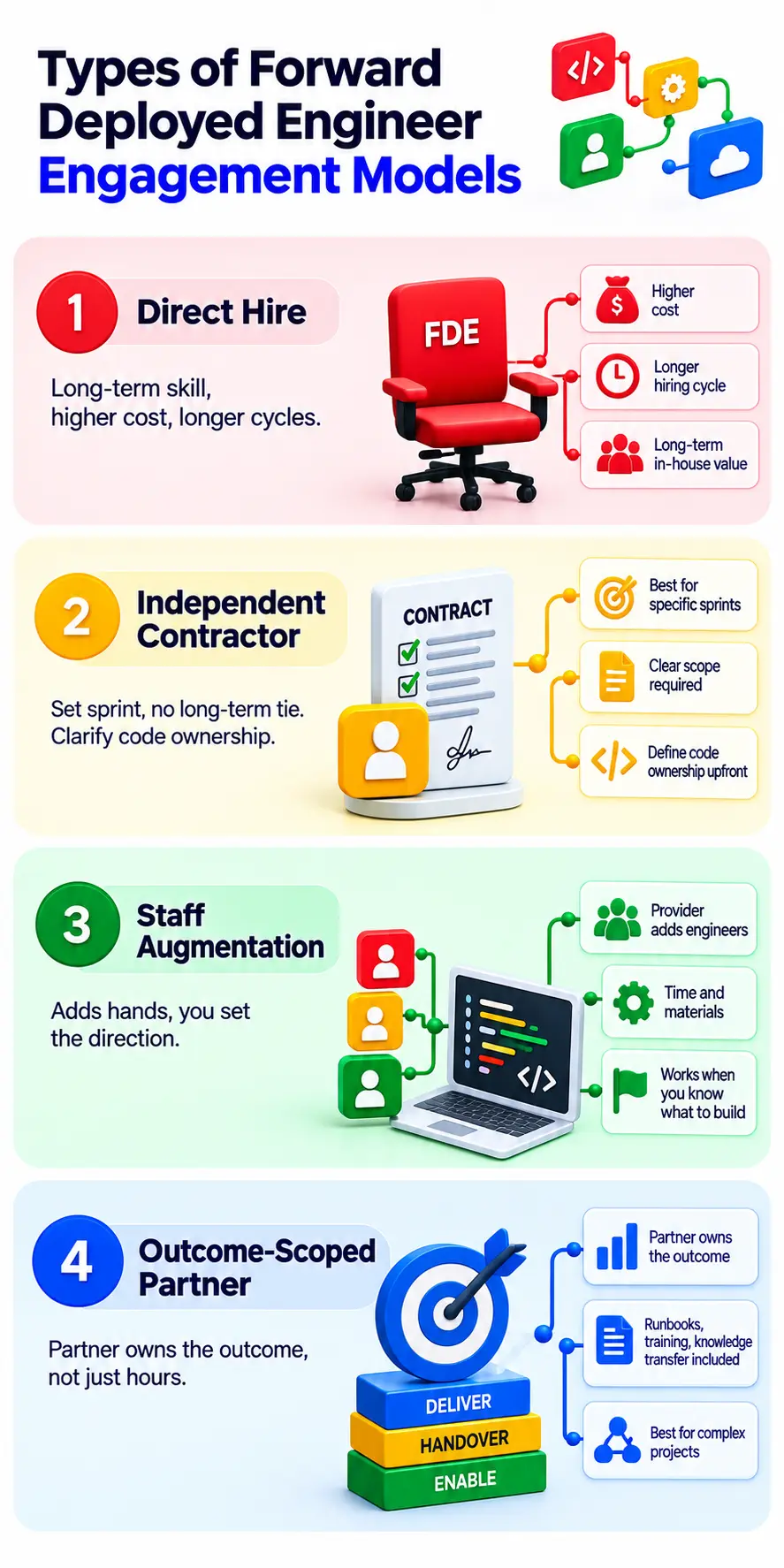
      Choose a Forward Deployed Engineering Engagement Model

      Four forward deployed engineering engagement models compared
      Model Best for Time to start Who leads the work? Who is accountable? What you keep
      Direct hire Long-term FDE capability Slow Your team You The person and their knowledge
      Independent contractor Short, defined piece of work Fast Your team Shared, per contract Code and docs
      Staff augmentation More capacity on a known backlog Fast Your team You Code and internal knowledge
      Outcome-scoped partner A defined result, shipped by a partner Fast Shared The partner Live system and handover docs

      1. Direct Hire

      Direct hiring makes sense when you want FDE skill inside your org for the long run. But the trade-off is time and cost. According to job boards for Anthropic, their pay is between $184,000 and $320,000 for this profile, and that is before equity. 

      Cycles run long due to how rare this profile is. Budget months, not weeks. But the knowledge stays inside your business for good.

      2. Independent Contractor

      A contractor gives you FDE skill for a set sprint with no long-term tie. This works when the scope is clear and your team can lead the work. However, one thing must be sorted before work starts: who owns the code. 

      Under US law, code belongs to the contractor unless a written agreement says otherwise. Do not leave this until the end.

      3. Staff Augmentation

      Staff augmentation brings in engineers from a provider on a time-and-materials basis. Your team sets the direction. 

      The provider adds the hands. This works best when you know what to build. However, if you still need to figure that out, this is not the right fit.

      4. Outcome-Scoped Partner

      An outcome-scoped deal means you contract with a partner to ship a defined result. Accenture, for example, runs a full Palantir FDE practice that works this way. 

      The partner owns the outcome, not just the hours. Handover is baked into the contract: runbooks, training, and knowledge transfer are all included. This model works best when complexity is high and your team does not have AI delivery experience.
      Open Popup

      How to Source Forward Deployed Engineers

      FDEs do not come from the same pool as regular product engineers. The mix of production depth and customer judgment is rare. Due to this, most hiring managers look in the wrong places and wind up with strong engineers who cannot work in a messy, customer-facing setting.

      Where to Look

      • FDE-specific roles. Engineers who held an FDE title at Palantir, OpenAI, Anthropic, Scale AI, or Databricks are the strongest signal. These firms vet this profile hard.
      • LinkedIn and networks. Search for Forward Deployed Engineer, Frontier Agent Engineer, or Applied AI Engineer. Look for production ownership language in the work history, not just the title.
      • Referrals. Engineers in complex enterprise settings tend to know others like them. Referral networks surface people who have not applied anywhere yet.
      • Adjacent roles. Customer Engineers from Google Cloud, Solutions Architects from AWS, and Technical Architects from Salesforce or ServiceNow can be a good fit, but only if their history shows real production ownership.

      Backgrounds That Translate Well

      • Forward Deployed Engineer or similar. Direct fit. But check that they owned production, not just advised on it.
      • Solutions Engineer with a build track record. Works if they wrote and shipped real code, not just designs.
      • Customer Engineer from a platform firm. Strong when they owned the outcome, not just the sale.
      • Full-stack engineer with customer-facing history. Can grow fast into the role if they have shipped inside a live, external system before.

      How to Vet a Forward Deployed Engineer

      A CV review and a coding test will not tell you if someone can do this job. You are hiring for two things at once: deep technical skill and the judgment to work inside a customer's world without being told what to do at every step. Due to this, you have to test both at the same time.

      Skill What to test Strong sign Weak sign
      Production engineering Shipping inside another org's live systems Real production examples with limits named Only clean, internal projects
      Technical discovery Digging into unclear needs before building Asks questions first, pushes back on the stated problem Jumps straight into coding
      Scoping Cutting a big ask down to something shippable Defines a 2-4 week scope with clear trade-offs Tries to build everything at once
      Communication Pushing back on customer assumptions without losing trust Offers clear options, speaks simply Always says yes, or speaks only in jargon
      Ownership Staying on the hook through launch and adoption Talks about what broke post-launch and how they fixed it Hands off right after shipping and moves on
      Adaptability Working with new tools and strange systems Evidence of picking up new stacks fast under real pressure Leans hard on one language or framework

      What Matters More Than Framework Knowledge

      Anthropic puts it plainly in its hiring docs: 'We care about what you can do, not where you learned to do it. About half our technical staff had no prior ML experience.' Accenture agrees. They care more about how a person breaks down hard problems than about what syntax they know. So in order of what really matters:

      • Production experience. Have they shipped code inside a live customer system, not a sandbox?
      • Customer discovery. Can they tell the gap between what a customer asks for and what they need?
      • Scope control. Will they cut scope to ship something that works, or try to build it all and ship nothing?
      • Ambiguity management. Do they build structure when no roadmap exists, or wait to be told what to do?
      • Production ownership. Do they stay through adoption, or leave once the code is in?

      What Matters Less Than Most Buyers Think

      • Long tech lists. A five-page skills section is not a sign of good judgment. Most FDE stacks get learned on the job.
      • Brand-name employers alone. Where they worked matters far less than what they owned and shipped there.
      • Specific framework expertise. The customer's stack will not match the candidate's prior one. Adaptability is what counts.
      • Model-training background. Most enterprise FDE work is about using and linking models, not training them.

      The 8 Interview Questions That Separate FDE Candidates

      Strong FDE interview questions are behavioral and specific. They test what someone has done, not what they think they should say. 

      Each question below maps to a core skill that Palantir, OpenAI, Anthropic, and Scale AI all look for. Listen for real detail, ownership words, and signs of judgment under real pressure.

      Question What to listen for
      Tell me about something you shipped inside a customer's system. Limits, access problems, stakeholder work, and who owned the result
      Tell me about a time a customer asked you to build the wrong thing. Discovery instinct, judgment, and pushback without breaking trust
      Tell me about something you chose not to build. Prioritization and scope control
      What did you do when you could not get the data you needed? Problem solving and the ability to unblock themselves
      How did you cut a big customer ask into something you could ship fast? Scoping and MVP thinking
      Tell me about a launch that broke after go-live. Production ownership and how they responded
      How did you hand the system over? Docs, runbooks, and knowledge transfer
      What would you do in your first two weeks with a new customer? Discovery method and how they plan the first steps

      Weak answers follow a clear pattern. The candidate talks about what they built but not the limits they hit. They repeat the customer's ask without asking if it was the right one. They call the job done when the code is merged, not when the customer can run it on their own.

      However, strong answers look different. The candidate names real people, real blockers, real calls they made. 

      With these FDE developers shortlisted talk about what went wrong and how they fixed it. Most importantly, they make it clear the outcome was theirs to own, not someone else's to sort out.

      How to Write an FDE Job Description

      Most FDE job ads fail before a strong candidate reads them. They list tools instead of describing the problem. 

      They use language that could fit any senior engineer role. Due to this, the right people scroll past without a second look.

      What to Put In an FDE Job Description

      • The actual business problem. Describe it in plain words. A strong FDE reads this and knows right away if they are the right fit.
      • The systems involved. Name the data sources, APIs, and platforms they will work inside. Hiding this wastes time for both sides.
      • The production outcome. Describe what must exist and be live when the work ends.
      • How success is measured. Adoption, reliability, or workflow impact. Not code shipped.
      • Customer interaction details. Name who they will work with and how often. Hidden travel or customer demands cause churn fast.
      • Handover expectations. State that the job ends with runbooks and a team that can run it alone.

      What to Leave Out of an FDE Job Description

      • Long lists of tools and frameworks. This signals you do not understand what the role needs.
      • Vague filler phrases. Phrases like passionate about technology are invisible to strong candidates. They skip past them.
      • Requirements not tied to the outcome. If it does not help ship and run the system, cut it.

      A Simple Template

      The problem: One or two plain sentences. Be specific about what is broken or missing.‍

      What you will do: Own discovery, design, build, and launch of the outcome. Work with real users. Stay on the hook through adoption and handover.‍

      The environment: Name the languages, cloud setup, data sources, and any governance limits.‍

      Done means: The system is live, adopted, and fully documented. Not just merged.‍

      What we need: 4 to 5 or more years of engineering. A track record of shipping inside complex customer systems. Python or TypeScript fluency. Experience in the relevant domain.

      How to Structure the FDE Engagement

      Most enterprise AI projects do not fail because the tech is wrong. They fail because no one set the work up before it started. Gartner links a large share of GenAI failures to unclear goals and poor planning. Both are setup problems. So define these things before any code is written.

      • The outcome. What must be live and working when the engagement ends? Write this down before work starts, not after.
      • Environment access. Access to data sources, APIs, and systems must be confirmed before day one. Access delays are the most common reason timelines blow up.
      • Code ownership. Under US law, a work-for-hire clause must be in writing for code to belong to the client. Sort this out before kickoff.
      • The internal owner. Name the person inside your org who will run the system after the FDE leaves. If no one is named at the start, no one will be there at the end.
      • Handover format. Agree on what handover looks like at kickoff, not at the finish line. Runbooks, training, and sign-off that the team can run it alone.
      • Exit terms. What happens if the engagement ends early? Who holds the half-built system? Decide this before it becomes a dispute.
      Area to define The key question
      Outcome What must be live in production?
      Access What systems and data are needed?
      Ownership Who owns the code and the running system?
      Internal owner Who takes the system after launch?
      Handover What docs and training are required?
      Exit What happens if the work ends early?

      How Much Does a Forward Deployed Engineer Cost?

      The cost depends on the model, the seniority of the person, their technical focus, and their location. 

      Direct FDE Hire Cost

      Base pay for FDEs at top AI labs runs between $184,000 and $320,000 per year in US tier-one markets. But these are base figures only. Equity is real and not in those numbers. 

      Due to this, the full cost of employment, including taxes, benefits, and equity, will sit well above the base. Hiring cycles are also long. Budget three to six months of active search, especially outside major tech markets.

      Forward Deployed Engineer Contractor and Staff Augmentation Cost

      There is no public rate for FDE contractors or staff augmentation. Rates vary by seniority, focus, and location. The US Bureau of Labor Statistics puts the mean wage for software developers at $138,110 per year. 

      However, FDE contractor rates sit well above that, given the production ownership and customer-facing demands the role carries.

      Outcome-Based FDE Partner Pricing

      Partner deals are priced by complexity, scope, and duration. There is no public benchmark. Meaning, treat any generic average figure with care unless it comes with a clear method and a real source.

      Cost factor Effect on price
      Seniority More depth and ownership means higher rates
      Location Tier-one US markets carry a clear premium - whereas outsourced FDE developers in countries like India or Philippines can be more affordable
      Technical focus AI and regulated-environment experience adds cost
      System complexity More systems and tighter rules mean more work
      Speed to start A partner or contractor starts faster but costs more than a long hire cycle

      Hire Directly or Use a Partner?

      Neither path is always better. But the right call depends on how long you need FDE skill, how fast you need to move, and whether your team can lead this kind of engineer once they are in place.

      Your situation The likely fit
      FDE skill is central to the business long term Direct hire
      Short-term, defined scope Independent contractor
      Known backlog, clear direction Staff augmentation
      Defined outcome, high complexity Outcome-scoped partner
      Problem not yet defined Discovery or consulting first
      No internal owner for the system Establish ownership before you start

      Go direct when you are building core AI systems that need to stay inside your org. The problem must be clear enough to justify a long-term hire. You need the management capacity to lead elite engineers. 

      Use a partner when complexity is high, your team does not have AI delivery experience, and speed matters. Accenture, which runs a dedicated Palantir Business Group, brings FDE methods and certified talent. IBM, Deloitte, and Google Cloud's professional services teams run similar setups at scale.

      How Entrans Scopes and Staffs a Forward Deployed Engagement

      Entrans brings Fortune 100 AI delivery experience and ISO 27001 certification to every project. But what sets Entrans apart is our method built around the points where most enterprise AI work falls apart.

      • Every Entrans project kicks off with an outcome session. The acceptance criteria are written and agreed on before any code is written.
      • What that means is scope creep gets taken off the table early, which is exactly what drives Gartner's finding that 60% of GenAI pilots never reach production. Entrans treats environment access as a hard requirement, not a task to sort out later.
      • We confirm that you have access to data sources, APIs, and deployment tools before engineering starts, all after NDAs are signed. This one step removes the most common cause of blown timelines in embedded work.

      Want to know how Entrans can help you with your FDE requirements? Book a free consultation call!

      Share :
      Link copied to clipboard !!
      Forward Deployed Engineering Services by Entrans
      Entrans FDEs work inside your systems and ship AI to production.
      20+ Years of Industry Experience
      500+ Successful Projects
      50+ Global Clients including Fortune 500s
      100% On-Time Delivery
      Thank you! Your submission has been received!
      Oops! Something went wrong while submitting the form.

      FAQs on How to Hire Forward Deployed Engineers

      1. What Is a Forward Deployed Engineer?

      A Forward Deployed Engineer is a senior engineer who sits inside a customer's systems and owns the full life of a solution, from discovery through launch and handover. The model was started by Palantir and is now used by OpenAI, Anthropic, Scale AI, and Databricks. They write production code. They own results. They are not consultants who hand off and move on.

      2. How Do You Hire a Forward Deployed Engineer?

      Start by picking the model that fits: direct hire, contractor, staff augmentation, or outcome-scoped partner. Then look at FDE roles at Palantir, OpenAI, Anthropic, Scale AI, and Databricks, or at adjacent roles from Google Cloud, AWS, Salesforce, and ServiceNow. However, vet for real evidence of production ownership and customer discovery, not just technical skill.

      3. What Skills Should a Forward Deployed Engineer Have?

      The core skills are production engineering, technical discovery, scope control, customer communication, and end-to-end ownership. Most FDEs work in Python and TypeScript and have cloud experience across AWS, Azure, or GCP. But framework know-how matters far less than the ability to ship inside a live, messy, real enterprise system.

      4. How Do You Vet a Forward Deployed Engineer?

      Use behavioral questions that call for real examples of past production work inside customer systems. Test for discovery instinct, scope judgment, and ownership language. Strong candidates talk about what went wrong and how they fixed it. Weak ones describe what they built without naming the limits they hit. Coding tests alone will not surface the judgment this role demands.

      5. How Long Does It Take to Hire a Forward Deployed Engineer?

      Direct-hire cycles are long. The profile is rare and competition is high. Budget three to six months of active search in tier-one markets. However, contractor and partner paths move much faster. Established providers keep pre-vetted talent pools ready, so start times can shrink from months down to weeks.

      Hire Forward Deployed Engineers
      Pre-vetted FDEs who have shipped AI inside complex enterprise systems.
      Free Project Consultation
      Trusted by Enterprises & Startups
      Top 1% Industry Experts
      Flexible Contracts & Transparent Pricing
      50+ Successful Enterprise Deployments
      Aditya Santhanam
      Author
      Aditya Santhanam is Co-founder & CTO of Entrans Technologies, spearheading AI-driven cloud and data solutions. A 13-year tech veteran, he leads innovation in generative AI, AI agents and MLOps. He also co-founded Infisign (identity security) and Thunai.AI (enterprise AI agents)

      Related Blogs

      Forward Deployed Engineering Services Companies: How to Choose the Right Partner

      Learn how to choose the right forward deployed engineering partner, compare providers, evaluate vendors, costs, engagement models, and key red flags.
      Read More ↗

      How to Hire Forward Deployed Engineers: Engagement Models and Vetting

      How to hire forward deployed engineers: engagement models, vetting questions, contract terms, and what FDEs cost.
      Read More ↗

      Why AI Pilots Stall, and What It Takes to Reach Production

      Why AI pilots stall before production, and how to fix it. Six blockers, a diagnostic, and a 9-point gate to move your AI pilot to production.
      Read More ↗