Learn how an offline EV charging OCPP solution keeps chargers operational, secures billing, and protects uptime during network outages.

Agentic Unconference 2026 - September 19, Chennai
View Event →


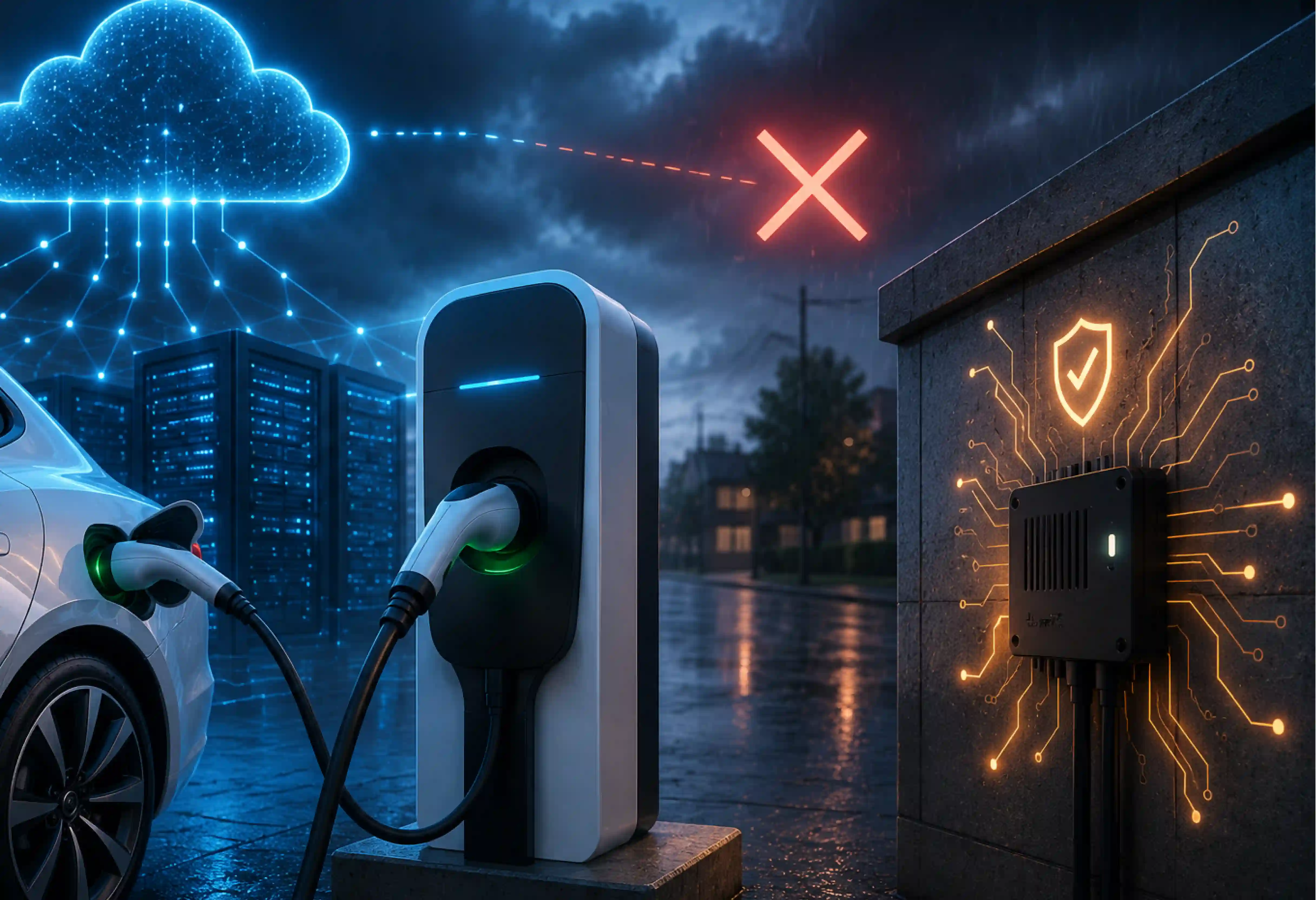


Is your EV charging network built to keep running when the internet goes down?
Most aren't!
When a CSMS depends entirely on a cloud connection to authorize sessions, store transactions, and manage load, a single network drop can strand drivers, wipe out billing records, and put your DR compliance at risk.
That's why this guide breaks down exactly how to build a CSMS that keeps charging through outages.
From the four deployment scenarios that make offline EV charging operations non-negotiable to the step-by-step playbook your operations team needs when a whole region goes dark - which is what this guide will cover…
The assumption that EV chargers will always have a strong, low-latency connection is one of the most common and costly design mistakes in 2026. Here are the four scenarios where offline EV charging operations is not optional:
Each of these scenarios requires the same underlying answer: a CSMS that treats disconnection as a normal operating mode, not a failure state.
OCPP is the standard communication protocol between EV chargers and a central CSMS. The most recent version, OCPP 2.0.1, has added meaningful offline EV charging features.
But understanding exactly where those features stop is what separates a well-designed edge system from one that falls apart the moment the connection drops.
OCPP gets you a solid foundation for short outages with known users. For anything beyond that, the architecture needs to go further.
A well-designed CSMS does not treat the network as a binary switch. Connections in the real world are rarely perfectly stable or perfectly dead.
A four-state model gives engineering teams a clear, automated set of behaviors for every condition the network throws at the system. Each state has a defined set of behaviors locked in before an outage ever happens. The system moves between states automatically, without waiting for a human to intervene:
Store-and-forward is the architectural principle that makes the four-state model work in practice.
The core idea is simple: all data writes to a local durable store first, regardless of whether the network is up or down, and gets forwarded upstream when conditions allow.
Getting this right separates systems that hold up through real outages from ones that lose data or collapse on reconnection.
The four-step pattern that works:
The most common pitfall is relying on retry logic instead of true store-and-forward. Retry logic assumes a temporarily unavailable service will come back shortly. At the edge, a failed connection can mean the network is gone for hours or days.
Continuous retry loops rapidly consume CPU cycles and lock up application threads that should be managing the physical safety of the charging session.
When connectivity does return, every node retrying at the same time creates a data storm that takes down the central system. The fix is to drop retry logic entirely and let the store-and-forward pattern do the work.
Authorization in Offline Mode: Cache, Allowlist, BLE-Assist
The biggest business risk in offline EV charging is revenue loss. If a station cannot verify a user's payment credentials, the operator faces a difficult choice: charge the vehicle for free, or turn the driver away.
In 2026, neither outcome is acceptable. Offline EV charging authorization needs to work across three layers.
The first line of defense is the local credential cache. The edge node keeps an encrypted store of recently authorized users.
When a driver with no cached credentials shows up at an offline EV charging station, the cache and allowlist don't help. This is where Bluetooth Low Energy (BLE) assist comes in, using the driver's smartphone as a secure bridge between the offline charger and the cloud.
The process works in five steps:
The driver's phone does the network work that the charger cannot do on its own. Sessions go through cleanly, payment is secured, and no revenue is lost, even during a total wide-area outage.
Getting the connection back is not the end of the process. Reconciliation is a financial, regulatory, and grid management task, and getting it wrong has direct cost consequences.
The edge node attaches precise timestamps to every offline EV charging event as it happens.
When data starts moving upstream through the controlled catch-up process, those timestamps let the system apply Time-of-Use billing accurately, even for sessions that took place hours ago.
This is not a nice-to-have; it is a billing accuracy requirement.
Accurate reconciliation ties directly to whether operators can claim the funding they are owed. Demand Response programs require operators to prove, with precise timestamped telemetry, that their chargers curtailed output during a grid event. Without that proof, the operator forfeits the DR rebate entirely.
Software architecture handles a lot automatically, but when a full regional outage hits, operations teams need a clear plan that goes beyond what the system does on its own.
The most effective incident response starts well before anything goes wrong. Three basics cut the risk significantly:
Beyond security, operators need to run a pre-peak systems audit on a regular schedule. This means checking that edge nodes have enough local storage for an extended outage, that allowlists have been pushed to all sites recently, and that BLE-assist is configured and tested at every location. Finding a gap during a routine audit is manageable. Finding it during a regional outage is not.
When monitoring systems flag a regional outage, the first job is to work out the scope. Is this a network failure, a hardware issue at the ISP level, or something adversarial? The answer changes the response.
While the edge architecture manages offline EV charging operations automatically, physical site issues still need human attention.
A jammed connector or a broken display cannot be fixed remotely, and during an outage when digital monitoring is unavailable, a single hardware problem at a busy depot can back up traffic quickly.
Having a site contact list ready for every high-traffic location is part of the playbook.
Moving beyond the just basic offline capabilities of standard OCPP, Entrans implements advanced edge solutions utilizing a four-state charging model: Online, Degraded, Offline, and Recovering
This goes especially considering we implemented this for a leading EV charger manufacturer and helped the company migrate from OCPP 1.6 to OCPP 2.0.1.
Entrans protects operator revenue during outages through localized caching, allowlists, and BLE-assist technologies
In doing this, we guarantee seamless driver experiences and accurate billing even when regions go dark.
Want to see what this would look like? Book a free consultation call!

The offline EV charging indicator means the charger has lost its wide-area network connection to the cloud. The session starts because the charger checks your credentials against a local cache or allowlist stored in its own memory. Authorization happens at the edge, and the transaction record gets stored locally until the connection comes back.
Without proper architecture, all of them try to push their stored data upstream at once, which hits the central CSMS the same way a DDoS attack does and can bring it down. A store-and-forward system with pull-based flow control prevents this by having the central system set the pace of data ingestion, pulling from each edge node at a rate it can safely handle.
BLE-assist handles this. The offline EV charger sends out a Bluetooth signal. The driver's EV app picks it up and relays the authorization request to the cloud over the phone's cellular connection. The cloud sends back a signed token, the app passes it to the charger over Bluetooth, and the session starts. The driver never needs to interact with the cloud directly.
The edge node records every event, including power curtailments, with precise timestamps in its local durable store throughout the outage. When connectivity returns, that data goes upstream as part of the controlled catch-up process. Utilities use those timestamped records to verify compliance and process DR rebates.
Not fully. OCPP certification proves the charger's protocol communication works correctly. The offline EV charging behaviors it covers, such as local auth lists and transaction queuing, are solid for short outages with known users. Extended outages, unknown users, multi-node load balancing, and controlled reconnection all require additional edge architecture that goes beyond what the OCPP spec covers on its own.

-1.svg)