Enterprise AI development services explained: why 95% of pilots stall, real cost ranges, ROI timelines, and how to pick the right partner.


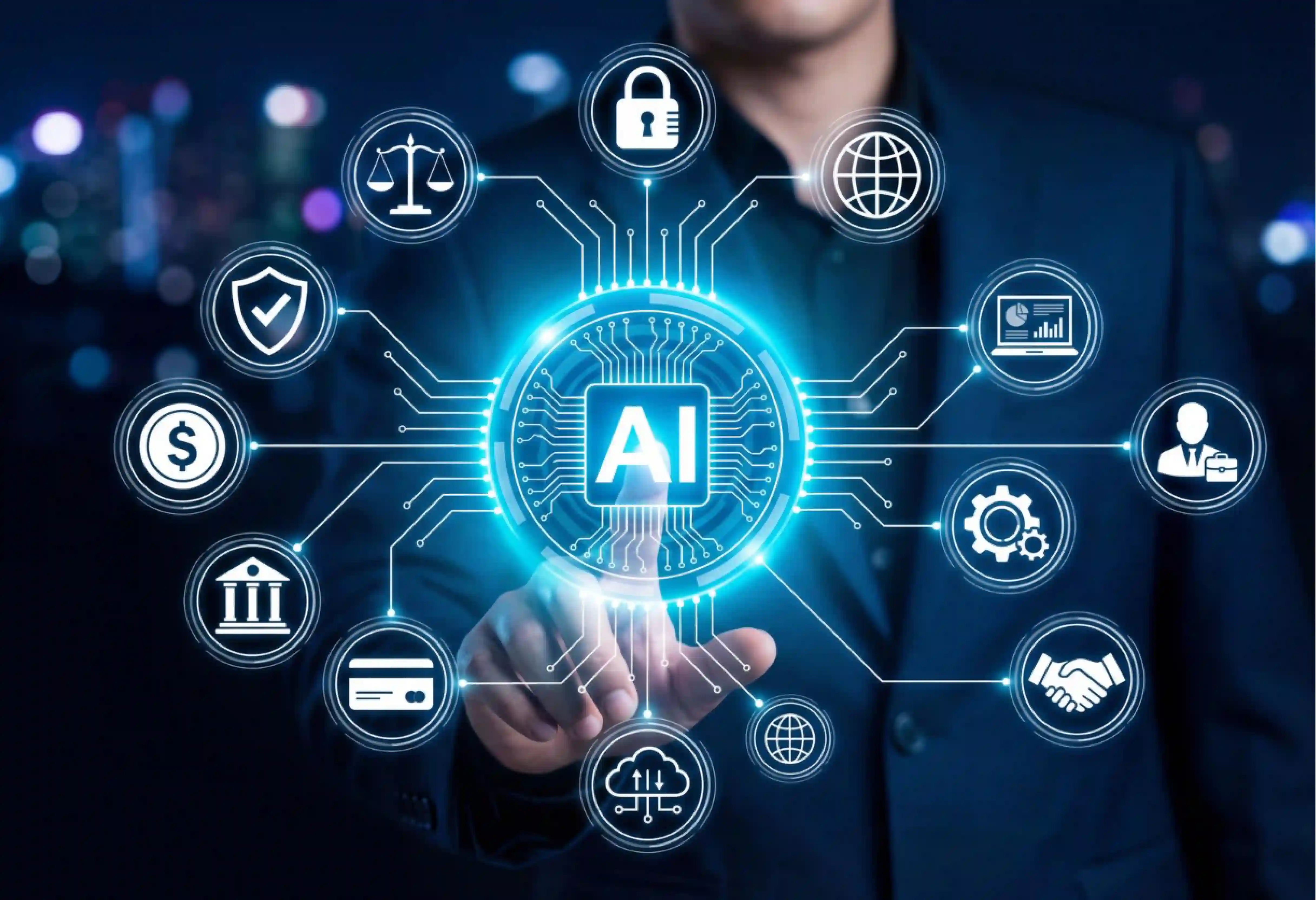


Imagine a system that thinks, learns, and breathes alongside its customers as a digital ecosystem. This forms the brain of your organization's Enterprise AI. Enterprise AI developments provide the architectural backbone for the modern intelligent corporation. By utilizing generative AI and agentic AI, businesses can now deploy intelligent systems that act. It bridges the gap, turning innovation into execution.
In this blog, we will examine in detail what enterprise AI development is and the ways of developing AI solutions for enterprise problems.
Enterprise AI Development refers to the design, deployment, and scaling of artificial intelligence systems tailored for core organizational operations.
Not like standard AI/ML projects, by not just building models but also integrating them into production systems, governance frameworks, and business operations at scale.
Enterprise AI in 2026 differs in three ways.
Enterprise AI development is no longer an emerging category; it has become a necessity. Statistics show that AI usage will increase by 44% year-over-year. Enterprise AI spending is expected to reach $247 billion in 2026. This growth is driven primarily by the transition from human-in-the-loop assistance to fully autonomous agentic workflows that directly impact bottom-line efficiency.
Recent research from MIT and Deloitte highlights that almost 95% of enterprise AI pilots fail to give expected results. At the pilot stage, results show promise, but many organizations struggle to move beyond early experimentation. This gap between initialization and execution is caused by foundational issues, slowing progress, and limiting ROI.
Most of the organizations consider AI projects as an innovation experiment and isolate them from the core business. These projects lack a defined pathway to production, no clear ownership, integration pathways, or measurable business outcomes. So without a roadmap, AI remains stuck and does not move on to the next stage, i.e., production environment.
AI systems totally rely on the data. Poor data quality, such as fragmented data sources and inconsistent formats, gives unreliable outcomes. Without rigorous data engineering, clean pipelines, reliable governance, and AI-ready architecture, the AI model is effectively predicting outcomes based on the data that is fed. These outputs make stakeholders not trust.
Some organizations don't prioritize security, compliance, and auditing in the first phase, and never adopt an AI risk management framework. This creates more challenges around compliance, security, and model transparency, especially in regulated industries. So when governance is introduced too late, it requires a lot of rework, slows deployment, and increases risk.
Traditional AI architectures are not designed to perform any action. They just focus on generating predictions or content, but cannot execute tasks dynamically. Agentic AI systems can think and act on their own with minimal human intervention. Without AI systems, organizations miss out on the full value of automation and real-time decision-making.
At Entrans, we treat the above challenges as design constraints and not as technology limitations. Our approach prioritizes the “Product” over the “Proof. To establish this foundation, understand how to build an enterprise AI strategy that can help, ensuring long-term tactical alignment before execution begins.
Enterprise AI adoption does not happen at one time. It basically happens through three main stages. We utilize a proprietary Strategy-> Agent -> Scale framework designed to move companies from experimental “AI curiosity” to autonomous operational excellence.
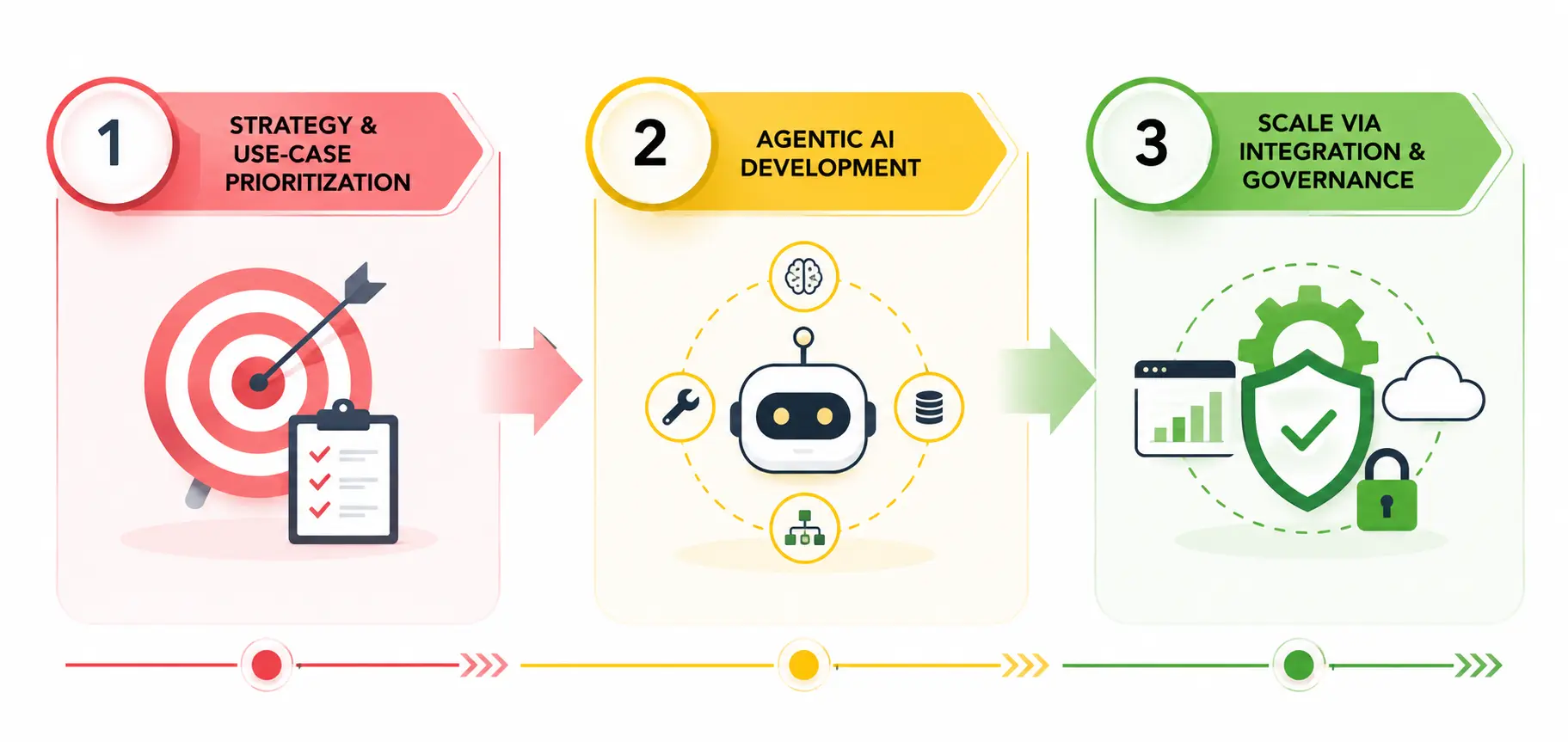
This is the most important stage, as most of the AI systems fail here. We start with auditing the organizational workflows to map high-frequency, manual, and heavy tasks against the specific capabilities of modern AI. The main focus is on identifying high-impact, feasible use cases aligned with business objectives. They evaluate data availability, quality, and infrastructure readiness. The overall outcome is to get a prioritized backlog of “High-Impact/Low-Risk” use cases that serve as the foundation of the roadmap.
Once the roadmap is finalized, the focus shifts to building agentic AI systems. This phase builds systems capable of reasoning, planning, and executing multi-step tasks. They allow them to interface directly with your existing software environment. The main focus is to design AI agents that operate within defined workflows. It combines models, tools, and data pipelines into cohesive systems. Unlike traditional AI, agentic AI provides real-time insights, delivers actionable outcomes, reduces manual intervention, and increases operational speed. Organizations can tap into specialized enterprise AI agent development services, which can be improved by designing workflows that map perfectly to legacy infrastructure.
It is the final phase where AI is embedded into the enterprise fabric. This requires rigorous CI/CD pipelines for AI, observability platforms to track performance drift, and guardrail governance to ensure every decision made by agents complies with your organization’s security and legal standards. This includes automated testing, feedback loops for continuous improvement, and deep integration into existing ERP/CRM middleware. This leads to a stable, reliable, and auditable ecosystem that functions as a core component of your operational tech stack.
Enterprise AI is not a single capability; it is an interconnected set of services that move organizations from idea to production at scale. At Entrans, we deliver full-spectrum enterprise development services that cover strategy, development, integration, and optimization. Below are the core enterprise AI development services delivered by Entrans.
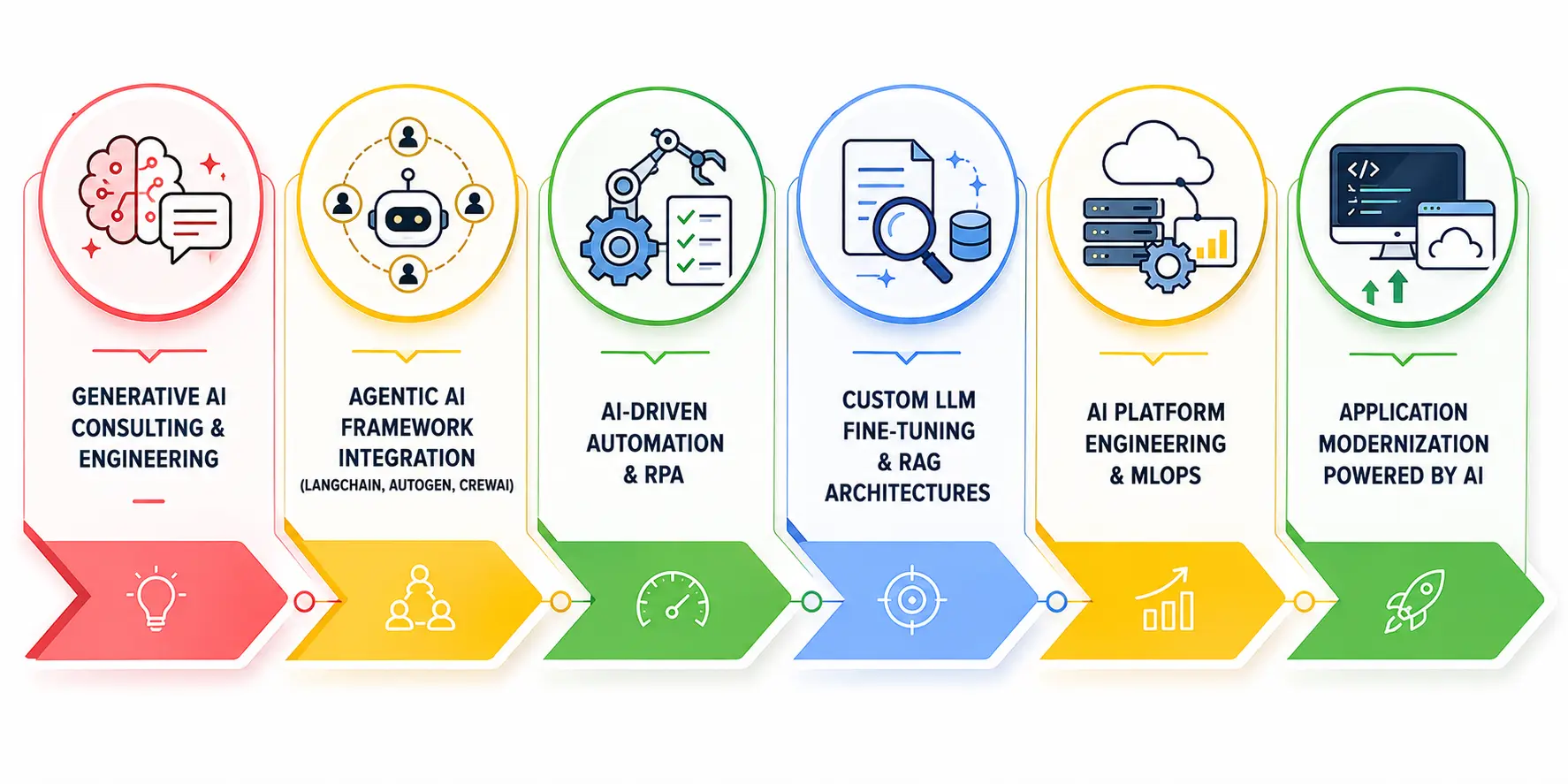
Our consulting services focus on high-level problems that arise because of AI intervention. We start with framing the use cases that align with industry standards. It bundles prompt engineering, model selection, and architectural design. The main goal is to deploy generative AI solutions that are secure. Comprehensive enterprise generative AI development services can be helped by aligning model engineering with your corporate security policies.
We build autonomous agents using frameworks such as Langchain, AutoGen, and CrewAI. These systems are designed to plan, execute, and perform multi-step tasks across existing enterprise software. We design multi-agent workflows for complex processes. We enable autonomous decision-making within defined constraints, and this forms the backbone of scalable, agentic AI architectures. Utilizing a seamless agentic AI framework integration can be improved by accelerating the deployment of these complex multi-agent layers.
We bridge the gap between traditional Robotic Process Automation (RPA) and intelligent automation. While legacy RPA is rigid and breaks easily with UI changes, our AI-driven automation utilizes computer vision and natural language processing to handle dynamic, unstructured processes. The key capabilities include repetitive, rule-based tasks with AI-enhanced decision-making. This reduces manual effort while improving speed and accuracy. This service makes enterprises move from static automation to dynamic, self-improving workflows.
We don’t believe in one-size-fits-all models. We build proprietary Retrieval-Augmented Generation (RAG) architectures that ground AI responses in your specific, secure enterprise data. We perform targeted fine-tuning on curated datasets to improve accuracy, terminology, and response style.
Scaling AI requires a strong foundation of DataOps and MLOps engineering. This service focuses on building the infrastructure and processes needed to operationalize AI. It covers end-to-end AI/ML pipelines such as data ingestion, training, and deployment. With robust MLOps practices, enterprises can maintain performance, reliability, and governance across AI systems.
Legacy system debt is the biggest barrier to AI adoption. We use AI to accelerate the modernization of monolithic, outdated architectures. We use AI-driven code refactoring tools to document legacy systems and migrate them to cloud-native environments. The result is a transition from outdated systems to intelligent, adaptive applications that support long-term innovation.
Choosing the best Enterprise AI development company is a strategic decision that can define the success of your AI initiatives. Let's see how the top enterprise AI development companies compare and reduce technical execution risks from day one. The following checklist gives a clear impact to choose an Enterprise AI Development company.
Before engaging with an enterprise AI development company, clearly define your organization's AI goals. Are you aiming for process automation, predictive modeling, or enhanced decision support?
Prioritize an Enterprise AI development company with a demonstrated history of success within your industry. Review their portfolio, case studies, and industry focus to confirm they understand large-scale systems.
Ensure the Enterprise AI development company possesses expertise in the specific AI technologies relevant to your needs, such as machine learning, natural language processing, or computer vision.
Focus on the enterprise AI development company that has delivered previous products with measurable outcomes.
Given the critical nature of AI, the enterprise AI development company must demonstrate a strong commitment to responsible AI practices, data privacy, and ethical considerations.
Request detailed case studies and client feedback to evaluate the enterprise AI development company's ability to deliver tangible business outcomes.
Understand the pricing structure models of an Enterprise AI development company. They should be transparent, long-term ROIs and not just initial development costs.
Ensure that the Enterprise AI development company offers flexible engagement models that align with business needs. Check whether the enterprise AI development company follows agile methodologies with iterative delivery and feedback loops. Rigid delivery models can obviously slow down the progress.
Governance should be built into the lifecycle at an earlier stage. Evaluate data privacy, security, and regulatory compliance practices. Ensure that the enterprise AI development company follows clear policies for responsible AI usage.
Look at the post-launch monitoring support of an enterprise AI development company that gives SLA-backed monitoring, model retraining, and supports feature expansion.
Budgeting for an Enterprise AI agent in 2026 requires looking beyond build. It varies depending on scope, complexity, and business needs. The costs are driven by the following factors.
The cost gap in enterprise AI development exists between experiment and product. It is a single project that goes through each stage with increasing complexity, scope, and cost.
Its main deliverable is testing feasibility on a specific, isolated dataset. The estimated cost is mainly for use-case validation and technical feasibility, initial model development,t or API integration. PoCs are designed to prove potential, not deliver production-ready systems.
In this phase, the PoC is expanded into a functional solution with a real business environment. The main deliverable is a functional, user-tested tool that handles edge cases, integrates with existing internal APIs, and includes basic human insight. It is an important phase, as many AI projects fail if they are not built on a scalable architecture.
In this phase, enterprise AI becomes operational, and major investments happen. The main deliverable is an autonomous agentic system embedded into your operations with automated CI/CD for AI and enterprise-grade compliance guardrails. So overall, the final product is delivered with governance, security, and compliance frameworks.
A simple way to estimate ROI is to compare the annual value generated against the total investment. Check on processes impacted by AI, such as support, operations, and finance. Translate that into annual savings or revenue lift. Most enterprise AI projects achieve payback in 6 to 18 months.
Enterprise AI development companies are driving major transformations across multiple sectors. Some of the major industries that boost efficiency and innovation are
Enterprise AI model success is not what you build; it is about how it executes. One should choose the right model that aligns with the internal capabilities, speed requirements, and long-term strategy.
Build internally when the AI application itself is a product, and if the business strategy relies on an algorithm. Consider this model only if you have a mature AI/data engineering team, and use cases are highly specialized. It also has disadvantages such as delays, hiring challenges, and fragmented systems.
Choose this when one needs a standard solution for email management, generic customer support, or simple data visualization. Prefer this if your competitive edge relies on workflows that deviate from industry standards provided by the platform. Choose this if you want rapid deployment with minimal engineering effort.
Partnering with a development firm is good when you lack in-house expertise and need specialized solutions. When your use cases require integration with complex systems such as ERP, CRM, and legacy tech, partnering with a firm is considered to be a good option.
Our Enterprise model has produced measurable outcomes in various industry verticals. One of the case studies is discussed below.
We have modernized the lending operations of a United States financial service provider. Our target goal was to streamline loan processing, ensure regulatory compliance, and deliver faster decisions. Entrans partnered with the client to develop a unified, cloud-native lending platform powered by rule-based decision engines and workflow automation.
Interested in knowing more about it? Check out the case study of transforming lending operations.
Partnering with Entrans is more than just selecting a service provider. Our Enterprise AI delivery model is built to move organizations from fragmented pilots to fully operational, scalable AI systems.
We accelerate your time-to-value with Thunai.ai - a specialized framework for building workflows and Infisign.ai - our robust solution for AI-powered identity and access management directly into enterprise systems.
Entrans also accelerates implementation through 6,000+ integration-ready connectors, enabling seamless integration with existing systems, ERP, CRM, and legacy systems, and provides AI development services for enterprise growth.
Our staff augmentation services blend onshore and offshore expertise. By this, we ensure the right talent at the right time, balancing high-touch local collaboration with cost-efficient global scalability.
Want to know more about how we build an integrated, intelligent, and future-proof enterprise?. Book a consultation call with us!.
Enterprise AI development involves designing, building, and deploying AI solutions tailored to specific business workflows, security standards, and governed data architectures. IT includes data engineering, model development, integrating with existing systems, and ongoing optimization.
The cost for enterprise AI development may vary depending on project complexity. data engineering requirements, the depth of legacy system integration, and the need for specialized security and compliance frameworks. Typically, it may vary from $10,000 to several million dollars.
To choose an enterprise AI development company, one must consider its industry experience, technical expertise, portfolio of past projects, client reviews, and cost structure.
Standard AI development focuses on passive models that process data to provide output or predictions based on predefined logic. Agentic AI development means creating autonomous systems that can make real-time decisions, execute multi-step tasks to achieve specific goals with minimum human intervention.
Enterprise AI implementation may take 3 to 6 months for smaller projects and more than a year for complex projects. The timeline varies depending on the scope, data readiness, integration complexity, and organizational alignment.
Enterprise AI development is mainly used for predictive analysis, process automation, and personalized user experience. Finance, healthcare, retail, and manufacturing benefit the most by implementing AI.
Enterprise AI projects deliver ROI primarily through increased operational efficiency, labor cost reduction, and creation of new revenue streams. Organizations that anchor AI initiatives and integrate them into existing workflows see break-even returns within 12 to 24 months.


-1.svg)