> Blog >
Mainframe Modernization to Cloud: What It Means, How It Differs from Migration, and Which Path Is Right for You
Mainframe modernization to cloud is not just migration. Explore the full spectrum of approaches, ROI ranges of 288 to 362%, and how to avoid the modernization trap.

Mainframe Modernization to Cloud: What It Means, How It Differs from Migration, and Which Path Is Right for You

3 mins
April 10, 2026
Author
Aditya Santhanam
TL;DR
  • Mainframes are not outdated relics. They still power 71% of Fortune 500 companies and handle 20 to 30 billion transactions every day, which means modernization is urgent, not optional.
  • Modernization and migration are two very different moves. Migration shifts code to the cloud as-is and carries over technical debt, while modernization rebuilds for cloud-native performance and delivers ROI between 288% and 362%.
  • There is no one-size-fits-all path. The journey ranges from API enablement and data-first approaches to full replatforming, and the right choice depends on your risk tolerance, budget, and performance needs.
  • The biggest hidden risk is the modernization trap. Patching legacy systems with API gateways without a real rewrite plan quietly stacks up debt and inflates costs over time.
  • In the case of upgrading older enterprise hardware, breaking the process down into clear steps makes things easier to follow and figure out.

    Mainframe systems might seem like rigid machines heading toward the end of their usefulness. The reality points out that they remain the daily operating foundation for 71% of Fortune 500 companies.

    Putting aside the complexity, the global reliance on these systems remains massive. Mainframe software handles 20 to 30 billion business transactions every single day. 

    Getting familiar with mainframe modernization to cloud plans early on can pay off well. Recent data points out the return on investment for these projects ranges from 288% to an extraordinary 362%

    Table of Contents

      Why Modernization and Migration Are Not the Same Thing

      The terms mainframe modernization to cloud frequently mix together in executive planning sessions. They represent fundamentally distinct technical plans. They carry vastly different risk profiles. They also dictate entirely divergent long term financial and operational outcomes. Here is a breakdown of how they differ.
      Cloud Migration Cloud Modernization
      • Transfers digital assets and applications from physical mainframes over to the cloud.
      • This process happens with minimal to no modifications to the underlying source code.
      • Primarily relies on emulation software.
      • This software runs older languages like COBOL on x86 virtual machines.
      • Aims to cut down immediate hardware costs.
      • Carries low short term execution risk.
      • Carries high long term risk due to carrying over technical debt.
      • Transforms, redesigns, or entirely rebuilds older workloads.
      • Aims to tap into cloud native features.
      • Breaks down large applications into agile, independent microservices.
      • Shifts over to object oriented languages like Java or C#.
      • Aims to bring about architectural agility and continuous innovation.
      • Aims for the ability to handle more work.
      • Requires putting down a higher upfront capital investment.
      • Yields exceptional long term return on investment.
      • Clears away older technical debt entirely.

      The Mainframe Modernization Spectrum: From API Enablement to Full Cloud Migration

      When to Modernize in Places vs. When to Migrate Entirely

      Viewing older changes as a binary choice turns out to be an analytical error. The process represents a complex range of architectural decisions. These decisions depend on operational risk tolerances and capital budget limits. In mainframe modernization to cloud, here are the primary stages mapping out this range.

      1. API Enablement and Encapsulation: The underlying mainframe source code remains entirely untouched. Companies roll out modern connection layers. These layers open up older business logic securely as RESTful APIs.
      2. Data First Method: Emphasizes splitting off the enterprise data layer from mainframe limits. This relies on Change Data Capture mechanisms. Operational data moves over to cloud native environments like Snowflake.
      3. Replatforming: Moves older applications onto a modern runtime platform. This includes targeted source code modifications. Primary logic stays the same. The physical servers shift over to the cloud.
      4. Refactoring and Automated Code Transformation: Algorithmic code mathematically changes over from older languages into modern languages like Java or Python. Generative AI models now speed up this process.
      5. Full Cloud Migration: The planned decision to completely throw away the older system. Companies either build up a new cloud native application from the ground up. Alternatively, they swap out functionality with a Software as a Service product.

      Making The Choice - Migrate Fully or Modernize Your Mainframe in Places

      Companies must figure out their specific operational needs when deciding their path in mainframe modernization to cloud. They choose to update in place on the platform or move entirely off the platform. Currently, 99% of enterprises run in hybrid environments.

      • Updating in Place: Microsecond latency and high volume concurrent batch processing demand this path. Performance physics heavily dictates this choice. Tightly linked compute and data setups help keep down cloud exit costs. Maximum data sovereignty and quantum safe hardware encryption also make this option preferable. The average cost to update on the mainframe dropped from $9.1 million in 2024 down to $7.2 million in 2025.
      • Moving Entirely: The need to clear up severe agility delays pushes this decision. Applications requiring rapid continuous updates fit this path perfectly. Applications needing dynamic auto scaling also benefit from moving over. This path becomes an operational necessity if the system uses highly obscure older languages. Such situations happen when maintenance talent completely ages out.

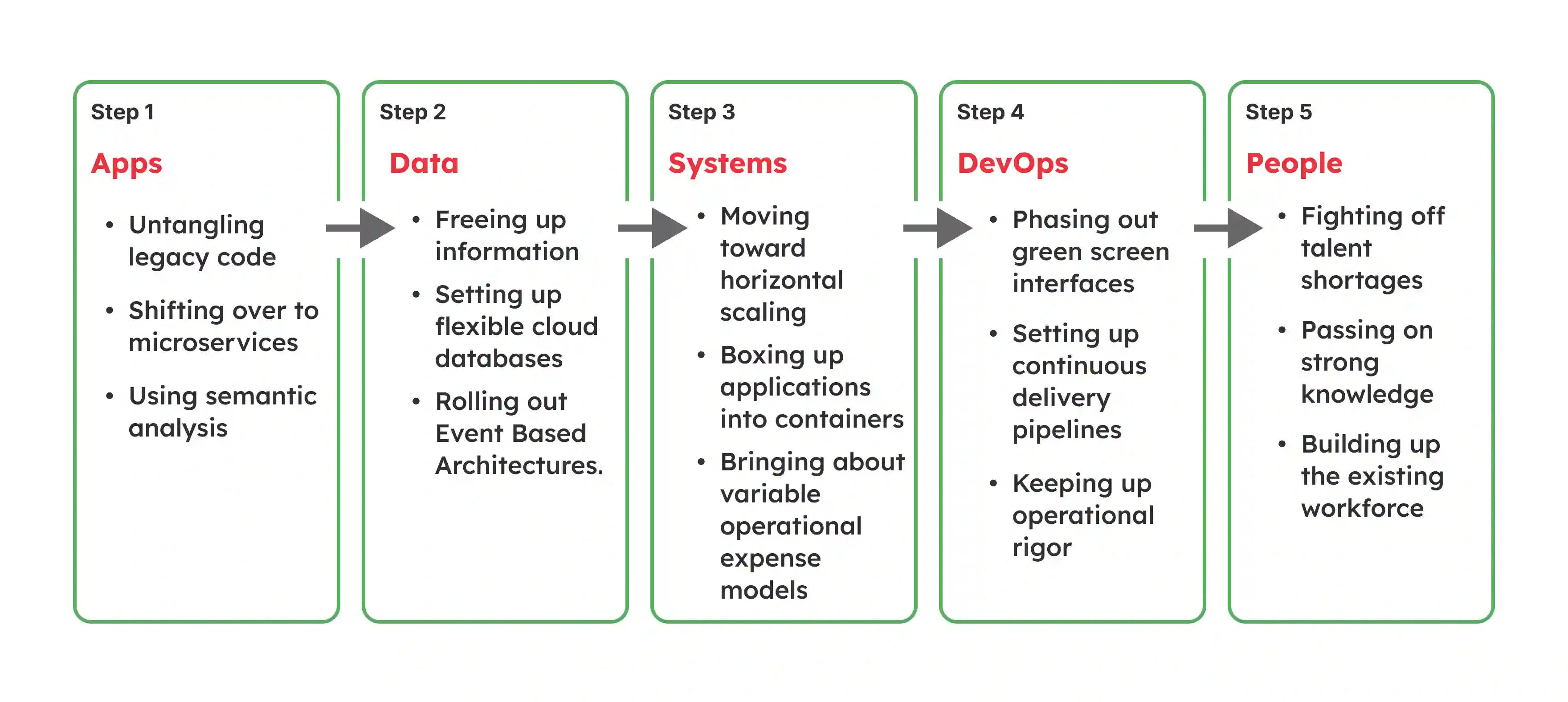
      The 5 Dimensions of Mainframe Modernization: Apps, Data, Infrastructure, DevOps and People

      A full program cannot solely target code translation. Orchestrating a synchronized mainframe modernization to cloud plan across five distinct dimensions sets up a sustainable path.
      Cloud as the Natural Endpoint for Mainframe Modernization Programs

      The mainframe remains a highly profitable part of the hybrid IT environment. The public cloud has overwhelmingly stepped up as the natural endpoint for updated older workloads. mainframe modernization to cloud took over a dominant 67.78% revenue share of the overall older modernization market in 2024. Three overriding business needs drive this massive shift.

      1. Economic Speed: Mainframe modernization to cloud helps wipe out exorbitant capital expenditure. Moving to the cloud phases out perpetual licensing costs. Transitioning over replaces static financial burdens with a highly elastic pricing model. This model relies on consumption. Using this model consistently cuts down operational costs by 60% to 90%.
      2. Advanced Innovation: The cloud opens up a platform for data based innovation. Companies instantly tap into a massive catalog of managed services. This access happens without issues. Serverless analytics engines can query historical data. Machine learning algorithms break down and analyze this data in minutes.
      3. Architectural Resilience: Cloud environments natively supply geographic dispersion. They simplify and speed up disaster recovery. They also handle automated multi region failovers. Cloud based disaster recovery solutions bring about rapid recovery at a fraction of the cost of secondary physical data centers.

      Industry Patterns: How Banking, Insurance, and Government Approach Mainframe Modernization to Cloud

      Dependency heavily concentrates in specific operational verticals. Because of this, mainframe modernization to cloud distinct patterns have emerged. Industry specific regulatory pressures heavily shape these patterns. Changing consumer expectations for real time digital access also play a part.

      • Banking and Capital Markets: Banks heavily lean toward a Hybrid API Led pattern with mainframe modernization to cloud. Executives view complete replacements as excessively risky. Banks update in place by opening up primary functions as RESTful APIs. They aggressively rely on AI tools. These tools root out and fix technical debt.
      • Insurance: Insurers increasingly move toward a Data First pattern in mainframe modernization to cloud. They break off massive data layers. This action allows real time access for advanced analytics without shaking up policy administration. They roll out Smart Claims Management systems powered by AI. These systems dynamically line up cases for human review.
      • Government and Public Sector: With mainframe modernization to cloud, the public sector quickly latches onto an Automated Refactoring pattern. Governments lean heavily on highly secure GovCloud environments due to strict data sovereignty mandates. They bring in AI transformation accelerators. These accelerators translate massive blocks of code over to modern stacks.

      Avoiding the Modernization Trap: When Incremental Becomes a Permanent Workaround

      Industry analysts highly recommend iterative methods. These methods present a significant hazard known as the modernization trap. This trap in mainframe modernization to cloud happens when short term technical fixes mutate into permanent architectural workarounds. Falling into this trap drives up technical debt rather than clearing it away.

      • Hiding older systems behind new interfaces stands out as the most common technical sign of the modernization trap. An enterprise might set up an API gateway to cover up a highly inefficient older process in mainframe modernization to cloud.
      • They do this to roll out a quick digital experience. The older mainframe was never designed to take on massive volumes of unpredictable cloud queries. Because of this, processing consumption shoots up. This leads to crippling operational costs. Moving software without changes can turn into a permanent trap.
      • An enterprise might merely move a large application over to a cloud emulator. Skipping the investment of time to rewrite the code means they hold onto all older limits. The business pays for elastic cloud servers but misses out on the native computational benefits after mainframe modernization to cloud.
      • Steering clear of this trap requires a fundamental shift in enterprise IT governance. Companies must view the process as a continuous, permanently funded lifecycle of iterative development. Companies must apply strict architectural discipline.
      • Treating API gateways strictly as transitional paths makes a huge difference. Companies must back up these paths with a mandatory, funded plan. This plan in mainframe modernization to cloud will eventually separate and rewrite the underlying older domains into independent microservices.

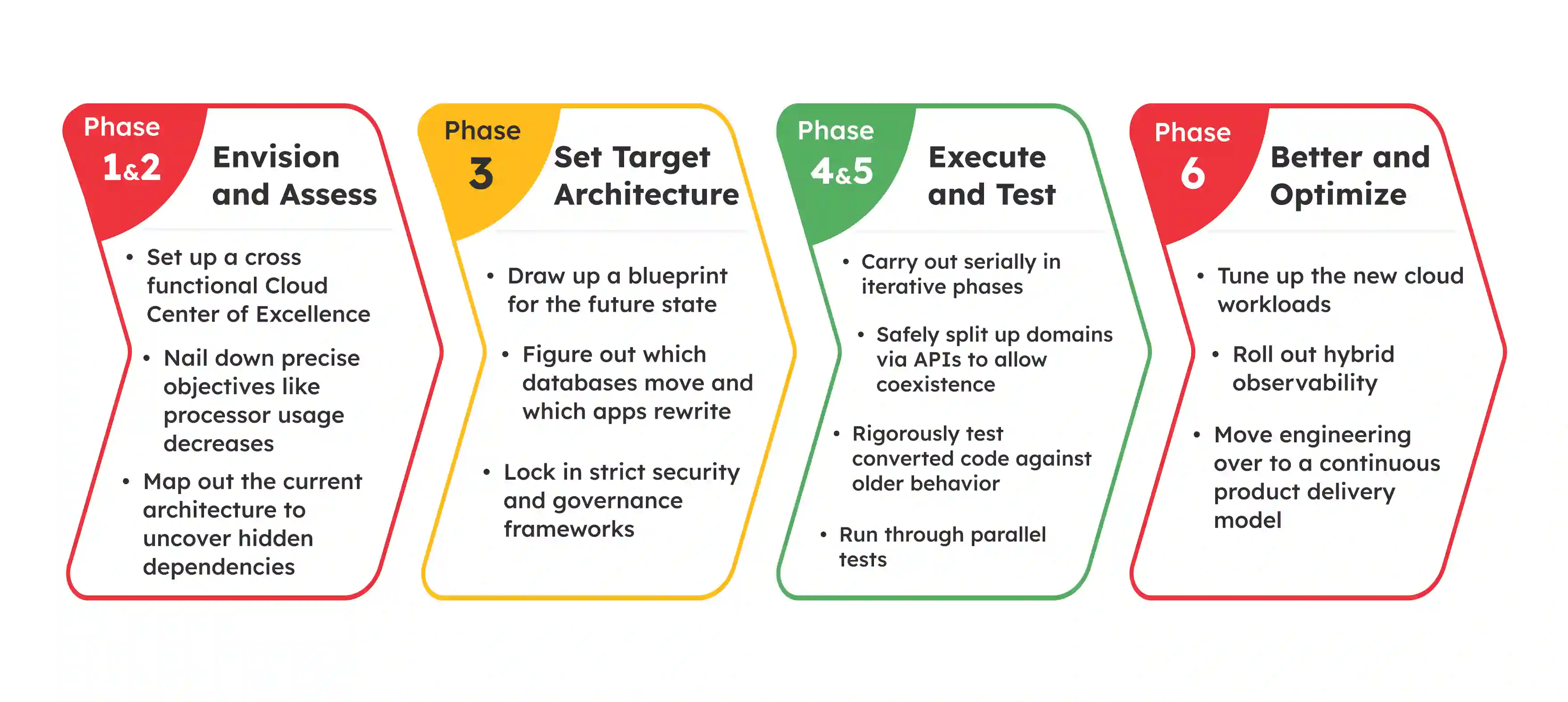
      How to Build a Modernization-to-Migration Roadmap That Evolves with Your Business

      Building a successful mainframe modernization to cloud plan requires rigorous orchestration. This shifts the executive mind from a purely technical migration over to a business value based transformation. Relying on established frameworks keeps the roadmap adaptable.
      Partnering With Entrans Experts for Your Mainframe Modernization-to-Migration Roadmap

      Partnering with experts ensures your mainframe modernization to migration roadmap delivers measurable, sustained business value.

      Rather than a risky rip-and-replace or a superficial lift-and-shift that preserves technical debt, Entrans treats modernization as a precise engineering discipline (especially considering we’ve partnered with Fortune 200 and Fortune 500 companies).

      So, Whether you are transitioning to microservices, executing phased deployments, or optimizing cloud operations, our tailored strategies minimize disruption - we can help you map this out.

      Want to know what the modernization to migration roadmap looks like for you? Book a free consultation call!

      Share :
      Link copied to clipboard !!
      Stop Maintaining. Start Modernizing.
      Entrans builds phased, low-risk mainframe modernization roadmaps tailored for global enterprises.
      20+ Years of Industry Experience
      500+ Successful Projects
      50+ Global Clients including Fortune 500s
      100% On-Time Delivery
      Thank you! Your submission has been received!
      Oops! Something went wrong while submitting the form.

      Mainframe Modernization to Cloud FAQs

      1. Is learning COBOL and mainframe technology a bad career path for a fresh developer?

      Absolutely not. Mainframes continue to run the absolute center of global business operations. This brings about a massive demand for developers as the older workforce retires. The most promising path blends older knowledge with cloud engineering and DevOps automation.

      2. What are the realistic costs and timelines for a full cloud migration?

      No universal baseline exists. Costs scale with company complexity. Complete rewriting historically took up to ten years. That path also cost tens of millions of dollars. Relying on agentic AI and LLMs actively compresses multi year timelines down to multi quarter deliverables.

      3. Is moving without changes a viable long term plan?

      Analysts and engineers heavily caution against leaning on it as a permanent solution. Moving code without changes simply takes older limits into the cloud. This carries over massive technical debt. Treating it strictly as an intermediate step within a broader rewriting plan works best.

      4. How exactly is Generative AI changing mainframe modernization?

      GenAI has genuinely shifted from theoretical hype over to a functional business catalyst. Currently, 88% of companies plan to roll it out or currently use it. Teams use AI to reverse engineer millions of lines of undocumented code. The software automatically maps out data transformations. AI also generates synthetic data for testing.

      5. What are the biggest technical hurdles that cause migration projects to fail?

      Profound technical complexities and poor planning bring about project failures. Notorious challenges include translating older EBCDIC data into modern ASCII formats. Managing fixed point versus floating point math discrepancies also trips up teams. Failing to map out intricate data dependencies before moving code acts as another massive hurdle.

      Hire Mainframe Modernization Experts
      Work with engineers who have delivered cloud modernization programs for Fortune 500 companies.
      Free project consultation + 100 Dev Hours
      Trusted by Enterprises & Startups
      Top 1% Industry Experts
      Flexible Contracts & Transparent Pricing
      50+ Successful Enterprise Deployments
      Aditya Santhanam
      Author
      Aditya Santhanam is the Co-founder and CTO of Entrans, leveraging over 13 years of experience in the technology sector. With a deep passion for AI, Data Engineering, Blockchain, and IT Services, he has been instrumental in spearheading innovative digital solutions for the evolving landscape at Entrans. Currently, his focus is on Thunai, an advanced AI agent designed to transform how businesses utilize their data across critical functions such as sales, client onboarding, and customer support

      Related Blogs

      Mainframe to AWS Cloud Migration: Tools, Services, and How to Run a Successful Program

      Migrate your mainframe to AWS and cut infrastructure costs by up to 85%. Explore tools, migration phases, security standards, and the AWS MAP program.
      Read More

      Mainframe Modernization to Cloud: What It Means, How It Differs from Migration, and Which Path Is Right for You

      Mainframe modernization to cloud is not just migration. Explore the full spectrum of approaches, ROI ranges of 288 to 362%, and how to avoid the modernization trap.
      Read More

      ETL Migration to Cloud: Key Considerations, Best Practices & Complete Guide (2026)

      Learn key considerations, migration strategies, and best practices for ETL migration to cloud. Reduce timelines and modernize your data pipelines in 2026.
      Read More