Discover the 12 EV charging software challenges slowing US operators in 2026 and the engineering fixes that solve them.

Agentic Unconference 2026 - September 19, Chennai
View Event →


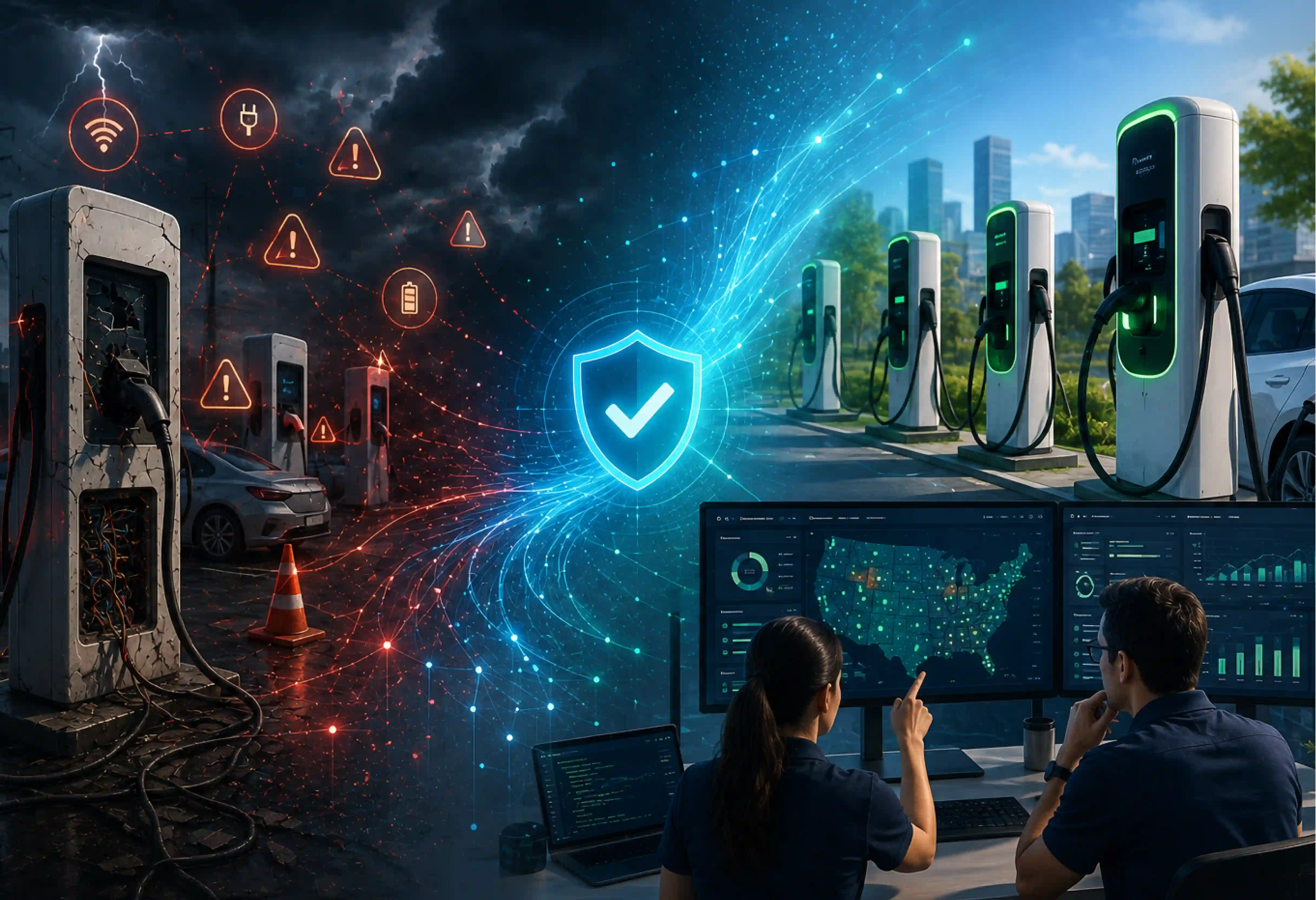


Running an electric vehicle company in the US can be extremely challenging!
This goes especially given the significant spend, risk of technical debt, and most importantly, the strict compliance requirements that can get updated year on year.
There is also a HUGE talent deficit in the EV market, given its niche and sometimes limited scope for developers.
That said, navigating this system is not impossible, granted you have the right systems in place
So to help EV companies and teams handle these, we’ve covered the main EV software challenges faced by US operators.
Over the years, the main developments in electric vehicles (aside from the stunning batteries) have been in software and regulations for safety in EV vehicles.
For instance, there is a mandate for uptime with chargers 97% of the time. This is a standard required in industry and one that needs to be met.
On the whole, EV charging challenges are not hardware issues, but rather ones that need to be fixed using software, OCPP updates, and better systems to deal with them.
This can be in areas where network issues are common. Or even the basement charging stations that create these issues.
Likely one of the most prominent challenges with EV charging software right now is offline charging. This has to do with validating users to use charging stations in low signal and no network areas.
There are aspects like the risk of the internet or mobile networks being unreachable or offline during important moments.
And in doing so, making it possible for users to validate credit card payments or wallet transactions is essential.
Not having this can be a huge risk in terms of trust and reliability for EV charging equipment distributors and EV charging stations. To deal with this, many manufacturers make use of Bluetooth EV charging authorization.
To enable EV charging, EV charging software and stations to use a data transfer protocol and language known as OCPP.
The issue with this is that every few years, there is an updated version of the language that causes many EV vehicle software and charging stations to be incompatible. (for instance, there are very distinct differences between OCPP 1.6 and OCPP 2.0.1)
In terms of EV charging software challenges, this is definitely one that comes to the top of the list.
EV vehicle sprawl causes there to be a huge number of EV charging stations, but the newer vehicles with updated OCPP cannot utilize the older, outdated ones, as they cannot connect to their home network.
One of the most damaging and least talked about EV software challenges right now is stuck transactions.
This is when a charging session starts fine, but never properly ends inside the system. The cable stays locked to the car. The driver cannot leave. And the backend has no idea what happened.
For drivers, this EV charging software challenge means physically hunting for the emergency release inside the trunk. Not a great experience at a highway charging stop.
But the financial damage goes further than bad reviews.
Some networks have responded by blocking all prepaid debit cards entirely. That is real revenue being turned away to patch a software timing problem.
If an OTA update is interrupted, even briefly, by a power flicker or a dropped cell signal, the charger can be left with no working software at all.
This is called bricking or getting bricked. The hardware is physically fine. But it will not boot, respond, or charge anything.
Unlike a smartphone, most legacy chargers do not have a backup partition to fall back on. One bad update, and the unit is done.
This risk is not one of the more theoretical EV charging software challenges.
In logistics yards, bricked chargers have forced teams to manually tow electric vehicles that could not move under their own power.
Paying to charge an EV should take seconds. Right now, for too many drivers, it does not.
Every tap of an RFID card or contactless payment has to travel through multiple systems in real time. The charging station talks to the CSMS.
The CSMS reaches out to a payment gateway, and the gateway communicates with a bank. Any single point of delay in that chain adds seconds. Sometimes tens of seconds.
Some operators have tried to fix this EV charging software challenge by forcing users to pre-load a balance into a closed app.
That removes the bank delay at the charger. But it also pushes away every driver who refuses to lock money into an app they might use once.
The real fix is edge-based payment validation that works even during connectivity drops. EV In terms of EV charging software challenges, most operators are not yet prioritizing fixing this.
EV charging has always been advertised as simple: plug in and walk away. No need for apps, no need for cards, and now it’s very quick!
Well, that’s what ISO 15118 Plug and Charge promises. The car and the charger usually exchange cryptographic certificates automatically, and billing happens in the background.
Another one of the EV charging software challenges is that almost no one has actually built this end-to-end. The standard is complex. Automakers and hardware manufacturers read it differently. And the security network required, called a Public Key Infrastructure, is expensive and hard to run.
Several major networks have quietly given up on ISO 15118 and switched to a workaround called Autocharge. Aside from this, according to a 2025 report, 90% of EV charger professionals expect grid capacity to hinder their growth over the next 12 months.
Autocharge reads the car's MAC address or VIN and bills the associated account (sounds perfect?). The reality is that MAC addresses can be spoofed and are often NOT secure.
EV drivers do not want to carry a different app or RFID card for every charging network they might visit.
OCPI, the Open Charge Point Interface, was built to solve this. It lets a driver registered on one network start a session on a competitor's hardware. In theory, it is one of the most important protocols in the industry.
In practice, it breaks constantly since different versions of OCPI do not map cleanly onto modern OCPP 2.0.1 data or even the newest OCPP 2.1.
One of the major EV charging software challenges is that when a roaming partner changes their API pagination or updates a security header during a routine patch, the whole connection silently fails.
Most EV operators find out a charger is broken when a driver files a complaint. That is too late.
Did the failure come from the car's onboard converter? A contactor inside the charger? The cellular backhaul? The payment gateway? Without distributed tracing, there is no way to know quickly.
In terms of EV charging software challenges, this one can be helped by operators using AI-powered anomaly detection to catch problems before drivers do.
Operators with this kind of visibility can fix up to 70% of network faults remotely, without sending anyone on site. That said, it is a direct cost for the uptime advantage.
The more secure EV charging becomes, the more it depends on digital certificates to work at all.
Every charging station, every vehicle, and every backend server needs a valid certificate to communicate. When a certificate expires or gets revoked, the connection is cut instantly.
No warning - the charger just goes offline!
Automated Certificate Lifecycle Management platforms exist to handle this, but connecting them to legacy CSMS backends remains one of the harder technical challenges in the industry.
When a huge number of electric vans return at the end of a shift and plugs in at the same time - the local grid connection cannot support all of them all!
Meaning, the CSMS has to distribute available capacity across every vehicle in real time.
However, if the load-balancing logic has a bug, one of two things happens.
Either it trips the site-wide breaker and takes everything down. Or, individual vehicles get throttled to zero kilowatts and sit uncharged until morning.
Harmonizing vehicle schedules, utility grid signals, and OCPP charging profiles without conflicts requires a level of AI orchestration most operators have not yet built - and can be a challenge in terms of EV charging software.
Open protocols were supposed to end vendor lock-in in EV charging. They have not fully delivered on that promise.
Hardware manufacturers regularly inject proprietary extensions into standard OCPP messages - These are control premium features like ad screens, built-in payment terminals, and liquid-cooling telemetry.
However, when an operator tries to switch to a different CSMS provider, those extensions break immediately because the new backend does not have the translation logic for them.
Which often leads to a total loss of premium functionality on hardware the operator already paid for.
Procurement teams are now demanding certified OCPP compliance testing before signing any new multi-million dollar network contracts.
Working on EV charging software is not a single discipline. It requires knowing high-voltage electrical systems, internet networking protocols, cryptography, and cloud software all at once.
A developer who knows WebSockets but not grid harmonics will miss things. An electrical engineer who knows load balancing but not Kubernetes will struggle to deploy anything.
One of the major EV charging software challenges - Right now, people who hold all of these skills at once are extremely rare.
The specific talent gaps around OCPP 2.0.1 technicians (which is what makes it hard to migrate from OCPP 1.6), OCPI roaming data routing, and ISO 15118-20 cryptographic setup are the most common to see.
Curious about OCPP migration and offline charging, and want to know how Entrans helps you get there?
With twelve active EV charging software challenges pulling in different directions, knowing where to start is half the battle.
The first 30 days should be entirely about triage. Deploy telemetry dashboards that correlate OCPP status codes with cellular modem data. Find out exactly where your offline gap lives. Run a forensic audit of your Charge Detail Records against payment settlement logs to see how many stuck transactions you actually have.
Days 31 to 60 are about securing what you have. Stop running OTA updates directly to legacy microcontrollers. Deploy industrial edge gateways inside the cabinet to handle encryption locally. Stand up a Certificate Lifecycle Management system with an automotive-grade PKI partner.
Days 61 to 90 are when you look about scaling this. With clean data flowing and the network secured, activate predictive maintenance models and deploy Dynamic Load Management with real AI orchestration. Begin closed-beta testing of ISO 15118-20 Plug and Charge with automaker partners.
Book a free consultation call with our team!

Connectivity and uptime are the most urgent and biggest EV charging software challenges. The federal NEVI program requires 97% uptime to access funding, but field studies show most public chargers fall well short of that. Software, not hardware, is the primary reason.
OCPP is the protocol that lets charging stations talk to management software. Older stations run OCPP 1.6. Newer systems require OCPP 2.0.1. The two are not natively compatible, and the hardware to upgrade many legacy units simply does not exist.
A stuck transaction is when a charging session starts but never properly closes in the backend system. The cable locks to the car, the pre-authorization hold stays on the customer's card, and the operator loses revenue they cannot recover.
EV charging software development role requires a rare combination of electrical engineering, networking, cryptography, and cloud software skills. Very few people hold all of these at once. As V2G and advanced grid communication standards grow in importance, the gap is getting wider, not smaller.

-1.svg)