> Blog >
AI Governance: What It Covers, Who Owns It, and Where Enterprise Programs Break
Find out about AI governance, its ownership, cost, and the process of developing the policies, technologies, and evidence required for rapid AI implementation.

AI Governance: What It Covers, Who Owns It, and Where Enterprise Programs Break

4 mins
September 11, 2026
Author
Jegan Selvaraj
TL;DR
  • AI governance is not only a governance framework but a functional requirement. It involves establishing ownership, approvals, monitoring, and evidence throughout the AI life cycle.
  • Clear ownership prevents enterprise deployment bottlenecks. Organizations must explicitly assign accountability across four core roles: executive sponsor, risk classifier, control implementer, and evidence custodian.
  • AI agents need tighter controls than models because they can access tools, change records, trigger workflows, and take actions.
  • Shift focus from static models to autonomous agents. For AI that is going from responding to queries to taking physical actions, AI governance needs runtime guardrails, limitations on API calls, and automated termination capabilities.
  • Consider an example where your AI application works perfectly fine during the pilot but creates problems once scaled up. Without clear ownership, approval rules, monitoring, and evidence, an AI initiative can fail. That is where AI governance comes in. AI governance defines who owns each decision and what evidence must exist before and after deployment.

    This blog will uncover the operational secrets behind seamless deployments and show how unlocking core AI governance benefits keeps your releases fast, reliable, and defensible. 

    Table of Contents

      What Is AI Governance?

      AI Governance is the operating framework, controls, management system, and audit trail that guarantees that AI systems are designed and used safely and ethically.

      AI Governance is not AI ethics, nor data governance, nor model accuracy optimization. It governs the process of creating, deploying, using, auditing, and deactivating AI.

      It enforces boundary lines through three critical pillars: 

      • Policy frameworks - These include the strategic guidelines, legal and regulatory requirements for acceptable thresholds of AI risk, business alignment, and compliance.
      • Engineering controls - These refer to technical controls embedded into CI/CD pipelines that implement policy guidelines programmatically.
      • Evidence - These include audit trails, monitoring output, model cards, and documentation supporting compliance and decision-making.

      AI Governance vs Data Governance vs AI Ethics vs Model Risk Management

      The key difference between data governance and AI governance lies in the following question: Is the data being managed properly? (data governance) Can we control the use of that data using AI? (AI governance). Model Risk Management goes deeper into whether a model's risks and performance have been independently assessed, while AI ethics asks whether the use of AI is responsible and acceptable. 

      A clear way to frame this is to show where the four disciplines overlap and where their responsibilities stop.

      Governance domain What it Governs Typical Owner Key Artifact Produced  What It Does Not Cover 
      AI Governance  Risks to the full AI life cycle: control, monitoring, documentation, and retirement of such risks. Chief AI Officer (CAIO) / Chief Risk Officer (CRO) AI System Passport / Algorithmic Impact Assessment  General data management, ethical principles by themselves, or detailed model validation 
      Data Governance  Data Lineage, Quality, Access Controls, Privacy Compliance with GDPR and CCPA, and Classification of data in the enterprise repository. Chief Data Officer (CDO)/Chief Information Officer (CIO)  Data Catalog, Lineage Data, Data Quality rules, Ownership & Access Control Approval of AI use case, performance of AI Model, or acceptance of AI decision 
      AI Ethics  Moral guidelines, societal impact, fairness principles, and human-centric values guiding AI development.  Ethics Board / ESG Lead / Corporate Compliance  Responsible AI Principles Charter & Ethical Risk Framework  Engineering controls, automated CI/CD guardrails & logging.
      Model Risk Management (MRM)
      Model Risk Management (MRM) Financial, quantitative, and statistical risk validation to prevent model failure or unexpected financial loss.  Head of Model Risk / Chief Risk Officer (CRO)  Model Validation Report, Risk Inventory  Non-quantitative outputs (e.g., LLM hallucinations/toxicity), AI policy orchestration, and broad regulatory ethics compliance. 

      Utilizing data governance for AI governance

      If you have established data governance functions, there is no necessity to rebuild your functional data layer from scratch. 

      What can be reused?

      • Data Catalogs & Lineage: The current process of tracing raw and sanitized data sources works well for training AI models.
      • Access Control & RBAC Policies: Security and identity controls that govern access to databases work for training datasets and endpoints.
      • Data Quality & Privacy Frameworks: PII data masking, data sanitization processes, and compliance data controls (GDPR/CCPA) work directly for preparing data for AI.

      What is new?

      It is the AI control layer around that foundation.

      • Use-Case Risk Classification: AI system classification in terms of risk for the use case and degree of autonomy and impact (low-risk or high-risk, under the European AI Act).
      • Evaluation & Inference Evidence: Continuous monitoring of the dynamic behavior of models (drift, toxicity, hallucination, prompt responses).
      • Model Approval & Gate Controls: Automated release gates integrated into CI/CD pipelines, including production guardrails and automated kill switches to disable compromised AI systems.

      Why AI Governance Matters Now, and What It Costs to Skip

      AI governance is shifting from a policy conversation to an operational necessity. Boards prioritize AI governance through three practical business forces: 
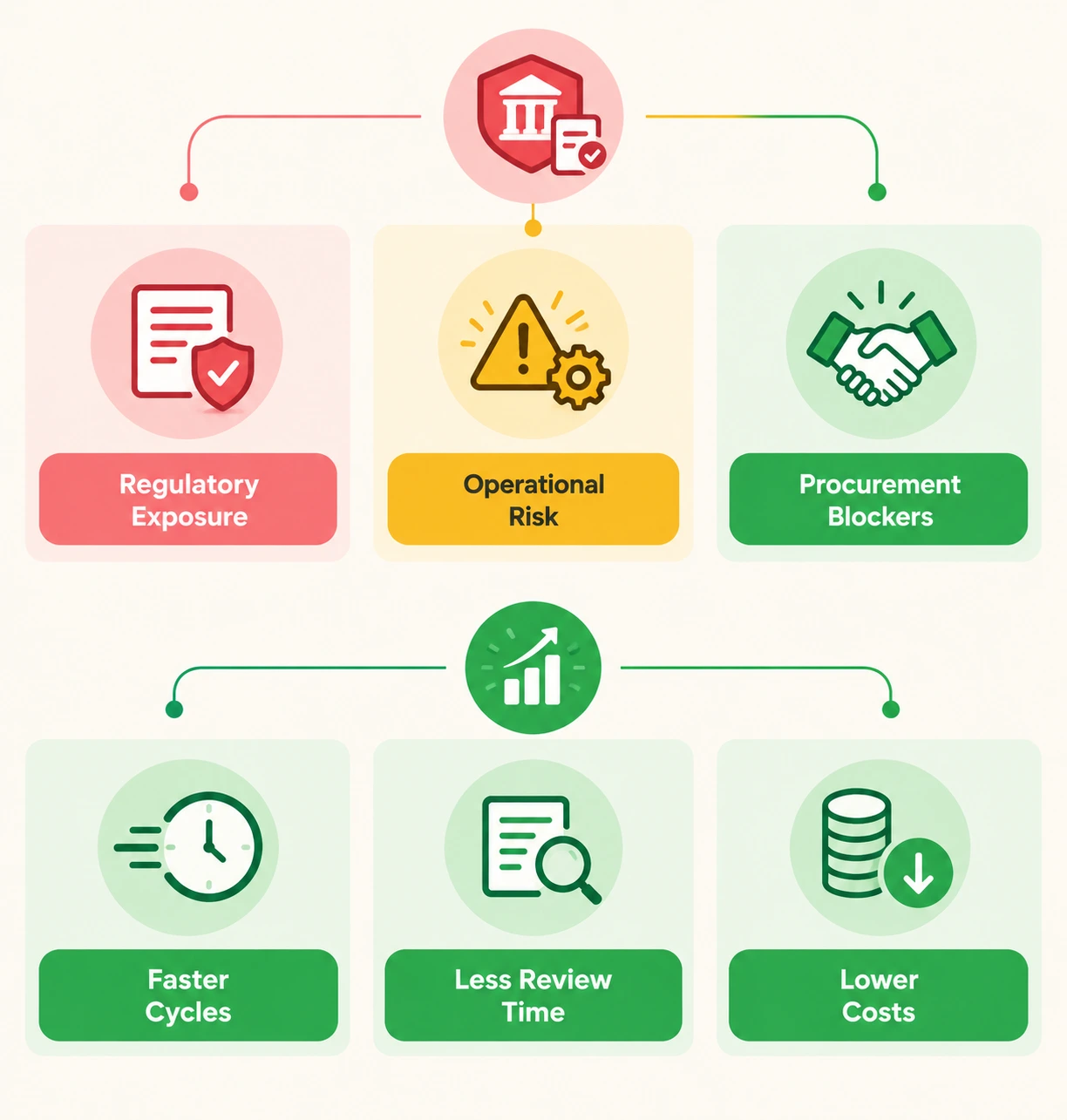
      AI governance business risks, regulatory exposure, and operational costs
      1. Regulatory exposure: There is an increasing amount of regulation regarding documentation, risk assessment, logging, human intervention, and transparency. For example, the EU AI Act was implemented in August 2026 and started the process of transparency, with high-risk duties including risk management, traceability, documentation, and human involvement.
      2. Operational risk: AI use creates certain operational issues, such as the lack of accountability for these tools and the need for testing and monitoring.
      3. Procurement blockers: Customers really want vendors to show how AI systems are governed, tested, and monitored before approving them.

      The AI governance benefits are thus pragmatic in nature: 

      • Quicker cycles due to pre-existing data, 
      • less time spent in the review phase for deployments, 
      • lower costs in the event of tough questions posed by auditors or consumers. Effective AI governance makes governance an inherent process of delivery.

      Who Owns AI Governance in an Enterprise?

      The biggest AI governance failure is often surprisingly simple: no one clearly owns it. It is a design decision about where authority, risk decisions, controls, and evidence sit. Organizations generally select one of three operating models: 

      1. Centralized governance function: A Single party (or Chief AI Risk Officer) develops policies, reviews cases, and analyzes facts.
      • Trade-off: Strict enforcement, but high operational risk of a bottleneck.
      • Best for: Highly regulated companies, small to medium-sized enterprises.
      1. Federated to Business Units: BUs execute deployment under central policy baselines.
      • Trade-off: Ensures agility and business context while increasing inconsistency across divisions.
      • Best for: Big firms with many business units.
      1. Engineering-led model: The governance framework is embedded into the development and deployment process.
      • Trade-off: Ensures maximum speed but might result in blind spots with regard to legal and non-technical regulations.
      • Best for: Tech-driven mature firms but might be lacking in business and risk management.

      Regardless of the model, four mandatory roles must exist:

      1. Accountable Executive: Owns the final business decision.
      2. Risk Classifier: Determines the AI use case's risk level. 
      3. Control Implementer: Puts required controls into the system. 
      4. Evidence Custodian: Logs and maintains audit-ready system telemetry.

      The Regulatory Landscape a US Enterprise Actually Faces

      For US enterprises, the regulatory environment is not a single law, but a patchwork enforcement boundary.

      • EU AI Act: With respect to a business in the US that operates in the EU, the EU AI Act would apply depending on the place where the AI system is placed on the market, used, or the location where its output is utilized, despite the business itself not being in the EU. These requirements will depend on the risk level, which may entail the following: transparency, documentation, human supervision, and others. It all depends on the particular application of the AI.
      • NIST AI Risk Management Framework (AI RMF): In the US, the NIST Artificial Intelligence Risk Management Framework (AI RMF) is a voluntary framework for AI risk management. The four fundamental activities of the NIST AI RMF framework include Govern, Map, Measure, and Manage. This framework helps firms understand the AI risks associated with their businesses. The NIST AI RMF framework has a Generative AI Risk Profile as well.
      • ISO/IEC 42001: The ISO/IEC 42001 standard is an internationally recognized AI Management System standard, and certification is also available through certification bodies accredited to provide such services. It is concerned with consistent policy, process, risk management, and continual improvement of responsible AI. It differs from the NIST AI RMF standard in that it provides a management system standard for certification.
      • Federal Reserve SR 11-7: For banks, SR 11-7 continues to be a significant document for the purpose of model risk management that deals with model development, validation, governance, and oversight. The document is not only concerned with statistical models but rather with model risk management itself.

      The Six Dimensions of an AI Governance Program

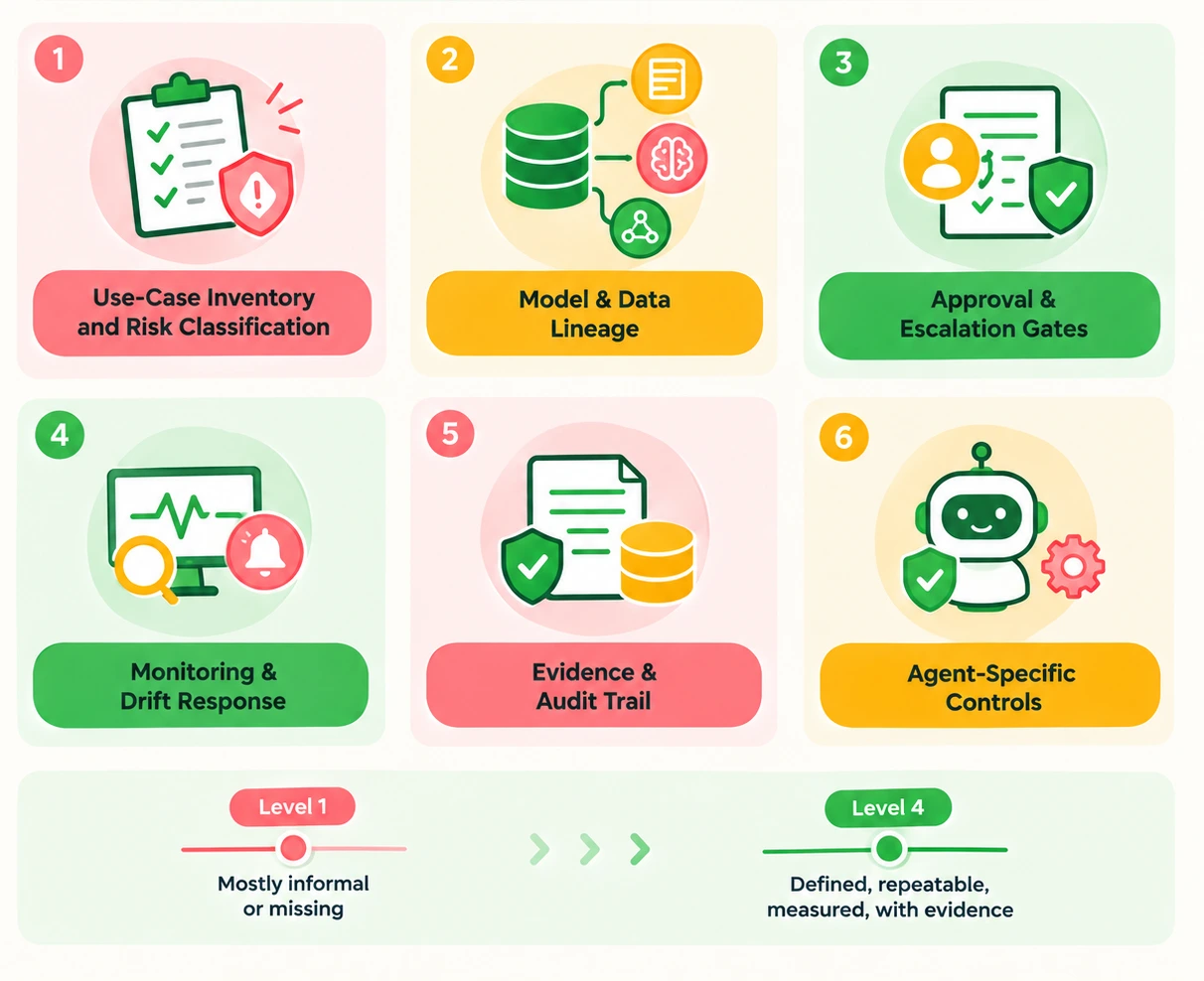
      A basic AI governance program must answer six questions:

      • What AI do we have?
      • Where did its data and models come from?
      • Who can approve it?
      • How do we know when something goes wrong?
      • Can we prove what happened?
      • What changes when AI can take action on its own? 

      Evaluating your AI maturity across the six core dimensions provides a clear operational baseline without requiring complex assessment downloads. Use the four-level scale below to score your current state. 

      • Level 1 means controls are mostly informal or missing. 
      • Level 4 means the process is defined, repeatable, measured, and backed by evidence.
      Six dimensions of an AI governance program

      1. Use-Case Inventory and Risk Classification

      Provides a continuous tracking system for AI use cases and rates the risk depending on impact, users, data, and decisions.

      • Key Artifact: AI Risk Register for Enterprise
      • Level 1: Use of AI is fragmented throughout teams, without any consistent risk classification.
      • Level 4: All use cases have an assigned owner, risk level, purpose, impacted stakeholders, and associated review requirements.

      2. Model & Data Lineage

      Keeping track of the origin of the data and models, their transformation, and their destinations.

      • Key Artifact: Enterprise AI Risk Registry 
      • Level 1: Scattered use cases, with no uniform risk categorization.
      • Level 4: All use cases have owners, risk tier, intent, impacted entities, and review process.

      3. Approval & Escalation Gates

      Deployable checkpoints throughout the deployment lifecycle that keep non-conforming systems from going to production.

      • Key Artifact: Stage-Gate Check-off Matrix and Exception Log. 
      • Level 1: Judgment-based decision and may vary among different groups.
      • Level 4: Criteria for reviewing the system, issues, and evidence based on risk-driven gates.

      4. Monitoring & Drift Response

      Continuous monitoring of the live model’s behavior, including decreases in accuracy, bias development, and data drift.

      • Key Artifact: Production Model Health Dashboard & Alert Logs.
      • Level 1: User complaints are the main method of identifying failure of the model.
      • Level 4: Telemetry data in real time, which leads to automatic alerts and traffic routing.

      5. Evidence & Audit Trail

      Immutable, centralized record-keeping designed to prove compliance to internal auditors and external regulators on demand.

      • Key Artifact: Audit-Ready System Passport & Evidence Package.
      • Level 1: Scrambling to reconstruct logs and code commits when an audit hits.
      • Level 4: Continuous, tamper-proof logging automatically indexed and queryable by compliance teams.

      6. Agent-Specific Controls

      Safety parameters governing autonomous systems that execute multi-step actions, access external APIs, or call tools.

      • Key Artifact: Agent Execution Policy & Boundary Matrix.
      • Level 1: Prompts relying on basic instruction-following without API action caps.
      • Level 4: Deterministic runtime guardrails restricting tool calls, budget limits, and human-in-the-loop triggers for high-impact actions.
      Open Popup

      What Changes Once Models Run in Production

      Pre-deployment testing proves potential; production reveals reality. AI operational governance shifts the focus from static evaluation to active runtime control. 

      The fact that the governance process does not end when the model is approved is another aspect. The production environment should continuously monitor drift, handle incidents, have proper ownership of the solution, and have a tested approach for reverting a model or configuration to the previous state in case of an incident.

      Risk is also altered by the transition from prediction to action. The model can impact a certain decision, whereas an agent can use an API, modify a record, send a notification, or initiate a workflow.

      Where AI Governance Programs Break

      Below are the four core failure modes where AI governance programs break down:

      Nobody owns the evidence

      Teams frequently establish high-level policies without explicitly assigning who collects, maintains, and verifies compliance documentation. Asking for the rationale behind model approval or its data sources leads to no one knowing the whole story. There is no clarity on who is responsible when the technology goes from research to production. Ownership of the evidence is required for good governance, not just policy ownership.

      Governance velocity does not match deployment velocity.

      From conception to deployment, artificial intelligence use cases may take only a matter of weeks, whereas the governance evaluation process may continue in a more cumbersome and manual manner. As a result, there will be a temptation to bypass the control process as opposed to waiting for it. It is easier for new models and applications to emerge at a faster rate.

      Shadow AI sits outside the inventory.

      Governance programs cannot mitigate risks, evaluate compliance, or apply policies to models and tools they do not know exist. Decentralized teams routinely adopt external generative AI tools, niche APIs, and open-source models without formal IT or security intake. These unvetted deployments silently introduce unknown data privacy leaks, intellectual property vulnerabilities, and unmonitored compliance exposure. Without total coverage across all shadow assets, even the most robust governance policies remain fundamentally ineffective. 

      Third-party model updates change behavior underneath a production application.

      Changes to the model of a production application will affect how the application operates even when no changes are made to the application itself. The changes could change how the application outputs data or responds to certain actions, or pose a different level of risk. It is essential to govern changes that third parties make to models and should not be considered maintenance activity for the vendor.

      What Is Changing in AI Governance

      AI governance is moving beyond static policies as AI becomes more capable and more deeply embedded in business operations. It is changing three core frontiers: 

      1. From Models to Actions

      As these AI agents go beyond merely answering to acting, governance must include what the AI system is allowed to perform, what systems it has access to, and when human approval is needed. According to Gartner, the approach to governance should be based on the agent’s autonomy level.

      2. Evidence-backed vendor procurement

      Not only are policy statements being asked for by buyers, but documentation on data, testing, security, monitoring, ownership, and incident handling is now becoming part of the vendor assessment and contracting process.

      3. AI Governance Is Reaching Cyber Underwriting

      Insurers in the cyber insurance field are beginning to include specific risks associated with artificial intelligence as autonomous technology brings about novel threats and liabilities. Changes in the market have indicated that insurers are reconsidering policy language and looking at AI-specific risks.

      The above recordings are as of September 2026; review them by March 2027.

      Honest Limits: What AI Governance Will Not Fix

      AI governance sets guardrails and operational standards, but it does not check the technical and organizational flaws. Here is what governance cannot do:

      • Governance will not fix a bad model or poor data: Policies cannot improve underlying model accuracy, eliminate inherent algorithmic bias, or substitute for rigorous data engineering. If your foundational data quality is poor, governance only creates a compliant pathway for unreliable outputs. Model development, testing, validation, and monitoring still belong with the teams building and operating it. 
      • Governance cannot classify risk without domain context: Risk classification frameworks fail when the stakeholders in the room lack deep domain expertise. Tooling cannot automatically evaluate contextual risk if nobody understands the specific operational use case and downstream impacts.
      • Governance cannot replace an operating model: Governance programs cannot simply be purchased as software platforms. Automated tools streamline workflows only after team roles, approval thresholds, and accountability standards are established; bought beforehand, platforms become expensive shelfware. 
      • More Governance Is Not Always Better: An approval gate on every model in a 300-model estate can bring deployment to a halt. Stop treating every model as if it carries the same risk. Apply deeper review where the impact warrants it and lighter controls where it does not.

      What to Stop Doing: Over-Governance

      • Mandating manual approval gates for every single model in a 300-model estate stalls deployment without reducing risk. 
      • Stop treating low-risk internal utilities like high-risk production systems. 
      • Tier your controls, automate low-risk approvals, and reserve manual review gates strictly for critical, customer-facing, or highly regulated deployments. 

      How Entrans Approaches AI Governance

      At Entrans, we start auditing with what is already happening rather than a policy template by following the process below.

      • Inventory and Mapping: First, we start with a governance baseline for two weeks. This involves assessing existing use cases of AI and their implementation and scoring the existing state in the six governance dimensions. 
      • Six-dimension scoring: We evaluate each deployment across six core operational dimensions: data lineage, security guardrails, auditability, model drift monitoring, regulatory alignment, and ownership. 
      • Gap Discovery: The review also involves identifying the artifacts of evidence that currently exist and those that are missing.
      • Deliverable: The output is a scored rubric and a prioritized, costed remediation backlog. It allows for a concrete understanding of the current situation, what needs to be done, and the necessary requirements for each remediation step. The aim is not to develop another presentation that will go into the common drive.

      In this way, it also helps to avoid one of the common pitfalls associated with governance - adding an approval step in front of every single application of AI just because it is required by the framework. With real examples, it becomes easier to identify varying risks.

      Across 200+ enterprise transformations, Entrans has seen that the blocker is often not the absence of a policy. The harder problem is the missing evidence needed to show that the policy is actually being followed. The next step is turning that baseline into a practical remediation plan.

      Learn more about how we carry out a successful AI governance program. Book a consultation call with us.

      Share :
      Link copied to clipboard !!
      Put AI Governance Into Production
      Build practical AI governance controls, ownership, monitoring, and evidence around your enterprise AI systems.

      FAQs

      1. What is the difference between AI governance and data governance?

      Data governance controls the quality, access, and lineage of data, whereas AI governance controls how models built on that data are classified, approved, monitored, and evidenced. 

      2. Who is responsible for AI governance in an organization?

      AI governance is a shared, cross-functional effort among business, IT, legal, security, data, and compliance teams. The Chief Risk Officer (CRO) or Chief Technology Officer (CTO) keeps everyone on the same page and makes sure decisions have clear owners.

      3. Is AI governance required by law?

      Yes. While there is no single global rule, major regional laws and regulations enforce AI governance: comprehensive regulations, sector-specific laws, and indirect legacy mandates.

      4. What does AI governance cost?

      AI governance costs vary widely depending on the organization's scale, industry, and existing infrastructure. A small program may need $15,000 to $90,000, while larger enterprises may need dedicated teams and tools. Overall, a mid-to-large organization's budget is $100,000 to $500,000.

      5. Do we need an AI governance platform?

      Not necessarily. You can start with existing tools, policies, approval workflows, and monitoring systems, then add a dedicated platform when the number and complexity of AI systems grow. 

      6. How is governing AI agents different from governing models?

      Governing an AI model focuses on predicting static outputs, while governing an AI agent focuses on controlling dynamic actions.

      7. How long does an AI governance program take to stand up?

      Setting up a functional AI governance framework takes 4 to 12 weeks for a focused, single-use-case rollout, while scaling a fully automated, enterprise-wide compliance program generally requires 6 to 12 months.

      Hire AI Governance Engineers
      Build and operate AI governance controls with experienced engineers who understand enterprise AI, security, monitoring, and compliance.
      20+ Years of Industry Experience
      500+ Successful Projects
      50+ Global Clients including Fortune 500s
      100% On-Time Delivery
      Thank you! Your submission has been received!
      Oops! Something went wrong while submitting the form.
      Free Project Consultation
      Trusted by Enterprises & Startups
      Top 1% Industry Experts
      Flexible Contracts & Transparent Pricing
      50+ Successful Enterprise Deployments
      Jegan Selvaraj
      Author
      Jegan is Co-founder and CEO of Entrans with over 20+ years of experience in the SaaS and Tech space. Jegan keeps Entrans on track with processes expertise around AI Development, Product Engineering, Staff Augmentation and Customized Cloud Engineering Solutions for clients. Having served over 80+ happy clients, Jegan and Entrans have worked with digital enterprises as well as conventional manufacturers and suppliers including Fortune 500 companies.

      Related Blogs

      Enterprise AI Governance: Making It Work Across Business Units, Regions, and an Existing GRC Function

      Learn how to scale up AI enterprise governance from one business unit to another. Discover how to create scalable AI governance without compromising on speed of development.
      Read More

      How Much Does a Forward Deployed Engineer Cost in 2026?

      FDE cost in 2026 varies by hiring model, experience, and location. Compare salaries, contractor rates, FDE-as-a-Service pricing, and hiring costs.
      Read More

      AI Governance Frameworks Compared: NIST AI RMF, ISO 42001 and the EU AI Act

      Learn about the actual distinctions between NIST, ISO 42001, and the EU AI Act. Discover which AI governance system is right for your enterprise pipeline.
      Read More