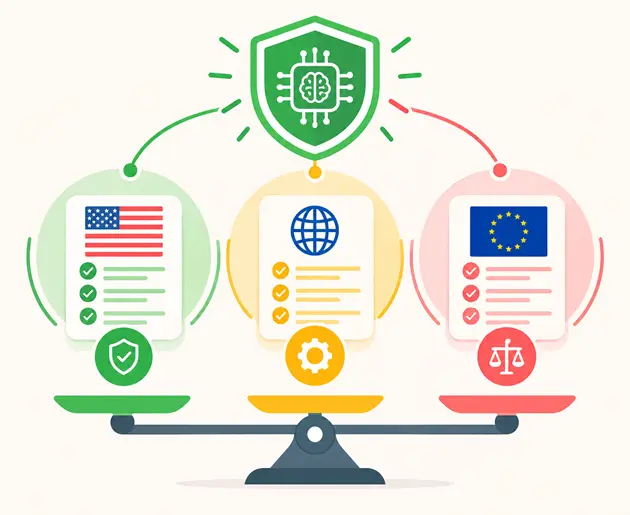
> Blog >
AI Governance Frameworks Compared: NIST AI RMF, ISO 42001 and the EU AI Act
Learn about the actual distinctions between NIST, ISO 42001, and the EU AI Act. Discover which AI governance system is right for your enterprise pipeline.

AI Governance Frameworks Compared: NIST AI RMF, ISO 42001 and the EU AI Act

4 mins
September 11, 2026
Author
Jegan Selvaraj
TL;DR
  • NIST AI RMF, ISO 42001, and the EU AI Act serve different purposes. The NIST AI RMF is a voluntary risk framework, ISO 42001 is a certifiable management framework, and the EU AI Act is mandatory legislation.
  • Pre-existing controls for SOC 2 and ISO 27001 may address many control requirements, while specific risk classifications for AI, documentation of models, testing, and monitoring may require additional controls.
  • Most companies employ NIST AI RMF for internal pipeline engineering and employ ISO 42001 to demonstrate compliance during customer due diligence.
  • Adoption of the frameworks requires the involvement of the engineering pipeline, not just the policy document.
  • What will happen when you select the wrong AI governance framework? The cost of such a decision will definitely be too high. Picking an AI governance framework looks easy until you understand that the NIST AI RMF, the ISO 42001 standard, and the EU AI Act are not really alternative frameworks for the same thing.

    They are voluntary, potentially certifiable, and legislative, respectively. Customer requirements, EU operations, regulatory exposure, existing security programs, and the number of AI systems in production can all change the answer. 

    This blog compares the three AI governance frameworks and bridges the gap between technical innovation and institutional trust.

    Table of Contents

      What an AI Governance Framework Actually Gives You

      An AI governance framework is essentially a publicly declared control framework, a set of requirements, and a set of evidence requirements for designing and managing AI systems.

      • What does it tell? It communicates the control domains that should be covered, such as risk classification, modeling, human monitoring, and what evidence should be maintained.
      • What it does not tell: It does not supply the controls themselves, which you implement in your own delivery pipeline.

      So are policy, platform, and framework the same?

      Taxonomy & Standards (The Framework): Rules & Guardrails (The Policy) Execution & Instrumentation (The Platform)
      Creates common language and sets criteria for evidence to demonstrate safety, fairness, and transparency. The framework maps out the territory, but not the controls.
      A policy states what the organization requires. Dictates organizational boundaries such as acceptable use cases, data privacy limits, and human-in-the-loop requirements. The platform helps put those requirements into practice. It automates monitoring, tracks model drift, logs pipeline audit trails, and generates real-time compliance reporting.

      Why choosing a framework is important

      It is important since the chosen framework influences the way your controls will be designed and measured. In terms of enterprise adoption, controls may find their place within model approval processes, data flows, monitoring procedures, access control, and auditing. Many enterprises may use more than one, with the regulatory requirements sitting alongside a risk or management framework.

      The bigger issue is the switching cost.

      The most common frameworks used are

      • NIST AI RMF: It provides a useful framework for organizations and is commonly adopted in voluntary practice in the United States. What is the solution to mitigate risks of AI related to identification, evaluation, and management?
      • ISO 42001: It uses a management system approach and provides a formal framework for managing AI governance. How should we build and run a formal AI management system?
      • EU AI Act: It is a regulation with legal requirements that can apply to organizations operating in or serving the European market. What legal requirements apply to the AI systems we place on the market or use?

      The right choice is therefore less about choosing the most popular framework and more about choosing a governance structure your business can actually operate and prove over time.

      The Three Frameworks That Matter for a US Enterprise

      Before evaluating specific options, enterprise leaders must understand a fundamental category difference: NIST AI RMF, ISO 42001, and the EU AI Act are not three choices on a single spectrum. 

      • NIST is a voluntary risk guidance framework
      • ISO 42001 is a certifiable management system standard
      • EU AI Act is a legally binding law. 

      When deploying an AI governance framework, US enterprises typically focus on these three core drivers. 
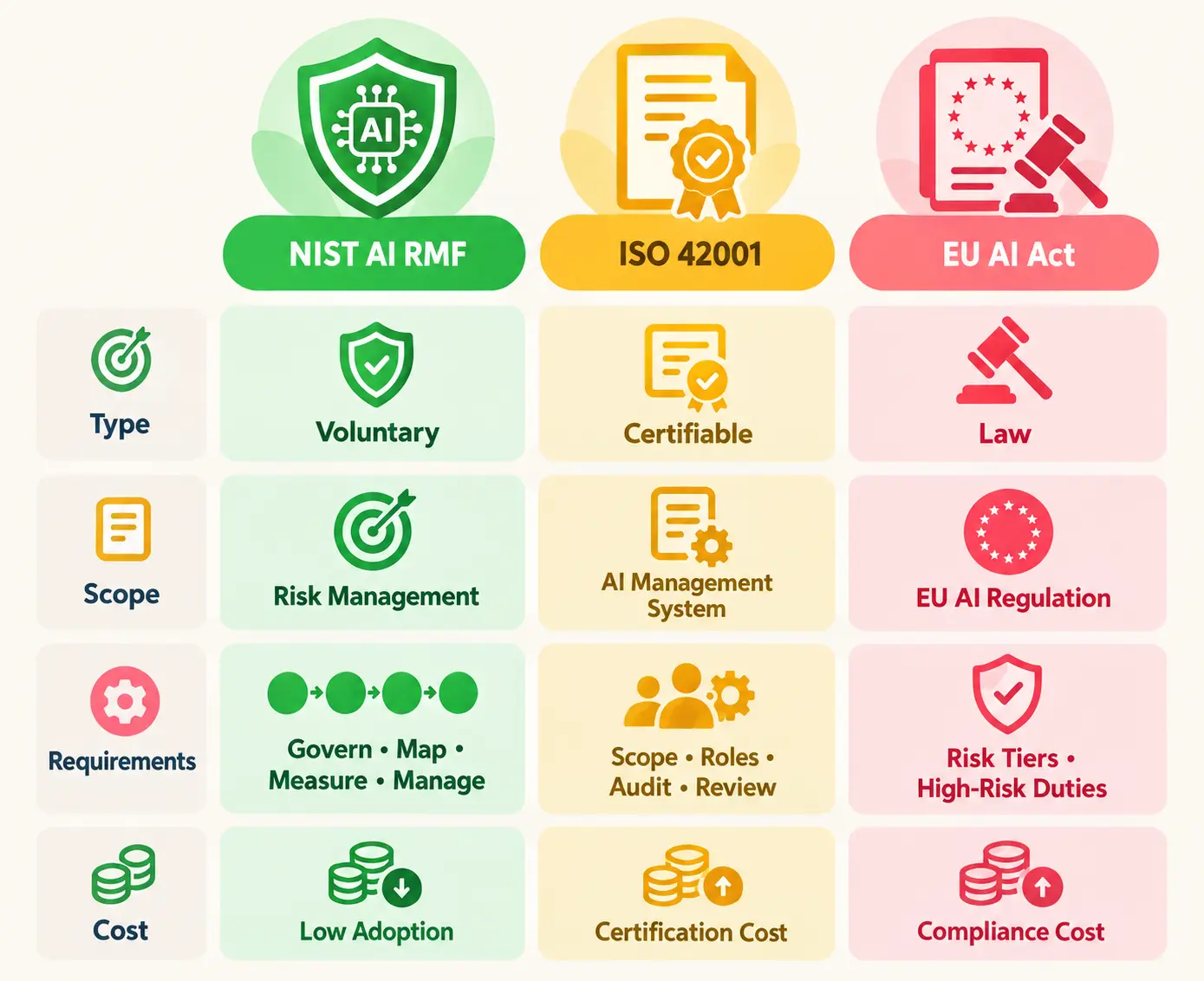
      AI governance frameworks including NIST AI RMF, ISO 42001, and EU AI Act

      NIST AI Risk Management Framework

      The NIST AI Risk Management Framework (AI RMF) is the voluntary US guidance framework for managing AI risk. It is built around four functions: 

      • Govern - Covers organizational culture, governance structures, and third-party risk policies. 
      • Map - Covers contextual documentation mapping system capabilities, deployment environments, and risks. 
      • Measure - Covers quantitative and qualitative testing, evaluation, validation, and verification (TEVV) metrics.
      • Manage - Covers documented risk allocation, mitigation strategies, and post-deployment monitoring plans.

      The evidence thus relates to the risk work: policy and responsibility records, context and impact assessment, testing and measurement outcomes, and records of risk management processes for identified risks. 

      In general, it incorporates issues of trustworthiness into the process of designing, developing, evaluating, and deploying AI systems.

      Who it binds

      No one legally. It serves as a voluntary baseline for US enterprises that acquire or use AI systems.

      What it demands

      This entails policies and accountability in governance, context, and risk documentation relating to AI, risk quantification and testing, monitoring, risk treatment, incident response, and continual improvement. The evidence stems from the application of the four functions through the AI life cycle.

      What it costs to adopt

      The framework is freely available. Cost varies by the size and maturity of the AI environment. The primary expense is building continuous telemetry, logging, and automated testing controls directly into your active CI/CD pipelines and machine learning workflows. 

      Best used for

      U.S. enterprise alignment & internal risk culture.

      ISO 42001

      A globally accepted and certifiable standard for an Artificial Intelligence Management System (AIMS) that specifies how an organization implements its AI governance capability.

      As against the NIST AI RMF, this standard is conceived as a management system that could be independently verified and certified.

      Who it binds

      Any organization seeking formal, third-party certification, most often driven by enterprise customer requirements, procurement hurdles, or vendor due diligence. Certification is the explicit reason most enterprises adopt it. 

      What it demands

      ISO 42001 requires a formal management system having a clear scope, policies, objectives, responsibilities, risk processes, documentation, audits, management reviews, and a continuous improvement process. 

      The main distinction of the NIST approach is that here the organization develops a formal management system which can be audited and certified.

      What it costs to adopt

      The costs are the standard costs, internal preparation, documentation, internal audit, and external certification where the organization requires it. The total cost is determined by the size of the organization, its existing management systems, artificial intelligence footprint, and amount of preparatory work required before the audit of certification.

      Best used for

      Global enterprise certification & supply chain trust. Enterprises choose it, particularly when customers, partners, or procurement teams ask for formal evidence of an AI management system. 

      The EU AI Act

      An all-encompassing and legally binding framework set out by the European Union, which places statutory compliance obligations on entities developing or deploying AI technologies in the EU.

      Who it binds

      The standard is applicable to entities that develop, offer for sale, or use AI technology in accordance with the terms and conditions of the Act, and this includes entities that are outside the EU. An American corporation conducting its operations within the EU in a manner governed by the Act would be included.

      What it demands

      Requirements will depend on the category of risk the system falls under. High-risk systems will have requirements relating to risk management, data quality, logging, technical documentation, human intervention, accuracy, cybersecurity, and monitoring.

      What it costs to adopt

      Direct legal, technical, and regulatory overhead. Enterprises must fund rigorous legal risk classifications, re-engineer pipeline telemetry to maintain audit-ready technical files, and establish continuous monitoring operations to meet strict enforcement penalties.

      Best used for

      Legal compliance for systems deployed or used in the EU.

      The Comparison Table: Control by Control

      The following comparison provides a breakdown of the different controls that make up the landscape of the AI governance framework and demonstrates where they overlap and do not coincide.

      Utilizing existing SOC 2 and ISO 27001 controls allows you to deploy AI governance frameworks for enterprise deployment without reinventing your entire operational architecture.
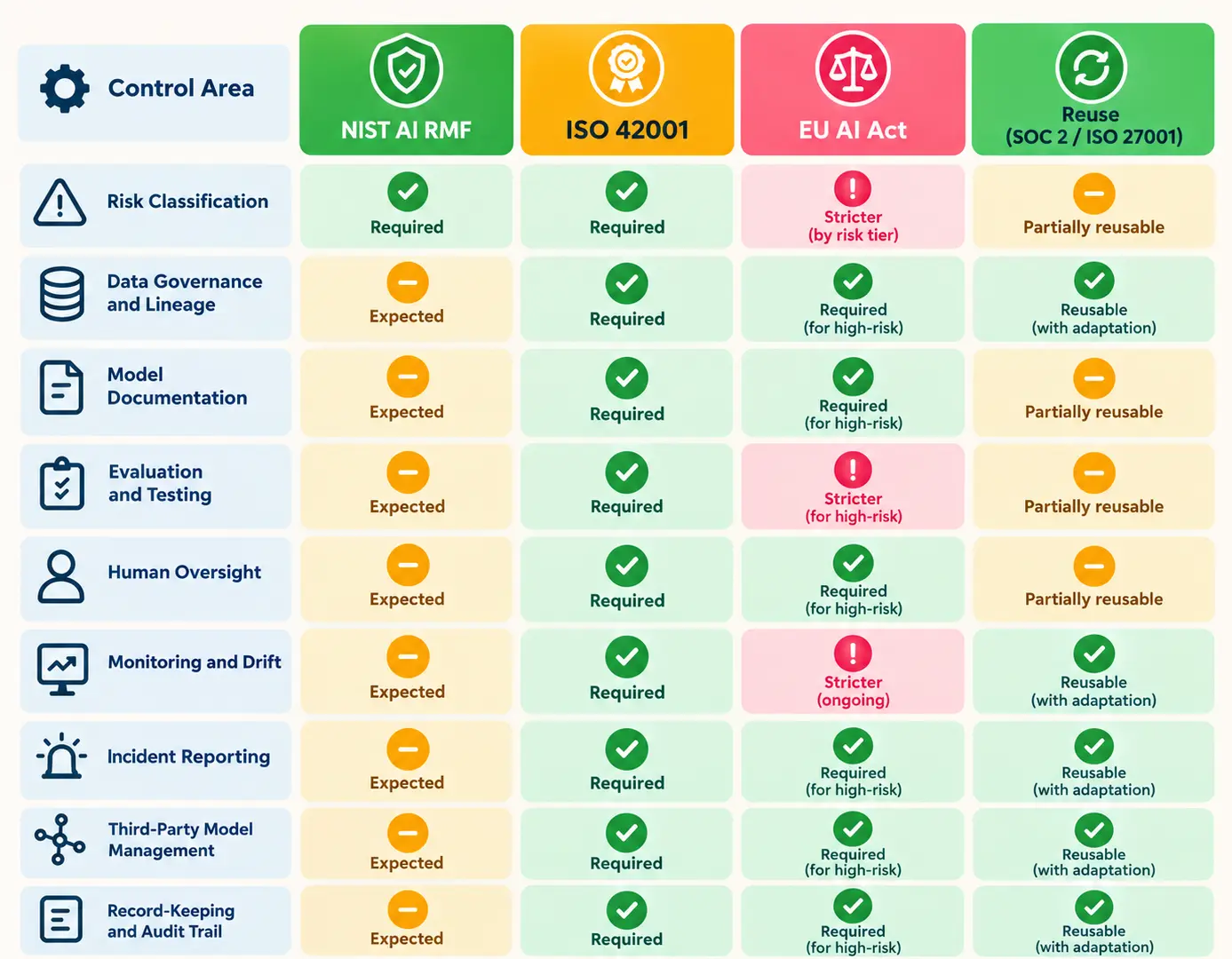
      AI governance framework comparison across NIST AI RMF, ISO 42001, and EU AI Act

      The comparisons of frameworks ( with existing SOC 2 or ISO 27001) based on control areas are listed below

      1. Risk Classification

      • NIST AI RMF: This approach entails understanding the context, use cases, implications, and risk classification, and which risks should be prioritized for treatment. 
      • ISO/IEC 42001: This approach requires organization-specific risk assessment criteria and impact analysis. 
      • EU AI Act: This approach uses legally defined risk categories and obligations associated with these categories, specifically for high-risk systems. 
      • SOC 2 / ISO 27001 Reuse Delta: This approach uses existing risk registers that define asset risks and security risks but no application context risks or ethical implications.

      2. Data Governance and Lineage

      • NIST AI RMF: Data Quality and Representativeness Metrics, as well as Supply Chain Integrity. 
      • ISO/IEC 42001: Controls on data acquisition, data labeling, and data handling operations in AI. 
      • EU AI Act: Proper data governance and management, data quality, and dataset controls required.
      • SOC 2 / ISO 27001 Reuse Delta: Controls on data classification/handling from ISO 27001 reused; lineage and training bias metrics required.

      3. Model documentation

      • NIST AI RMF: Concentrates on transparency cards, intended use, and performance measures.
      • ISO/IEC 42001: Captures design, lifecycle phases, and operational boundaries of the system. 
      • EU AI Act: Rigorous, legally defined technical documentation before deployment. 
      • SOC 2 / ISO 27001 Reuse Delta: The standard system architecture diagrams will do; however, model cards and algorithmic specifications are novel artifacts.

      4. Evaluation and Testing (TEVV)

      • NIST AI RMF: It gives robust guidance for Testing, Evaluation, Validation, and Verification throughout the life cycle. 
      • ISO/IEC 42001: It does lifecycle verification tasks tied to continuous quality control. 
      • EU AI Act: It does mandatory pre-market evaluation and compliance checks. 
      • SOC 2 / ISO 27001 Reuse Delta: Software QA testing processes adapt partially, but AI-specific red-teaming and bias testing are net-new. 

      5. Human oversight

      • NIST AI RMF: It promotes human-in-the-loop controls in accordance with context.
      • ISO/IEC 42001: It requires assigned operational roles and human intervention capacity. 
      • EU AI Act: High-risk applications need to have human override capabilities.
      • SOC 2 / ISO 27001 Reuse Delta: This is aligned with RBAC and Segregation of Duties, but the real override controls are new.

      6. Monitoring and Drift

      • NIST AI RMF: Ongoing assessment of model deterioration and unintended consequences. 
      • ISO/IEC 42001: Measurement, management review, and continuous monitoring. 
      • EU AI Act: Continuous monitoring and logging across the lifecycle. 
      • SOC 2 / ISO 27001 Reuse Delta: Straightforward correlation to SOC 2 / ISO 27001 SIEM, logging, and APM features; metrics will differ because of drift.

      7. Incident Reporting

      • NIST AI RMF: Response plan and feedback mechanism for AI problems.
      • ISO/IEC 42001: Root cause analysis and corrective action procedures established as standards.
      • EU AI Act: Reporting to European Union regulators in the case of a major incident.
      • SOC 2 / ISO 27001 Reuse Delta: IR Plan and Escalation Tree are mapped directly; AI safety triggers are included in runbooks.

      8. Third-party Model Management

      • NIST AI RMF: The risks and dependencies on external models and vendors are assessed.
      • ISO/IEC 42001: Due diligence, SLA management, and vendor control.
      • EU AI Act: Liability is shared between importer, distributor, and deployer.
      • SOC 2 / ISO 27001 Reuse Delta: TPRM vendor questionnaire is reused; add additional questions for AI risks.

      9. Record-keeping and Audit Trail

      • NIST AI RMF: System logs required to verify safety and governance decisions. 
      • ISO/IEC 42001: Documentation that needs to be produced for the certification audit trail. 
      • EU AI Act: Continuous event logging is required for high-risk AI systems during their usage.
      • SOC 2/ISO 27001 Reuse Delta: SOC 2 Trust Services Criteria – Logging/Auditing solves technological problems; extend logging criteria for AI input/output.

      What the table tells you

      The biggest difference is not that one framework has more controls than another. The difference is why those controls exist and how much evidence you need to produce.

      • NIST gives you a flexible risk-management structure. 
      • ISO 42001 adds the discipline of a formal management system and certification path. 
      • The EU AI Act creates legally enforceable obligations when the Act is applicable, including highly prescriptive obligations for high-risk applications.

      For organizations that are already SOC 2- or ISO 27001-compliant, this means that you are not beginning from scratch.

      The larger shortfall lies in risk classification for AI, AI assessment, documentation for AI, human supervision, and evidence related to AI.

      Open Popup

      Choosing a Framework: A Decision Path

      To select the right AI governance framework, follow this branching decision sequence based on your immediate commercial and regulatory triggers: 

      1. Do you deploy or offer AI systems to users in the EU?

      • YES: Start with EU AI Act compliance. Identify the legal obligations that apply, then map your internal controls to them.
      • No: Proceed to Step 2. 

      2. Do enterprise customers require formal certification during vendor due diligence?

      • YES: Adopt ISO 42001. Its certifiable structure provides third-party proof of governance for enterprise procurement.
      • NO: Proceed to Step 3.

      3. Are you a US bank subject to SR 11-7 model risk expectations? 

      • YES: Implement the NIST AI RMF. It aligns naturally with existing US Model Risk Management (MRM) practices.
      • NO: Evaluate model volume in production.

      4. How many models are already in production?

      • 1-5 models: Start with NIST AI RMF and build the basic governance processes around your current systems.
      • 5+ models: Put a formal management structure around the portfolio. ISO 42001 may become more useful as governance grows. 

      The Hybrid Adoption Reality

      Most organizations will adopt a hybrid approach whereby they utilize NIST AI RMF internally as their operating framework and ISO 42001 externally for attestation purposes, as well as fulfilling the obligations of the EU AI Act where it applies.

      Confused about which to pick? Start with the control domains that are common in all three frameworks:

      • AI inventory
      • Risk assessment
      • Documentation
      • Testing
      • Human supervision
      • Monitoring
      • Incident management

      Because these controls form the base of all AI governance frameworks for enterprise deployment, which can be helped by reviewing an AI readiness assessment framework comparison to evaluate your organizational posture this foundation is never wasted work. 

      The idea is not to select a single framework and stay there but to create controls capable of supporting your company’s needs.

      What It Takes to Implement, in Engineering Terms

      Selecting an AI governance framework is just one part of the process. The harder part comes when engineers and risk teams must implement these requirements and produce artifacts and evidence that are applicable in production environments.

      When moving AI governance frameworks for enterprise deployment from abstract slide decks into production code, delivery teams must build and maintain specific technical artifacts across the ML lifecycle: 

      • Use-Case & Risk Register: Create a centralized dataset mapping every active AI model, system owner, data classification, business intent, and assigned risk tier.
      • Automated Model Cards & System Specs: Document what each model does, where it is used, known limitations, data sources, dependencies, and approved use.
      • Evaluation & Red-Teaming Result Sets: Store test cases, benchmarks, accuracy, safety, bias assessments, and other assessment results. Such information must be linked to particular versions of models.
      • Data Lineage & Feature Audit Trails: Trace the sources of training, tuning, retrieval, and evaluation data and their flow within the system. This becomes especially complicated when the data travels through multiple platforms or external models.
      • Signed Approval Logs & Gate Checks: Document the reviewer’s name, their approval, the conditions for such an approval, and the date of the approval itself. Such records transform the approval policy into tangible proof.
      • Monitoring & Drift Dashboards: Monitor model performance, drift, errors, utilization, access, cost, and other indicators relevant to the risk posture of the system.
      • AI-Specific Incident Runbooks: Automated alerting rules, circuit breakers, and escalation paths designed to isolate or throttle degraded models immediately upon detecting anomaly thresholds.

      Where the Engineering Time Goes

      The high cost is not in building the spreadsheet or in putting together the policy. It is in modifying the control for the existing AI infrastructure.

      New models are ready to be tracked for lineage, evaluation, monitoring, approvals, and auditing purposes. Existing models might lack any of these controls.

      That means teams may have to go back and add logging, capture model and data metadata, connect evaluation pipelines, version artifacts, build monitoring, update CI/CD workflows, and reconstruct evidence that was never recorded in the first place.

      The framework tells you what needs to be governed; your engineering teams still have to build the paths that produce and preserve the evidence.

      Where Framework Adoption Goes Wrong

      Even with the right AI governance framework, enterprise adoption often fails due to core execution missteps:

      Treating the framework as paperwork

      Treating an AI governance framework as a policy exercise rather than operational control sets. Teams draft compliance documentation, but nothing changes in CI/CD deployment gates or pipeline code.

      Choosing the strictest framework by default

      The most demanding requirements first can be a time-waster for team members when the organization has lots of use cases to analyze. The decision will depend on the level of risk, customer needs, and the nature of requirements such as the need for EU AI Act compliance.

      Unassigned Telemetry Owners

      Mapping NIST AI RMF or ISO 42001 requirements across spreadsheets without assigning explicit engineering owners to generate, validate, and maintain individual evidence sets.

      Making certification the destination

      ISO 42001 accreditation is something that could be very helpful, but the certificate must come after an operational management system and not before. This is also true if you try to compare NIST AI RMF against ISO 42001.

      How Entrans Maps a Framework to Existing Controls

      At Entrans, we start with what you already have, rather than asking you to build a new AI governance framework from scratch. We conduct a structured control-mapping workshop designed to connect AI governance frameworks for enterprise deployment directly to active pipeline engineering. 

      We start from your existing SOC 2 or ISO 27001 posture and the specific AI use cases already in flight across your environment. From there, we construct an actionable, three-column delta analysis:

      • Reusable Controls: Existing access policies, logging infrastructure, and incident escalation paths that apply immediately.
      • Adaptable Controls: Traditional change management, third-party risk assessments, and monitoring setups that need light modification for AI pipelines.
      • Net-New Controls: Uniquely algorithmic requirements such as model lineage tracking, bias evaluations, red-teaming, and drift detection.

      Drawing on experience across 150+ AI projects delivered, we consistently find that use-case risk classification and pre-deployment evaluation evidence represent the primary net-new build for most enterprise teams.

      Whether aligning with the NIST AI RMF, preparing for ISO 42001 audit readiness, or navigating EU AI Act compliance, our cybersecurity and compliance practice engineers the underlying pipeline controls and evidence automation.

      Do not implement an AI governance framework to tick a box. Turn it into controls your teams can actually run, track, and prove. Book a consultation call with us to learn more.

      Share :
      Link copied to clipboard !!
      Turn AI Governance Into Working Controls
      Map NIST, ISO 42001, and EU AI Act requirements to controls your AI pipeline can run and prove.

      FAQs

      1. What is the NIST framework for AI governance?

      The NIST AI Risk Management Framework (AI RMF) is a voluntary framework that helps organizations manage AI risks throughout the system lifecycle.

      It is built around four functions: Govern, Map, Measure, and Manage

      2. What is the difference between NIST AI RMF and ISO 42001?

      NIST AI RMF is a voluntary risk-management framework, while ISO 42001 is a certifiable AI management system standard. NIST guides how to manage AI risks; ISO 42001 sets requirements for a formal management system.

      3. Does the EU AI Act apply to US companies?

      It can. Obligations attach based on where an AI system is placed on the market or used, not solely on where the provider is incorporated, so a US enterprise serving EU users with a high-risk system can fall in scope. Classification for a specific system is a legal determination and should go to counsel.

      4. Can we use more than one AI governance framework?

      Yes, and most large enterprises end up doing so. The control areas overlap substantially, so the practical pattern is one framework as the internal operating language and another as the external attestation. Map the control sets once rather than running two parallel programs.

      5. What can we reuse from SOC 2 or ISO 27001?

      More than most teams expect. Access control, change management, vendor management, and incident response usually map across with modest adaptation. What does not carry over is risk classification by AI use case, model documentation, evaluation and bias testing evidence, and drift monitoring, all of which are net-new.

      6. How long does it take to implement an AI governance framework?

      Mapping controls and standing up a use-case register is a matter of weeks. The duration is set by the existing estate: producing lineage and evaluation evidence for models already in production without instrumentation is the long and expensive part, and it scales with how many such models exist.

      7. Do we need a governance platform to adopt a framework?

      No. A platform enforces and records controls once you have defined them, and cannot decide who classifies risk or who owns evidence. Buying tooling before mapping controls typically produces a configured product and no change in how models reach production.

      Hire AI Governance Developers
      Build AI governance pipelines with engineers experienced in risk controls, evaluation, monitoring, and audit evidence.
      20+ Years of Industry Experience
      500+ Successful Projects
      50+ Global Clients including Fortune 500s
      100% On-Time Delivery
      Thank you! Your submission has been received!
      Oops! Something went wrong while submitting the form.
      Free Project Consultation
      Trusted by Enterprises & Startups
      Top 1% Industry Experts
      Flexible Contracts & Transparent Pricing
      50+ Successful Enterprise Deployments
      Jegan Selvaraj
      Author
      Jegan is Co-founder and CEO of Entrans with over 20+ years of experience in the SaaS and Tech space. Jegan keeps Entrans on track with processes expertise around AI Development, Product Engineering, Staff Augmentation and Customized Cloud Engineering Solutions for clients. Having served over 80+ happy clients, Jegan and Entrans have worked with digital enterprises as well as conventional manufacturers and suppliers including Fortune 500 companies.

      Related Blogs

      Enterprise AI Governance: Making It Work Across Business Units, Regions, and an Existing GRC Function

      Learn how to scale up AI enterprise governance from one business unit to another. Discover how to create scalable AI governance without compromising on speed of development.
      Read More

      How Much Does a Forward Deployed Engineer Cost in 2026?

      FDE cost in 2026 varies by hiring model, experience, and location. Compare salaries, contractor rates, FDE-as-a-Service pricing, and hiring costs.
      Read More

      AI Governance Frameworks Compared: NIST AI RMF, ISO 42001 and the EU AI Act

      Learn about the actual distinctions between NIST, ISO 42001, and the EU AI Act. Discover which AI governance system is right for your enterprise pipeline.
      Read More