Compare top options using an ai readiness assessment framework. Discover how Microsoft, Cisco, and NIST models evaluate data, governance, and strategy.

Agentic Unconference 2026 - September 19, Chennai
View Event →




Almost 95% of enterprise AI pilot projects fail to provide P&L impact. AI readiness is more than just a figure. The choice of framework rewrites your AI future. Picking the right AI readiness assessment framework is an executive intervention. One model may highlight strong technology capabilities, while another may expose weaknesses in data, governance, talent, or strategy. That makes a huge difference when leaders are deciding where to make the next investment.
This blog analyzes AI Readiness Assessment frameworks, understanding what they measure, how they score readiness, their ideal use, and their limitations.
The AI readiness assessment framework is a systematic approach to defining the dimensions, criteria, and scoring rules to evaluate an organization's ability to deploy and scale AI. It provides us with a comparative score for the different business units, thus highlighting areas that need improvement.
To develop a strategy, it becomes imperative for us to understand the differences between the three concepts. Establishing clear transformation goals can be helped by executing an AI strategy development blueprint tailored for enterprises.
Determining organizational preparedness can be improved by deploying an enterprise-grade AI readiness assessment solution across operations.
Different assessment frameworks don’t just measure your readiness. Dimension count defines what is allowed to count as a weakness. The chosen framework fundamentally reshapes your diagnostic outcome.
Aligning executive expectations can be improved through an end-to-end AI readiness assessment guide that highlights key business pillars.
There is no one-size-fits-all approach for AI Readiness. Each of the major frameworks varies from each other in terms of categorization of competencies, metrics, and whether it delivers a rating or maturity score. The following table highlights the differences in selected publicly available frameworks.
This model is an assessment across the following seven domains: AI strategy, AI use-case and product portfolio, AI governance, AI engineering, AI data, AI ecosystems and operating models, and people and culture. They make it best fit for mid-to-large enterprises needing C-suite strategic alignment and board reporting.
The fundamental need for cloud maturity is AI readiness. It evaluates six operational perspectives from business outcome alignment to operational monitoring.
This framework uses seven pillars. This online test will take around 45 minutes and will be based on multiple-choice and multiple-response questions. The final result includes a score and tailored guidance.
An operationally pragmatic approach geared toward bringing AI from experiments into fully integrated workflows.
According to the Deloitte model, ten elements fall under the capabilities of AI, which include AI exploration, AI strategy and governance, AI data readiness, AI infrastructure and platform, AI applications, AI workforce, AI delivery and operations, and AI sourcing management. Trustworthiness of AI, AI security, risk, and user experience permeate the entire framework.
The IBM GenAI framework has outlined five stages ranging from consumption of generic models to the creation and deployment of models in various environments while ensuring continuous improvement and lifecycle management. The IBM framework has also stated that the previous framework for enterprise AI maturity was seven-dimensional.
As enterprises accelerate from basic experimentation to production-grade deployments, evaluating organizational readiness has become important. Microsoft addresses this challenge directly with its AI Readiness Assessment—a free, self-service diagnostic tool hosted on the Microsoft Learn platform. This is very useful for companies already working within the Microsoft ecosystem. The assessment is free, contains 45 questions, and uses multiple-choice and multiple-response questions. After completion, users receive curated guidance based on their responses.
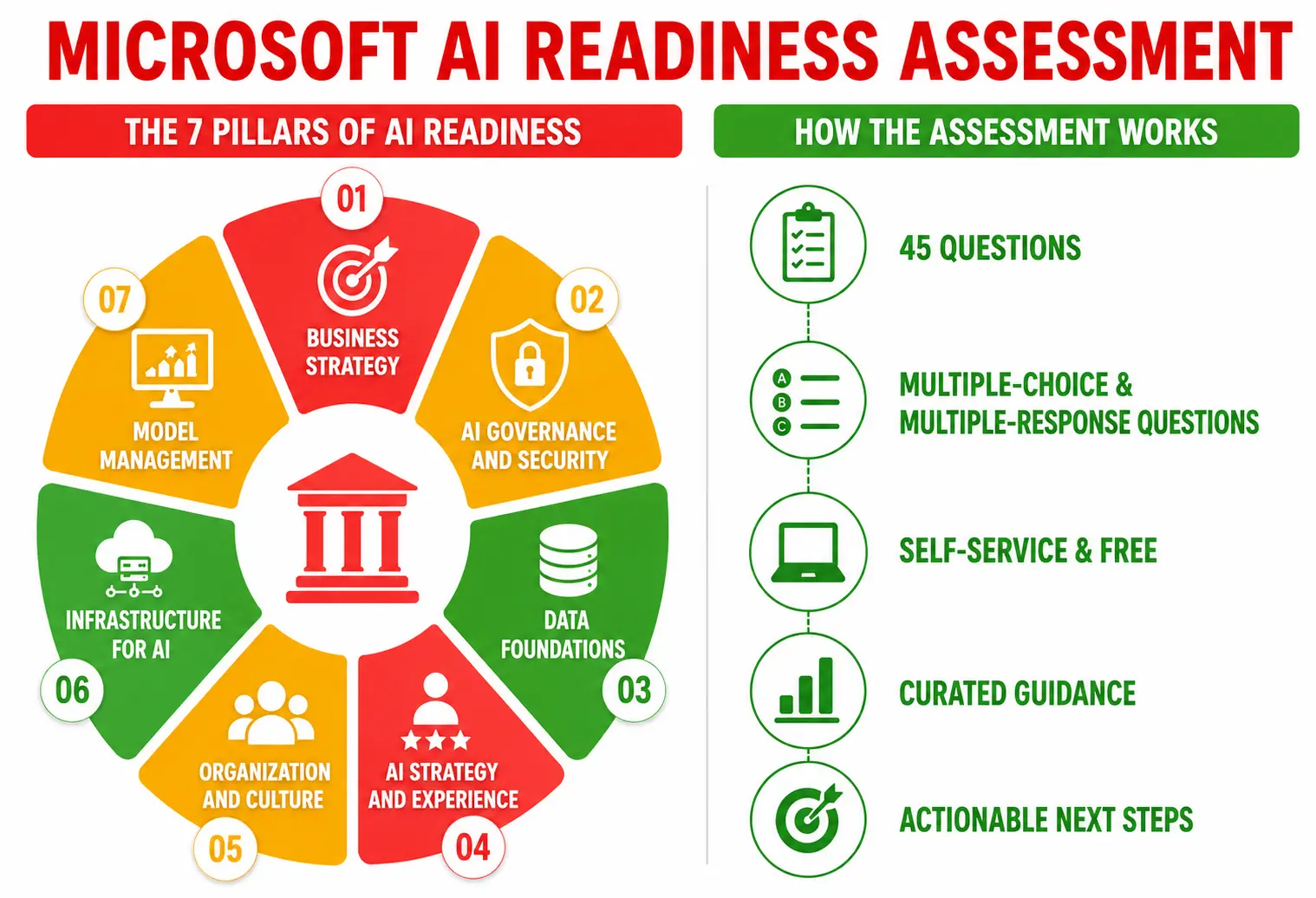
The first pillar is to denote how the AI connects with business goals. Companies need to mention clear reasons for using AI, defined priorities, and use cases that support measurable business outcomes.
The assessment helps identify whether AI plans are connected to wider business priorities. A business experimenting with several AI tools but without clear priorities may discover gaps here.
AI may create new worries in terms of privacy, security, compliance, appropriate use, and risks. This pillar focuses on how the company has developed governance practices to oversee the use of AI and safeguard private data.
The questions in this category can prompt companies to consider issues like policies, security, accountability, risk management, and appropriate AI practices. All these issues are relevant when AI is no longer limited to pilots and is used in customer-facing and mission-critical environments.
This pillar focuses on data quality, accessibility, architecture, and integration across legacy and cloud environments. If the organization has best-in-class AI technology but poor data, the ability to convert the AI into business applications becomes very difficult. The model output is directly linked to fed input data.
Auditing underlying data pipelines can be improved through a targeted AI data readiness assessment before model deployment.
Access to AI technology does not automatically translate to an AI strategy within a business. In this pillar, we examine the business’s approach to its AI efforts and its experience with AI technology.
It evaluates how AI will interact with end users, whether employees utilizing copilots or customers interacting with external applications. Previous AI projects, lessons learned, use-case selection, and the overall AI direction can all influence readiness.
AI readiness is also influenced by the workforce. The workers must be sufficiently skilled and have a positive attitude towards working with the emerging technologies.
This pillar concerns organizational preparedness, employee preparedness, involvement of leaders, AI skills, and culture. Even a company that possesses great technologies and data can encounter problems due to the inadequate skills and attitudes of the workforce.
AI workload requirements can be different when it comes to a company’s technical environment. This pillar aims to check whether the organization has the right technical infrastructure that will be capable of supporting AI usage.
Such areas as compute, cloud infrastructure, network, scalability, and technical capabilities become important here. The objective is to know whether the current technical environment can support AI usage.
This pillar checks MLOps capabilities, such as model deployment workflows, continuous monitoring, retraining processes, and versioning. This pillar ensures that you have the capability to keep the model performing well and avoid drift.
The Microsoft AI readiness assessment framework template consists of 45 questions that evaluate the 7 pillars mentioned above. Generally, it is in multiple-choice and multiple-response formats that allow businesses to describe their current situation across areas.
So after the AI assessment is over, Microsoft returns curated guidance based on responses. The free format makes this a convenient first step for companies that want to understand their position before investing in a more detailed assessment.
This assessment tool would be ideal for Microsoft-based firms. For companies that are already relying on Microsoft technologies, the assessment tool can easily relate to their technology setup and AI plans.
For instance, companies that are using Azure, Microsoft 365, Power Platform, Microsoft Fabric, and other Microsoft tools can adopt the assessment tool as a starting point for their AI journey.
Moreover, smaller teams can use it as a starting point for internal discussions regarding their AI readiness without having a large assessment budget.
Cisco's AI Readiness Index offers a structured way to benchmark how prepared businesses are to use AI at scale. It is one of the global diagnostic tools. The model looks at six dimensions: Strategy, Infrastructure, Data, Governance, Talent, and Culture. Together, these areas cover both the technical foundation and the people and business capabilities needed for AI.
One useful feature is Cisco's published maturity bands. Scores are grouped into four ranges:
These published thresholds make the index useful when an enterprise wants to compare its position against a clearly stated public benchmark.
Benchmarking against a public standard. Because its maturity thresholds are openly published, executive teams can easily baseline their scores against thousands of global industry peers.
It is different from a typical AI readiness framework. Rather than producing a readiness score, it helps organizations manage the risks associated with designing, deploying, and using AI systems.
The NIST AI RMF is built around four core functions: Govern, Map, Measure, and Manage.
Regulated industries (finance, healthcare, defense) and any enterprise that must legally or ethically defend an automated decision, mitigate algorithmic bias, or establish audit trails.
The UNESCO Readiness Assessment Methodology (RAM) takes a different approach to AI readiness. Instead of looking at the readiness of a firm for the technologies, data, and expertise required to apply artificial intelligence, it assesses the readiness of a nation or governmental body to apply artificial intelligence in accordance with the UNESCO Recommendation on the Ethics of Artificial Intelligence.
The methodology focuses on the broader context in which artificial intelligence operates. Topics include the legal and regulatory environment, institutions, governance, human rights, education, research, social and economic effects, and ethics. This can inform policymaking regarding deficiencies and national policies on artificial intelligence.
It is most useful to government agencies and institutions involved in formulating national AI strategies. This approach is especially useful if one has to determine not whether AI can be used but whether the environment around it is ready for such responsible application.
AI readiness assessment through consultancy tends to be consistent across the different 5- or 6-domain structures. Consistent domains include strategy and leadership, data, technology and infrastructure, organizational capability and culture, governance and risk management, and use case value delivery in approaches by RSM, PwC, Quinnox, and Athena.
These types of models work well in organizations that require more than just a readiness score. They usually target buyers who want to know how best to proceed with their AI journey.
However, some other readiness frameworks for AI have gone beyond the traditional categorization into five or six domains. For example, the Digital Education Council framework, which is categorized into ten dimensions, together with the sector-based tools, can provide more granular dimensions of readiness. It could be beneficial when enterprises operate in very regulated or specialized sectors.
Dimension inflation leads to executive paralysis. Overly complex frameworks yield fragmented scores and bloated diagnostic dashboards that non-technical leaders struggle to translate into clear, prioritized business actions.
Choosing the AI readiness framework should be done based on business goals, not just because the framework is popular. A simple decision tree can help narrow down the right approach:
The most effective enterprise strategy is a hybrid architecture: A practical approach is to use a commercial dimension model as the scoring layer, then place NIST AI RMF over it as the governance layer.
The commercial model can assess areas such as strategy, data, technology, talent, governance, and use-case readiness. NIST AI RMF can then add a common structure for managing AI risks through Govern, Map, Measure, and Manage. This approach gives leadership a single readiness score and prioritized roadmap.
A good AI readiness assessment framework should reflect how your business operates. The ultimate goal is to turn the assessment into a practical decision tool. This will show where the gap has arisen, where you are ready, and what should happen next. The steps below show how to generate an enterprise-grade AI readiness framework.
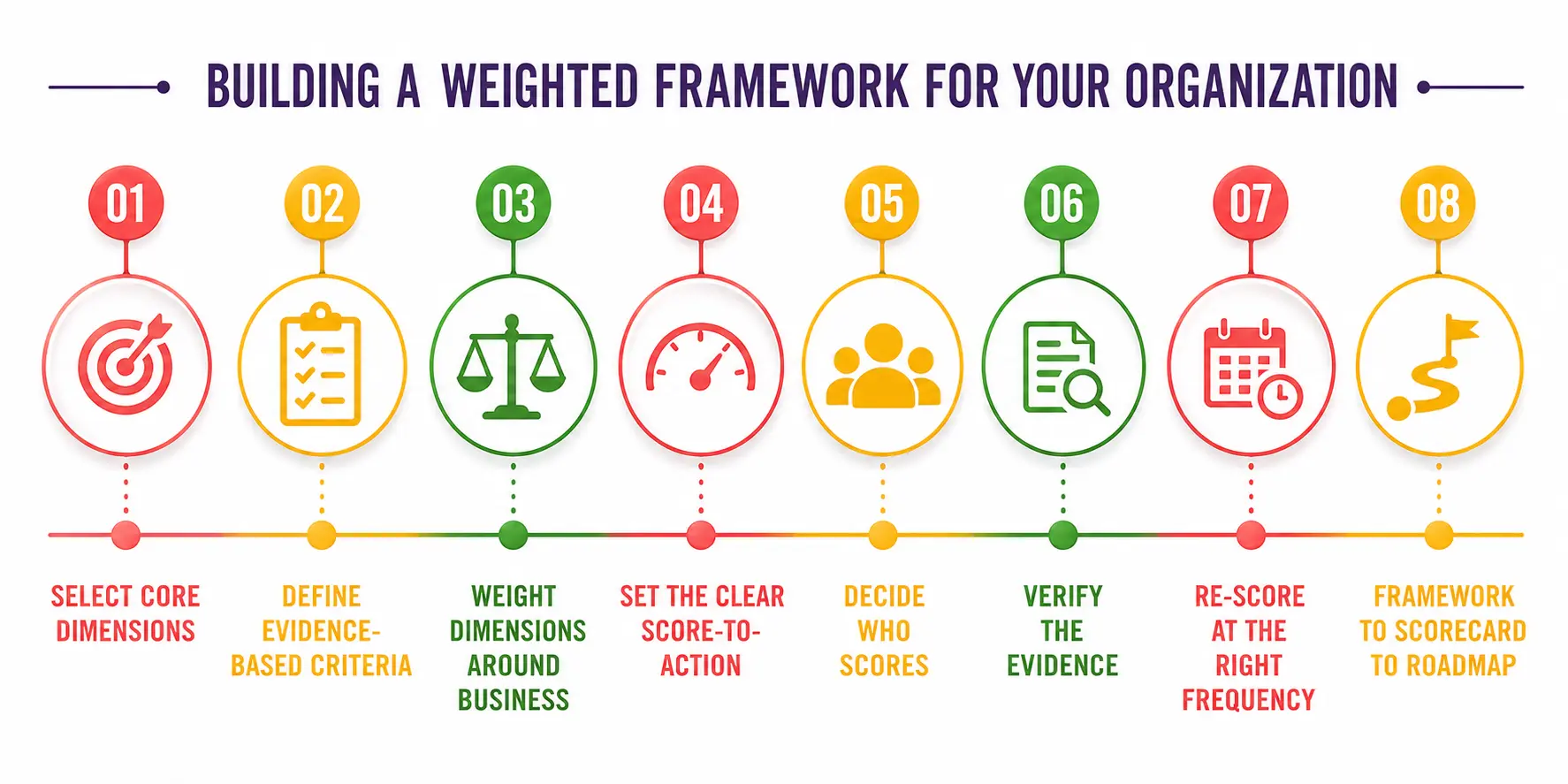
Begin by selecting 5 to 7 structural dimensions that represent the foundational pillars of enterprise AI execution. A balanced enterprise set typically includes strategic alignment and business case, data hygiene, pipeline readiness, infrastructure and MLOps, governance, security and compliance, workforce capability and culture, integration and architecture.
For each dimension, define clear, objective criteria across a standard 4- to 5-level maturity scale. Avoid vague statements such as mature data or strong governance.
Gathering technical evidence can be improved by using an AI readiness assessment checklist, which helps to adhere to audit requirements.
For example:
Assigning static, equal weights across all dimensions treats every operational risk as identical. This is where a weighted framework becomes more useful. It varies depending on industries. For example, a regulated financial services firm puts greater weight on governance, data, and model management. A manufacturer may give more weight to infrastructure, data, and use-case value.
Financial services rate the dimensions based on AI decisions for regulatory, customer, financial, and reputational consequences. Manufacturers rate the dimensions depending on plant systems, connected equipment, operational data, edge computing, and production workflows.
A composite score is useless unless it maps directly to governance decisions and budget allocations. Establish strict action triggers based on overall weighted readiness scores:
An enterprise should set them based on its risk tolerance, AI ambitions, regulatory requirements, and investment plans.
AI readiness should not be scored by one person sitting in isolation. A useful assessment brings together people from several areas, such as:
The assessment lead should coordinate the scoring and challenge unsupported ratings.
For high-risk dimensions, subject-matter experts should review the evidence rather than simply accepting the initial score.
Every score submitted during the assessment must be validated by physical technical evidence:
The assessor can use a simple three-step approach.
Claim → Evidence → Validation
AI readiness is a dynamic operational state, not a one-off certification. A one-time assessment can quickly become outdated.
For most enterprises, an annual full assessment is a reasonable baseline, with lighter reviews every six months. Faster-moving AI programs may benefit from quarterly reviews of high-risk dimensions.
A major event should also trigger a reassessment. Examples include a new regulatory requirement, major AI deployment, acquisition, cloud migration, or significant change in the data environment.
The framework produces the score; the score produces the gap register; the gap register produces the sequenced roadmap. The final output should not stop at a number.
Each gap should connect to:
Capability gap → Business impact → Priority → Action → Owner → Target date
That structure turns an AI readiness assessment framework into something leadership can actually use.
The strongest frameworks are therefore not necessarily the ones with the most dimensions or the most complicated scoring formulas. They are the ones that use relevant weights, defensible evidence, clear thresholds, and practical next steps to help an enterprise decide what to do next.
The Entrans 7-Dimension AI Readiness Framework gives enterprises a practical way to assess AI capability and turn the findings into a remediation plan.
This framework is deliberately engineering-led with greater weight placed on data and platform evidence. Findings are translated into a cost remediation backlog with priorities, actions, owners, and estimated effort.
The weighting varies based on client context. For a regulated financial services client, delivery can place greater weight on Data Foundations (20%), AI Governance and Risk (20%), and Model Management (15%). For a non-regulated manufacturer, weighting can shift toward Technology and AI Infrastructure (20%) and Business Strategy and Use-Case Portfolio (20%).
Want to know more about it? Book a consultation call.

AI readiness framework provides a structured baseline. This identifies technical, data, and organizational gaps. It also highlights capability gaps and helps prioritize the next steps.
Common components include business strategy, data, technology, governance and risk, talent, organizational culture, and AI model management. Some frameworks also assess use-case value and operating models.
An AI readiness assessment evaluates whether an enterprise is prepared to deploy its first AI use cases today. An AI maturity model describes capability levels and shows how an organization can progress over time.
There is no fixed number. Basically, five to seven dimensions often give more coverage without making the assessment difficult to use. More dimensions can help when deeper industry or business-unit detail is needed.
The best framework depends on the enterprise’s goals, risk profile, industry, and technology environment. Most enterprises use a hybrid approach, pairing commercial models (for executive scoring) with open standards like NIST AI RMF or ISO 42001 (for operational governance).
Governance sets the mandatory guardrails for data lineage, security, privacy, and risk mitigation. A serious governance gap may also limit the overall readiness score, even when other capabilities are strong.
Yes. Free assessment resources are available from sources such as Microsoft and other public frameworks. NIST AI Risk Management Framework (AI RMF) and UNESCO’s Readiness Assessment Methodology (RAM) offer open-access templates and guidelines for enterprise evaluation.

-1.svg)