> Blog >
AI Readiness Assessment: How Enterprises Score Their Readiness Before Scaling AI
AI readiness assessment helps enterprises identify data, infrastructure, governance, and security gaps before scaling AI into production.

AI Readiness Assessment: How Enterprises Score Their Readiness Before Scaling AI

4 mins
August 20, 2026
Author
Aditya Santhanam
TL;DR
  • An AI readiness assessment helps enterprises identify data, infrastructure, governance, security, talent, and process gaps before scaling AI into production.
  • Entrans evaluates readiness across 7 dimensions and turns the findings into a prioritized scorecard, gap register, and implementation roadmap.
  • A readiness score alone is not enough. The real value comes from evidence-backed gaps, clear ownership, risk controls, and practical 30/60/90-day actions.
  • The strongest assessments connect AI strategy to measurable business outcomes, helping enterprises move from isolated pilots to secure, scalable AI adoption.
  • Every entrepreneur is keen on adopting such custom models, but have they considered whether their technology infrastructure can withstand the stress of production? Instead of rushing into an investment with high risk, some firms perform a comprehensive AI readiness assessment. This AI readiness assessment process enables leaders to identify gaps, compare priorities, and assess use-case feasibility before moving from pilots to production.

    This blog explains the key dimensions enterprises should assess for carrying out an AI readiness assessment and explains how the results can be shaped into an actionable roadmap.

    Table of Contents

      What Is an AI Readiness Assessment?

      AI Readiness Assessment is a structured evaluation of whether an organization’s infrastructure, data quality, culture and governance, talent, processes, and strategy can adopt artificial intelligence.

      What an AI Readiness Assessment is NOT

      A useful assessment looks beyond individual AI ideas, and leadership must distinguish a rigorous operational audit from light-touch exploratory exercises:

      • Not a vendor demo: It does not evaluate external software slickness or pitch specific SaaS tools.
      • Not a use-case brainstorm: No brainstorming is done, and only technical feasibility is considered.
      • Not a one-off survey: This method is dependent upon data lineage, architecture auditing, and governance checks, and not on employees' sentiments.

      The main need for the AI readiness Assessment is 

      • The change is from individual pilots to production and agentic workloads, where undocumented processes and unmanaged data can no longer be tolerated.
      • This determines technical shortcomings, security threats, and strategy ahead of deployment.

      Why AI Readiness Assessments Matter Now

      As companies shift from experimental applications of AI to production and agentic workloads, the urgency increases. These problems now become a reality in terms of incomplete documentation, fragmentation of data, and uncertainty around ownership and governance. An AI readiness assessment aims to detect such weaknesses before engaging in large-scale AI endeavors.

      Organizations are facing intense pressure to scale artificial intelligence across core operations. However, a huge execution gap has been created between the aspirations of the leadership and reality within the business context, as companies are trying to implement artificial intelligence solutions more rapidly than the underlying data pipelines, security, and governance frameworks are ready for.

      Third-party research provides further insight into how significant a factor this infrastructure bottleneck is:

      • Legacy Constraints: As per NTT DATA, 90 percent of businesses believe that legacy infrastructure is holding back their ability to use AI.
      • Lack of Forward Planning: The same research found that only 45% of firms have completely evaluated their future infrastructure requirements to support AI.

      Gartner notes that AI agents are not yet ready for enterprises, and only 45% of enterprises are ready for AI agents. It is a helpful frame since it helps one focus on something other than model performance. It is the environment surrounding the agentic model that matters. However, it is not enough merely to know about this reciprocal problem of mutual readiness. There needs to be a measure of it.

      The 7 Dimensions of Enterprise AI Readiness

      Scaling AI across an enterprise requires a systematic evaluation across your operating environment. At Entrans, we perform an enterprise readiness assessment based on 7 major dimensions to uncover potential technical debt, compliance issues, and operational inefficiencies that are often overlooked.
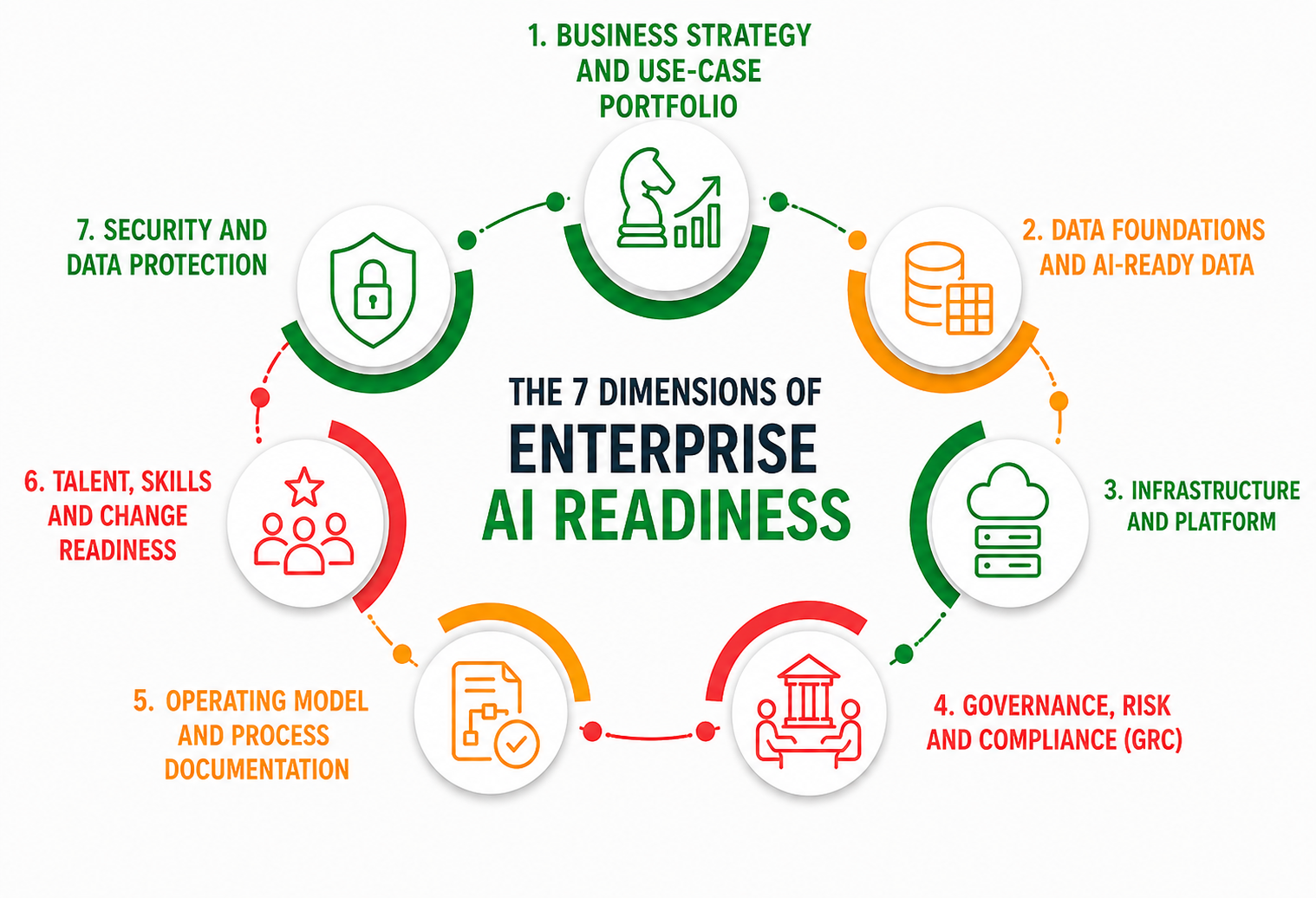
      Dimensions of Enterprise AI Readiness

      1. Business Strategy and Use-Case Portfolio

      A well-prepared business maps out AI efforts in relation to actual business outcomes, such as higher sales, reduced costs, greater customer satisfaction, or enhanced operational efficiency. Every instance must have an owner, metrics, an outcome, and justification for continuing or terminating.

      • Failure Signal: Overloaded use-case queue with no business owner, no baseline metrics, and no criteria to justify termination.
      • Assessor Evidence: A business case with baseline metrics, ROI models, and chartered agreements.

      2. Data Foundations and AI-Ready Data

      AI is based on data that can be discovered, traced, comprehended, and trusted. The assessors must evaluate the following factors: data quality, lineage, classification, annotation, centralization, and unstructured data.

      • Failure Signal: Critical inputs locked in unindexed PDFs or legacy formats with zero source traceability.
      • Assessor Evidence: Data lineage maps, automated quality check logs, and schema documentation.

      3. Infrastructure and Platform

      AI workloads need suitable compute, separated environments, modern APIs, integration patterns, and a safe sandbox for testing autonomous agents.

      • Failure Signal: No isolated environment to test autonomous agent behavior without risking live operations.
      • Assessor Evidence: Architecture diagrams, API gateway performance specs, and sandbox isolation policies.

      4. Governance, Risk and Compliance (GRC)

      Process clarity in human-in-the-loop, model inventory management, and adherence to NIST AI RMF, ISO 42001, or EU AI Act.

      • Failure Signal: No one within the organization is accountable for the model's results.
      • Assessor Evidence: AI policy register, model registry, audit logs, and compliance mapping docs.

      5. Operating Model and Process Documentation

      AI cannot reliably follow workflows that exist only in people’s hands. We should have end-to-end operational processes documented cleanly enough for an autonomous system to follow. 

      • Failure Signal: Critical steps and escalation paths living purely in employees' heads rather than official workflows.
      • Assessor Evidence: Standard Operating Procedures (SOPs), process maps, and rule books.

      6. Talent, Skills and Change Readiness

      Readiness requires business architecture skills, technical teams that can build and maintain AI systems, trained users, and a communication plan. 

      • Failure Signal: Purchasing an enterprise AI platform before anyone is made responsible for driving actual business adoption.
      • Assessor Evidence: Enablement plans, role matrices, training schedules, and adoption metrics.

      7. Security and Data Protection

      There is a need to set boundaries on the authorization limits, control over data retrieval, safeguarding of sensitive data, and management of third-party models.

      • Failure Signal: RAG systems returning sensitive enterprise data to users who lack permissions to view it directly.
      • Assessor Evidence: Access control matrices (RBAC/ABAC), data loss prevention (DLP) rules, and vendor security reviews.

      Summary of the 7 dimensions with weightage

      Entrans’s seven-dimension model looks at the business, data, technology, governance, people, processes, and security that sit behind an AI program. Each area can be scored separately, giving CIOs a practical view of where the business is ready and where work needs to come first.

      Dimension Suggested Weightage Focus
      Business Strategy and Use-Case Portfolio 15% P&L alignment and clear ROI metrics
      Data Foundations and AI-Ready Data 20% Lineage, unstructured data governance, and quality
      Infrastructure and Platform 15% Modern APIs, compute scale, and agent sandboxes
      Governance, Risk and Compliance 15% Audit trails, regulatory alignment, and accountability
      Operating Model and Process Documentation 10% Machine-readable workflows and escalation paths
      Talent, Skills and Change Readiness 10% Adoption capability and cross-functional teams
      Security and Data Protection 15% Retrieval permissions and sensitive data boundaries
      TOTAL 100%

      How the Major AI Readiness Frameworks Compare

      Not all AI readiness frameworks measure the same thing. Comparing public AI readiness frameworks reveals significant differences in operational focus, scoring mechanics, and target organizational needs. 

      Framework Dimension Scoring Output Best suited Limitation
      Microsoft AI Readiness Assessment 7 pillars, 45 questions Personalized readiness guidance Cloud/Microsoft-centric enterprise deployments Biased towards Azure-native stack integration
      Cisco AI Readiness Index 6 dimensions Benchmark score (0–100) mapped to 4 tiers: Pacesetter, Chaser, Follower, Laggard Measurable readiness across technology and business capabilities Surface-level operational depth for app-layer workflows
      UNESCO RAM 5 dimensions Qualitative impact profile & policy recommendation report Government and public institutions Not designed for enterprise scoring
      NIST AI RMF 4 Core Functions (Govern, Map, Measure, Manage) Qualitative compliance and risk-mitigation scorecard Governance overlay for high-risk, regulated AI applications Not an operational deployment or adoption framework
      Consultancy Models 5–6 Domains (Strategy, Tech Stack, Operating Model, Data, Risk, Scale) Multi-tiered maturity level matrix (e.g., Level 1–5) End-to-end digital transformation across business units Expensive; heavily dependent on proprietary advisory services

      Public Vs. Extended: Why Enterprises Use a Hybrid

      Cisco evaluates the capacity of the infrastructure, Microsoft evaluates the preparedness of the platform software, UNESCO evaluates ethical considerations, while NIST evaluates risk considerations.

      There is no generic public model that can handle scenarios like legacy pipeline data, compliance with regulations, and operational processes within the industry. Enterprises usually adopt a hybrid strategy for dealing with the problem. After that, use industry-specific operational key performance indicators to create an internal scorecard.

      The AI Readiness Scorecard: Score Your Organization

      An evaluation of your organization’s preparedness needs to be done in an organized manner. The scorecard will assist in evaluating your organization based on seven different aspects. Each aspect should be rated by you using a rating scale of 1 to 5, and then use the recommended weighting to get the total percentage score.

      Score Maturity level What it means
      1 Initial Little or no formal capability; activity is mostly ad hoc.
      2 Developing Some practices exist, but coverage is inconsistent.
      3 Defined Processes, ownership, and standards are established for most areas.
      4 Advanced Capabilities are measured, repeatable, and used across the business.
      5 Leading Capabilities are continuously improved and tied closely to business outcomes.

      Example

      For each dimension, divide your score by 5 and multiply it by the assigned weight. Then add all seven weighted scores and get the final percentage.

      Suppose an organization scores.

      1. AI Business Alignment and AI Strategy: 4/5
      2. Data Readiness: 3/5
      3. Technology & AI Infrastructure: 3/5
      4. AI Governance & Risk: 3/5
      5. Talent & AI Skills: 2/5
      6. AI Use Cases & Operating Model: 4/5
      7. Security, Privacy & Responsible AI: 3/5

      From the table above, which shows the weightage for each dimension, calculate the weighted score.
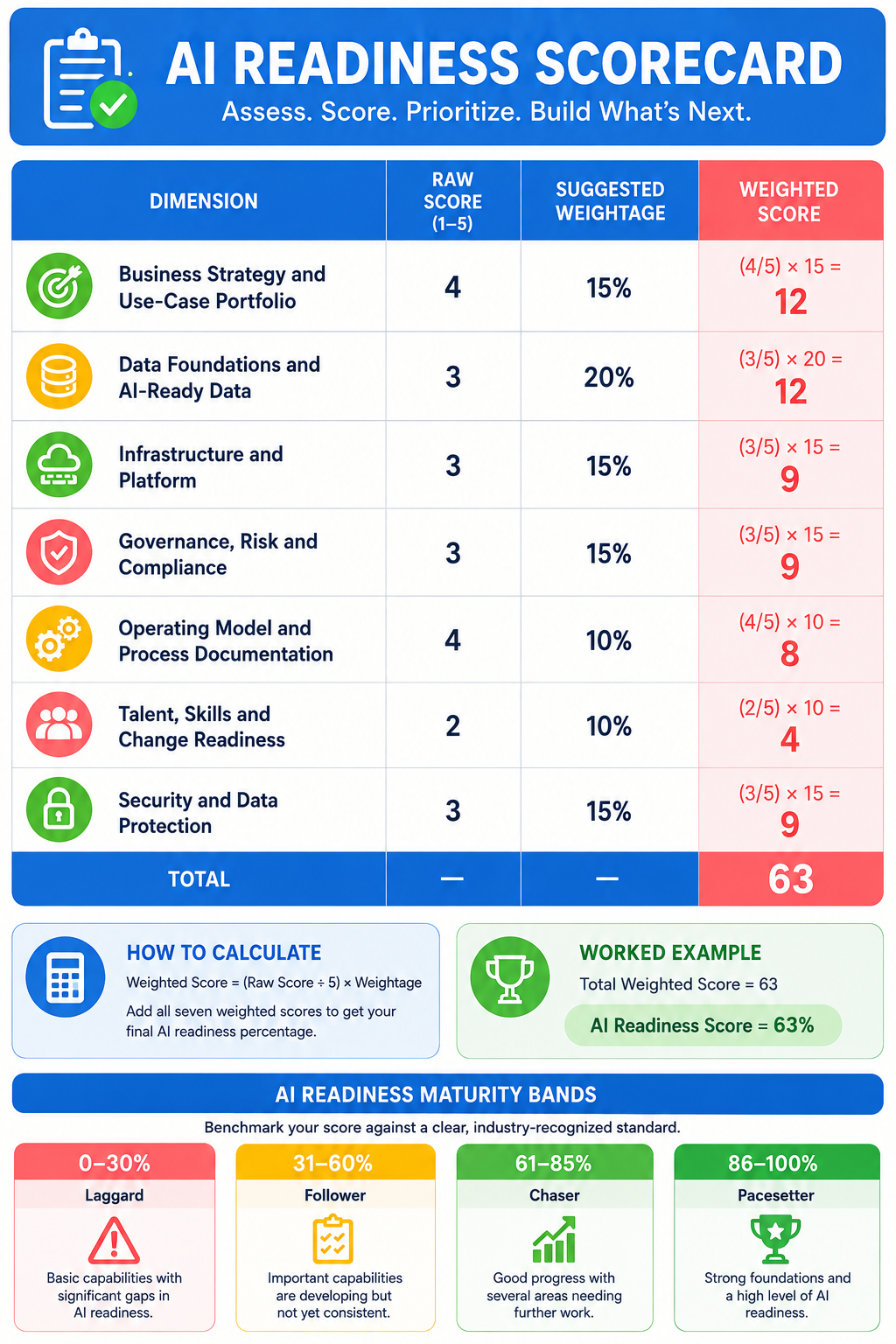
      A Readiness Scorecard

      Where Does Your Score Stand? 

      A 63% score in the worked example places the organization in the Chaser band. 

      These bands are helpful for contextualization, but the scorecard is to be regarded as an assessment customized for the organization as opposed to being a replica of the scoring methodology used by Cisco.

      AI Readiness Maturity Levels Explained

      An AI readiness score informs you about your current status, but that score alone won’t help you know how to take things forward. A maturity model helps provide an understanding of the score range in the context of how AI is being implemented in your organization.

      Experimenting: Proofs of Concept in Silos

      AI is being experimented with by teams that are piloting and defining use cases for these tools, but all of these experiments are very isolated from one another. There are no clearly defined business objectives or owners for the project, nor any data governance and practices in place.

      • Highest-Return Next Move: Establish a formal AI Steering Committee to inventory active pilots and enforce basic data security guidelines. 

      Foundational: Standardizing the Core

      The enterprise establishes centralized infrastructure and core data hygiene. Technical teams specialize in integrating APIs to baseline databases, but the implementations are still isolated from any critical processes.

      • Highest-Return Next Move: Unify the siloed data sources into a central data lakehouse architecture.

      Operational: Production-Grade Integration

      AI is part of selected business processes, with defined ownership and repeatable workflows. Teams track performance and have clearer controls around data, models, and usage.

      • Highest-Return Next Move: Implement automated CI/CD for Machine Learning (MLOps) to reduce deployment friction and accelerate iteration speed. 

      Scaling: Multi-Departmental Adoption

      AI evolves from a facilitator for efficiency to becoming the core operating mechanism itself. Custom-tailored agentic flows, customized fine-tuning of models, and successful upskilling programs work towards driving bottom-line results.

      • Highest-Return Next Move: Establish an internal AI Center of Excellence (CoE) to build repeatable templates for agent architecture and data connections.

      Transformational: AI-first Business models

      AI natively dictates corporate strategy, customer experience, and operational design. Dynamic systems autonomously adapt to real-time market shifts with continuous human-in-the-loop oversight.

      • Highest-Return Next Move: Invest in proprietary model fine-tuning and unique data assets to construct defensible competitive moats.

      How an AI Readiness Assessment Actually Runs

      The AI readiness assessment process will take between 4 and 8 weeks. This process is more than just a 45-question survey; it looks at the relationship between all four aspects.

      Steps in assessment Duration
      Discovery and Stakeholder Alignment 1-2 weeks
      Data and Platform Inspection 1-2weeks
      Scoring and Gap Analysis 1 week
      Prioritization 1 week
      Roadmap 1-2 weeks

      1. Discovery and Stakeholder Alignment

      The Assessor meets business leaders and technical teams to understand AI goals, target processes, constraints, and current priorities.

      2. Data and Platform Inspection

      Audit technical architecture, which includes automated data pipelines, schema hygiene, API connectivity, model storage, and cloud infrastructure scale. 

      3. Scoring and Gap Analysis

      Score the telemetry against the existing frameworks (e.g., NIST AI RMF) to assess gaps in security, information silos, and staffing.

      4. Prioritization

      Gaps are ranked by business value, risk, effort, and dependencies. 

      5. Roadmap

      Build a phased deployment timeline.

      Core Stakeholders Required

      To ensure actionable outcomes, five key stakeholders must sit in every review session:

      • Data Engineering Lead (evaluates data quality and pipeline health)
      • Platform/Infrastructure Architect (assesses compute and runtime readiness)
      • Chief Information Security Officer (CISO) / Security Lead (ensures data privacy and network controls)
      • Compliance & Legal Counsel (evaluates regulatory alignment and risk exposure)
      • Business Process Owner (defines target ROI metrics and workflow constraints)

      Expected Deliverables

      Hold your assessment vendor accountable for three core artifacts upon engagement completion:

      Deliverables Key contents
      Technical Gap Analysis Report Comprehensive architecture diagrams detailing data lineage issues, API limitations, and infrastructure bottlenecks.
      Risk and Governance Heatmap Quantitative compliance audit mapped to frameworks like NIST or EU AI Act protocols.
      Phased implementation Roadmap Prioritized 12-to-18-month execution plan detailing estimated ROI, budget parameters, and resource allocation.

      What You Should Receive: Deliverables Checklist

      An enterprise assessment must produce actionable technical blueprints, cost engineering backlogs, and risk controls. The table below outlines the core outputs expected from a comprehensive AI readiness engagement:

      Concrete Output Actionable Value
      Scored Assessment Matrix Scores across all readiness dimensions, supporting evidence, and an overall readiness rating.
      Gap Register Identifies critical vulnerabilities that must be remediated before model deployment.
      Prioritized Use-Case Shortlist AI use cases are ranked by feasibility, business value, expected ROI, data availability, and risk.
      Target Architecture Diagram Gives platform teams a concrete design for scalable infrastructure.
      Governance & Risk Control Plan Establishes enforceable safety guardrails for production environments.
      30 / 60 / 90-Day Execution Roadmap Specific actions for the first 30, 60, and 90 days, including owners and dependencies
      Cost Remediation Backlog & Investment Estimate Provides finance leadership with an accurate Total Cost of Ownership (TCO).

      Entrans Deliverable Package

      When Entrans conducts an AI Readiness Assessment, the client receives a fully integrated, production-ready deliverable package. This gives the buyer a tangible standard for judging what a finished AI readiness assessment should contain. 

      • Executive Summary & Maturity Score: Benchmark report placing the enterprise on the 7-dimension scorecard relative to industry peers.
      • Architecture Blueprints: High-level and component-level architecture diagrams detailing cloud runtime specs, data lineage, and API middleware layers.
      • Entrans Actionable Backlog: A fully estimated Jira/Azure DevOps project file containing tagged user stories, resource requirements, and cost estimates for immediate sprint planning.
      • 30/60/90-Day Deployment Blueprint: Step-by-step operational timeline mapping data preparation, infrastructure setup, and initial model staging.

      Where AI Readiness Assessments Fail

      Most of the AI readiness assessments fail before a single line of code is written. The precise questions to be asked before starting with AI systems are

      1. Assessment Theatre: The final score becomes the main deliverable, with little evidence.
        Ask
        : What evidence supports each score, and can we review the scoring criteria?
      2. Wrong seniority in the Room: Diagnostic surveys are completed entirely by executive leadership or IT managers who rarely touch daily data pipelines or operational edge cases. The resulting score reflects optimistic executive intent rather than ground-truth technical reality. 
        Ask:
        Which stakeholders were interviewed, and how did you validate their answers with technical evidence? 
      3. Vendor-Anchored Bias: The AI readiness assessment finishes with recommending the assessor’s own platform, product, or services.
        Ask:
        Were alternative technologies evaluated using the same criteria? Would your recommendation change if we chose another vendor?
      4. IT Isolation: The evaluation focuses on server specs, network bandwidth, and cloud instance. An infrastructure-ready enterprise can still fail due to workflow misalignment or low domain adoption. 
        Ask:
        Who owns the business process being assessed, and how were their goals and constraints included?
      5. Static Expiration: Gaps are identified, teams make changes, but nobody runs a follow-up assessment to confirm whether readiness has improved.
        Ask:
        When will we re-score the organization, and which metrics will show that each gap has been closed? 

      From Assessment to Roadmap: The First 90 Days

      Now it is time to execute the AI readiness assessment. A structured 30/60/90-Day Roadmap turns diagnostic findings into immediate, measurable technical momentum:

      Governance & Data Quick Wins (Days 1-30)

      Clarify decision rights, close high-priority data gaps, and establish baseline metrics. Enforce access control policies. 

      • CFO Metric: Zero unmapped compliance risks; 100% data lineage verification for pilot datasets. 

      Platform and Pilot Hardening (Days 31 - 60)

      Configuration of MLOps pipelines, secure API gateways, and cloud compute environments. Stress-test initial model prototypes in isolated staging sandboxes.

      • CFO Metric: 50%+ reduction in model deployment cycle times; strict cloud compute budget cap adherence.

      First Production Workload (Days 61 - 90)

      Move the strongest pilot into production with defined controls and a measurable baseline.

      • CFO KPI: realized savings or revenue impact, process cycle time, and cost per completed transaction. 

      The ultimate goal is to create measurable progress that leadership can review, fund, and act on.

      How Entrans Runs a Readiness Assessment

      At Entrans, we run AI readiness assessments as a 4-6 week technical engagement. The engagement starts with discovery interviews involving business owners, data teams, platform leaders, security, and compliance stakeholders. 

      The Entrans assessment team then reviews relevant data environments, platforms, workflows, controls, and supporting documentation. Findings are mapped against a 7-dimension matrix, and the delivered package consists of an architecture blueprint, a cost 30/60/90-day roadmap, and an estimated Jira backlog that is ready for sprint planning.

      One observation from more than 200 enterprise transformations is that organizations often score lowest on data foundations. Data quality, ownership, accessibility, and consistency frequently limit progress even when the business has strong AI ambitions. 

      Ready to move on to the next step (from assessment to action)? Book a consultation call with us.

      Share :
      Link copied to clipboard !!
      Turn AI Gaps Into a Production-Ready Roadmap
      Assess your AI readiness, uncover critical gaps, and build a clear path to secure, scalable AI adoption.
      20+ Years of Industry Experience
      500+ Successful Projects
      50+ Global Clients including Fortune 500s
      100% On-Time Delivery
      Thank you! Your submission has been received!
      Oops! Something went wrong while submitting the form.

      FAQs

      1. How do you conduct an AI readiness assessment?

      AI readiness assessment is done through discovery interviews, data and infrastructure audits, and risk and compliance mapping across established frameworks. From the findings, gaps are identified, and a practical roadmap is created.

      2. What is the difference between an AI readiness assessment and an AI maturity model?

      An AI readiness assessment determines whether an enterprise is prepared for AI initiatives right now, whereas an AI maturity model measures the broader stage of AI capabilities and its progress across defined maturity stages.

      3. What are the typical components of an AI adoption readiness assessment?

      Typical components include business strategy, data foundations, technology platforms, governance, security, talent, and use-case readiness. This AI readiness assessment also considers feasibility, risks, expected value, and the effort needed to move toward production. 

      4. How long does an AI readiness assessment take?

      Typically, it takes 4 to 8 weeks for an AI readiness assessment. It varies depending on scope, complexity, and stakeholder availability. 

      5. What happens after an AI readiness assessment?

      The findings are turned into a prioritized gap register, use-case shortlist, target-state recommendations, and implementation roadmap. Teams can then tackle quick wins, address major gaps, and prepare selected AI workloads for production. 

      6. How much does an AI readiness assessment cost?

      A formal, third-party enterprise assessment ranges from $50,000 to $250,000+, depending on company size and technical scope. The cost varies based on enterprise size, scope, number of business units, technical complexity, and assessment depth.

      Hire AI Engineers for Production-Ready AI
      Build and scale AI initiatives with experienced engineers who can strengthen data, infrastructure, governance, and deployment.
      Free project consultation + 100 Dev Hours
      Trusted by Enterprises & Startups
      Top 1% Industry Experts
      Flexible Contracts & Transparent Pricing
      50+ Successful Enterprise Deployments
      Aditya Santhanam
      Author
      Aditya Santhanam is the Co-founder and CTO of Entrans, leveraging over 13 years of experience in the technology sector. With a deep passion for AI, Data Engineering, Blockchain, and IT Services, he has been instrumental in spearheading innovative digital solutions for the evolving landscape at Entrans. Currently, his focus is on Thunai, an advanced AI agent designed to transform how businesses utilize their data across critical functions such as sales, client onboarding, and customer support

      Related Blogs

      How to Plan an AngularJS to React Migration Without Breaking the Business

      Plan a seamless AngularJS to React migration. Learn how to manage coexistence, lower security risks, and execute a phased rollout without downtime.
      Read More

      The Enterprise AI Readiness Assessment Checklist: 60 Questions and How to Score Them

      Audit your enterprise capability with our 60-question ai readiness assessment checklist. Score data, infrastructure, and governance gaps before deployment.
      Read More

      AI Readiness Assessment Frameworks Compared: Which Model Should Your Enterprise Use?

      Compare top options using an ai readiness assessment framework. Discover how Microsoft, Cisco, and NIST models evaluate data, governance, and strategy.
      Read More