Most enterprise AI initiatives stall in proof-of-concept; choosing the right assessment partner is critical to securing measurable business ROI.
Four distinct provider types exist: Big Four for board presentation, hyperscalers for single-cloud locks, engineering partners for execution, and product vendors for quick tools.
Demand concrete technical deliverables like gap registers, target architecture blueprints, and 30/60/90-day execution roadmaps rather than generic slide decks.
Protect your investment by requiring transparent scoring rubrics and independent code and data pipeline verification over self-reported surveys.
Why is it that only 15% of AI projects at corporations have measurable ROI when the remaining 85% get stuck in the proof-of-concept stage indefinitely? A polished AI readiness report does not necessarily mean you have found the right partner.
Choosing the right one among AI readiness assessment consulting firms is not as simple as you think. Each firm focuses on a particular strategy that it is needed for. Before choosing from AI readiness assessment services companies, discover the questions that can reveal which partner is right for your business.
This blog will help you look beyond the sales pitch and understand what each type of AI readiness assessment provider is genuinely good at.
Table of Contents▾
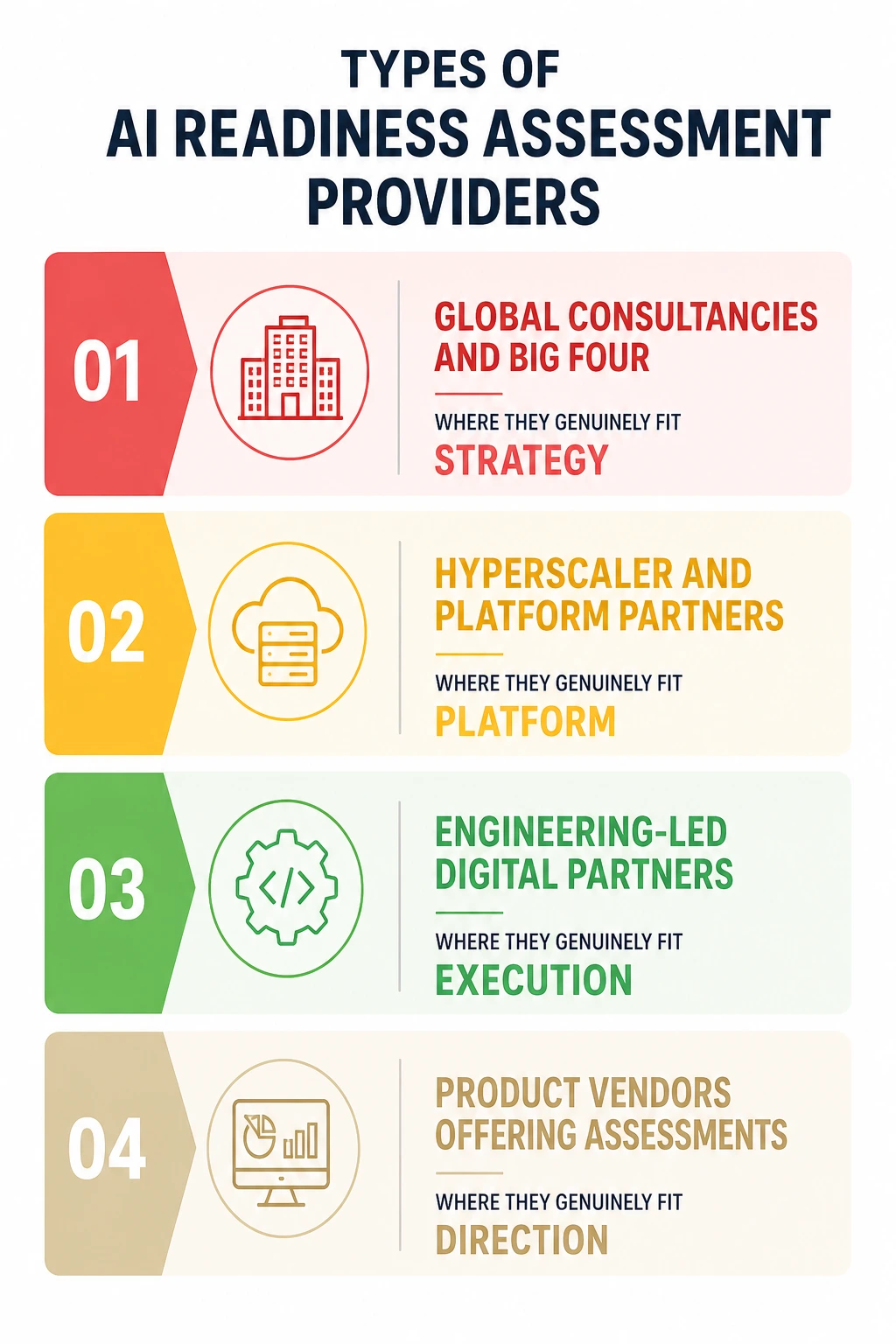
The Four Types of AI Readiness Assessment Providers
AI readiness assessment is not designed for all categories. Some are built for board-level strategy, some focus on cloud platforms, while others connect assessment directly to engineering work. The category also has a trade-off: engineering-led firms may carry less brand weight than a Big Four name in a board presentation.
Below are the four types of AI readiness assessment providers for enterprises.
Overall enterprise adoption can be helped by reviewing our enterprise AI readiness assessment breakdown. Below are the four types of AI readiness assessment providers for enterprises
Global consultancies and Big Four
Global consultancies and Big Four firms are usually proficient in areas such as board framing, benchmarking, and change management, which includes involvement of senior executives and business transformation.
Typical Price Band: High ($100k–$350k+). They have the highest costs among all four groups per week.
Engagement Length: 6 to 12 weeks
What They Are Genuinely Good At: Strategic framing at the executive level, peer benchmarking, and transformation management. They can also connect AI readiness to wider business strategy and transformation programs.
Structural Bias to Watch For: Heavy on strategy artifacts, lighter on hands-on data and platform remediation, and typically carrying the highest cost per week.
Hyperscaler and platform partners
Hyperscaler and Cloud platform partners are strongest at infrastructure and platform readiness within one cloud ecosystem. They sometimes offer AI readiness assessment at no direct cost.
Typical Price Band: Low to Zero
Engagement Length: 2 to 4 weeks
What They Are Genuinely Good At: They are particularly strong at assessing cloud infrastructure, data platforms, AI services, security controls, and platform capabilities within their own ecosystem.
Structural Bias to Watch For: This assessment could naturally lead to the sponsoring platform. A company that has either a multicloud or on-premises environment will not necessarily be afforded the same level of scrutiny on every platform.
Engineering-led digital partners
Engineering-led digital partners are strongest when the assessment must end in delivered remediation rather than a report. They sit between strategy consulting and pure technology assessment. Their strength is connecting the assessment to the technical work that follows. In many cases, complex software infrastructure can be improved by leveraging top-tier legacy system modernization service providers during execution.
Entrans fits in this category as we assess data quality, architecture, AI platforms, security, governance, and engineering processes. Our approach centers on evidence-based scoring and links the readiness results to a tangible road map that considers data, platform, governance, security, and production AI workload aspects. This method will be most useful if the business is interested in progressing from assessment to implementation.
Typical Price Band: Mid-range ($40k–$90k)
Engagement Length: 3 to 6 weeks
What They Are Genuinely Good At: Guaranteeing that the assessment results in remediation and not just a report, since they themselves will have built the data pipelines, platform architecture, and governance infrastructure.
Structural Bias to Watch For: Less brand weight in a traditional board pack compared to a Big Four name.
Product vendors offering assessments
Product companies often make AI readiness assessments available through online questionnaires, self-assessment tools, or lightweight consulting engagements. They are fast, low-cost, often free, and useful for a directional score.
Typical Price Band: Very low to free (self-serve)
Engagement Length: Self-serve (hours to days)
What They Are Genuinely Good At: They are fast, inexpensive, and useful for getting an initial directional score. A product-led assessment can help a company identify obvious gaps before commissioning a deeper assessment.
Structural Bias to Watch For: The assessment functions as a demand-generation instrument for the product, meaning identified gaps consistently align with what the vendor sells.
Early-stage internal alignment or software tool evaluation
Which Provider Should You Choose?
The right choice depends less on the provider's size and more on what you need the assessment to accomplish. Gartner recommends looking for AI readiness assessment partners who specialize in AI TRiSM (Trust, Risk, and Security Management) and clear ROI alignment over basic productivity promises. Additionally, selecting a methodology can be improved by reading an AI readiness assessment framework comparison to analyze different evaluation models.
Need board-level strategy and industry benchmarking? Consider a global consultancy or Big Four firm.
Need to assess readiness for a specific cloud ecosystem? A hyperscaler or platform partner may be the better fit.
Need the assessment to flow directly into technical remediation? An engineering-led digital partner is often a stronger choice.
Need a quick, inexpensive starting point? A product vendor's assessment can give you an initial directional view.
A credible AI readiness evaluation must produce concrete, execution-ready artifacts. When signing up with an AI readiness assessment partner, require a comprehensive deliverable set built on quantified maturity scores and domain-level diagnosis across data, infrastructure, security, governance, control plan, and a 30/60/90-day roadmap.
Use these capabilities as your vendor checklist:
quantified maturity
domain-level diagnosis
relevant industry benchmarking
prioritized recommendations
practical transformation roadmap
Demand these mandatory deliverables:
Scored Assessment & Gap Register: Thorough assessment using rubrics compared to industry benchmarking, with a gap analysis of severity & effort.
Use-Case & Architecture Blueprint: Priority use-case list (based on feasibility and ROI) supported by target architecture vision.
Execution & Control Plan: Enterprise governance structure, transformation plan in 30/60/90 days format, along with estimated cost of investment.
The simple way to disqualify is as follows: If your engagement ends up with a slide presentation without creating a cost remediation backlog for you, then it is not an assessment at all. A good assessment will have actionable results mapped to the effort involved, investment required, priority, and steps towards production AI.
12 Questions to Ask Before You Sign
Before entering into a contract for an artificial intelligence (AI) readiness evaluation, some questions should be asked to gain insight into the workings of the provider. The ideal AI readiness assessment provider would be one who can describe its methodology and how conclusions are acted upon. Beware of vague answers, hidden methodologies, and attempts to immediately purchase the technology.
Methodology & Transparency
Which framework do you use, and will you share the full rubric upfront?
Worrying Answer: The provider uses a proprietary score but will not explain the dimensions, weights, or scoring logic.
What industry benchmark are you comparing us against, and where does that data originate?
Worrying Answer: We use generic cross-industry averages from our global survey pool.
How many of your assessment dimensions are platform-specific?
Worrying Answer: Most of our evaluation measures compatibility with our preferred cloud or software ecosystem.
Validation & Conflict of Interest
Who scores the assessment, and is it the same team incentivized to sell the follow-on remediation?
Worrying Answer: Our senior account executives lead the scoring and map out the phase-two implementation scope.
How do you independently verify technical evidence rather than relying on self-reported questionnaires?
Worrying Answer: We conduct interviews and trust your team's documented architecture notes.
Can you name three recent engagements where your final recommendation was to slow down or halt?
Worrying Answer: Our clients are always ready to move forward into development after our review.
What happens if your finding is that we should not proceed with AI adoption right now?
Worrying Answer: Every client can deploy AI; it's just a matter of choosing the right software vendor.
Data, Governance & IP
How do you handle regulated data and security compliance during discovery? In data-sensitive environments, enterprise safety can be improved by applying strong cybersecurity and compliance protocols.
Worrying Answer: We just need temporary read-only admin access across your production databases.
Who owns the intellectual property and technical artifacts generated in the output?
Worrying Answer: We retain ownership of the custom assessment frameworks and underlying roadmap models.
Resource Commitment & Financials
Who do you need from our organization, and for how many hours per week?
Worrying Answer: Well, we'll just do ad hoc calls with your engineers as and when any questions arise.
Is the final 30/60/90-day roadmap costing out with effort estimates?
Worrying Answer: We provide timeframes and milestones; project costing is determined during implementation contracting.
What is the recommended re-score cadence after initial remediation?
Worrying Answer: An assessment is a one-time project, so a re-score isn't necessary.
How Assessment Pricing Actually Works
AI readiness assessment pricing varies depending on AI readiness assessment service providers. Budget planning can be helped by reviewing detailed AI readiness assessment cost benchmarks.
Common pricing models include:
Free platform tools: Cloud providers and product vendors may offer self-assessments at no cost, usually with limited scope.
Fixed-scope assessments: Boutique and engineering-led vendors may offer to assess at a fixed cost, typically based on the size of the business and deliverables.
Day-Rate Consultancy Engagements: Flexible and time-and-materials-based billing typical of international consulting firms, resulting in increased total cost ($100k+).
Credited/Subsidized Engagements: Assessment performed for no fee or discounted rate due to payment from cloud vendor or partner firm.
Primary Cost Drivers
Organizational Scope: Number of business units, use cases, and stakeholders.
Data Estate Complexity: Number of legacy data systems, unmapped pipelines, and unstructured data stores. Underlying pipeline health can be improved through modern data engineering and advanced analytics services.
Regulatory Domains: Higher compliance needs (HIPAA, GDPR, SOC 2), leading to increased security audit requirements.
Free tools can be a smart starting point, especially when your team needs a quick baseline before speaking with AI readiness assessment services companies. Microsoft provides an AI readiness assessment that is based on the following seven pillars, whereas Cisco has its AI Readiness Index. These tools can assist teams in identifying general readiness gaps, developing a common language, and getting an orientation on their current status.
A free assessment generally will not validate evidence across your data estate, interview multiple business units, inspect architecture, estimate remediation effort, or produce a cost transformation roadmap. Results can also remain high-level rather than tailored to your regulatory and operational context.
The Golden Rule
Run a free assessment to align leadership, establish a baseline score, and build a shared vocabulary. However, transition to a paid engagement as soon as your project involves material capital allocation, regulated data environments, or cross-business unit integration. That is where deeper evidence, diagnosis, prioritization, and financial planning become valuable.
Red Flags in an AI Readiness Assessment Proposal
Before signing an AI readiness assessment proposal, we should consider other factors such as price and presentation.
Pre-Determined Conclusions: The proposal already recommends a platform, product, or target architecture before the assessment begins.
Product-Mirrored Dimensions: Assessment categories that align perfectly with the vendor's proprietary software catalog rather than broader industry standards.
No named framework: There is no identification of any assessment framework, or even a refusal to reveal the scoring criteria in advance.
Pure Self-Reporting: Using only survey questionnaires without any code review, architecture review, or pipeline verification.
Siloed Stakeholder Input: Scoring that depends only on feedback from IT professionals without taking into account the feedback of the leadership of business units, legal experts, and compliance experts.
Uncosted Roadmaps & Missing Re-Scores: Roadmaps without engineering costs involved in implementation and re-score after remediation.
Procurement & Pricing Red Flags
Suspiciously Low Pricing: An assessment priced far below market rate usually indicates an automated, surface-level questionnaire designed as a sales hook.
Inflated Pricing: An assessment priced far above market rate usually signals traditional strategy consulting with a lightweight assessment tacked on.
A proposal ought to clarify methodology, criteria for evidence, criteria for scoring, participants involved, outputs, timeline, and cost before signing the document.
Building the Shortlist and Running the Evaluation
Selecting an AI readiness assessment consulting firm is a buying, not a searching, process. A straightforward procedure can enable you to make comparisons based on the actual offer that each vendor provides.
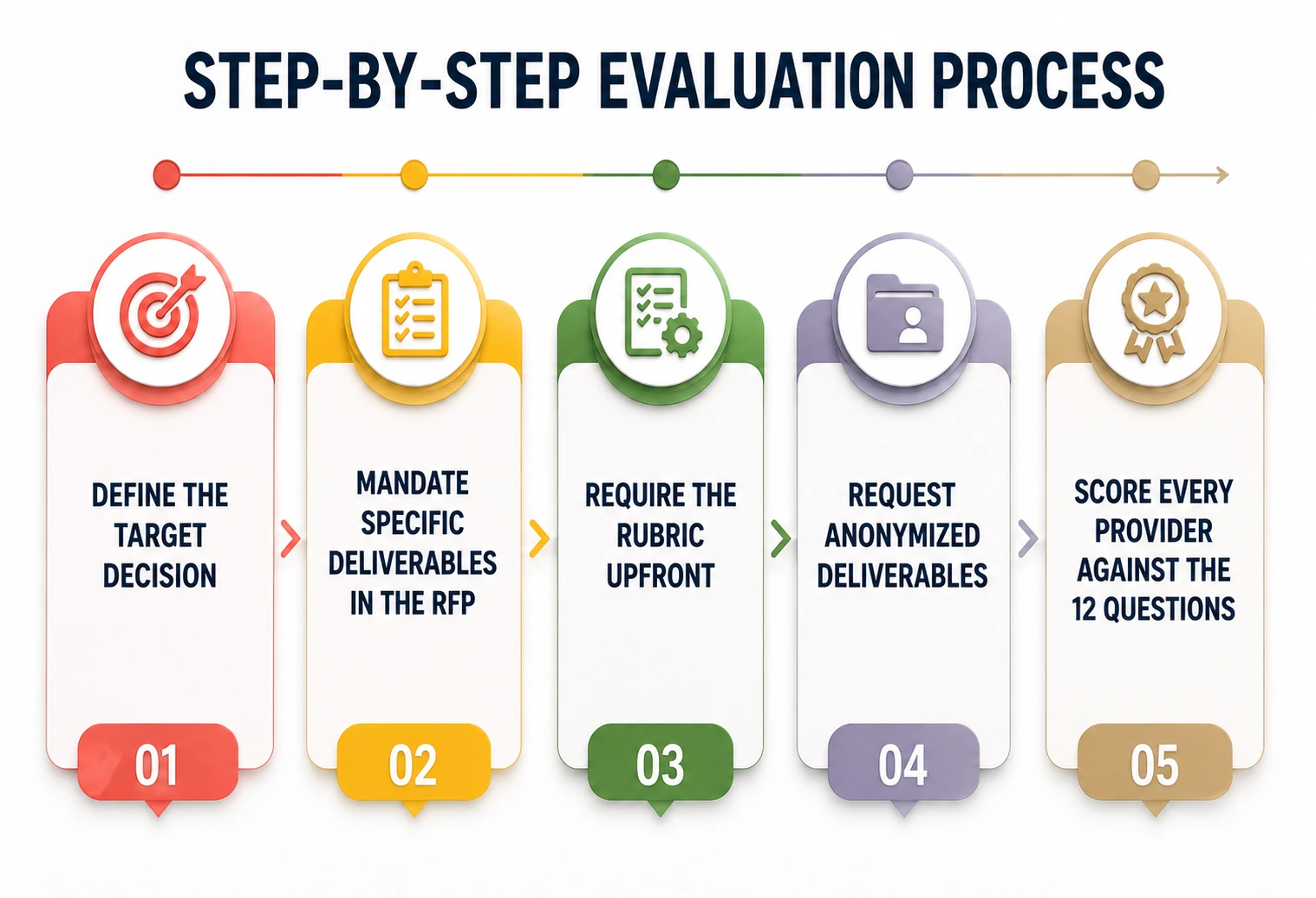
Step-by-Step Evaluation Process
Define the Target Decision: Clearly specify what capital allocation or technical milestone this evaluation must justify before drafting requirements. Ensure which AI use cases to pursue, whether your data and platforms are ready, where to invest, or whether to delay certain initiatives.
Mandate Specific Deliverables in the RFP: Ask for the scored assessment, gap register, use-case shortlist, target architecture direction, governance plan, 30/60/90 roadmap, and investment estimate.
Require the Rubric Upfront: Demand that vendors provide their full scoring methodology, evaluation dimensions, and evidence verification process in their proposal.
Request Anonymized Deliverables: Ask for two complete, anonymized sample outputs from recent client engagements to evaluate true depth over sales decks. Look for the depth of diagnosis, evidence used, prioritization, and level of detail in the roadmap.
Score every AI readiness assessment provider against the 12 Questions: Use the pre-signature questionnaire to evaluate vendor transparency, potential conflict of interest, and technical rigor.
Reusable Vendor Scorecard
A sample scorecard is shown below.
Evaluation area
Weight
Methodology & Rigor
25%
Deliverable Depth
25%
Objectivity & Alignment
20%
Domain & Technical Expertise
15%
Commercials & IP Rights
15%
TOTAL
100%
Score each area from 1–5, then multiply the score by its weight. The highest score should not automatically win; use the scorecard alongside references, proposal quality, team experience, and the provider's answers to the 12 buyer questions.
When You Do Not Need an External Partner
An external partner may not be necessary when:
Your evaluation covers a single business unit with well-documented data pipelines and zero regulatory or compliance exposure.
Data, process, platform, and ownership have all been clearly stated.
The assessment can be performed by an internal leader without any interest in its outcomes.
There are no complicated regulatory/compliance issues involved with the assessment.
The decision that your team wants to make is clear to you.
Where Entrans Fits, and Where It Does Not
Entrans fits within the engineering-led digital partner category in the four-provider model. That positioning comes with clear strengths and trade-offs. Overall, machine learning operational efficiency can be improved by integrating dataops mlops services early in your roadmap.
Where Entrans fits best: When an AI readiness assessment needs to move beyond diagnosis into technical remediation. Entrans can connect findings across data, platforms, security, governance, and AI workloads to the engineering work that follows.
Where it may not be the best fit: When the primary requirement is board-level brand recognition, large-scale industry benchmarking, or a strategy engagement where a Big Four name carries greater weight.
Entrans sells both AI readiness assessment services and remediation services. That creates a potential conflict of interest. The practical way to manage it is to keep the scoring evidence-based, use a stated rubric, document the findings, and make remediation recommendations traceable to identified gaps rather than predetermined services.
Having delivered over 150 AI projects, Entrans anchors its evaluation frameworks in real-world technical execution patterns, ensuring every identified gap maps directly to a practical, deployable fix.
Get a clear technical audit and a step-by-step roadmap to launch production-ready AI.
20+ Years of Industry Experience
500+ Successful Projects
50+ Global Clients including Fortune 500s
100% On-Time Delivery
Thank you! Your submission has been received!
Oops! Something went wrong while submitting the form.
FAQs
1. What should an AI readiness assessment provider deliver?
An AI readiness assessment provider should deliver a scored assessment, gap register, prioritized use cases, target architecture direction, governance plan, 30/60/90 roadmap, and investment estimate.
2. How do I choose an AI readiness assessment firm?
Select a partner by defining your core technical decision upfront, mandating a costed remediation backlog in your RFP, and requiring full access to their scoring rubric. Compare shortlisted firms using the same rubric, deliverables, methodology, experience, cost, and evidence requirements.
3. Should I use a free AI readiness assessment tool or hire a consultant?
Start with a free tool to get a directional score and shared vocabulary before investing in a deeper assessment. Hire a consultant when the decision involves major investment, regulated data, multiple business units, or evidence-verified findings.
4. Is it a conflict of interest if the firm that assesses us also does the remediation?
Yes, it creates an inherent incentive to scope unnecessary follow-on work to boost downstream implementation revenue. Firms manage this by using objective, shared rubrics, verifying hard code evidence, and providing open-standard backlogs that any third party can execute.
5. How long should an enterprise AI readiness assessment take?
Product-led directional assessments take anywhere from a few hours to a few days, while focused engineering or platform assessments typically take 2 to 6 weeks. High-level global strategy engagements with change management usually run between 6 and 12 weeks.
6. What questions should I ask an AI readiness assessment vendor?
Ask about the framework, scoring rubric, evidence verification, assessor independence, benchmarks, roadmap costing, and re-scoring process.
Also ask for anonymized prior outputs and examples where the provider advised a client to delay or stop an AI initiative.
Hire AI Engineers to Scale
Onboard top developers to fix data gaps, build pipelines, and modernize your architecture.
Free Project Consultation
Trusted by Enterprises & Startups
Top 1% Industry Experts
Flexible Contracts & Transparent Pricing
50+ Successful Enterprise Deployments
Aditya Santhanam
Author
Aditya Santhanam is Co-founder & CTO of Entrans Technologies, spearheading AI-driven cloud and data solutions. A 13-year tech veteran, he leads innovation in generative AI, AI agents and MLOps. He also co-founded Infisign (identity security) and Thunai.AI (enterprise AI agents)
Related Blogs
Vector Database Use Cases: 15 Real-World Applications and Examples
Explore 15 vector database use cases, real-world examples, tools, performance results, and practical guidance for choosing the right vector database.
AI Automation Examples: 25 Real-World Use Cases Across the Enterprise (With Results)
Explore 25 enterprise AI automation examples across 9 functions with real performance results, 3 end-to-end workflow breakdowns, and a quick-win framework.






-1.svg)