Discover real ai readiness assessment cost drivers. Compare pricing tiers, key variables, and ROI formulas to budget for your enterprise AI audit.

Agentic Unconference 2026 - September 19, Chennai
View Event →




Everyone sees only the benefits of AI’s transformative magic, but nobody talks about the price tag of getting your business ready for it. The answer may surprise you: AI readiness assessment costs. AI readiness assessment pricing varies widely because assessments are not all doing the same job. Some rely mainly on questionnaires and self-reported information.
This blog explains the breakdown in AI readiness assessment costs by scope, evidence depth, expertise, deliverables, and roadmap detail.
An AI readiness assessment costs between $0 and $500,000+. This price may vary depending on several factors: scope, depth, business unit count, and provider model. Published prices currently start around $1,500 for narrow assessments, while enterprise engagements depend on complexity and business unit count rather than a standard list price. For organizations seeking a comprehensive view of how to evaluate these foundational steps, our complete AI readiness assessment guide can be improved by examining the full operational breakdown.
In cases where there are multiple units and large consultancy engagements, the quotation occurs post-discovery as the cost is largely influenced by the number of business units, the systems, the data domains, the interviews, geography, regulations, and roadmap involved. Some vendors have indicated enterprise or volume pricing to be custom or scope-driven.
A rule of thumb that works well is that the greater the degree of moving away from completing the questionnaire to looking at evidence, benchmarking business units, target architecture development, and investing roadmap development, the greater the cost.
The report length does not determine the price of an AI readiness assessment. It depends on whether findings are evidence-verified and whether the implementation roadmap is accurately costed. Understanding these budget brackets can be helped by reviewing the AI readiness assessment cost guide to align financial plans with real technical requirements.
An AI readiness assessment cost rarely depends on company size alone. It is clear when two enterprises with similar revenue receive different quotes. The number of business units, data sources, regulatory requirements, and depth of analysis all affect the effort involved.
Here are the eight variables that usually move AI readiness assessment pricing the most:
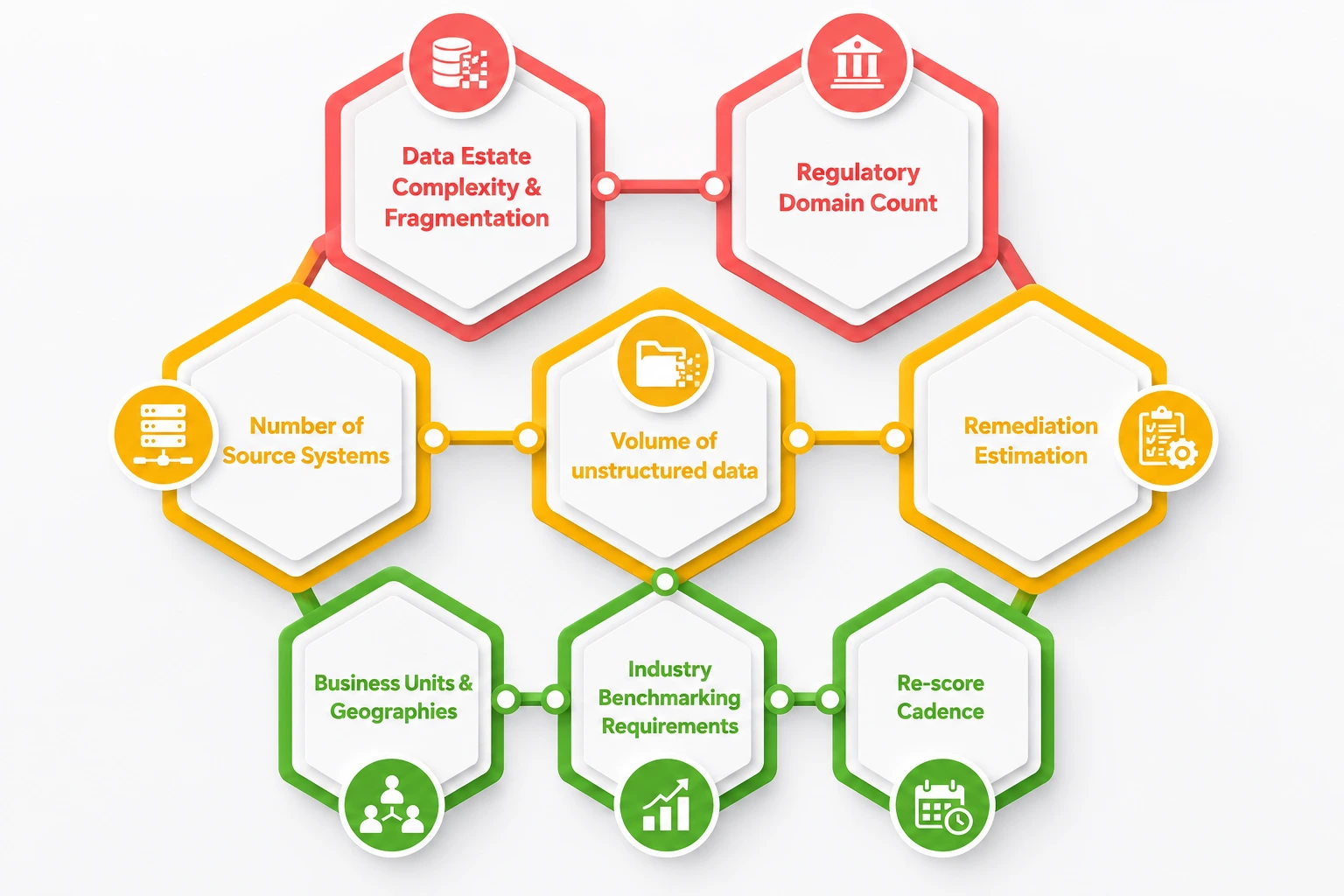
It is usually one of the two biggest factors in terms of costs. There can be hundreds of data sources, such as databases, data warehouses, cloud-based software solutions, old legacy systems, data lakes, and separate data pipelines that require much more effort from the assessors than just one integrated data environment. Performing an in-depth AI data readiness assessment can be helped by isolating data lineage friction before expanding engineering scope.
This operates under overlapping compliance frameworks (e.g., HIPAA, PCI DSS, SOX, NIST AI RMF, or the EU AI Act). With multiple regulatory domains come more controls, more evidence, more ownership structures, and also risks to be considered. Navigating these requirements can be improved by specialized cybersecurity and compliance oversight to protect sensitive assets.
Reviewing five systems is totally different than reviewing 50 systems. Every single new system brings up questions with regard to APIs, data, authentication, ownership, and technical limitations. Some of the patterns and platform capacity are compared between 5 core applications vs. 50+ legacy systems, which can alter the engineering effort.
Moving beyond a diagnostic gap report to deliver detailed engineering cost estimates, technical refactoring blueprints, and ROI models increases scope depth. A gap report is cheaper to write than a gap report that quantifies the cost and effort required to resolve all the findings identified. If the assessment involves human elements, technology estimates, licensing costs, migration, and engineering effort, then the scope becomes wider.
Unstructured sources such as documents, emails, telephone conversations, PDF files, images, and others may demand further analysis. The assessment may be required to determine accessibility, classification, quality, retention, permissions, and suitability for methods like RAG. Addressing these architectural hurdles can be helped by advanced data engineering and advanced analytics capabilities.
Assessment of one business unit in one country is much easier than that of 20 business units in different countries. Increased numbers of business units mean increased numbers of stakeholder, process, and platform reviews. It requires intensive manual data lineage, schema discovery, and data hygiene audits. For organizations navigating complex structures, conducting an enterprise AI readiness assessment can be helped by aligning disparate operational goals early.
If the assessment only needs to provide a score regarding your readiness internally, then benchmarking may not be required at all. Benchmarking against industry peers and using industry benchmarks for maturity will require further analysis and could increase the cost of the assessment.
An initial assessment and the one that is performed quarterly or periodically for every AI project have different cost structures because the recurrent assessment involves a repeatable measuring process and new evidence gathering.
To help benchmark where your organization sits, consider these two real-world scoping scenarios handled by Entrans teams:
Example 1: Data estate complexity
An enterprise with three business units might initially look straightforward. However, the discovery reveals more than 100 source systems, several legacy databases, multiple cloud data platforms, and fragmented ownership across regions. The assessment now needs deeper data-flow mapping and platform reviews. The number of business units is manageable, but the data estate complexity pushes the assessment into a higher pricing tier.
Example 2: Regulatory scope
Another enterprise may have a relatively consolidated technology estate, but it operates across healthcare and financial services environments. The assessment therefore needs to consider requirements associated with HIPAA, PCI DSS, and SOX, alongside its AI governance requirements. Even with fewer systems to inspect, the regulatory scope increases the evidence and control review substantially.
Conclusion: The message is clear – do not base your comparison of quotes for AI readiness assessments on the size of companies or number of assessment questions alone. You should ask what is included under the hood of the quote.
Free AI readiness assessment tools can be a useful starting point, but not guarantee anything. Microsoft’s AI Readiness Assessment uses a 45-question tool covering 7 pillars, and Cisco’s AI Readiness Index assesses readiness across six dimensions such as (evaluating strategy, infrastructure, data, talent, governance, and culture.
They deliver high-level maturity scores, foundational frameworks, and general recommendations. They measure unverified data and misallocated capital.
Because of their reliance only on the answers provided by individuals, these methods lack any form of evidence validation, exhibit bias, and do not provide a cost-effective plan of action. It is therefore dangerous to make any strategic decisions based on such an unverified self-assessment.
An AI readiness assessment can look like another consulting expense. But not evaluating the AI readiness assessment cost is a dangerous miscalculation.
A failed pilot, an AI platform that cannot access usable data, or governance gaps discovered after a production incident can quickly cost far more than the assessment itself.
Third-party research confirms that infrastructure friction is the hidden killer of enterprise AI. NTT DATA: 90% of companies feel that their current infrastructure is hindering their effective utilization of AI, while 45% have conducted an assessment of their future infrastructural requirements. This difference creates a question: "How much are you prepared to spend before you know that your current environment supports the AI journey?"
A straightforward business-case formula is:
Assessment cost ÷ potential avoided loss = break-even percentage
For example, if an assessment costs $50,000 and could prevent a $1 million failed platform investment, the assessment only needs to prevent 5% of that potential loss to break even.
The same logic applies to data remediation, governance work, cloud spending, and failed AI projects. AI readiness assessment cost should therefore be judged against the financial exposure it can uncover—not simply against the assessment fee.
Budgeting for an AI readiness assessment starts with treating it as a decision gate, not just another consulting expense. In many enterprises, the assessment can sit within the AI program budget when its purpose is to decide which AI initiatives should move forward.
A practical approach is to fund the assessment as a stage gate before larger AI spending:
Assessment → evidence-backed gaps → investment decision → larger AI program
One commercial structure worth negotiating is having the assessment fee credited against a subsequent delivery contract. If the same partner moves from assessment into remediation or delivery, this can make the initial assessment easier to approve while keeping the commercial path clear.
Before signing an AI readiness assessment pricing proposal, ensure you ask these six crucial questions to avoid scope creep, inflated costs, or vague deliverables:
An AI readiness assessment can be valuable, but not every assessment is worth the money.
The four primary traps where assessment spend is completely wasted include:
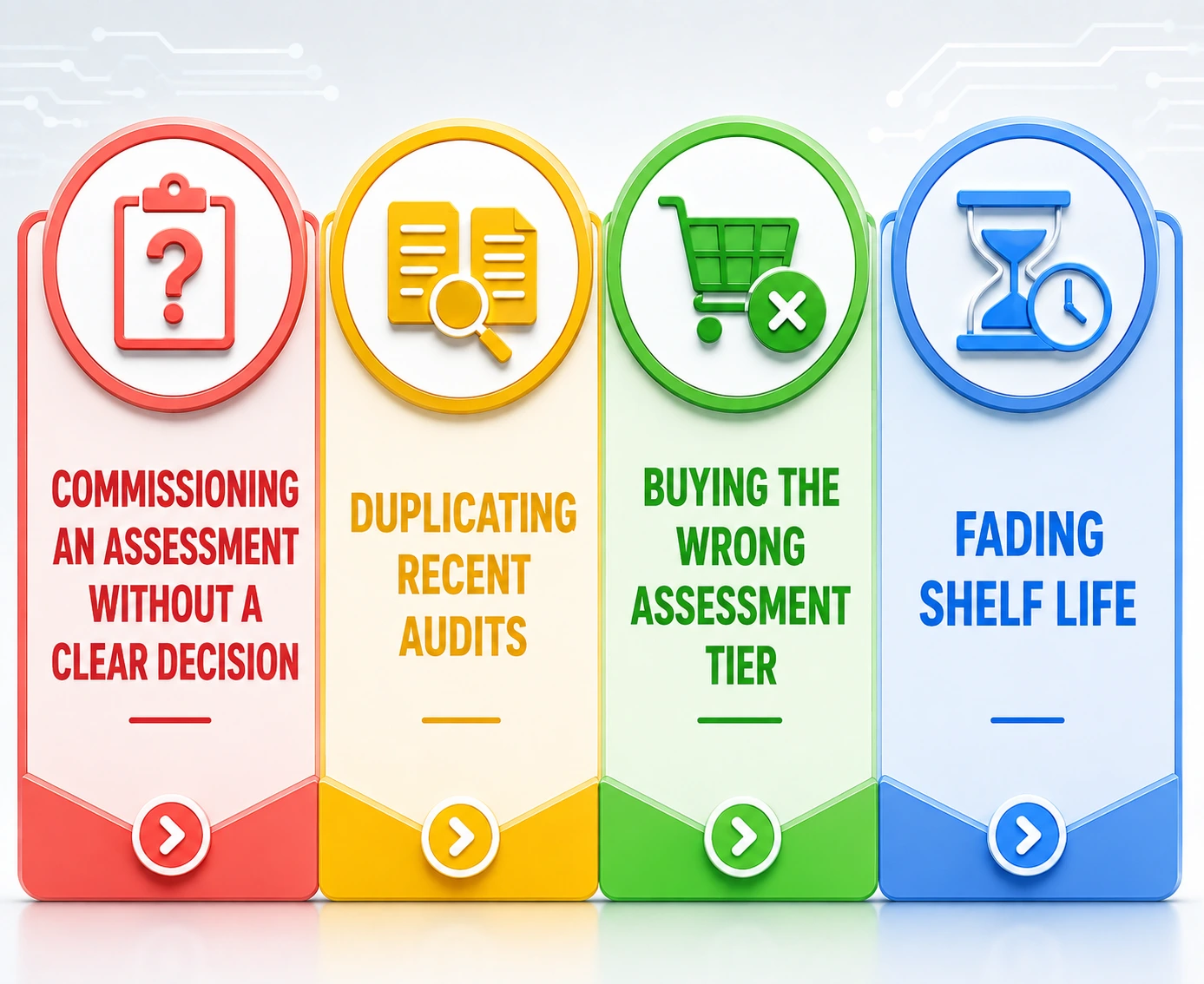
If the only goal is to know whether the enterprise is AI-ready, the project can turn into an expensive information-gathering exercise. Running an evaluation simply to "see where we stand" without a defined project or budget waiting on the result.
A new assessment does not need to repeat every security, compliance, or data review from scratch. If a recent audit contains reliable evidence, use it. Ask the assessment team to build on existing findings and focus its effort on questions the previous work did not answer.
It would be appropriate for a light-weight questionnaire to be used where there is a need for just a directional outlook. This will not work well if the CFO wants to have an investment that is costly and the CIO needs to be sure about the target platform.
Even a strong assessment loses value when nobody acts on it. Letting findings sit in a PDF for six months until the data estate shifts, rendering the assessment obsolete before remediation funding is ever approved.
The Golden Rule: Never commission an assessment without explicitly naming the exact decision it will unblock and setting the firm date that decision is due.
If you cannot identify the specific capital allocation, platform purchase, or architectural greenlight that hinges on the report's score, hold off on spending the money. An assessment should serve as a functional gateway to action, not an expensive exercise in corporate curiosity.
Entrans translates project scope into a fixed-fee quote by translating eight variables into the actual work involved: business units and geographies, data complexity, regulatory domains, unstructured data, source systems, remediation estimates, benchmarking, and re-score cadence. Exploring custom solutions through top AI readiness assessment consulting firms can be improved by aligning scope directly to measurable outcomes.
For instance, an assignment involving two business units with one regulated field is likely to demand more stakeholder interviews and data analysis than an assignment involving just one business unit. It is not uncommon for the quotation to go up even higher based on data complexity and the number of regulations involved.
The scope of work shall describe the business units to be considered, the systems, evidence review process, scoring criteria, interviews, deliverables, schedule, and re-scoring terms. A change order should be implemented in the event that the client changes the number of business units, source systems, regulatory domains, major data estates, or deliverables.
Our Pricing transparency is a commercial decision for its sales team. The assessment fee may also be creditable against a subsequent delivery contract.
Talk to us to learn more about it.

A standalone AI readiness assessment typically costs between $10,000 and $50,000 for mid-market businesses. Larger consulting engagements can exceed $100,000. Pricing depends on scope, data complexity, regulatory requirements, and evidence depth.
Yes. Free tools can give directional readiness. They are not useful for investment decisions because answers may be self-reported, evidence is not verified, and remediation costs are not estimated.
A typical enterprise AI readiness assessment takes 2 to 6 weeks from the starting stage to the final stage. Answering simple questions can take days, but that should not be confused with an evidence-led enterprise assessment.
Yes. Some AI readiness assessment providers agree to credit the assessment fee against a subsequent delivery.
Yes. AI readiness assessment is tied to a specific investment decision and uncovers costly data, platform, security, or governance gaps before larger spending begins.
AI readiness assessment quote includes assessment dimensions, evidence standards, stakeholders, deliverables, timeline, an actionable roadmap, and commercial terms.

-1.svg)