AI data readiness assessment: evaluate data quality, lineage, governance, accessibility, and security to build a reliable foundation for production AI.

Agentic Unconference 2026 - September 19, Chennai
View Event →





Most of the leaders assume that AI initiatives fail because of weak models or bad algorithms. But in reality, failure happens much earlier, hidden deep inside silent pipeline failures, missing metadata, and legacy permissions that break the moment. Is there any way to tell if your data is ready for the real world?. This is precisely where an AI data readiness assessment comes in.
This blog explains how we can utilize expert data readiness assessment services for AI initiatives so forward-thinking leaders can audit lineage and transform fragmented data architecture into a hardened foundation built for production scale.
Data readiness for AI is a process of determining whether an organization’s data is representative, traceable, governed, accessible, and secure enough to train, ground, and operate AI systems in production.
Data quality and data readiness do not mean the same. Data quality is a property of a dataset; data readiness is a property of the operating model. The distinction also extends to what counts as quality. A complete AI readiness assessment guide can be helped to better understand these strategic shifts.
According to Gartner, for a specific use case, AI-ready data should be representative, including the patterns, errors, outliers, and surprising cases required for training or running the model. For traditional data preparation, such unique data might have been filtered out because they would be considered noise, whereas for an AI system, they are actually useful.
This is why data readiness assessment involves more than just asking if the datasets are clean. The questions to be answered include whether
the appropriate data is available
AI scaling is exposing data problems that traditional analytics could often work around. McKinsey identifies four shifts:
Accenture’s 2026 research found that only 7% of surveyed companies had reached the data-readiness level needed to scale advanced AI. The failure is rarely the model alone. The harder question is whether anyone can prove where a number came from and who is entitled to see it. Enterprise research also confirms that AI programs stall on data infrastructure rather than model capability. This foundation can be improved by using an AI infrastructure readiness assessment to align underlying systems. Furthermore, cloud fragmentation is forcing Chief Data Officers to centralize AI enablement to prevent siloed drift.
AI initiatives rarely fail because there is no data available. In most cases, the reason is that the data is unreliable, untraceable, inaccessible, or unsuitable for the task that the AI application will need to accomplish.
The data readiness assessment is not only about the quality score of data but also about whether your data estate is able to support the AI use case from development all the way to production.
The six dimensions form the base for AI data readiness assessment. Each section finds answers to the questions;
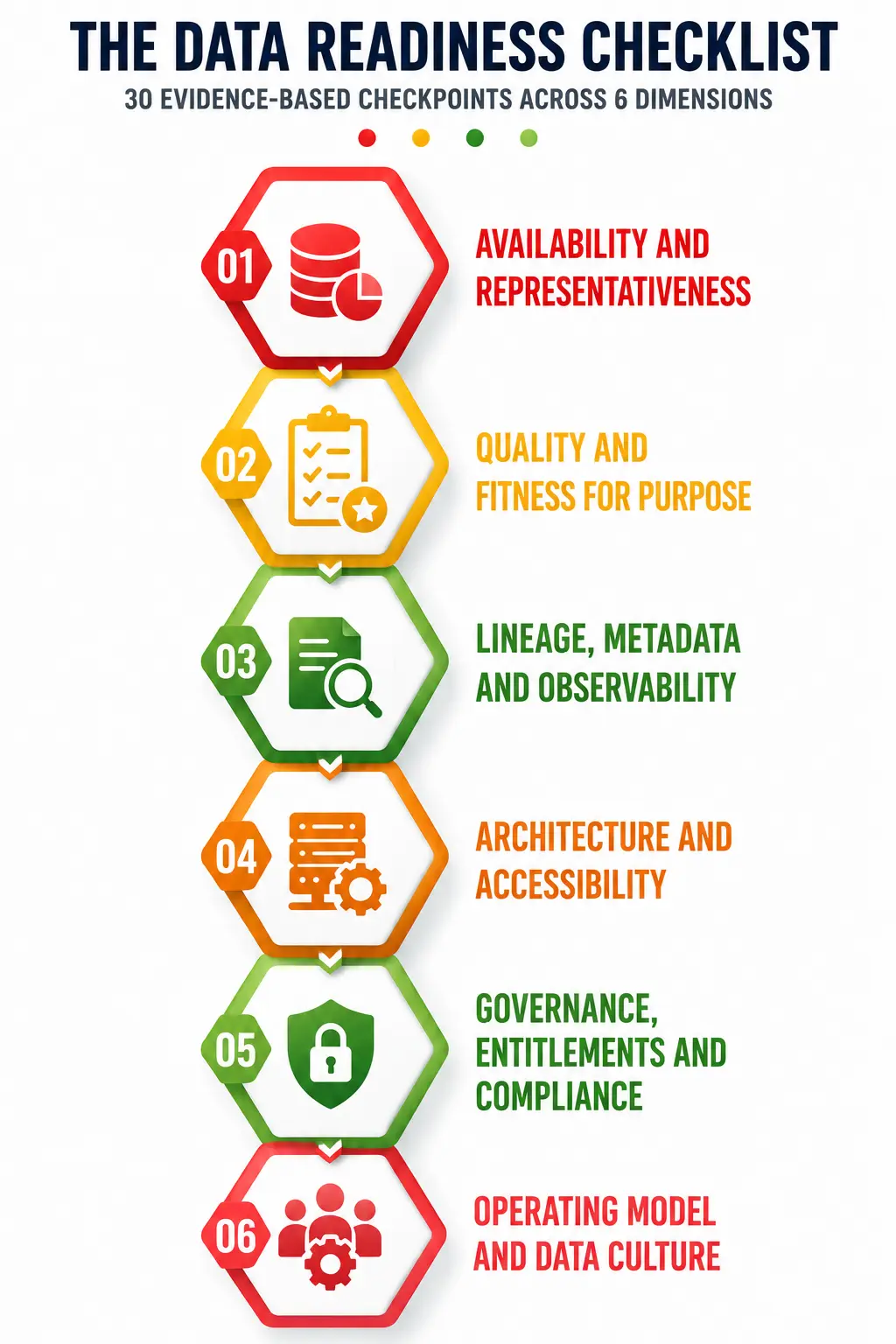
The first question is simple: Does the data needed for the specific use case exist with sufficient history and coverage, including the edge cases the model must handle?
Even datasets with millions of records may turn out to be irrelevant to the model in question. The assessment focuses on whether the right history, population, attributes, events, and time period are available. Most importantly, it evaluates whether the data captures the environment that the AI system will operate in.
Extreme cases are essential in such an assessment. Unusual transaction sequences are critical in fraud models. For specialized industries, evaluating a data lakehouse for banking can be improved to handle complex compliance and real-time transaction data. Difficult interactions, escalations, and partial requests are important for customer service systems. And abnormal demand periods – for forecasting systems.
Hence, the evaluation must be done on the basis of how much coverage the use case provides, rather than whether tables, records, or terabytes of data are available.
Whether the necessary data is available with adequate history, quantity, and context, particularly taking into account practical edge cases, errors, and seasonal variations that the AI system will encounter during its deployment.
A formal coverage analysis mapped directly against the specific use-case requirements, rather than a raw record or table count.
The realization at later stages of the process that the data collected does not reflect what the model needs.
Data quality score cannot be interpreted out of its context. A score of 98% for completeness could be very good for some applications of AI but bad for other uses.
This criterion considers completeness, accuracy, timeliness, consistency, and duplication with respect to the threshold that is appropriate for the specific application. An important field that influences the making of a financial decision will require a stricter threshold than an optional field.
The analysis also considers if these thresholds have been negotiated by the owners of the business process. It is not right for a data team to make this decision on its own.
The above attributes are evaluated against custom thresholds defined per use case rather than generic global rules.
Data profiling outputs tied to an agreed-upon Service Level Agreement (SLA) for every critical field.
A company applies one enterprise-wide quality threshold to every dataset instead of defining fitness based on the AI use case.
Even though the inputs may have questionable validity, an AI application can generate credible results from them. However, the process of verifying the provenance of such results is challenging without any lineage and metadata.
The observability dimension addresses the question of whether it is possible to trace the history of a particular field starting from its origin through all the transformations until its consumption by the system/AI application. This dimension also covers the business definitions of such fields.
Observability plays an equally important role. An unnoticed failure in the pipeline late at night could result in the AI application using outdated information. Overall pipeline health can be improved by establishing continuous DataOps and MLOps services for real-time monitoring.
The end-to-end traceability of every data point to its source system, documented business definitions for key fields, and active pipeline monitoring that flags failures before downstream AI systems ingest bad data.
A functional lineage graph, documented business glossary coverage metrics, and automated pipeline observability alert logs.
Operating "black box" pipelines where a corrupted upstream schema silently degrades downstream model predictions without triggering an alert.
Data consumption is also affected by AI. While reporting traditionally allows for scheduled extracts and overnight processing, an AI assistant, recommender system, or agent would require access to this data immediately, sometimes even in just seconds or milliseconds.
The assessment will investigate how data is distributed in warehouses, lakehouses, databases, file stores, SaaS, APIs, and legacy systems. It will also analyze how data needs to be extracted to make it available. Legacy environments can be improved through modern data platform modernization pipelines to reduce latency.
However, unstructured content should be considered separately. Various documents, emails, support tickets, contracts, images, and other unstructured content require some preparation before it can be used by retrieval-based AI applications.
The balance between centralization and fragmentation, modern lakehouse/warehouse design, API latency for real-time retrieval, and the readiness of unstructured data (PDFs, docs, logs) for chunking and embedding.
An enterprise architecture diagram showing clear data flows alongside a comprehensive inventory of legacy systems that still require custom extraction scripts.
Storing high-value knowledge in siloed, unstructured formats that cannot be ingested into vector databases or retrieval-augmented generation (RAG) pipelines.
AI poses an immediate question regarding who is allowed to extract what information and when.
This governance process deals with ownership, classification, retention, entitlements, and permissions. This exercise will have to map the above-mentioned controls to whatever regulation or standard is applicable to the business, including HIPAA, PCI-DSS, GDPR, the EU AI Act, or other legislation. Risk management can be helped by integrating dedicated cybersecurity and compliance safeguards into access controls.
It is important to pay particular attention to entitlements. The application of AI allows retrieving and processing information in a manner impossible with traditional applications. An individual entitled to access one customer’s record may not be entitled to retrieve a bundle of sensitive records via an AI assistant.
Automated classification coverage, a dynamic entitlement access matrix, and a formally documented sign-off workflow for new AI data uses.
Exposing sensitive customer or financial data to LLMs because existing access controls were designed for humans, not AI agents that aggregate and retrieve data across multiple systems.
Technology is insufficient to enable data to become prepared for AI. Data ownership, its definition, maintenance, change management, and problem resolution when quality decreases – all these processes require someone's involvement.
This dimension deals with whether the data products have defined owners and whether data change management takes place within an existing process. The assessment includes whether the business sides feel comfortable using these numbers in their decision-making processes. Choosing an approach can be improved by reviewing an AI readiness assessment framework comparison across operating structures.
The latter part is usually missed. Even if technically perfect, the data may have little business value if departments such as finance, sales, operations, or customers constantly doubt its accuracy.
Develop a data operating model at that stage before the AI solution goes live.
Named data product owners with explicitly defined domain accountability and a documented pipeline change management process that predates the AI initiative.
Building sophisticated technical pipelines without clear business ownership, leaving models orphaned when underlying business logic or domain definitions change.
Data readiness completely changes based on the data type an AI system uses. The different types of data are
Data readiness centers on clear schema definitions, end-to-end lineage tracking, and strict, field-level quality thresholds.
Assess extraction quality, chunking strategy, metadata enrichment, retrieval accuracy, and whether source permissions carry through to AI retrieval.
Demands rigorous provenance tracking to identify AI-produced content and prevent models from retraining on their own outputs; a recursive feedback loop quickly becoming tech's fastest-moving governance nightmare.
A useful data readiness score shows more than a single percentage. One needs to score each dimension from 1 to 5 using evidence to justify the rating.
A sample scorecard is shown below.
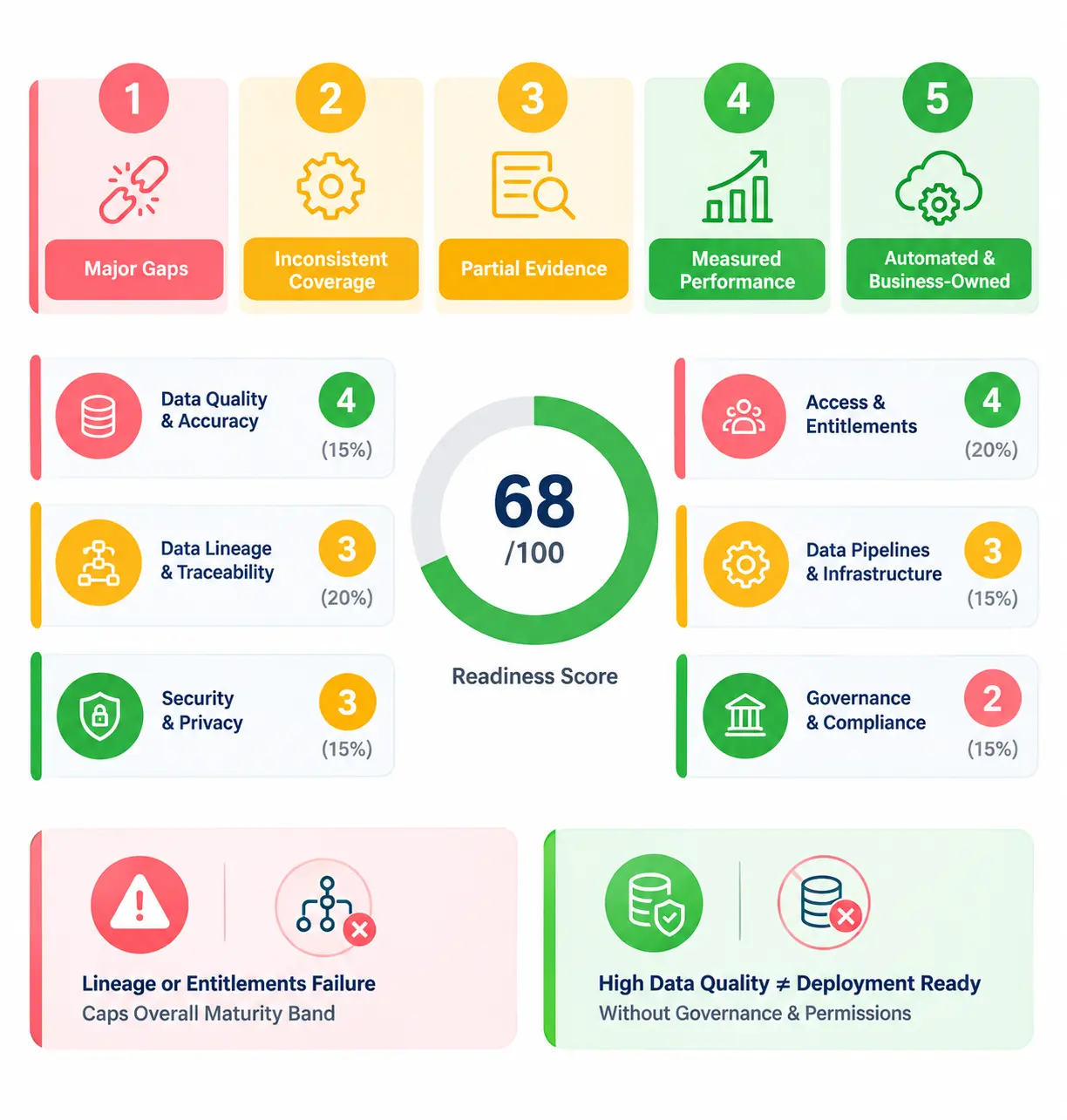
Apply the agreed weight to each dimension and calculate the weighted total. For example, scores of 4, 4, 3, 3, 2, and 4 across the six dimensions, using the earlier weights, produce a 68/100 readiness score.
One rule matters: a failure on lineage or entitlements caps the overall maturity band, regardless of the total score. Both are production prerequisites, not accelerators.
Entrans enterprise assessments routinely reveal estates with high raw data quality that remain completely unready for deployment due to ungoverned pipelines and unmapped permissions. Broader strategy can be improved using tailored data engineering and advanced analytics solutions to fix structural gaps.
A data readiness assessment checklist should test what can be proven and not simply what can be believed. The 30 checks below go deep inside to check that evidence can support an AI workload in production. Systematic tracking can be helped by adopting an AI readiness assessment checklist during audits.
[ ] Edge-case inventory: Documented inventory of historical edge cases, system outages, and operational anomalies mapped directly to model test suites.[ ] Temporal coverage: Data has sufficient historical depth for the intended workload.
[ ] Labeling fidelity: Ground-truth labels are verified for consistency, with inter-annotator agreement metrics above set domain thresholds.
[ ] Class balance evaluation: Minorities, rare conditions, and low-frequency events are explicitly cataloged rather than smoothed out or dropped.
[ ] Sampling alignment: Training and validation splits mirror real-world inference payload distributions instead of randomized static snapshots.
[ ] Field-level SLAs: Explicit timeliness, completeness, and accuracy SLAs defined per critical field rather than applied globally.
[ ] Profiling outputs: Automated data profiling scripts run regularly, flagging schema drift, null rate spikes, and value-range anomalies.
[ ] De-duplication rules: Entity resolution logic handles near-duplicates and cross-system records without stripping domain-specific context.
[ ] Noise thresholding: Outlier filtering rules distinguish between measurement errors and genuine operational signals.
[ ] Validation gating: Ingestion pipelines automatically reject records that fail field-level validation before touching downstream stores.
[ ] End-to-end lineage graphs: Column-level lineage mapped from source systems through transformations to final consumption endpoints.
[ ] Business glossary coverage: Standardized business definitions mapped to >90% of critical data assets and feature stores.
[ ] Automated pipeline alerts: Real-time observability tools configured to flag data freshness drops, schema breaks, and volume anomalies.
[ ] Transformation audit trails: Every intermediate SQL script, dbt model, or ETL transformation step is version-controlled and logged.
[ ] Upstream change notification: Automated alerts trigger downstream model pauses whenever source schema changes occur.
[ ] Unstructured extraction quality: PDF, doc, and image parsing pipelines extract text without losing tables, layout structure, or semantic context.
[ ] Chunking & embedding strategy: Optimal text-chunking parameters and embedding model selections validated specifically for RAG retrieval tasks.
[ ] Retrieval latency: Feature stores and vector indices maintain sub-second retrieval latency under peak concurrency loads.
[ ] API modernization: Extraction endpoints utilize modern REST/gRPC interfaces, eliminating bespoke batch extraction scripts.
[ ] Lakehouse/Warehouse integration: Hybrid storage architectures support both structured query performance and vector search capabilities without data duplication.
[ ] Automated classification: Automated PII, PHI, and sensitive data discovery scanning applied across all candidate datasets.
[ ] Entitlement inheritance: Document-level security permissions (e.g., RBAC/ABAC) pass directly into downstream vector search indices and LLM retrievals.
[ ] Regulatory mapping: Data handling practices mapped explicitly to target compliance regimes (GDPR, HIPAA, PCI DSS, EU AI Act).
[ ] Approval workflow: Formal sign-off protocol for authorizing internal data usage within model training or retrieval contexts.
[ ] Retention enforcement: Automated purge schedules prevent expired or obsolete records from polluting active vector spaces and feature stores.
[ ] Product ownership: Every critical data product powering an AI feature has a named business owner with defined operational accountability.
[ ] Pre-existing change control: Pipeline modifications require formal change management approval processes that predate the AI deployment.
[ ] Feedback loops: Downstream user feedback and model output corrections route back to source data teams for root-cause fixes.
[ ] Cross-functional sign-off: Business, legal, and data engineering leads jointly sign off on data readiness before production rollout.
[ ] Generated data tracking: AI-produced synthetic data and LLM outputs are explicitly tagged with provenance metadata to prevent recursive retraining loops.
Generative and Agentic AI changes what data readiness needs to cover. Assessing LLM deployments can be helped by completing a Gen AI readiness assessment for contextual retrieval. In retrieval-augmented systems, access controls should be verified at retrieval time, and provenance information should be retained by each chunk of content. Provenance becomes even more important since the answer provided by the AI becomes outdated as soon as any change happens to the data it is based on.
With agentic systems, there should be the ability to track what set of documents, records, and sources have contributed to the decision taken or an answer provided.
One important point that many enterprises miss is simple: the retrieval layer must enforce the same entitlements as the source system.
Assessment output is useless without a clear execution order. Begin with lineage and classification before moving onto quality work, and ensure that entitlements are fixed before broadening the retrieval scope. Consolidate fragmented sources before optimizing pipelines.
Typical effort timebands are 2–4 weeks for focused fixes, 1–3 months for cross-system fixes, and 3–6+ months for significant data estate fixes.
Data readiness assessments fail most often when teams treat them as audits rather than targeted engineering reviews.
The four critical mistakes that break assessments:
Entrans assesses a data estate against the named AI use case, rather than assigning a generic readiness score. Organizations seeking end-to-end guidance can be helped by engaging specialized AI readiness assessment consulting firms to audit their systems.
Interested in knowing more about it? Book a consultation call with us.

AI-ready data is data that is representative of the specific use case, traceable to source, quality-assured against defined thresholds, accessible through modern integration patterns, governed with clear ownership, and secured with entitlements that hold at retrieval time.
Evaluating data readiness for AI requires profiling source data for specific use-case representativeness, quality, lineage, accessibility, entitlements, governance, and ownership. Then we should score each dimension using evidence such as profiling reports, lineage graphs, and entitlement tests.
Data quality is a property of a dataset, whereas data readiness is a property of the operating model around that data. Data quality focuses on standard hygiene within a static table. Data readiness focuses on the end-to-end operational pipeline.
AI projects may sometimes fail when data is incomplete, outdated, fragmented, poorly governed, and does not represent the real-world use case.
Generative AI demands dynamic, context-aware data readiness—including unstructured content chunking, document-level metadata enrichment, and real-time context retrieval latency. Unlike traditional AI, it must also track which sources informed each response and prevent AI-generated content from silently feeding back into training data.
An AI data readiness assessment scoped to one or two use cases typically takes three to five weeks, including profiling and lineage inspection. An enterprise-wide data estate assessment runs six to ten weeks. Scoping to the use case rather than the whole estate is usually the better decision, because it produces remediation you can actually fund.
The Chief Data Officer (CDO) owns the overall AI data readiness framework to ensure cross-enterprise data standards and security compliance.

-1.svg)