Explore 24 business process automation examples across finance, HR, and operations to reduce manual work, cut errors, and improve efficiency.

Agentic Unconference 2026 - September 19, Chennai
View Event →




NatWest saved 46,000 employee hours on IT controls and KPMG Canada avoided 37% of its support tickets with AI self-service.
BPA or Business Process Automation is one aspect of AI almost every company in 2026 is interested in.
But here’s the thing. If you automate a broken process and you just break it faster.
Data from Zapier goes to prove this since it also found that 74% of workers felt the cost of poor AI output having to spend of their time cleaning it up.
The fix is to pick the right process and the right tool. Which is why, in this bog, we’ll cover 20 task-level examples and 4 end-to-end workflows.
Business process automation, or BPA, uses software to run repeatable work. It replaces manual steps like emailing forms, retyping data, and chasing approvals. The software follows rules, calls other systems, and logs every step.
Think about one invoice. A person reads it, checks the purchase order, and types it into the ledger. With automation, software does all three steps. A person sees only the odd case.
Basic workflow automation moves a task from one step to the next. Intelligent automation adds AI. It can read emails, PDFs, and plain-language requests. Business Process Management, or BPM, is the practice of studying and improving these flows.
Why does this matter? Manual work hides in plain sight. Staff copy data between apps all day. Each copy takes time and invites errors. BPA turns that busywork into a flow you can measure.
These four terms get mixed up. They are not the same tool. Each one solves a different problem.
Here is a simple rule. Use RPA when a legacy system has no API. Use BPA when your systems can talk to each other. Use BPM to learn what to fix first.
Each Business process automation OR BPA example swaps a manual workflow for an automated one. The table gives you the quick view. The write-ups after it show how each flow works and what real teams got back.
Invoices are the classic time sink in finance. Staff read each one, check the PO, and key it into the ledger. Intelligent document processing handles all three steps. Clean matches go straight to payment.
SAP Signavio found that manual invoicing of indirect goods took up to 10 times more effort than machine work. Automation also cut lead times by 30 minutes per transaction.
New hires should not wait days for badges, laptops, and system access. In a manual setup, HR emails IT, facilities, and payroll one by one.
A unified flow removes those delays. One HRIS change starts background checks, hardware choices, access setup, and training. Hearst sped up new-hire productivity by more than 30 days with Oracle Fusion Cloud HCM.
Slow lead handling costs you deals. Manual teams export CSV files and email lists to regional sales managers.
Webhooks cut out that delay by capturing each lead at once. The CRM then scores the lead and assigns it by territory or skill. U.S. Bank used AI lead models this way. Its case study shares no hard number, so set your own baseline.
Tier-one desks often act as human routers. Agents read each ticket and guess which team should own it.
AI agents tag the intent, suggest help articles, and route open cases to the right expert. DXC Technology removed its tier-one support group entirely. That cut costs and sped up service.
Chasing signatures wastes days in every approval cycle. Preset flows route each request by cost limit and department.
An approved request becomes a PO and goes straight to the supplier. Honda standardized purchasing across four companies with Oracle Procurement. It saved 400,000 labor hours a year.
Nobody enjoys taping receipts to paper forms. Employees now upload a photo from their phone. Document recognition reads the merchant and the amount.
The system checks each claim against policy rules, then sends it for payment. Hearst automated its reconciliations and approvals with Oracle Fusion Cloud ERP. That led to faster closes and simpler audits.
Contracts get lost in long email chains. Drafts bounce around with tracked changes, and version control falls apart. A CRM-based flow keeps one central record instead. It flags updates and alerts reviewers without a single email. Experts join through the record. AnaVation now handles more than 50 RFIs and white papers with Salesforce.
Slow onboarding sends new customers to your rivals. Agents collect IDs, key data by hand, and book follow-up calls.
A self-service portal changes that. APIs sync the data into the core system. AI agents check documents and open the account. ServiceNow reports faster time-to-value for new banking clients but shares no figure.
Claims are a rules problem with messy inputs. Adjusters read forms and check policy limits in old mainframe systems.
Automation splits that work into parts. AI sorts the claim type. RPA bots pull policy data from legacy systems. Rules approve low-risk claims on their own. ServiceNow says insurers cut manual touchpoints but publishes no numbers.
This is the classic swivel-chair job. Staff copy data from a web portal into a legacy screen. A desktop flow records those clicks and keystrokes.
An unattended bot then repeats them. Zapier found that 76% of workers spend one to three hours a day moving data. Automating that work can return up to 15 hours a week.
Reps hate typing notes after every call. A webhook fires the moment a Zoom call ends. An AI agent reviews the recording using a set framework.
It posts a Slack summary, creates the Salesforce record, and drafts the email. Healthie saved more than 60 hours a week across its Sales and Customer Success teams.
Forgotten accounts are a serious security risk. In a manual setup, IT disables access one app at a time.
A "terminated" status in the HRIS can start a single flow instead. APIs then remove access across every connected system. ServiceNow says this closes orphaned-account gaps but shares no hard number.
Password resets should not sit in a queue for hours. A virtual AI agent reads the request in plain language.
It then runs the fix, such as an Active Directory update. KPMG Canada avoided 37% of support tickets this way. Remote automated 27.5% of its help desk tickets. That saved 616 hours a month.
Access requests should not need a permissions spreadsheet. A catalog request goes to the manager for digital approval.
Scripts then connect to identity systems and grant access from set role-based profiles. ServiceNow links HR and IT flows so access arrives with onboarding. It reports less manual work but gives no figure.
Interview scheduling is pure back-and-forth. Recruiters email candidates just to find a time that works. AI now parses resumes for keyword matches.
Strong candidates get a link to self-schedule. The calendar and the ATS update through APIs. BGIS moved recruiting to Oracle Cloud HCM. It cut licensing costs and sped up hiring.
Re-keying orders is a classic source of errors. An order placed in Commerce Cloud now syncs straight to the ERP.
The system reserves stock and alerts the warehouse. It then sends a digital invoice to the client. Ticketmaster uses unified CRM and order data to see every customer interaction. That speeds up its lead-to-cash cycle.
Late payments hurt cash flow. Clerks used to review aging reports each week and draft emails by hand. Now the ERP watches invoice due dates.
At a set point, such as 30 days overdue, it sends a personalized reminder. SAP Signavio models show that this tightens working capital and lowers Days Sales Outstanding.
Audit season should not take weeks. Risk modules watch system logs and user actions all the time. When an audit starts, they pull the logs into a formatted report.
NatWest automated controls on its critical IT processes. It saved 46,000 employee hours and retired 10 legacy systems.
Lending mixes speed with strict checks. Customers upload documents to a secure portal. AI extracts the text and checks identity databases through APIs.
A rules engine approves the loan or sends it to an underwriter. ServiceNow says banks cut origination time while keeping KYC checks tight. It shares no numbers.
Thousands of survey replies cannot be read by hand. AI reads the sentiment on each one. Bad scores alert a live agent in Slack right away.
Good scores can send a warm lead alert to sales. The Portland Trail Blazers cut manual review from 50 hours to 3 hours a week. Fans now get a reply within 24 hours.
Task-level wins are good. End-to-end wins are better. Linking steps across teams removes handoffs. That is where the biggest gains sit. Here are the four Business process automations most firms tackle first.
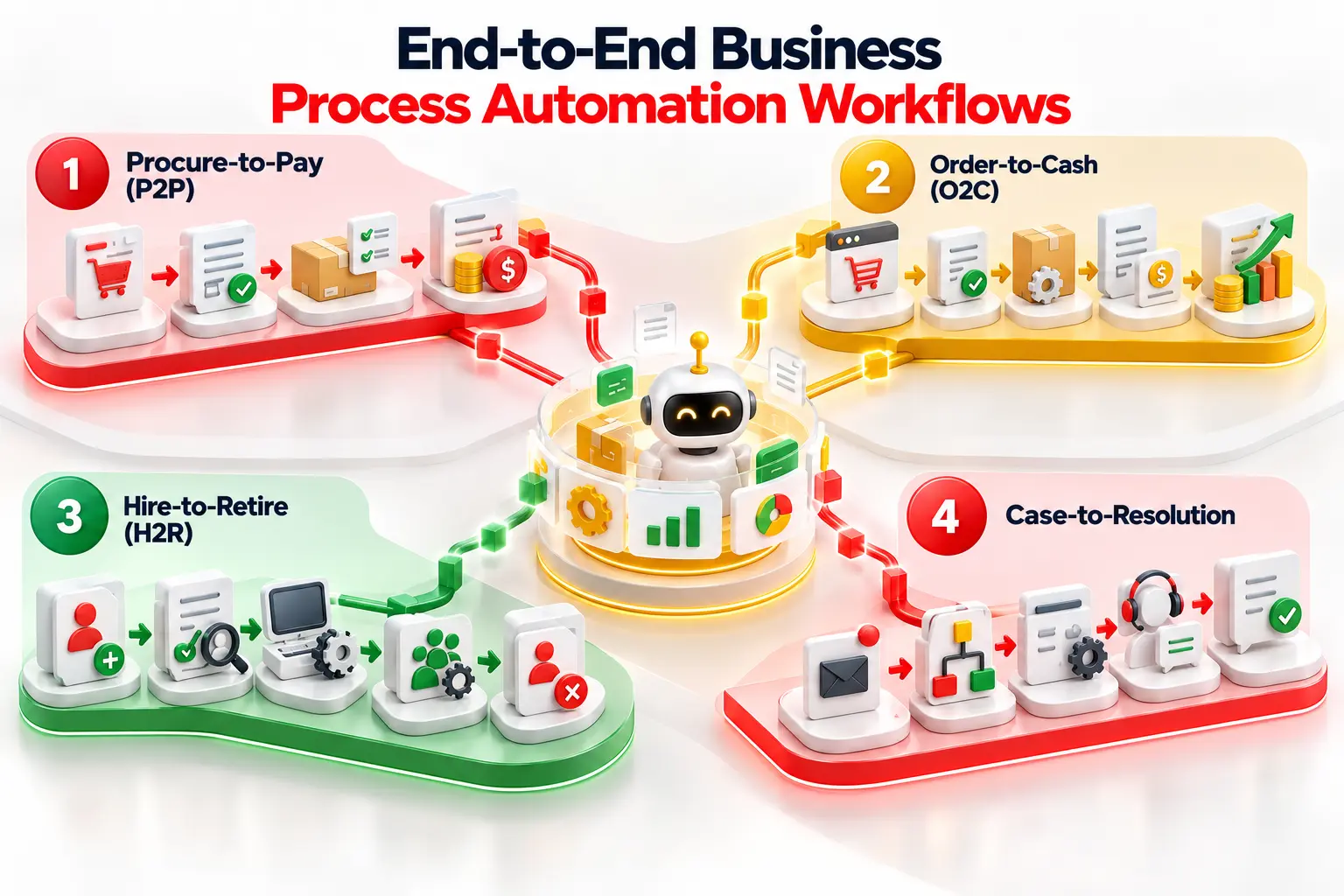
P2P runs from requisition to payment. It is also where manual effort hides. Process mining shows exactly where requests stall.
Honda used Oracle Procurement across four companies and reclaimed 400,000 labor hours a year. That is what fixing the whole flow, not one step, can deliver.
O2C covers order capture, credit checks, invoicing, and collection. Essity runs 70 production facilities and used SAP Signavio to harmonize O2C during an ERP move.
One source of truth replaced scattered Visio and SharePoint files. Continuous monitoring now shows where cash gets stuck.
H2R tracks a worker from hire to exit. ServiceNow joins HR, IT, and finance in one flow. New hires finish background checks, pick hardware, and set up access in one path.
DXC Technology gave 100,000+ employees a single portal. It also removed tier-one support entirely.
Cases need sorting, routing, work, and closure. ServiceNow reports that average resolution can fall from 4.7 hours to 1 minute when AI agents handle intake and action.
That is a vendor figure, so test it. Remote used Zapier to resolve 27.5% of IT tickets and avoid $500,000 in hiring costs.
You may care more about your own team than the whole company. That is fair. Here is what each department tends to automate first, and what real teams got back.
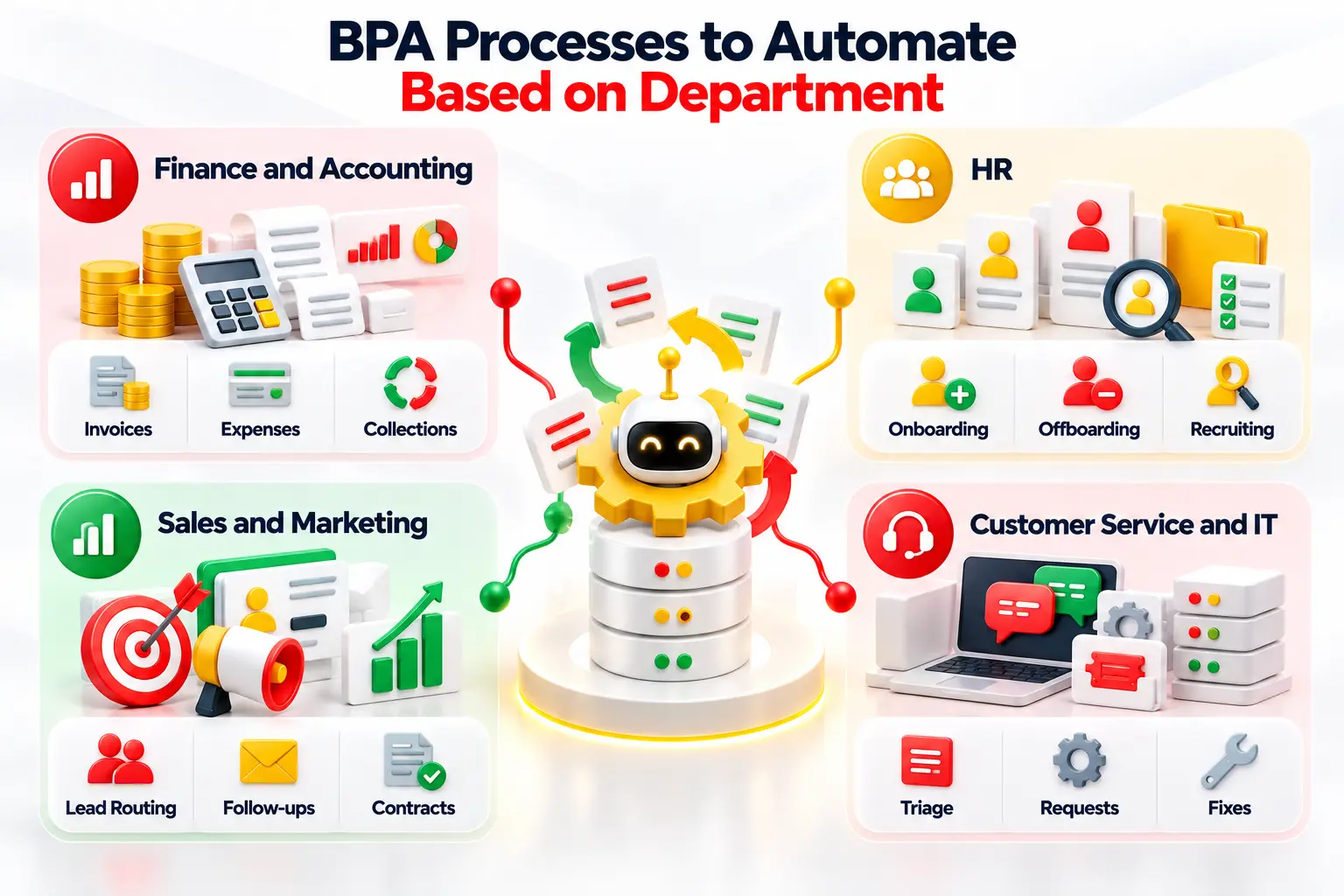
Finance teams start with invoices, expenses, and collections. Those flows have clear rules and high volume, so they are safe first bets.
Grupo Avenida cut its financial close time by 20% with Oracle. Hearst used Oracle Fusion Cloud ERP to speed closes and ease audits. Both lean on ERP-synced data instead of manual reconciliation.
HR automates onboarding, offboarding, and recruiting. Deloitte cut the time to resolve HR inquiries by 40% with ServiceNow.
Hearst replaced legacy tools and cut its job codes from 7,000 to 1,700 on Oracle. That made every downstream hiring workflow easier to run. Clean data makes automation work.
Sales teams automate lead routing, follow-ups, and contract steps. Healthie saved 60+ hours a week with Zapier AI agents. Alutiiq used Salesforce to pull expert input and live dashboards into one place. That helped its team make better bid decisions. Marketing teams can feed the same CRM through webhooks.
Service teams automate triage, requests, and fixes. Thrive saved 21,000 hours in six months with ServiceNow. It resolved 315,000 tasks.
Hitachi Energy saved 26,000 hours with AI search and self-service. It also reached 88% user satisfaction in its pilot. Service desks tend to see gains first.
Old-style automation needs clean, structured data. It follows strict IF/THEN rules. AI-powered automation can read emails, PDFs, and chat requests. It can also decide what to do next. Each approach has a best fit.
The gap is real. A traditional RPA bot cannot summarize an incident. ServiceNow's AI agents can. They gather logs, write the summary, and draft the fix notes. Biofy reported a 50% cost cut and a 100% performance gain on diagnostic data with Oracle AI. Accenture saw usage of its Otto tool rise 87% with ServiceNow AI agents.
But do not swap rules for AI everywhere. Zapier calls low-quality AI output "workslop." It happens when AI runs on messy or unpredictable tasks. Healthie shows the better path. Its agents work on predictable call summaries and save 60 hours a week. Keep rules for critical compliance steps. Use AI where inputs are messy and the cost of a miss is low.
Do not pick at random. Use data. SAP Signavio mines event logs to find the best targets. It looks for high volume, manual entry, many handoffs, and high error rates. Process mining beats gut feel every time.
Microsoft's HEAT framework adds a second layer. It starts with "Discover and Plan." It tells teams to build an Automation Center of Excellence. That group ranks each process by proven ROI instead of automating at random. Score every candidate on these checks:
Start with a process that scores high on the first four. Fix its design before you automate it. Then build the exception path. A quick win builds trust. Trust buys you the budget for bigger flows.
Measure before you build. You cannot prove a gain without a baseline. Track time, cost, and errors for the old process. Then track the same numbers after launch. Add tool and upkeep costs to the math. Also watch time to value, or how fast the savings begin.
Pick three to five KPIs. Time, cost, and error rate cover most cases. Add one people measure, such as satisfaction. Hitachi Energy tracked an 88% satisfaction score in its pilot.
Here is a quick example with made-up numbers. Say a team handles 2,000 invoices a month. Each takes 10 minutes by hand. Automation cuts that to 2 minutes. You save 16,000 minutes, or about 267 hours, every month. Multiply by your hourly cost. That is your monthly gain.
Treat vendor numbers as targets, not promises. Your volumes and data will differ. Run a small pilot first. Then scale what works.
Most failures share a few causes. Know them before you start. Each one is avoidable with a little planning.
Do not use AI to replace fixed rules on compliance tasks. Those need the same result every time. Let AI draft and summarize. Let rules decide. Then name one owner for every automated process.
Skip the long tool lists. Look at where each platform is strong. The overlap between them is large. The sweet spots are not.
Now decide how to get there. Buy a platform when your process is common. Build custom logic when it gives you an edge. Partner when you lack skills, time, or integration experience. Most firms mix all three. The key is to give the whole process one clear owner.
Partnering with Entrans helps you move from task bots to full process orchestration. Whether you need workflow automation, system integration, or custom AI agents, Entrans brings deep, AI-first engineering to the table. We help you find the right work to automate first.
With Fortune 100 retailers as clients and our own enterprise AI solution that is ISO 42001 certified, we know how to connect ERP, CRM, and service platforms into one working flow.
Want to see what we can automate for you? Book a free consultation call!

Common examples include invoice processing, employee onboarding, and lead routing. Others include purchase order approvals, expense reports, and IT service requests. Each replaces a manual workflow with an automated one. Honda, NatWest, and KPMG Canada all report large savings.
It runs repetitive tasks with software instead of people. Workflows move on their own through each step. Teams save time and make fewer errors. Managers also get clear audit trails and faster process cycles.
Start with a process assessment. Pick high-volume work with many manual steps. Fix the process design. Then choose the right tool, such as RPA, workflow software, or AI. Pilot it, measure the gain against a baseline, and scale.
BPA runs whole workflows through APIs. RPA mimics clicks on a screen, often for legacy apps. BPM studies and improves processes using event data. Most firms need all three working together.
Finance teams automate invoice processing, expense management, and payment reminders. They also automate approvals and financial close steps. Grupo Avenida cut its close time by 20% with Oracle. SAP Signavio showed gains in payment lead times.
HR teams automate onboarding, offboarding, and recruitment. They also automate access setup and HR inquiries. Hearst sped up new-hire productivity by 30 days. Deloitte cut HR inquiry resolution time by 40%.
Skip full automation for high-risk decisions and messy exceptions. Compliance steps also need fixed rules and human review. Use a human-in-the-loop design. Let software handle routine work. Let people handle the judgment calls.

-1.svg)