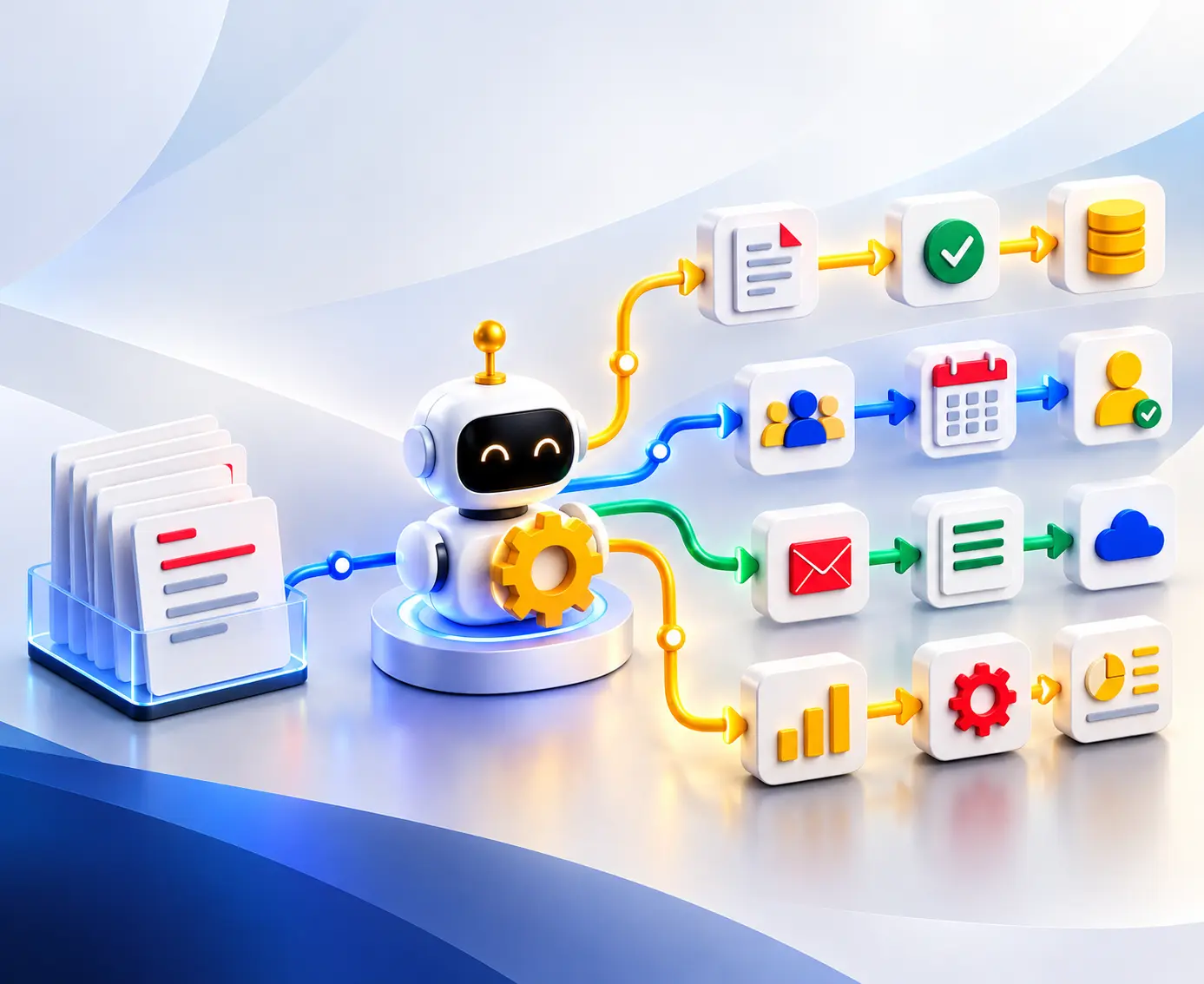
Explore 15 real-world intelligent automation use cases across industries to see how AI, RPA, and smart workflows cut costs and boost operational speed.

Agentic Unconference 2026 - September 19, Chennai
View Event →




How far can automation go? The basic level of RPA takes care of simple tasks, but even simple processes fail when it comes to unzipped files or irregularities.
Documents still need to be understood.
Decisions still need to be made.
Exceptions still land on someone's desk.
These are the places where the success stories of intelligent automation are born. Also, it could be beneficial to find out how to assess automation potential.
Here you can see a blog with 15 real intelligent automation use cases, applied technologies, and their influence on businesses and human interaction.
Intelligent automation involves combining software robots, artificial intelligence, and workflow management tools into one smooth process, covering all kinds of complicated business processes end-to-end. As bots perform repetitive tasks, artificial intelligence recognizes the document and makes decisions. Orchestration ties everything together.
Organizations wanting to discover more about enterprise architectures in today’s world can take advantage of AI-driven automation.
Intelligent Process automation turns unstructured processes into structured digital processes by means of the activities below.
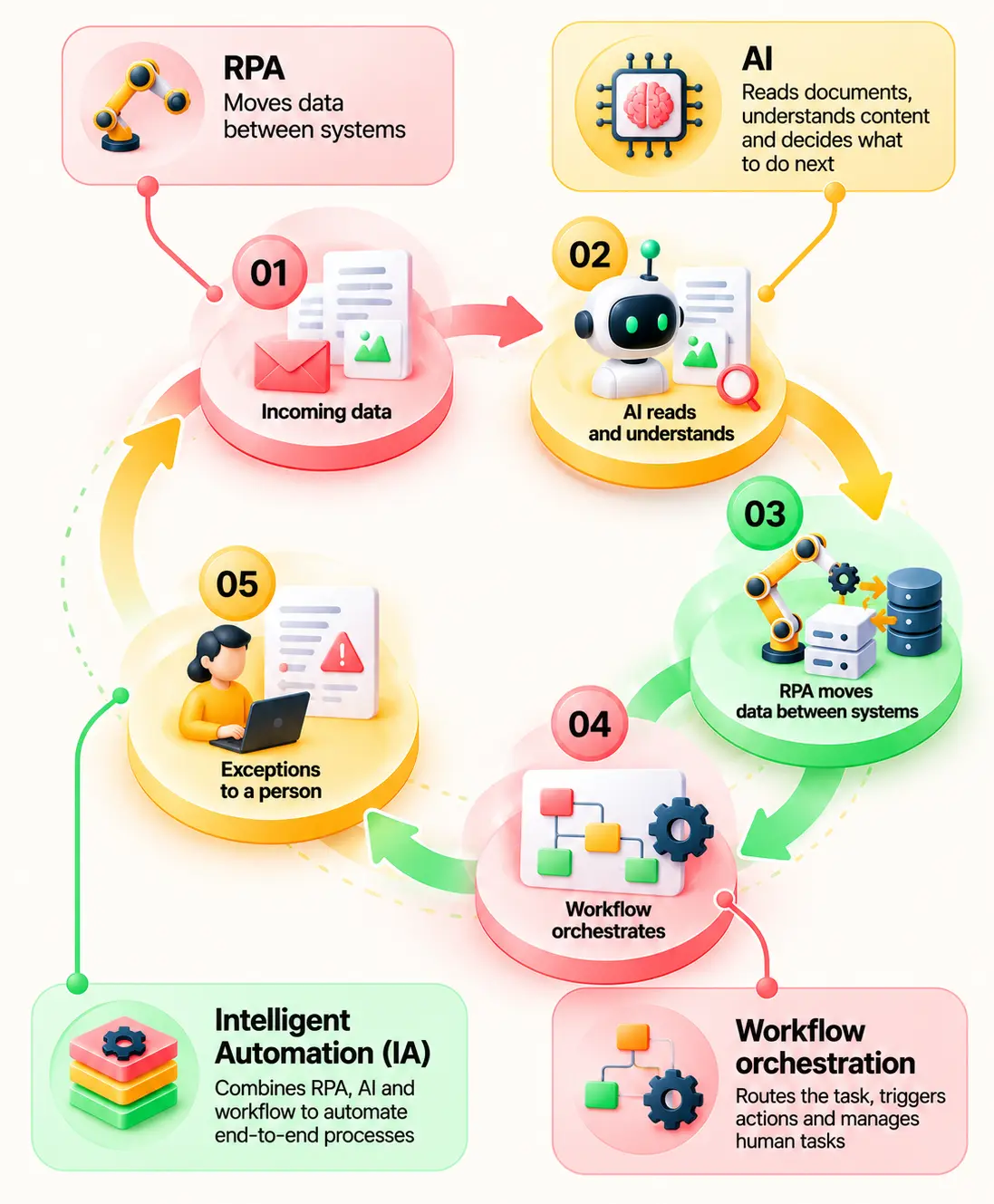
No. AI is one part of intelligent automation. AI is one of the components of intelligent automation. Comparing intelligent automation vs. RPA or intelligent automation vs. AI requires understanding the comparison between various technologies used for automation:
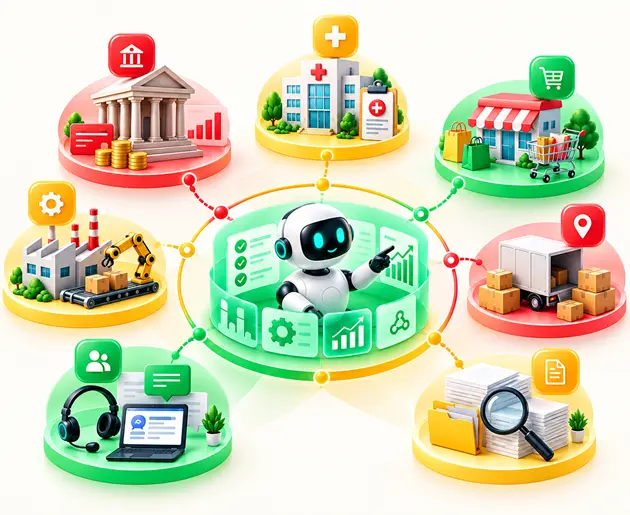
Some intelligent automation examples include invoicing, claims handling, customer service, employee onboarding, and IT process automation. Some examples of industries that extensively rely on intelligent automation include the banking industry, healthcare industry, insurance industry, and manufacturing industry. The endgame is having software do more of the job while passing it on to humans for approval.
For intelligent automation to be very efficient, all technologies must be used in the areas in which they perform optimally. This means that it is not possible to use technologies such as document reading, data manipulation, decision-making, workforce management, and exception handling in one system.
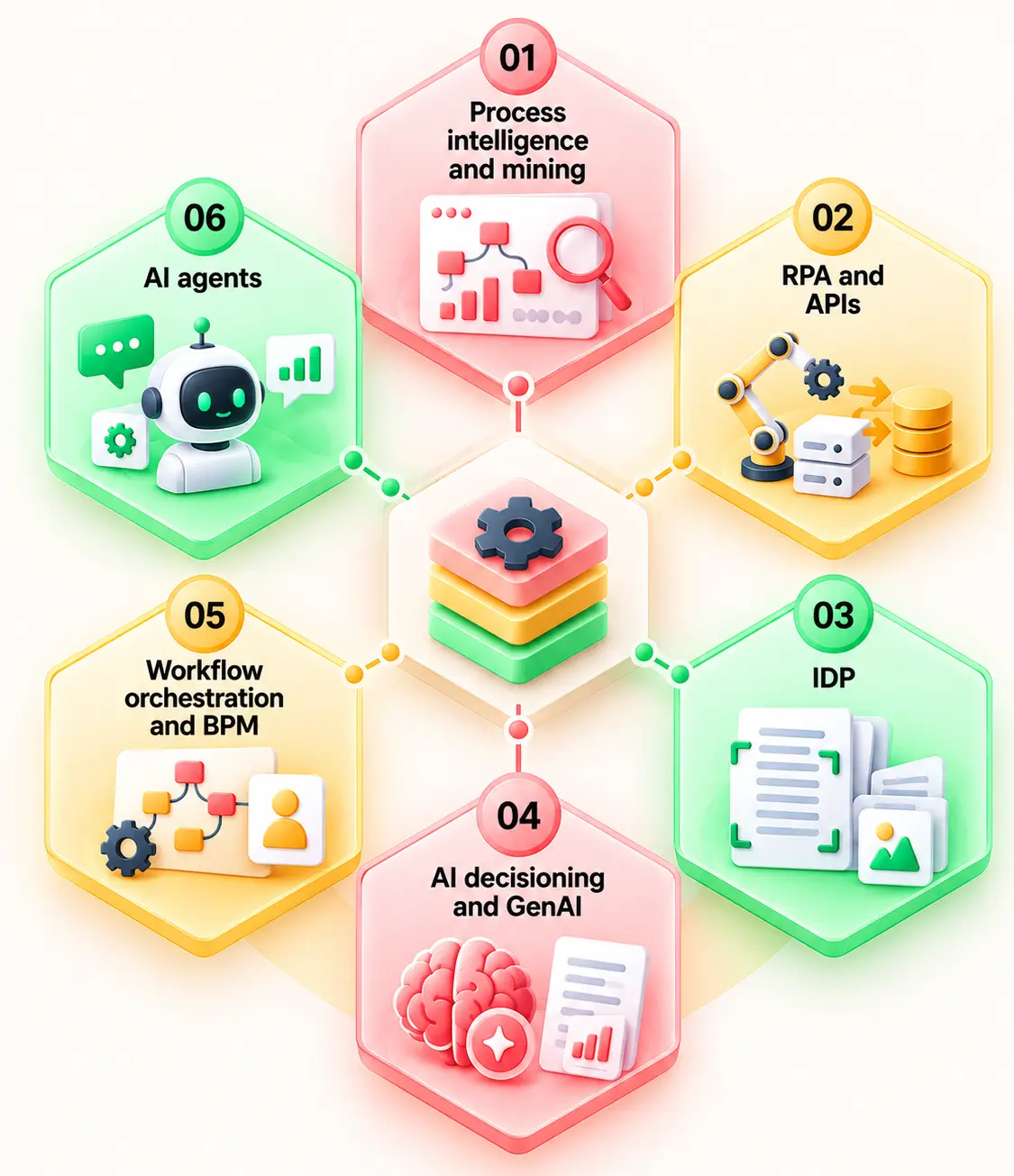
This stack of technologies is a key part of intelligent automation in various domains, including finance, insurance, healthcare, manufacturing, and more.
The actual worth of intelligent automation comes through when it goes from first process to final result. Even when it comes to data entry, documents, decisions, approvals, and exceptions might be beyond the scope of automation by RPA.
Intelligent automation use cases include the use of multiple technologies in order to complete tasks with minimal human intervention. Also, the technology stack will vary depending on the process itself.
While some processes will need IDP and RPA, others will need AI decisioning, Generative AI, and agentic automation. Some examples are provided below to demonstrate why a particular process is failing and which building blocks it needs.
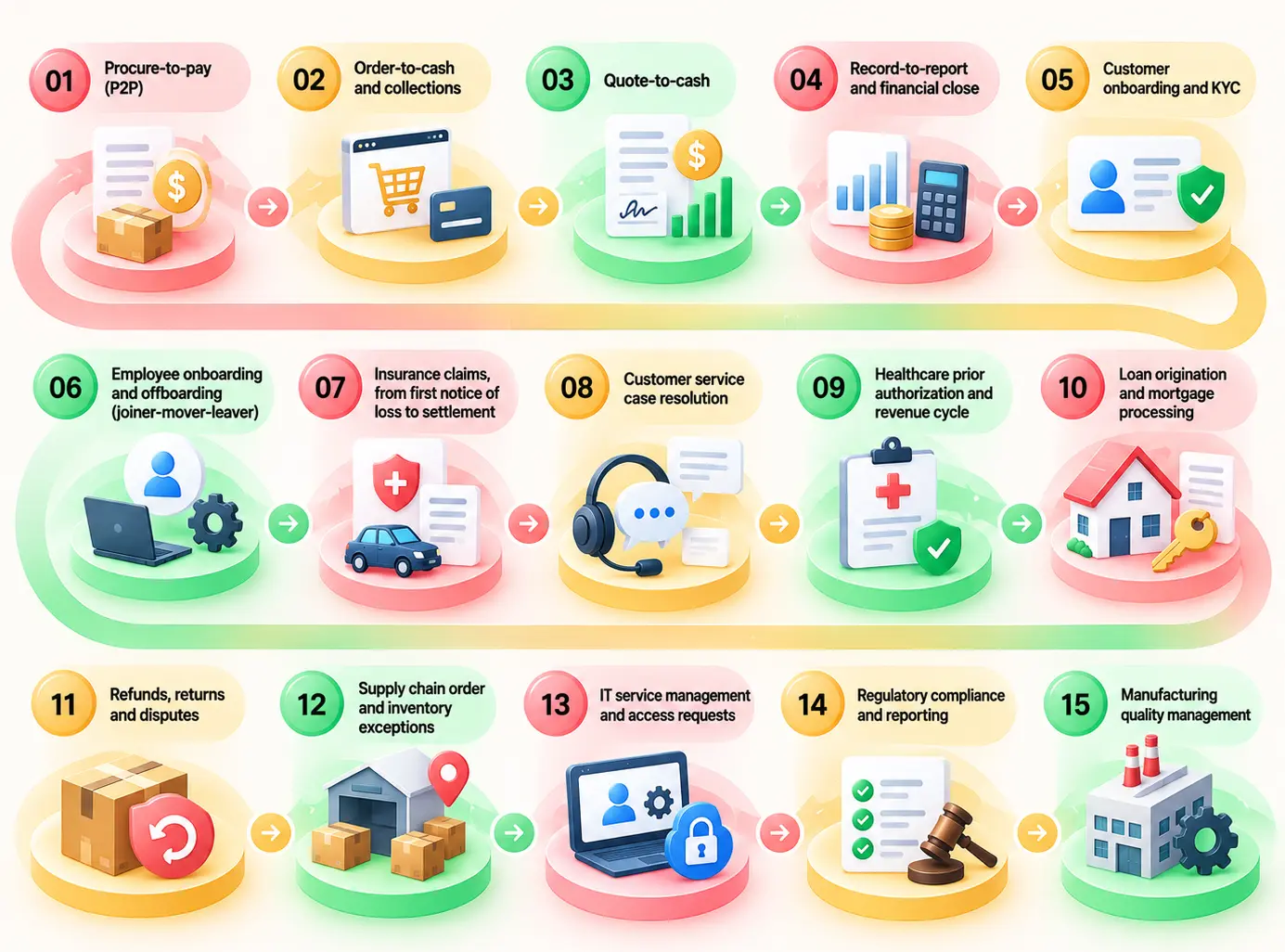
The P2P begins with the purchase requisition and ends with the process of creating a purchase order, receiving the goods, invoicing, approval, and payment.
Manually reconciling invoices, POs, and GRNs is the norm at the finance department level. Discrepancies in terms of document formatting, quantities, and pricing may have to be managed through emails and Excel sheets.
🔍 Mining | 🤖 RPA/APIs | 📄 IDP | 🧠 AI/GenAI | ⚙️ Orchestration | 🕵️ Agents
Invoices and GRNs were reconciled using an AI system developed by Entrans through the use of LLM capabilities provided by AWS Bedrock. Invoice data is collected, cross-referenced with POs and GRNs, and differences are detected. The case study of Entrans highlights an 80% reduction in manual reconciliation effort and payments that were processed 2X faster. According to Appian, NBN decreased invoice processing by 97%.
Manual reconciliation hours, invoice cycle time, first-pass match rate, exception rate, and payment clearance time. 80% reduction in invoice cycle time; 95% touchless processing rate.
This process includes order entry, credit analysis, billing, payment processing, cash posting, collections, and delinquent notices.
The orders could be received via multiple mediums, whereas payments would be recorded in ERP and banking systems. The process of collections would involve multiple follow-ups and discretion regarding contacting the customer.
🤖 RPA/APIs | 📄 IDP | 🧠 AI/GenAI | ⚙️ Orchestration | 🕵️ Agents
The workflow for the loan management enterprise that serves banks was created by Entrans with the help of n8n. This workflow analyzes delinquency levels, selects a communication channel, and starts a follow-up sequence. Entrans states that all follow-ups for delinquent banking clients are fully automated with no human involvement once set up.
45% reduction in Days Sales Outstanding (DSO).
The quote-to-cash process begins with the creation and pricing of quotes and progresses from approval to contract, to order entry, to billing, to payment.
There could be disparate systems among sales, finance, legal, and operations. Quotes will have to go through checks for price, approval, contract, and billing before the order moves forward.
🤖 RPA/APIs | 🧠 AI/GenAI | ⚙️ Orchestration
An IA solution could help the organization import customer and pricing information into the quote process, use rule-based routing of approvals, identify the terms of the contract, and issue invoices after completing the necessary steps. According to Appian, their client MagMutual reduced its quoting process from several days to minutes and manual data input by 98%.
60% faster quote turnarounds; 30% increase in sales conversion rates.
The key actions involved in the record-to-report cycle are recording, reconciliation, variance analysis, closing, reporting, and management discussion.
The finance department ends up spending a lot of time sourcing information, conducting reconciliations, searching for inputs, and analyzing variance drivers.
🤖 RPA/APIs | 🧠 AI/GenAI | ⚙️ Orchestration
The process flow of an IA tool would involve getting the ledger information, performing reconciliation logic on the same, highlighting any irregularities in the balances, creating a variance explanation, and routing any open items to the accountants for their approval. Currently, as per the reports from Appian, it is found that NatWest was able to reduce its governance close cycle from 73 days to 73 minutes through finance automation.
Financial close cycle reduced from 10 days to 3 days.
Identity capture, identity verification, sanctions checking and risk screening, account opening, and onward transmission of the validated data all constitute customer onboarding.
Documents arrive in different formats. Verification may involve multiple systems at work, whereas in cases of suspicion, further checking is required. Manual transfer can also complicate audit trails.
📄 IDP | 🧠 AI/GenAI | ⚙️ Orchestration | 🕵️ Agents
The KYC process described above enables collecting information about the individual’s identity, verifying documents, matching identity signals, comparing with the sanctions list data, calculating the risk level, and conducting human review of suspicious activity. The KYC fraud study carried out by Entrans covers document validation, face matching, liveness detection, device intelligence, risk scoring, and human escalation as elements of the anti-fraud solution.
Duration of KYC process, Straight-through onboarding rate, False positive rate, Manual review rate, and Duration of account opening.
It is useful in user account creation, privilege assignment, ordering of equipment, payroll and human resource issues, and restriction of access rights for employees changing positions or leaving the organization.
Each department may have its own database. If there is any mistake in handing over information, it might lead to delays for a new employee or even unauthorized access for a departing one.
🤖 RPA/APIs | ⚙️ Orchestration | 🕵️ Agents
IA process flow may produce tasks for IT, payroll, facilities, and security groups due to the activity of an individual employee. The Appian process flow is that of employee onboarding and results in IT provisioning, documentation, finance procedures, badges, and ERP. Appian also currently cites an example of employee onboarding in one day instead of three weeks on its platform site. This is vendor-reported.
Productivity access time, provisioning time, offboarding completion time, access exceptions, and percentage of automation in joiner-mover-leaver process.
This process begins with the first notice of loss and progresses through document gathering, insurance policy review, prioritizing, scoring, claims adjusting, settlement, and payment stages.
A claim can be initiated via a form, email, image, or document. The claims adjuster may have to gather information from multiple systems before taking any action.
🔍 Mining | 📄 IDP | 🧠 AI/GenAI | ⚙️ Orchestration | 🕵️ Agents
Appian has described Connected Claims through IDP used for extracting data from unstructured forms, AI agents for processing claim details, and connected workflows for shifting cases between various departments. According to Appian, PwC has helped its client improve the efficiency of claims processing by 30%.
Claim cycle time, touchless claims rate, adjuster handling time, fraud referral rate, leakage, and settlement time.
All customer emails, chat conversations, or cases are logged, classified, mapped to relevant knowledge base articles, answered, escalated when needed, and finally closed.
Support agents spend their time reading similar emails, searching for customers’ records, searching for appropriate answers in the knowledge base, and sending similar replies.
📄 IDP | 🧠 AI/GenAI | ⚙️ Orchestration | 🕵️ Agents
An automated email workflow process was created by Entrans for an insurance company that deals with over 200,000 customer emails yearly. It filters and distributes emails but retains human intervention in case of anomalies.
We have achieved savings in manual effort by 60%, response times of less than two minutes for frequent queries, and around a 25% improvement in customer satisfaction level.
60% lower resolution cost per ticket; 25% higher CSAT scores.
Prior authorization starts with a request and documentation. Thereafter follow document extraction, eligibility screening, clinical and payer criteria, authorization process, claim status, and denial management.
Patient, provider, and eligibility information can arrive in incomplete or unstructured documents. Staff may spend significant time extracting fields and checking each request against payer requirements.
🤖 RPA/APIs | 📄 IDP | 🧠 AI/GenAI | ⚙️ Orchestration
Entrans developed an authorization system using OCR, large language models, a rules engine, microservices, and automated testing. In the case study, they have achieved three times faster processing, reduced manual work and errors by 70 percent, and more than 95 percent extraction accuracy. The very same technology stack is used for eligibility check, claims status, and denial management processes.
Authorization turnaround time, extraction accuracy, manual touches per case, denial rate, and percentage of requests processed without manual entry.
Loan origination covers application intake, document collection, identity and income verification, credit checks, underwriting conditions, approval, closing, and servicing handoff.
Loan packets can contain many documents and data points. Underwriters may spend time checking information across systems and chasing missing items before a decision can move forward.
🤖 RPA/APIs | 📄 IDP | 🧠 AI/GenAI | ⚙️ Orchestration
An IA design can extract application data, verify documents, run checks, route exceptions, and keep applicants updated while underwriters handle cases that need judgment. Appian reports that Addiko Bank cut customer wait times for loan processing in half after redesigning its loan origination and management workflow. This is a vendor-reported result.
Application-to-decision time, underwriting touch time, approval rate, document exception rate, and closing cycle time.
The process begins with a request for a return or dispute, and then goes to eligibility determination, document checking, refund authorization, payment, and notification.
Most teams review the transactions and customers’ details manually. A lack of some information may result in complex processing of the most straightforward refund requests.
🤖 RPA/APIs | 🧠 AI/GenAI | ⚙️ Orchestration
According to Appian, Leroy Merlin used RPA and IDP to automate its refunds and returns process. Leroy Merlin shortened the time taken from 15 days to 1.5 to 2 days while improving the refund processing efficiency by 55%, as reported by Appian. The vendor has claimed 90% customer delight for returns.
Refund process time, first-time resolution, automated refund percentage, dispute aging, and customer satisfaction.
The process encompasses the confirmation of suppliers, purchase orders, advance shipment notifications, inventory management, re-ordering, change orders, and exceptions.
Information in supply chains is distributed across ERP, Excel sheets, suppliers' portals, and logistics systems. Employees can only identify the mismatch after some time. Logistics speed can be improved by reading about supply chain modernization and AI automation strategies.
🔍 Mining | 🤖 RPA/APIs | 🧠 AI/GenAI | 🕵️ Agents
Entrans describes supply chain transformation by employing a cloud data platform, automated data ingestion, analytics, and AI/ML in forecasting and planning for the supply chain. According to the Entrans case study on food-processing and supply chain, there is automation of data ingestion to insights processes, centralized data, predictive insights, and reduction of manual reporting work. There is no particular percentage figure attached to the supply chain exception process from the source.
30% reduction in stockouts; 50% faster exception resolution.
The employees create the IT ticket or the access request. The process identifies the request, verifies policy, grants access, implements the change, and closes the ticket.
IT teams receive large volumes of repetitive requests while more complex changes move through several approval layers. Manual triage can slow both simple tickets and higher-risk changes.
🤖 RPA/APIs | 🧠 AI/GenAI | ⚙️ Orchestration | 🕵️ Agents
Appian reports an IT request management deployment that cut end-to-end request cycle time by 25%, with $451,000 in annual direct cost savings and $821,000 in annual time savings. Separately, Appian reports NatWest reduced change-risk governance from as much as 73 days to minutes. Both are vendor-reported examples.
Mean time to resolution, request cycle time, first-contact resolution, access approval time, and change-risk review time.
Compliance workflow entails collection of evidence, control checking, review routing, report creation, decision documentation, and audit trail management.
Evidence could exist in emails, spreadsheets, shared drives, and enterprise systems, and compliance officers waste time collecting evidence and rebuilding their reports for every review cycle.
🔍 Mining | 🤖 RPA/APIs | 🧠 AI/GenAI | ⚙️ Orchestration
Appian cites the example of a drug company that uses a safety information tracking system to automate its compliance to more than 99.99% and reduce the time taken to generate the audit reports from six days to mere seconds. The above example is provided by the vendor itself.
90% reduction in audit prep effort; 100% continuous control visibility.
Quality management includes nonconformance reporting, inspection records, supplier quality papers, corrective and preventive actions, authorization, and closure.
The teams working in quality may operate within all these areas, including plant systems, Excel, paperwork, documents from suppliers, and emails. Lack of data or delays in approval may prolong the problem unnecessarily.
📄 IDP | 🧠 AI/GenAI | ⚙️ Orchestration
A manufacturing IA process can help document quality data, categorize nonconformities, extract data from suppliers and manufacturing sites, assign CAPA actions, and manage approvals. According to Appian, Merck has implemented a shop floor documentation process in five manufacturing facilities as a part of its manufacturing initiative. Qorvo has used Appian to manage manufacturing change requests. Both resources have described the implementation but have not provided any cycle time improvement numbers. Thus, these KPIs need to be measured independently.
50% faster CAPA resolution time; 40% reduction in quality failure costs.
Though business core areas such as finance and HR have similar operations in all industries, industry-specific issues require specific approaches to automation. Intelligent process automation in industry-specific segments entails dealing with old core system issues, regulations, and sudden volume peaks.
Understanding intelligent automation vs RPA is easiest when watching a single workflow evolve across three distinct technological eras:
This evolutionary leap shifts enterprise teams from rigid, script-based task execution to dynamic, goal-driven business operations.
An AI agent will thrive when the process is well-structured, the system activities are well-documented, and there are guidelines on when to refer the problem to a human.
Ensure that you have a solid workflow, set boundaries for the agent, and document its actions and outcomes. For a practical guide to planning and building agent-based workflows, explore Entrans’ Agentic AI Framework Integration.
Follow this four-step blueprint to target high-ROI opportunities:
Some intelligent process automation initiatives don’t succeed even after early pilot successes. Scaling automation across complex organizations fails when teams rely on legacy approaches rather than structured operational strategy.
Overcoming these pitfalls requires robust governance. Establish a clear strategic foundation by reviewing our enterprise AI governance framework.
Entrans selects best-in-class intelligent automation tools tailored to enterprise architecture, data security, and operational scale:
This hybrid stack bridges legacy IT with modern cloud infrastructure to deliver scalable intelligent process automation.
Explore our comprehensive evaluation of top enterprise implementation partners, platform integrators, and specialized automation consultancies in our detailed breakdown: top-hyperautomation-companies.
Expanding intelligent process automation from initial pilots calls for an engineering-focused partner that can incorporate the latest artificial intelligence into existing legacy systems. Entrans fast-tracks your journey with Forward Deployed Engineers embedded in your organization to develop on existing production systems.
With 200+ global enterprise deployments, 150+ successfully delivered AI projects, and an average 70% workflow automation rate, Entrans turns complex operational challenges into scalable digital systems.
Ready to Scale your Intelligent Automation Strategy? Book a consultation call with us.

Intelligent automation brings together RPA, AI, and workflow tools to handle business tasks from start to finish. RPA handles repetitive tasks, AI reads documents and supports decision-making, and workflow tools keep systems, bots, and people working together. This helps businesses get more work done with less manual effort.
Common examples of intelligent automation processing include automated invoice processing, AI-driven customer support routing, and predictive equipment maintenance.
RPA strictly follows predefined rules to automate simple, repetitive tasks like data entry without learning. Intelligent automation adds AI capabilities to process unstructured data, make decisions, and adapt over time.
No, intelligent automation and AI are not the same. AI helps systems learn, understand, and make decisions, while intelligent automation uses AI and automation tools to complete business tasks.
Intelligent automation uses AI and automation tools to handle specific tasks or workflows. Hyperautomation takes a broader view by finding and automating as many business processes as possible.
A good use case involves repetitive tasks that take time, follow clear steps, or require handling large amounts of data. The best choices save time, cut errors, and free employees to work on tasks that need human judgment.
Popular tools include UiPath, Automation Anywhere, Microsoft Power Automate, and SS&C Blue Prism. For AI-driven workflows, businesses also use tools such as IBM watsonx Orchestrate and ServiceNow.
Measure return on investment by tracking labor hours saved, error reduction costs, and accelerated process completion times. Weigh these ongoing operational gains against the upfront software licenses, development resources, and maintenance expenses.

-1.svg)