Learn how offshore forward-deployed engineers deliver across time zones. Explore hybrid pod roles, 4-hour overlap rules, security guardrails, and costs.

Agentic Unconference 2026 - September 19, Chennai
View Event →





How do you embed an engineer inside a company when they live ten thousand miles away? That is the idea behind offshore forward-deployed engineers. They work closely with their clients, understand their needs, and solve their problems across time zones.
But how will such a system work for a team that is miles apart? Will the offshore FDE engineers be able to connect with the on-site team and still deliver without any delay?
This blog explains how the FDE model works across time zones and what businesses need for successful remote collaboration.
The Forward Deployed Engineer (FDE) model came into existence from the Palantir-style engagements wherein engineers were seated right next to the client teams to deliver the production software within operational deadlines. Since customer immersion was the hallmark of the role, leadership teams would often pose the question of whether FDEs could work remotely. Many companies still associate FDE work with an on-site presence.
Industry hiring data shows the model is already shifting away from permanent on-site placement. According to FDE Pulse data, roughly 62% of FDE job postings now offer remote forward-deployed engineer or hybrid arrangements, with many roles requiring 20–40% travel for critical discovery, architecture workshops, or go-live milestones rather than full-time relocation.
But there are some operational concerns for engineering and delivery leaders:
In dealing with these risks, it is not necessarily required that the engineers be flown to a foreign land each Monday. The engineers deployed nearshore and offshore will be able to produce execution at par with the onshore team with proper communication routines, overlapping time zones, and proper onboarding processes.
The real issue is not whether FDEs can be done remotely. The issue is whether the offshore FDE team has the appropriate business environment, time zone overlap, security controls, and accountability for success.
An office visit is not always required for any particular activity by the Forward Deployed Engineer. Some activities require face-to-face interaction with the user, while other activities can be done remotely without compromising delivery.
Involve people on-site in decision-making and adoption. Make build and test processes offshore. Offshore forward-deployed engineers will be able to take care of most of the technicalities if they have a good understanding of the business environment and time zone overlap.
This is a win-win situation for businesses who can employ offshore forward-deployed engineers without losing customers.
A team doing offshore FDEs does not necessarily have to be co-located or in the same time zone to produce results. They need well-defined roles, planned communications, and business outcome responsibility.
The hybrid FDE team is one such team where we see US leadership along with offshore engineering expertise. This model gives remote forward-deployed engineers clear ownership while preserving live human connection where it counts.
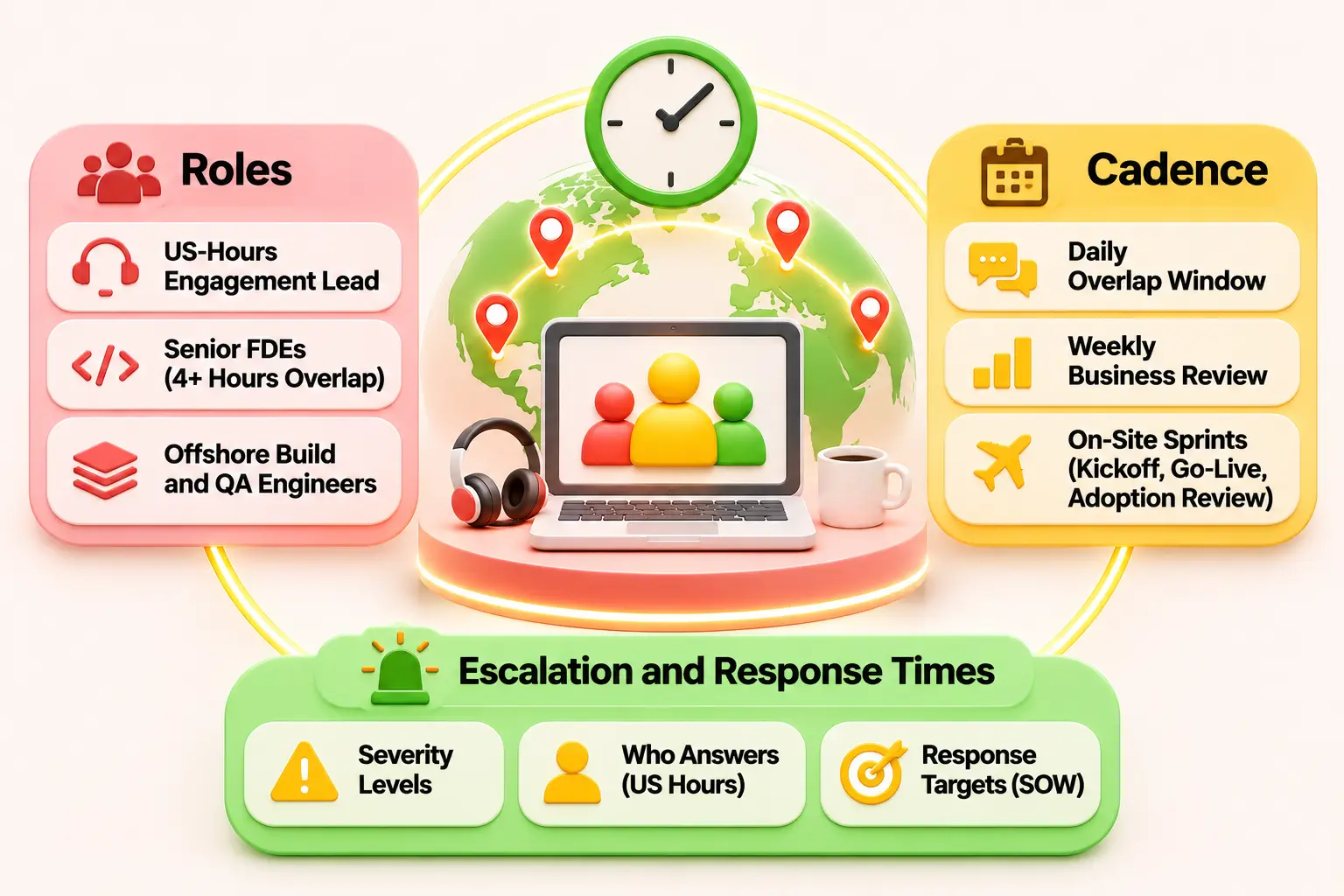
A high-performing offshore FDE team mirrors the structure of a dedicateD forward-deployed team, split across three clear layers:
Such a configuration provides a point of contact for the customer while allowing the technical work to proceed around the clock.
The FDE team in the remote environment requires scheduled communication.
There should not be any delays due to time zone gaps in addressing an issue that is highly important. Define severities in the Statement of Work (SOW). Define who will address each issue during US office hours. In addition, define response times for critical, high, medium, and low issues.
For instance, a production outage may require immediate attention while a minor UI issue may just fall into the normal cycle of support.
Choosing between onshore, nearshore, and offshore forward-deployed engineers depends on budget, live collaboration, and specialized AI talent. Before deciding to hire offshore forward-deployed engineers, it helps to weigh actual market rates against daily operational needs, a breakdown we explore further in our guide on forward-deployed engineer cost.
Onshore FDEs function in the same country as their clients. They provide easy access to stakeholders and quick collaboration in person. But hiring them costs more. Nearshore FDEs are those who work from nearby countries and can be found in Latin America for US-based clients. They provide a good time zone fit with reduced costs. Offshore forward-deployed engineers work from places like India.
They help businesses to access more talent pools and reduce costs of delivery, but need planned communications. Meanwhile, an offshore FDE team provides the deepest AI engineering talent pool and strongest unit economics, especially when paired with a scalable GCC-as-a-Service delivery model. In India alone, Indeed data shows FDE job postings jumped nearly 19-fold (1,807% year-over-year) between June 2025 and June 2026 as global enterprises scaled offshore AI deployment hubs.
Hybrid models can use all three approaches. In a hybrid model, keep the leadership that deals with clients closer to your business, and allocate development and testing activities to an offshore FDE team.
No loss of control over company data is experienced when forward deployed engineers are used. This is because remote FDEs may be used in conjunction with sensitive enterprise systems where access is governed by tight security guidelines.
Here, the goal is to give engineers what they require while limiting access to what they don't. Standing admin privileges are no longer justifiable for distributed pods, as third-party involvement in confirmed data breaches doubled from 15% to 30% and reached 48% in Verizon's 2026 DBIR.
When you hire offshore forward-deployed engineers, five practical guardrails protect your production environment without slowing down delivery:
These control mechanisms make it easier for engineers stationed at remote locations to work without requiring extensive access to networks. These control mechanisms also facilitate the process of undertaking security analysis, even with minimal FDE time zone overlap between the team members.
Building these controls into your onboarding checklist keeps audit readiness intact from day one as a standard practice across enterprise cybersecurity and compliance programs.
However, when offshore forward-deployed engineers are hired for a project, there could be some risks that might lead to failure in distributed delivery. To prevent that from happening, the following four issues need to be sorted out:
The use of offshore forward-deployed engineers by firms requires that the firms consider them as members of the delivery team and not as an external programming unit. Include them in business discussions, assign them responsibilities, and provide feedback.
For an offshore FDE team to succeed, there should be sufficient FDE time zone overlap, leadership stability, and accountability. These actions will make it possible for remote engineers to remain connected to business objectives and minimize delays.
Selecting an offshore FDE provider is not only about comparing hourly rates and technical expertise. It is important to know how the team collaborates with your company, deals with the production system, and behaves in case of emergencies.
The brief evaluation will help you determine whether the vendor is prepared for actual business operations. Here are 10 questions you should ask before hiring offshore forward-deployed engineers.
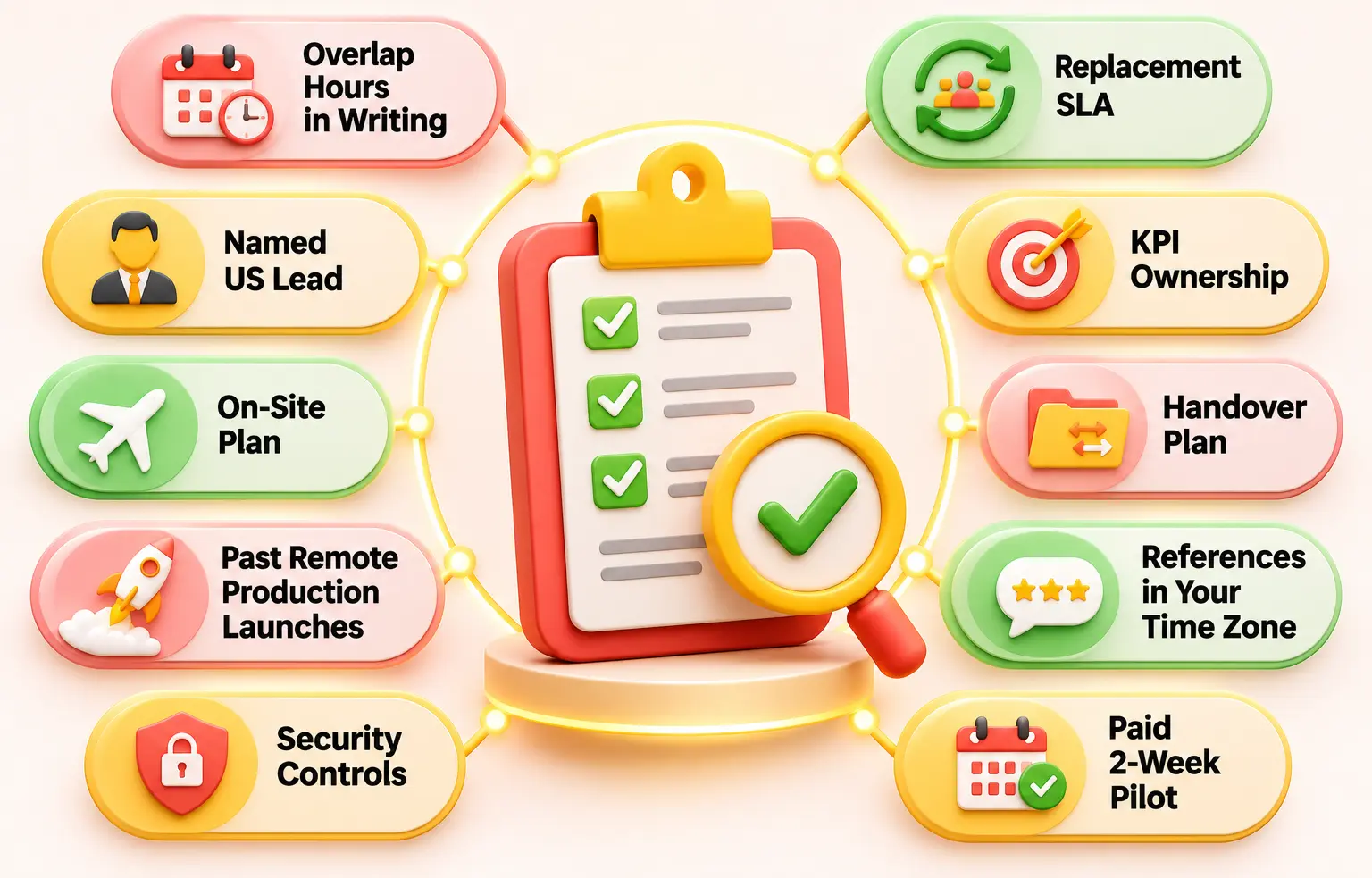
Offshore forward deployed engineers can support many enterprise projects, but they are not right for every situation. Sometimes it may need direct access to client sites, restricted systems, or local decision-makers.
In these cases, onshore or nearshore forward deployed engineers may be a better choice. Choose offshore delivery when the work, access rules, and communication needs support it.
Entrans uses a pod-based delivery model to connect business teams with offshore engineers. Each FDE pod comprises client leaders, senior engineers, offshore engineers, and quality assurance. An exclusive time is arranged to overlap schedules for business talks, tech talks, and instant decision-making. - Onsite sprinting for kickoffs, go-live and adoption review meetings.
This approach enables clients to use offshore forward-deployed engineers without losing communication or ownership of delivery.
Teams run focused on-site sprints for critical moments like workflow discovery, production launch, and user training before handing heavy integration builds and eval suites over to the offshore FDE team. We used this exact hybrid rhythm in our clinical document AI healthcare deployment, moving complex workflows from pilot to production safely. Whether you need a single dedicated remote forward-deployed engineer or a full pod, every engagement starts with a scoped two-week pilot.
Ready to experience business teams and offshore engineering talent together, without losing speed, control, or accountability. Book a consultation call to know more about it.

Yes. Forward-deployed engineers can work remotely when they have a clear business context, right access to the systems and correct communication. Moreover, the FDE model supports building integrations, writing eval suites, and deploying code remotely with ease.
Yes, the FDE team offshore works well when combined with the local engagement lead and daily overlapping hours. The combination allows the offshore developers to deliver code during nighttime while preserving live alignment of the stakeholders.
Most of the remote/hybrid work for FDEs requires no more than 20%-40% travel and not relocation. Travel for FDEs is usually centered on impactful activities like project kick-off, go-live, and user adoption meetings.
Yes, offshore FDEs are generally cheaper than onshore engineers due to different costs of hiring and delivery. The cost is determined by experience, expertise, and the requirements of the project.
At least a four-hour overlap every day is an excellent way to begin such discussions, reviews, and fast decisions. The exact time will be based on the client’s work schedule.
The advantage of nearshoring is the 6-8-hour overlap of workdays during which the team can conduct real-time calls. However, offshore has the advantage of more expertise in AI, as well as 24-hour builds after setting an overlap of 4 hours each day.
Access is locked down through Managed Virtual Desktops (VDI), Single Sign-On (SSO), and least privilege access. Synthetic test data is used in sandboxes and just-in-time access during production releases to ensure that no sensitive information leaves the cloud.