> Blog >
FDE Security and Compliance Checklist: How to Give Forward Deployed Engineers Safe Access to Production

FDE Security and Compliance Checklist: How to Give Forward Deployed Engineers Safe Access to Production

4 mins
November 23, 2026
Author
Aditya Santhanam
Talk To Our Experts
TL;DR
  • Phase access over 30 days to ship without delays: Start FDEs in a read-only sandbox with masked data in week one, then unlock gated production access through just-in-time elevation once legal contracts and security reviews are signed.
  • Lock down identity, devices, and data residency: Enforce named SSO/MFA accounts, centralized secrets vaults, and locked-down Virtual Desktop Infrastructure (VDI) so source code and regulated customer records never leave your cloud perimeter.
  • Treat AI agents like privileged third-party users: Restrict autonomous agents to scoped API and MCP permissions, route model calls through private zero-retention cloud endpoints, and require human sign-off for high-risk actions.
  • Enforce shared accountability from kickoff to exit: Pair a clear RACI matrix and regulatory agreements (SOC 2, HIPAA BAA, GDPR/DPDP) with a strict final-day offboarding checklist that revokes keys, rotates secrets, and verifies data deletion.
  • What about the case where an outside engineer must access your production systems? How do you safeguard your sensitive information while ensuring fast delivery? Every company should figure this out before any FDE engagement begins.

    FDE security and compliance begins with controlled access. You have to treat an FDE team like a privileged insider for a limited time frame. Include least-privilege access, time-limited access, identity provider access controls, activity logging, and approved data storage locations in the contract.

    This blog explains how forward-deployed engineer security and compliance unlocks speed without reckless exposure.

    Table of Contents ▾

      Why FDE engagements raise different security questions

      Traditional software providers develop code in a private sandbox and deliver the finished solution to you. Engineers working in a forward-deployed engineering model do the exact opposite. They come right into your ecosystem, interact with live databases, your APIs, and actual customer processes from day one.

      Given that they work within your ecosystem, providing contractor access to the production systems requires a more rigorous governance framework. This creates security needs that go beyond normal vendor access. Security and compliance of the forward-deployed engineers must be considered from the outset of the engagement. 

      Third-party engineers have no strict access control; a simple debugging session could compromise many sensitive repositories and customer records. 

      AI Adds Another Layer of Risk

      Beyond simple software access, AI projects present additional risks. The agents may perform tasks like sending emails, initiating workflows, and updating records. The prompts may include sensitive business information, and the external models used may process information outside the company’s secure environment. Businesses must set clear AI agent permissions, control data sharing, and review model provider policies. 

      AI deployment today presents three new risks to the security and compliance of forward-deployed engineers:

      • Agent execution: While software execution has been static before, AI workflows operate based on permissioned AI agents who make queries, call APIs, and store results themselves.
      • Sensitive prompt payloads: Engineers working on realistic edge cases will use actual customer questions, financial data, or clinical notes as input to model prompts.
      • Routing models externally: Routing LLMs to endpoints outside your cloud introduces the risk of having sensitive contexts stored there unless you have tight zero-retention agreements in place.

      The 30-day access plan: Moving Fast Without Cutting Corners

      A Forward-deployed engineer’s security and compliance should be performed ahead of development. 30-Day Access Plan enables your team to make access permissions right on time. You can let your engineers start getting familiar with the system while your security team is reviewing access requests.

      Set up access simultaneously with discovery. You do not need to wait till the security review process is completed to start working on the project. Start with low-risk access and then add more permissions as you move on through the stages.

      Timeline Access and Security Milestone Operational goal
      Week 0 SSO accounts are provisioned in your identity provider; a contract and Data Processing Agreement (DPA) have been signed. Before granting any system credentials to AI vendors, establish a legal and data security framework.
      Week 1 A dedicated development sandbox and read-only access to non-production schemas. Permit FDEs to build pipeline prototypes and experiment with data structures.
      Weeks 2–3 Access to production data that has been generated or masked; integration access keys are stored in a centralized secrets vault. Connects to APIs and tests edge cases without disclosing hardcoded access keys or customer PII.
      Week 4 Access to gated FDE production through just-in-time elevation and change request approval. Ship code that has been audited into the live workflow environment.

      Keep every access step accountable. 

      This planned process would enable controls for third-party engineer access without any delivery delays. Review the privileges allowed at each phase and strip out those privileges that are not needed by the team. 

      In the case of regulatory compliance projects, a SOC 2 AI development partner or HIPAA AI implementation partner should also detail how it manages sensitive data, credentials, and production modifications.

      Use this rule for AI agents' privileges as well. The agent must have permissions for the use of approved utilities, tools, and data, with defined actions allowed.

      Identity and access controls

      Forward-deployed engineer security and compliance require knowing precisely who accesses your systems and what they can modify. If you give contractor access to your production systems, using shared accounts and permanent administrative privileges will only lead to problems. Third-party engineer access control should be built from three fundamental layers.
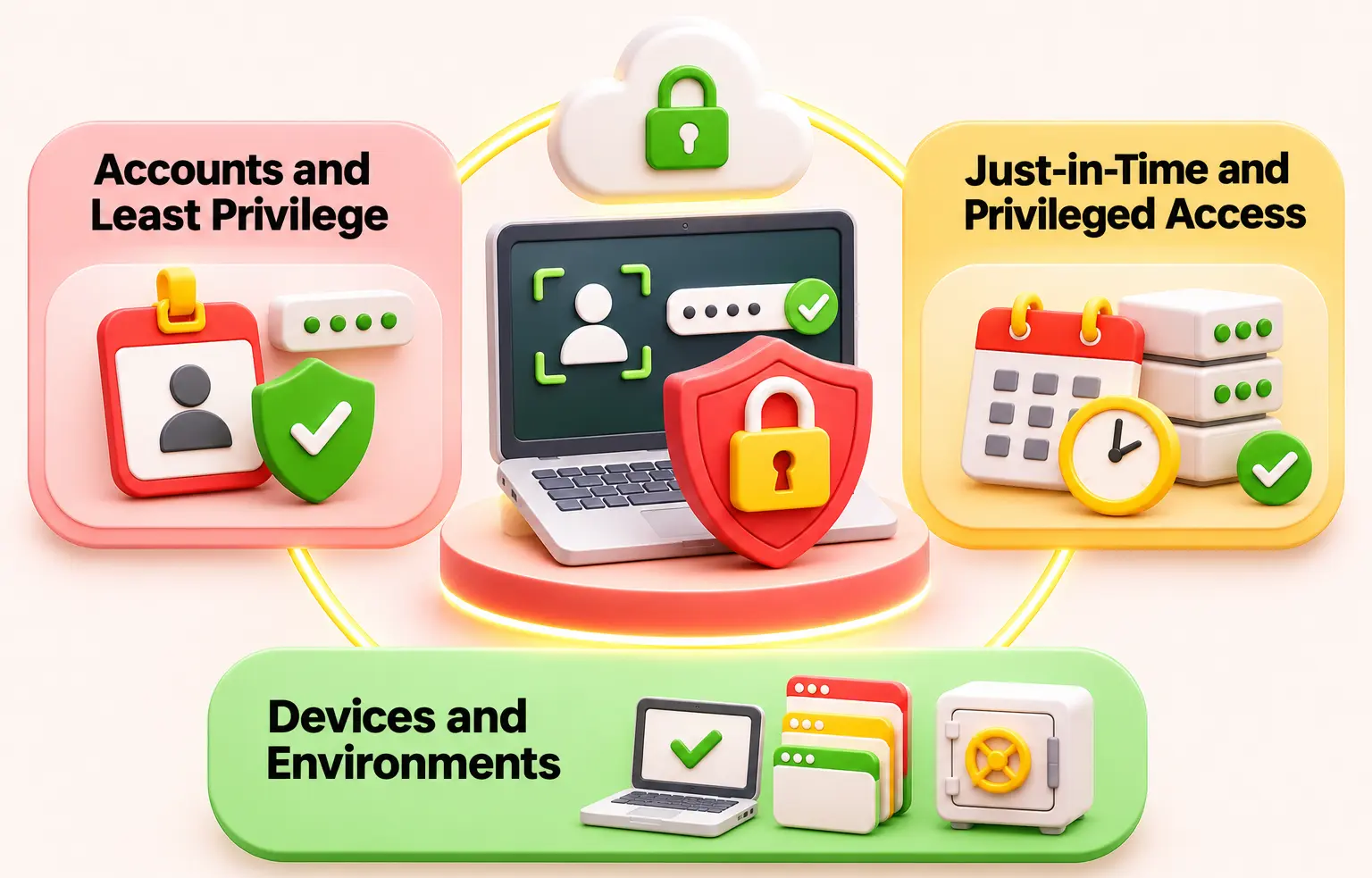
      Identity and access controls for secure FDE production access.

      1. Accounts and Least Privilege

      Forward-deployed engineers should have a specific account in your identity provider (IdP). Always use SSO and MFA for all individual accounts. Also, assign roles based on the individual work responsibilities of the engineers. 

      A developer should not have the same access level as those managing production. Also, there shouldn’t be any shared accounts or passwords at any time.

      2. Just-in-time and Privileged access

      FDE production access should be made available to anyone only when the job needs such access. A just-in-time approach should be taken for the provision of temporary access to engineers. 

      An expiry period is needed in such cases, and authorization is required before any elevated access can be given. Privileged Access Management (PAM) tools/bastion systems could be considered for access control to critical systems. Your internal process must approve the production change.

      3. Devices and Environments

      Do not store source code and client data on your personal devices. Insist on the use of external developers within the confines of Virtual Desktop Infrastructure (VDI) or company-owned laptops with endpoint monitoring. 

      Run early-stage testing in sandbox tenants and keep all API keys, database strings, and model tokens stored in a centralized secret storage, instead of locally. These foundational habits define reliable FDE-as-a-Service security and keep data security for AI vendors verifiable during any audit.

      Data Protection and Residency

      Forward-deployed engineering security and compliance require maintaining sensitive records away from where they should not be found. Before granting contractors access to production systems, classify your data sets according to their sensitivity. This will help you identify which data should remain secure and which is usable for construction.
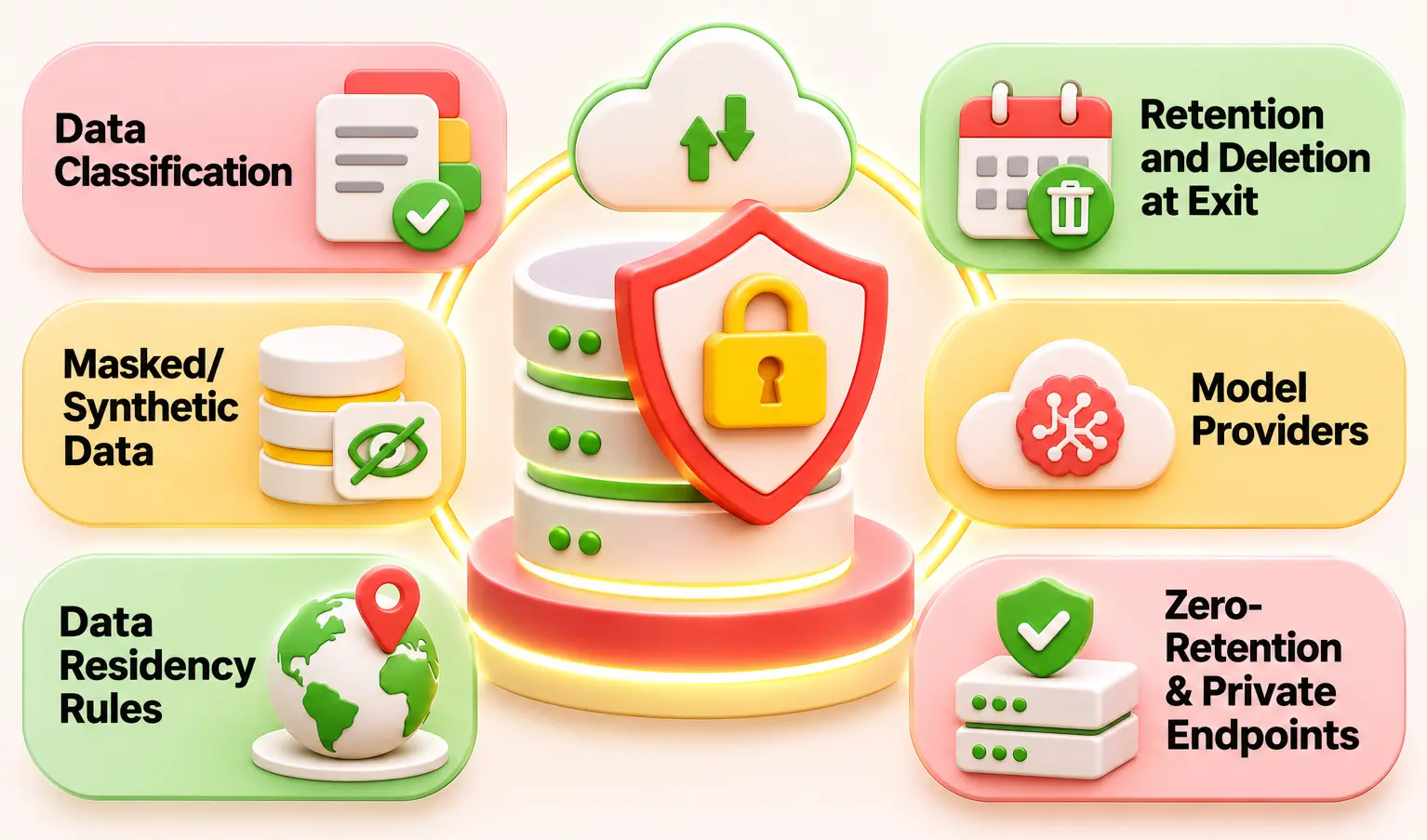
      Data protection and residency controls for secure FDE deployments

      Data classification

      Before a forward-deployed engineer is given access to your system, classify the data that will be used by the project. Categorize each data set as public, internal, confidential, or restricted. This will help you determine access levels for each type of data.

      Masked or Synthetic data

      Use masked or synthetic data for development and testing purposes. It allows engineers to develop and test their workflow using non-sensitive data. If they have to work with sensitive data, ensure they get your prior authorization and determine how much data they have access to view, copy, or export.

      Restriction on Data location

      The data must be limited to a country or region for accountability. Ask where data would be stored, processed, and accessed before you sign the partner. Confirm whether the data can be accessed by remote developers, cloud platforms, and subcontractors.

      Document all these conditions in the contract and Data Processing Agreement (DPA). The SOC 2 AI development partner or HIPAA AI implementation partner must provide an overview of its data handling policies.

      Controlling Data Across Model Providers

      With AI workflows, we have another perimeter: the foundation models’ APIs that exist behind your application. Data security needs to be ensured through proper guardrails on what information leaves your network:

      • Payload rules: Specify which data levels have access to external LLM APIs and cleanse the sensitive fields before the prompt is even sent from your server.

      Set retention and deletion rules.

      Specify how long the vendor is allowed to retain project data, logs, and temporary files. Once the engagement is over, remove all access and destroy/return data according to the contract. Request a confirmation in writing that all data was destroyed. This will help with engineer security and compliance.

      Zero-retention settings and Private endpoints

      Turn off logging and training on third-party API providers, so your context data is never stored or learned by any of those third parties. Use private cloud provider services like Azure OpenAI, AWS Bedrock, and Google Cloud Vertex AI for routing inference requests and keeping all of the traffic confined within your private virtual network. 

      This ensures that your FDE-as-a-Service is completely secure from prototype to deployment.

      AI-specific controls for agents and LLM apps

      Securing human engineers is just part of the process in putting autonomous workflows into effect. When an AI agent is rolled out, it runs with its own set of credentials and actually takes actions within the business environment. By approaching AI agent access the way we approach human third-party engineer access controls, autonomous systems don’t become an unwatched backdoor to your operations.

      A right forward-deployed engineer security and compliance provides five guardrails for each AI agent:

      • Scoped tool and MCP permissions: Limit all agents to the specific APIs and endpoints necessary for their workflow. When connecting external applications via MCP server development, use per-agent permissions for reads and writes, not broad service tokens.
      • Human approval for high-risk actions: Enable the creation of emails, database changes, and anomaly detection by agents on their own, but ensure that a human confirms before an agent does anything irreversible, such as processing a refund.
      • Prompt injection testing: Test your agents against prompt injection by using adversarial prompts in emails, PDF uploads, websites, etc., so that malicious text doesn't convince your agent to leak sensitive info or break the rules.
      • Evaluation gates before release: Don’t let any prompt, tool, or model update get access to the FDE production environment unless it passes automated regression and safety checks in staging.
      • Complete audit logs of agent actions: Ensure complete logs of every single prompt, tool call, API payload, and human intervention in a non-alterable audit log format. Connecting such audit trails into your overall enterprise AI governance framework will give your compliance teams a full picture of the rationale behind the agent’s actions.

      Compliance frameworks: what each one asks of your FDE partner

      Hiring a SOC 2 AI development partner or HIPAA AI implementation partner is a strong start, but a vendor's badge does not automatically make your live deployment compliant. The security and compliance of forward-deployed engineers are based on the policies that apply to your business and data. 

      Make sure to request documentation about the controls, data processing activities, and access methods from your FDE partner. While SOC 2 reports and ISO 27001 certificates can be helpful, they do not ensure compliance by themselves. The work of your team is also important.

      As regards the provision of access for contractors to production systems, there will always be mutual compliance. Your partner will enforce discipline in engineering practices, whereas you will have control over your cloud perimeter, identity, and FDE production access. In a regulated deployment such as our clinical document AI healthcare network deployment, both parties agree on boundaries before data transfer.

      Framework What it covers What to request from the partner What stays your responsibility
      SOC 2 (Type II) Security, availability, and confidentiality controls over time. Current Type II report, bridge letter, and background-checked engineers. Managing third-party engineer access control, SSO, and production audit logs.
      ISO 27001 Formal Information Security Management System (ISMS) governance. Valid ISO certificate, scope statement, and secure coding standards. Enforcing device controls, network segmentation, and cloud perimeter rules.
      HIPAA (BAA) Protected Health Information (PHI) privacy and security safeguards. Signed Business Associate Agreement (BAA) and HIPAA-trained FDE staff. De-identifying test data, encrypting PHI stores, and approving FDE production access.
      GDPR & CCPA Personal data privacy, residency, consent, and deletion rights. Data Processing Agreement (DPA), sub-processor list, and exit purge proof. Lawful basis for data use, regional cloud residency, and user deletion workflows.
      PCI DSS Cardholder payment data protection and isolated card environments. Isolated developer workflows with zero exposure to raw card numbers. Tokenizing payment records and keeping AI agents outside cardholder zones.
      EU AI Act Risk tiers, transparency rules, and human oversight for AI systems. Technical documentation, bias evals, and scoped AI agent permissions. Risk classification, user disclosures, and mandatory human-in-the-loop sign-off.

      Contract clauses to add before access is granted

      Effective forward-deployed engineering security and compliance begins on paper before any credentials are issued at all. As you grant contractors access to production systems, expectations must be made clear in your MSA and SOW. We have discussed this essential point in our post on how to hire forward-deployed engineers.

      Include these clauses before granting FDE production access:

      1. Data Processing Agreement (DPA): Specifies the process of data handling, sets stringent boundaries on the process, and ensures data security for AI vendors in all environments.
      2. Business Associate Agreement (BAA): Required when any workflow involves healthcare data, ensuring legal responsibility in terms of HIPAA compliance with your AI vendor.
      3. Confidentiality and Non-disclosure: Ensures the protection of proprietary prompts, model weights, internal schemas, and business logic from any form of disclosure.
      4. IP and code ownership: Assurances that every single piece of code, connector, prompt-template, or evaluation toolset created will be 100% owned by your organization at the time of development.
      5. Background checks: Demands criminal and employment screening for every engineer given access as a third-party engineer before activation of their accounts.
      6. Device and location rules: Calls for implementation of policy inside an air-gapped Virtual Desktop Infrastructure (VDI) or managed laptop environment, with access to FDE available only in selected geographic locations.
      7. Approved sub-processor list: Demands that the vendor must provide prior notice in writing, along with seeking permission, before passing data to any third-party sub-contractors, cloud services, or external model endpoints.
      8. Incident notice times: Forces your partner to notify you about any breach, credential compromise, or unauthorized access incident within 24-48 hours of the occurrence of the incident.
      9. Audit rights: Provides your team with rights to audit compliance documents and FDE-as-a-Service security controls.
      10. Data return and deletion at exit: This involves the transfer of all project materials and an assurance in writing that temporary data, tokens, and scratchpad files have been deleted.

      Who does what: a RACI for your security team and the FDE pod

      Unclear ownership will lead to dangerous holes in the security of the system whenever contractors are given access to the production environment. If either side assumes that the other is cycling API keys or revoking old accounts, then the forward-deployed engineer security and compliance will fail quickly.

      Duty segregation is very important in making sure that engineer access control is easy, quick, and efficient. In this RACI matrix, 

      • R is Responsible (does the work),
      • A is Accountable (owns the final sign-off)
      • C is Consulted (provides input)
      • I is Informed (kept updated)
      Security  Your Security Team  Your Engineering Lead  FDE Pod Lead  FDE Builders 
      Access requests  C I A R
      Access approvals  A R I I
      Secrets & vault keys  A R C I
      Code & prompt review  I A R R
      Production deploys  C A R R
      Incident response  A/R R C I
      Offboarding & exit purge  A/R C R I

      Keep accountability with the right team

      • Your Security Team holds the keys to the kingdom; you’re responsible for authorizing FDE production access, handling AI agent permissions, and conducting offboarding checks.
      • It is the responsibility of your Engineering Lead to approve code merges, manage vault secrets, and live deployments.
      • The FDE Pod creates scoped requests, builds in approved sandboxes, and deploys under approved guardrails. You get the secure FDE-as-a-Service and the secure data for the AI vendors from us.

      This ensures forward-deployed engineer security and compliance. You need to check the RACI at the start of the project and update it as necessary.

      Remote and offshore FDE teams: Location, VDI, and Residency Controls 

      Hiring distributed pods does not imply that you lose control over where your code and data reside. To keep forward-deployed engineer security and compliance intact across borders, enforce four strict perimeter rules:

      • Locked-down Virtual Desktop Infrastructure (VDI): Ensure that each builder connects through a centrally managed VDI that resides within the cloud perimeter. Turn off clipboard copy-paste, USB drives, and file downloads so that the engineers only stream pixels and not the raw data.
      • Zero local device storage: The source code, test logs, and staging schemas should never get into the hard drive of the contractor. Even if the endpoint gets compromised, your enterprise assets stay safe inside your virtual network.
      • Country-specific residency rules: Anchor your VDI deployments, staging databases, and model endpoints in the appropriate cloud region. In cases where compliance measures such as GDPR, HIPAA, and India’s DPDP Act mandate that information be kept within the country’s borders, prevent any cross-border transfer and make sure your HIPAA AI Implementation partner or SOC 2 AI Development partner operates exclusively on masked datasets.
      • Geo-fenced and IP-restricted entry: Combine Single Sign-On (SSO) with IP whitelists and conditional access for FDE production access restricted only to pre-approved office locations or network addresses.

      Combining VDI isolation with regional residency boundaries gives you reliable FDE-as-a-Service security and airtight data security for AI vendors across every time zone.

      Offboarding: closing access at the end of the engagement

      Forward-deployed engineer Security and Compliance should be enforced throughout the end of the project. It is advised that after the termination of the services of any FDE, do not rely solely on the expiry of accounts as the only measure.

      Go through this five-step exit checklist on the last day of every project to wrap things up in relation to third-party engineer access control and providing contractors access to production systems:

      • Deactivate accounts and keys: Turn off all SSO profiles, bastion logins, and VDI sessions that are available in your Identity Provider. Look for any permissions for AI agents and dispose of any temporary service accounts created for testing purposes.
      • Update shared secrets: Rotate all API keys, database passwords, webhook tokens, and cloud secrets that are available in your vault during the period of FDE production access.
      • Collect the managed hardware: Collect all the laptops issued by the company and make sure that the remote endpoint profiles have been cleared.
      • Confirm data deletion: Delete any temporary staging tables, sandbox buckets, and evaluation logs. Ask for a signed statement from your partner; this can be either a general vendor, a HIPAA AI implementation partner, or a SOC 2 AI development partner – confirming the deletion of all artifacts from your project.
      • Transfer runbooks and evals to internal owners: Transfer the architecture decisions, deployment runbooks, prompts, and evaluation suite to your internal engineering lead.

      Red flags when a vendor answers your security questions

      The way the contractor reacts to your pre-contract security assessment will tell you everything you need to know about their behavior within your environment. 

      Five red flags should be considered before allowing contractors access to production systems when assessing forward-deployed engineer security and compliance.

      • No named security owner: Where there is no security owner or Chief Information Security Officer (CISO) identified for the security of FDE-as-a-Service, all responsibility goes out the window once any kind of audit takes place.
      • Shared accounts across the pod: This would be the most rudimentary test not passed, where one account is requested from the vendor side instead of individual SSO accounts. Without named accounts, you can never track who did what to the code or database.
      • Demanding admin rights on day one: Professionals begin working in the sandbox with read-only privileges. When teams try to get FDE production-level access in discovery week one, it is about convenience rather than adherence to least privilege.
      • Cannot show past audits: It would be very rare for a good AI development partner with SOC 2 and HIPAA implementation to fail to provide the most recent Type 2 audit, bridge letter, or penetration test results. Otherwise, that is an attempt to evade the controls discussion.
      • Vague data handling for LLM calls: Solid data security of any AI vendor should give solid guarantees on prompt logging, retention policies, private endpoints use, and scope of AI agents' permissions. When a provider tries to dodge the question of prompt payload destination, better avoid it.

      How Entrans secures FDE engagements

      Security is not merely a final check process at Entrans. It is part of our six-step Forward Deployed Engineering process: Connect, Ground, Orchestrate, Evaluate, Govern, and Discover, in which governance is embedded. We also build security checks into the delivery process.

      Our security practices include:

      • Identity and Access Control: For accessing production environments when allowing access to contractors, the pods are hosted within your security perimeter instead of bringing data outside your tooling. Each FDE-as-a-Service project includes strict third-party engineer identity control through an Identity Provider, Single Sign-On (SSO), Multi-Factor Authentication (MFA), and restricted Virtual Desktop Infrastructure (VDI).
      • Logging/monitoring: This allows the team to review the activity logs from the system and also investigate suspicious events.
      • Secure coding practices: There is validation & logging within the API Integration as part of the security and deployment process checks.
      • Continuous testing: Security testing along with red team simulation will help to identify vulnerabilities.
      • Compliance support: Policy auditing, evidence gathering, and compliance reports.

      Our delivery teams back these daily habits with disciplined cybersecurity and compliance practices covering full audit logging, secrets vaulting, and certified exit purges so you get reliable data security for AI vendors without slowing down production launches. 

      Ready to experience safe, controlled access to production systems while keeping your data protected and your business in control? Book a consultation call.

      Share :
      Link copied to clipboard !!
      Deploy AI Securely. Keep Your Data Protected.
      Build and deploy AI solutions with security built into every stage.
      20+ Years of Industry Experience
      500+ Successful Projects
      50+ Global Clients including Fortune 500s
      100% On-Time Delivery
      Thank you! Your submission has been received!
      Oops! Something went wrong while submitting the form.

      FAQs

      1. Should forward-deployed engineers get access to production systems?

      Yes. However, only where their work requires it. Allow them access as and when necessary, on a need-to-know basis.

      2. How do you give external engineers least-privilege access?

      Create named accounts using SSO, MFA, and role-based access. Only grant the access that is required, and make sure that access has an expiration date.

      3. Does a vendor's SOC 2 report make our AI deployment compliant?

      No, the SOC 2 report doesn’t guarantee that your deployment is compliant. Your organization needs to manage access control, data security, AI-related risks, and other compliance issues.

      4. Do we need a BAA with an FDE partner for healthcare AI work?

      Yes, signing a Business Associate Agreement (BAA) is a must in any case where the process utilizes Protected Health Information (PHI). For a HIPAA-compatible artificial intelligence application, put together a BA, HIPAA-certified engineers, masked data test sets, and regionally hosted cloud services.

      5. How do you control what AI agents built by an FDE team can do?

      Provide the agent with access only to the authorized tools, data, and system components. Obtain authorization from a person for any high-risk transaction and document all transactions.

      6. Can offshore forward-deployed engineers work with regulated data?

      Yes, as long as engineers develop in a virtual desktop infrastructure (VDI) environment that does not allow access to information on the laptop itself. Lock down databases and model endpoints on regional servers, and make use of masked data sets while developing.

      7. What should happen to access when an FDE engagement ends?

      Accounts, API keys, tokens, and any permissions should be revoked. Secrets should be rotated, data deleted, devices collected, and project documentation transferred internally.

      Hire FDEs Who Build and Deploy Securely
      Get experienced engineers who work within your environment and deliver production-ready AI solutions.
      Free Project Consultation
      Trusted by Enterprises & Startups
      Top 1% Industry Experts
      Flexible Contracts & Transparent Pricing
      50+ Successful Enterprise Deployments
      Aditya Santhanam
      Author
      Aditya Santhanam is Co-founder & CTO of Entrans Technologies, spearheading AI-driven cloud and data solutions. A 13-year tech veteran, he leads innovation in generative AI, AI agents and MLOps. He also co-founded Infisign (identity security) and Thunai.AI (enterprise AI agents)

      Related Blogs

      FDE Security and Compliance Checklist: How to Give Forward Deployed Engineers Safe Access to Production

      Read More ↗

      Offshore and Remote Forward Deployed Engineers: How the FDE Model Works Across Time Zones

      Learn how offshore forward-deployed engineers deliver across time zones. Explore hybrid pod roles, 4-hour overlap rules, security guardrails, and costs.
      Read More ↗

      Forward Deployed Engineers vs. Staff Augmentation: Which Model Gets Your AI Into Production?

      Compare forward-deployed engineer vs. staff augmentation models for AI projects. Review TCO math, contract terms, and hybrid setups to ship faster.
      Read More ↗