Learn how forward deployed engineering works, from live-system integration and deployment to pricing, ownership, handover, and business outcomes.

Agentic Unconference 2026 - September 19, Chennai
View Event →




Most enterprise AI pilots never make it to production. Research from MIT’s NANDA initiative found that 95% of generative AI pilots produce no measurable business impact.
The gap between a demo and a live, governed production system is the problem.
Forward Deployed Engineering, or FDE, is the delivery model built to close that gap.
This helps you get a better idea of it; the guide walks through how the FDE delivery model actually works: the phases, the timeline, the pricing, and what you own when the engagement ends.
Forward Deployed Engineering is a software delivery model. Elite engineers embed directly inside a customer’s live environment. They don’t build in a vendor sandbox. They work inside the customer’s Virtual Private Cloud, connect to real data, and write code against real systems of record.
An FDE engagement isn’t done when the code ships. It’s done when the system is actually running the intended business outcome.
That kind of ownership is what separates FDE from normal software delivery. A normal vendor ships a feature and moves on. An FDE stays until the workflow works, inside the customer’s own environment.
These two terms get mixed up constantly. Forward Deployed Engineering is the delivery model – the overall approach a vendor uses. A Forward Deployed Engineer is the individual doing the work: writing code, integrating systems, sitting with the client.
FDE exists to solve one problem: enterprise software that works in a demo but collapses in production.
Legacy ERPs, fragmented data, and strict governance rules make that gap wide. Standard software can’t learn a company’s specific context. Generic automation starts from zero every time. It has no memory of the last ten decisions someone made by hand.
The scale of the response proves how real this problem is.
The last mile is the distance between a working AI demo and a working AI system inside a real company.
That distance includes six things: data access, systems integration, workflow logic, governance, production deployment, and who owns monitoring once it’s live.
The last mile also gets harder with every added step in an AI workflow. One technical analysis found that a 20-step agentic workflow, run without verification guardrails, collapses to a 12% success rate. Add per-step verification, the kind FDEs build in, and reliability holds at 64% or higher.
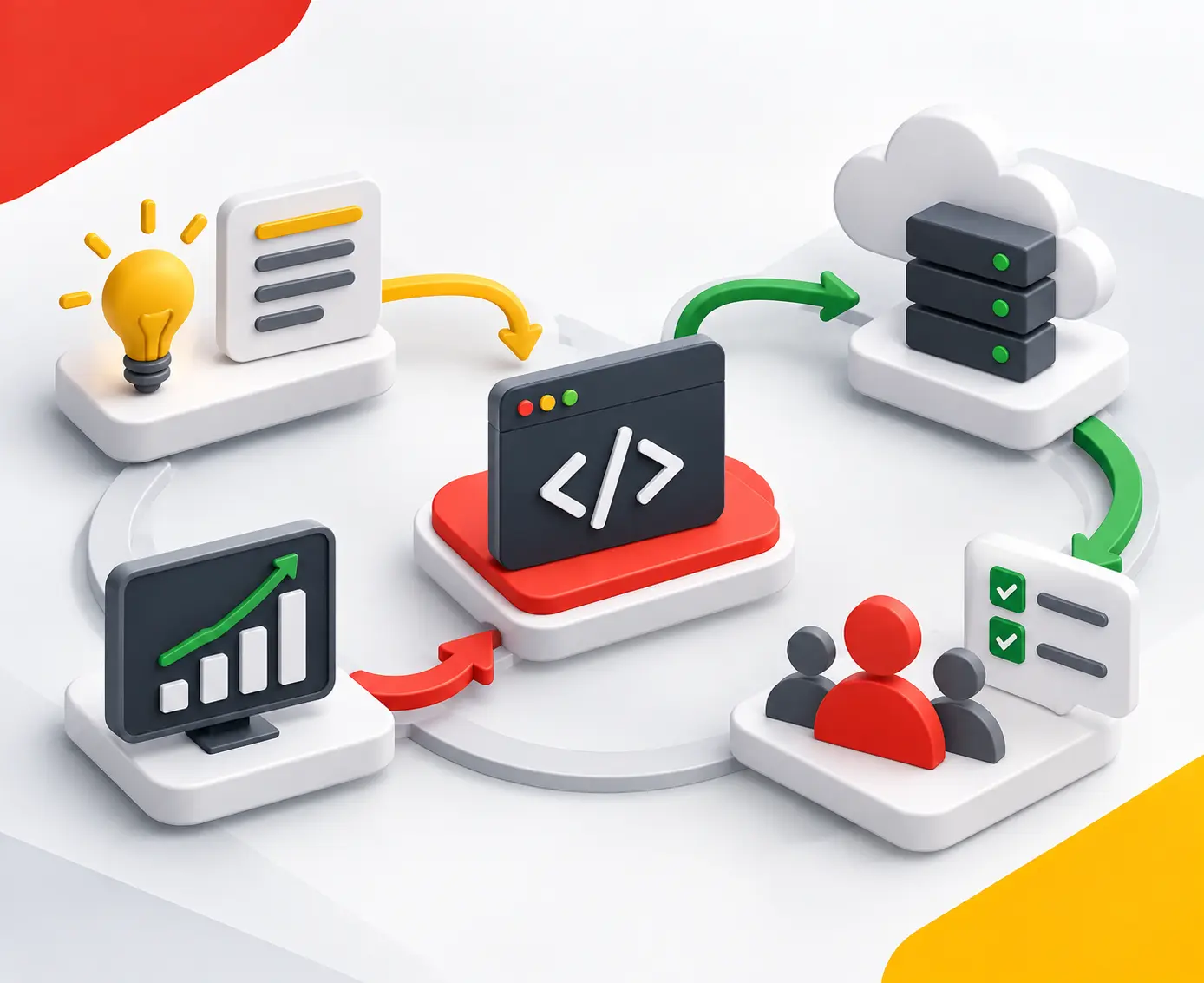
FDE isn’t a standard agile sprint cycle. It’s a loop, not a straight line. First, discover the real workflow.
Then define a narrow production target, build against live systems, and deploy with safety limits. Last, feed what you learned back into the core product. Four phases make up that loop.
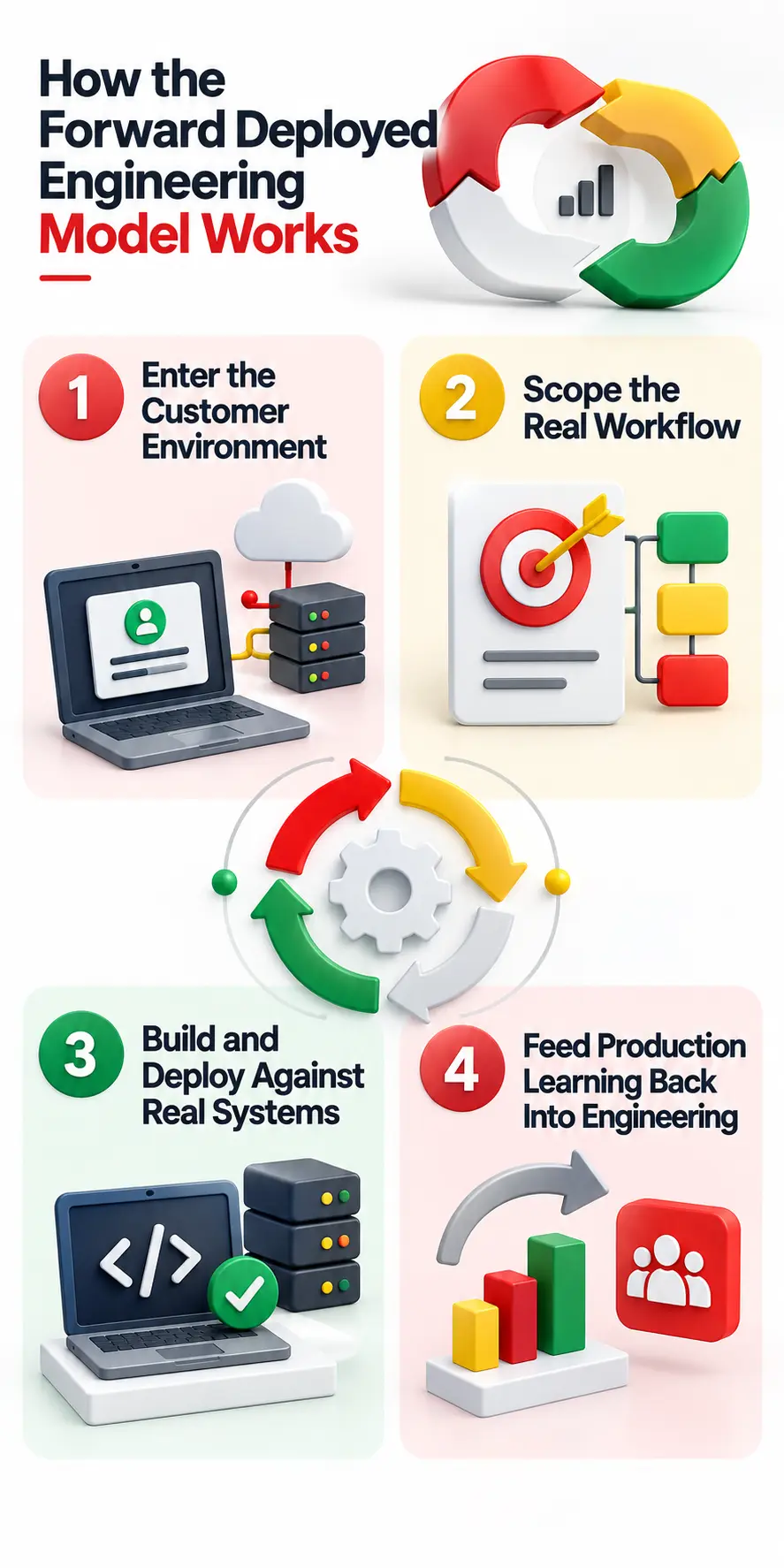
The engagement starts inside the customer’s own environment, not a vendor’s test lab. FDEs get access to the client’s repository, live data, existing APIs, and systems of record. They also get access to the actual development and production environments where the software will eventually run.
This step is mostly about discovery. FDEs use process mining tools to map how work actually happens. That’s usually different from what the official notes say. Unwritten shortcuts, manual workarounds, and tribal knowledge all live here. None of that shows up in a sandbox demo.
Next, the team narrows in on one specific, named business constraint. Not a generic AI use case, but something concrete: a slow procurement cycle, a high support ticket backlog, a manual data cleanup step. Naming it this precisely keeps everyone honest about what success actually looks like.
That constraint becomes the production outcome the whole engagement is scoped around. The team sets acceptance criteria, maps dependencies, and picks a measurable success metric up front. This step matters because it stops the engagement from turning into an open-ended research project.
This is where FDEs write actual production code, not a proof of concept. They connect AI agents to live enterprise data. They build Retrieval-Augmented Generation, or RAG, pipelines – sometimes GraphRAG pipelines – to establish one trustworthy source of truth.
They also build safety gates. That means defining exactly where autonomous action stops and a human has to approve the next step. This matters most in agentic workflows, where a small error early on can snowball fast across every later step. Once deployed, the system gets watched closely: token usage, accuracy, and hallucination rates all get tracked through ongoing evaluation loops.
Every FDE engagement produces field learning. Edge cases, odd data formats, and unexpected failure modes surface once real users touch the system. That’s information a sandbox demo could never generate.
The best FDE organizations pipe that learning straight back to their core product teams. A one-off integration built for a single client can turn into a reusable component for the next ten clients. This feedback loop is part of what separates FDE from a typical consulting engagement.
Organizations that use FDE well don’t treat it as just a staffing tactic. They treat it across four dimensions. There’s the role itself. There’s the team and skills it builds inside the company. Many vendors now use structured frameworks to manage this, like the DARE model: Design, Activate, Realize, Evolve.
The commercial shift is worth calling out. Many vendors now use Outcome-Level Agreements instead of billing by the hour.
That means the vendor shares real risk if the outcome doesn’t land. Because these deals build long-term platform adoption, some companies now book FDE spend as Customer Acquisition Cost, not as a standard delivery cost.
Vendors love to market speed. The real timeline is more disciplined than that. A technical pipeline can be functional within weeks. Full user trust takes longer.
In OpenAI’s wealth management deployment, the technical pipeline took six to eight weeks to complete. Getting end users to actually trust and adopt it took four more months of piloting and refinement. Here’s what the first 30 days usually look like.
Week one is almost entirely about access. The team secures repository access, system access, and data access. They map SSO and SAML dependencies, run security audits, and trace data lineage across legacy systems.
They also start building a real picture of the technical architecture. And they confirm who inside the company will own this system once the FDEs leave. Skipping this step is how engagements stall in week six instead of week one.
Week two is about definition, not code. The team maps the true, unwritten workflow – the one people actually follow, not the one in the process manual. They set strict evaluation criteria and lock in the production scope.
Most importantly, they agree on a success metric everyone can measure. This is the last checkpoint before serious engineering work starts. A vague scope at this stage almost always leads to a vague result later.
This is where the coding actually ramps up. The team writes infrastructure as code, deploys the first RAG ingestion pipelines, and connects to real APIs, not mocked ones.
By day 30, the goal is technical viability, not full production scale. A core pipeline should be integrated and able to run the workflow inside a monitored environment. It’s a working path, not a finished product. Trust and full adoption still take longer to build.
FDE engagements aren’t one-size-fits-all. The shape of the team, the length of the engagement, and how it’s priced all scale with how complex the customer’s problem is. A small integration might need just one engineer.
A full enterprise transition might need a pod that runs for years. Four models cover most of the market.
Actual FDE costs vary widely. Offshore contractors can run roughly $60 an hour. A senior, dedicated embedded engineer can cost $350,000 or more a year in total compensation. Outcome-based deals are typically only worth setting up above $1 million in annual contract value.
Marketing materials love to say clients “own the system” after an engagement. That’s true, but incomplete. Ownership is built gradually, through code reviews and co-development. It’s not handed over all at once at the end.
FDE success isn’t measured with normal software SLAs, like uptime or API latency. It’s measured against business outcomes and real user behavior. Time to first deployment shows delivery speed.
Production adoption is different. It’s the percentage of the target user base actually using the system, and it’s the real test of whether the work paid off.
Outcome achievement gets tracked against the baseline metrics the team set back in week one. Our FDE metrics guide breaks this down in more detail.
FDE earns its cost in environments where production delivery is genuinely hard. That usually means one of three things: strict regulation, legacy technical debt, or a complex AI agent workflow that has to run reliably. Each one raises the cost of getting things wrong.
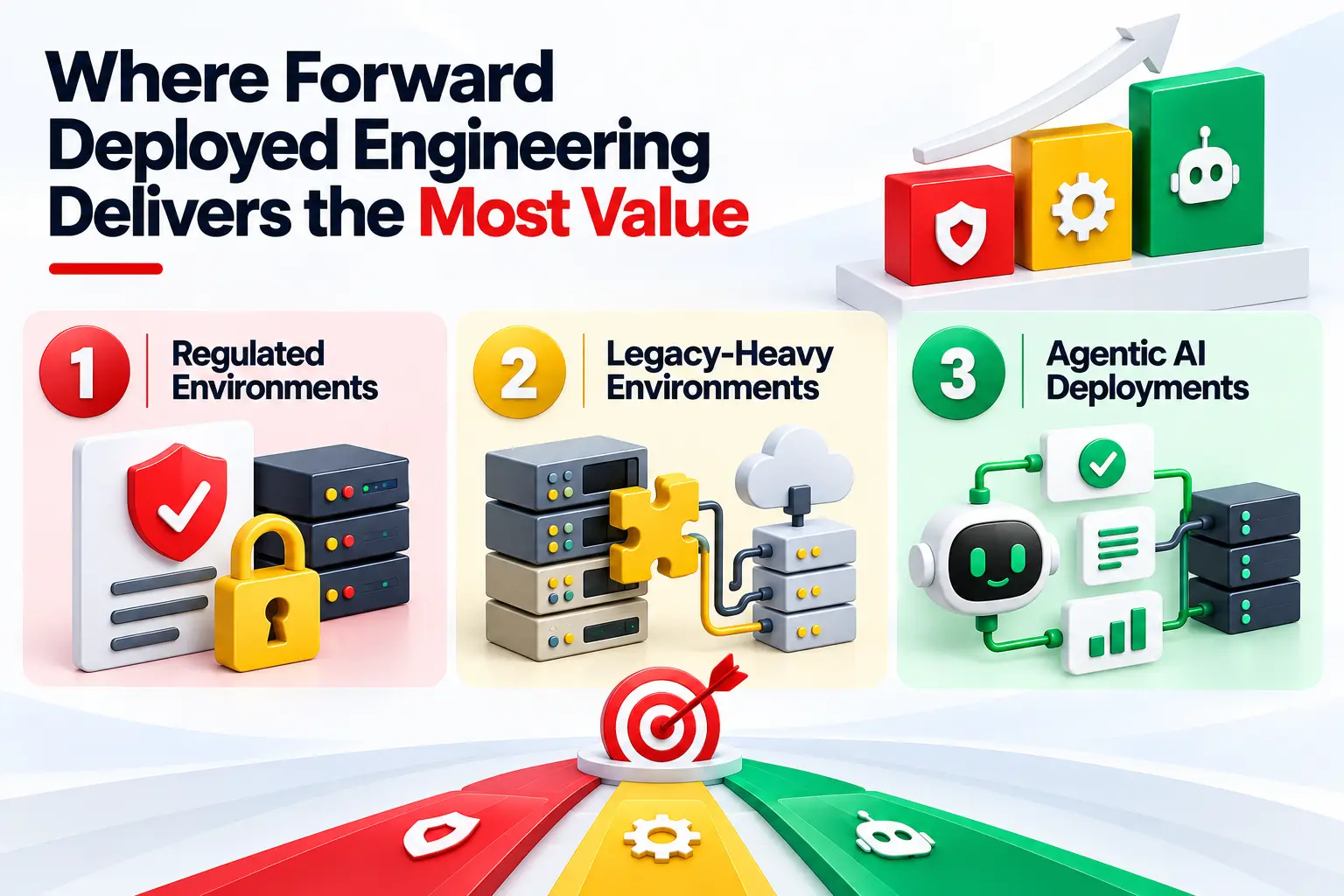
Healthcare, defense, and financial services live under frameworks like HIPAA, SOC 2, GDPR, and DORA.
These rules demand strict data governance, tight access controls, and careful handling of edge cases. That level of precision is hard to build without engineers who work inside the actual regulated environment. A mistake here can mean fines, not just a bad user experience.
Mainframes, aging ERPs, and disconnected systems of record don’t play nicely with standard SaaS tools.
They need custom API connectors, complex authentication flows, and manual data normalization. Off-the-shelf software usually can’t do any of that on its own. Someone has to write real code to bridge the gap.
Any serious agentic AI project needs safety controls, solid RAG pipelines, and deep integration with live systems of record.
Without that, small errors compound fast across a multi-step workflow. Elite engineering is what keeps those errors from stacking up. A single missed guardrail can turn a helpful agent into a liability.
FDE is expensive, and it’s not the right fit for every situation. It depends on production complexity, how much access the customer will grant, and whether the client has real internal ownership lined up. Watch for these five warning signs before you sign an FDE contract.
Used the wrong way, FDE turns into what practitioners call “human middleware.” That means a permanent, expensive patch covering for an immature product, instead of a temporary boost. Since senior FDE talent often costs $250,000 to $350,000 a year, that mistake gets expensive fast.
FDE gets compared to consulting, professional services, systems integration, and staff augmentation constantly. The differences come down to a few things. What gets delivered, and how much access the vendor gets.
Whether they touch live systems, and who’s accountable for the outcome. And how the scope gets set in the first place. The table below lays out each one side by side.
Entrans runs its FDE engagements through a structured, security-first process built for enterprise environments.
Meaning Entrans FDE as a service doesn’t comprise of read-only sandbox demos.
We’ve built products with f more than 6,000 integration-ready connectors speeds up the data ingestion work.
Not to mention, with Entrans, every engagement ends with a planned handover. Development continues until the system holds up under real enterprise load.
Then ownership transfers to a named client owner, inside the client’s own code repository.
Want to know how Entrans FDE developers would handle your project? Book a free consultation call!
It’s a delivery model where elite engineers embed directly inside a customer’s production environment. They build, integrate, and harden technology like agentic AI against real business constraints. The work happens inside the client’s own systems, not a vendor sandbox. It ends only once the system is live and working.
Forward Deployed Engineering is the overall delivery model a vendor uses. A Forward Deployed Engineer, sometimes called an FDSE, is the individual practitioner. They write the code and manage the technical side of the deployment. Larger engagements usually add a Deployment Strategist too, who manages the people side of the rollout.
Engineers map the real, unwritten workflow first. Then they build software directly against live data and APIs. They deploy it with human-in-the-loop safety limits. Last, they feed what they learn back to the vendor’s core product team, so the next client benefits too.
Initial technical value usually shows up within 30 to 90 days. Complex agentic AI deployments take longer to fully land. The behavioral change needed for real user adoption can add six months to over a year on top of that.
Pricing is shifting away from billable hours toward Outcome-Level Agreements tied to hard business metrics, like time saved or deflection rate. For large vendors, the cost is often folded into annual contract values above $1 million. Smaller engagements still get priced by the hour or by a fixed scope.
The client keeps full ownership of the customized codebase, data pipelines, knowledge graphs, deployment configurations, and operational runbooks. That’s designed to prevent lock-in at the integration layer. The underlying model or platform itself still stays with the vendor.


-1.svg)