Learn how to build a forward deployed team and choose between build, buy, partner, or hybrid models based on cost, speed, and delivery needs.

Agentic Unconference 2026 - September 19, Chennai
View Event →




If you’re looking into a forward-deployed team, odds are you want a team that does not waste your time or resources and is, most importantly, extremely competent given its compact size.
In 2026, you’re not alone: FDE teams, or Teams of forward-deployed engineers, are now the trend, given how well AI helps with agility in taking products and systems live.
Palantir built this model first. And with frontier labs like OpenAI and Anthropic scaling the same idea, it's become a lot more popular.
So, to help you understand if an FDE team is the right angle for you, in this article we’ll cover the different models you can put together, along with costs, pros, and limitations.
A Forward Deployed Engineering team is a group of senior engineers that do not follow traditional development roles. This is a development team that works embedded inside a customer's environment, writing real production code, and handling conversations with the client directly without the unnecessary overhead or limited scope of work.
The team exists because enterprise data is messy. No off-the-shelf AI model understands your customer records on day one.
It does not know your claims process or your internal naming rules. A Forward Deployed Engineering (FDE) team closes that gap. It works inside the mess, not around it.
In the old model, a vendor built a generic product. A sales engineer showed a demo. The customer's own IT staff or an outside integrator handled the messy part. That messy part meant making it really run. The FDE model folds all of that into one team. That team owns the whole path, from prototype to production and they do this by:
The FDE title gets confused with other roles often. That mix-up costs real money when a company hires the wrong kind of engineer. Solutions engineers build demos to help close a sale.
Professional services teams often bill by the hour. They get measured on hours billed, not outcomes reached.
An FDE team or forward-deployed team does none of these things by themselves to they are capable of a mix of tasks. This can be building custom, production-grade software for one client's own systems. And in doing so, an FDE team owns the result.
The honest reason is simple. Most AI projects fail before they ever go live. Between 70% and 85% of enterprise AI projects never scale past the pilot stage. This comes from failure research pulled from RAND, BCG, and Gartner.
Other research is even more blunt. Only about 5% of generative AI pilots ever deliver a real profit gain. Roughly $547 billion of the $684 billion spent on AI in 2025 failed to deliver what it promised. That is not a small rounding error. That is most of the money enterprises spent on AI last year.
The failure is almost never the model itself. It is the last mile of the work. That is the part where a working prototype meets real enterprise data, security rules, and old systems.
Gartner data shows that 38% of AI project failures trace back to poor data quality alone. The average time from proof of concept to real production use runs 18 to 24 months. Most companies do not have that kind of patience. They do not have that kind of budget sitting idle either.
Generic AI agents struggle here. Off-the-shelf LLM tools struggle too. They are built for the average customer, not your customer. An enterprise system needs someone who can read your exact data setup. That person must understand your exact rules and write code that fits your exact pipeline.
McKinsey research backs this up from a different angle. Organizational resistance, not technology, is the top barrier. 67% of executives name it as the number one block to AI use.
A Forward Deployed Engineering team helps here too. Embedded engineers build trust with the people who will really use the system. That matters more than trust with the executives who approved the budget.
Team structure is not a small detail. It decides if your FDE spend builds a working product or just a big consulting bill.
Most projects do not need a small army. One senior FDE, embedded for 8 to 16 weeks, can drive real results for a well-scoped project.
This one choice predicts success or failure more than almost anything else. When FDEs report into Sales, the incentives shift. The team starts chasing flashy, unscalable demos instead of working systems.
It starts optimizing for the next signature, not the next working build. Teams that report into core Engineering, Product, or a dedicated AI Center of Excellence keep a clear job.
Push the custom code back into the main product. Do not just leave it as a one-off build for one client.
An FDE pod cannot work alone, cut off from the business. It needs a named owner on the client side. That person must have the power to make calls, unblock data access, and confirm the workflow really matches how the business runs.
Without this person, even a perfect build can stall. It waits on a decision no one can make.
The work starts before anyone writes a line of code. The team maps the real workflow. It does not trust an outdated process document. Palantir's own method holds a simple belief.
Generic AI models give generic answers. Real value depends on grounding the model in the customer's own terms and data setup. From there, the team builds an ontology. It wires up the data pipelines and starts shipping working code in short cycles.
This is where most of the unglamorous work happens. Old databases do not have clean APIs. Security teams run their own slow approval process. A production engineer spends real time here.
They connect old systems to new AI agents without breaking anything already running. This is systems integration in the most literal sense. It is the step most AI vendors skip entirely.
Once the data and the integration work, the team deploys the real AI agents or LLM tools. These automate the target workflow.
This is not a one-time launch. The team watches the system in live use. It fixes what breaks. It keeps improving accuracy as real use turns up edge cases no lab test ever caught.
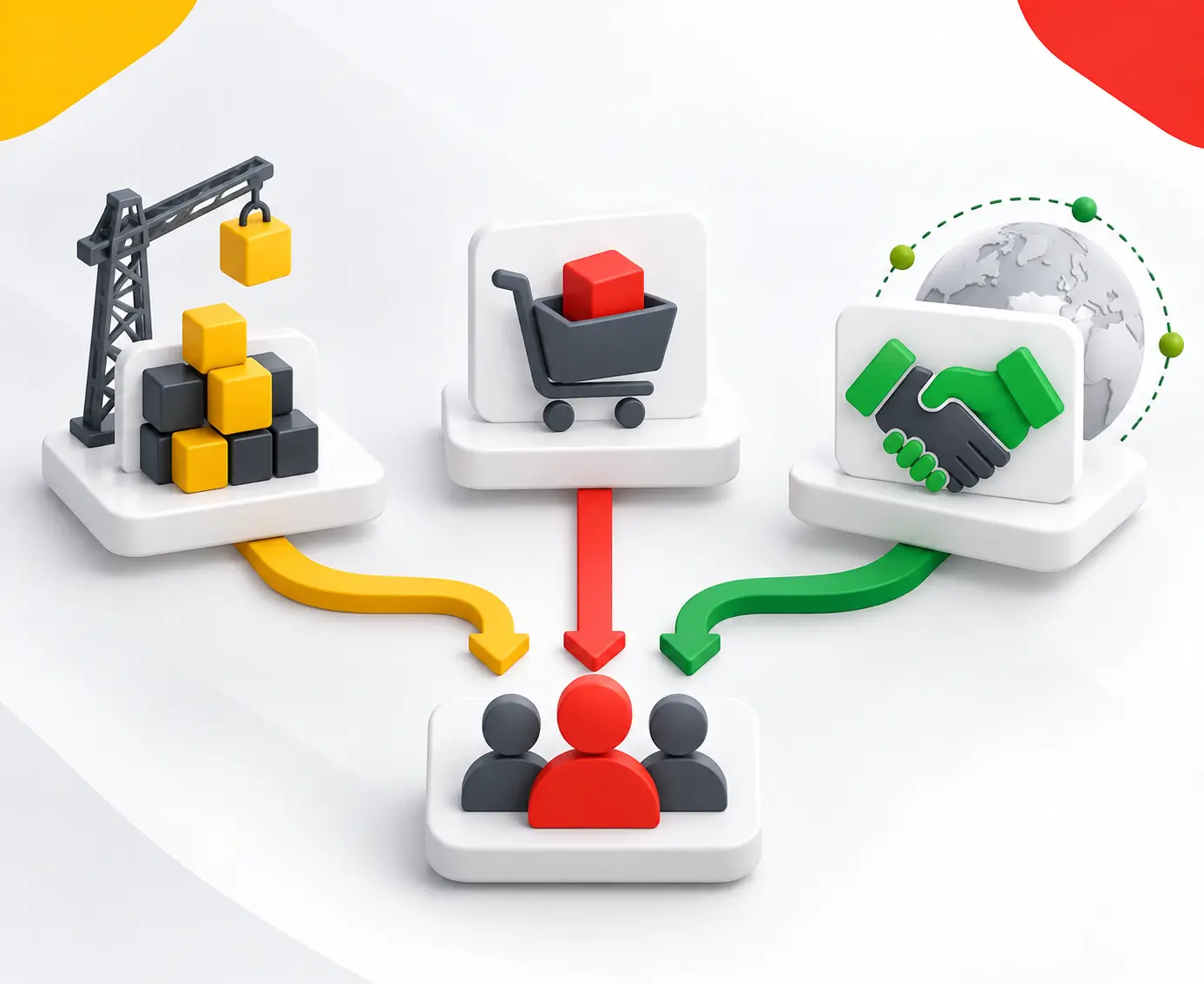
This is the choice that really sets your cost, your timeline, and your risk. Every enterprise leader lands in one of three lanes. Build the team in-house. Buy a managed platform or extra staff. Or partner with an embedded delivery team.
Building in-house gives you full control. You keep all the IP. You keep all the know-how. You get a lasting team you never have to renew a contract for. That control comes at a steep price.
Buying capacity through contractors is fast. You can go live in 6 to 10 weeks. The pricing is steady too, with a three-year cost that averages around $900,000.
Partnering with an embedded firm sits between the two. You get named engineers, not a rotating cast of contractors. The firm holds outcome ownership. That means the build has to really work before the job is called done.
Many leaders now pick a fourth path. Partner first to get a live system fast. Then hire in-house at the same time, while the partner is still working.
This grabs the partner model's speed. It also builds the lasting in-house skill the build model promises. And it does not force the business to wait 4 to 9 months for a first result.
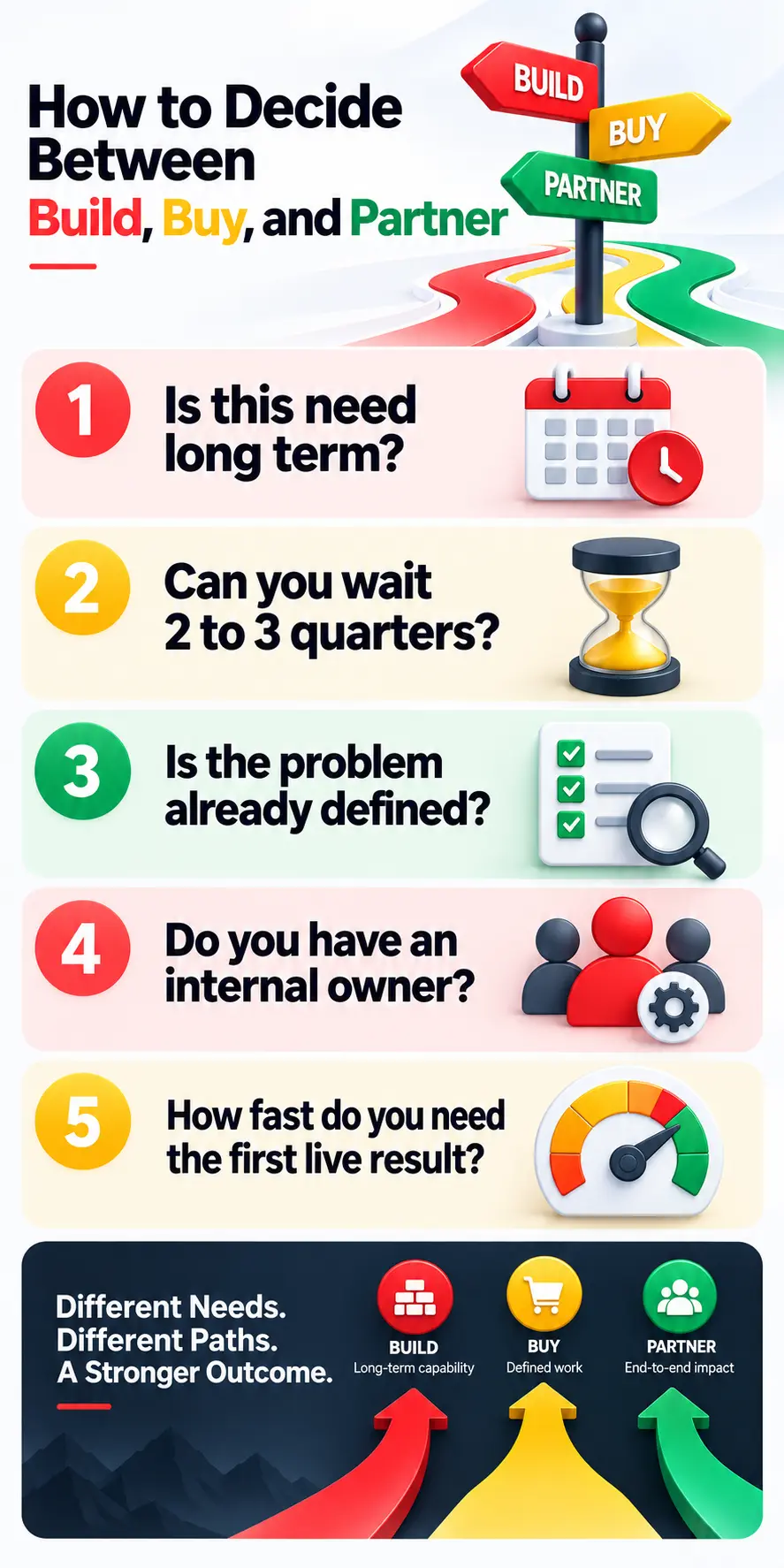
Skip the theory. Answer five direct questions before you put budget behind any of the three models.
Most leaders skip this exercise and go with whatever model their last vendor pitched them. That is how companies end up paying build prices for buy-speed work, or buy prices for a problem that needed real ownership. Five minutes with these questions saves months of regret later.
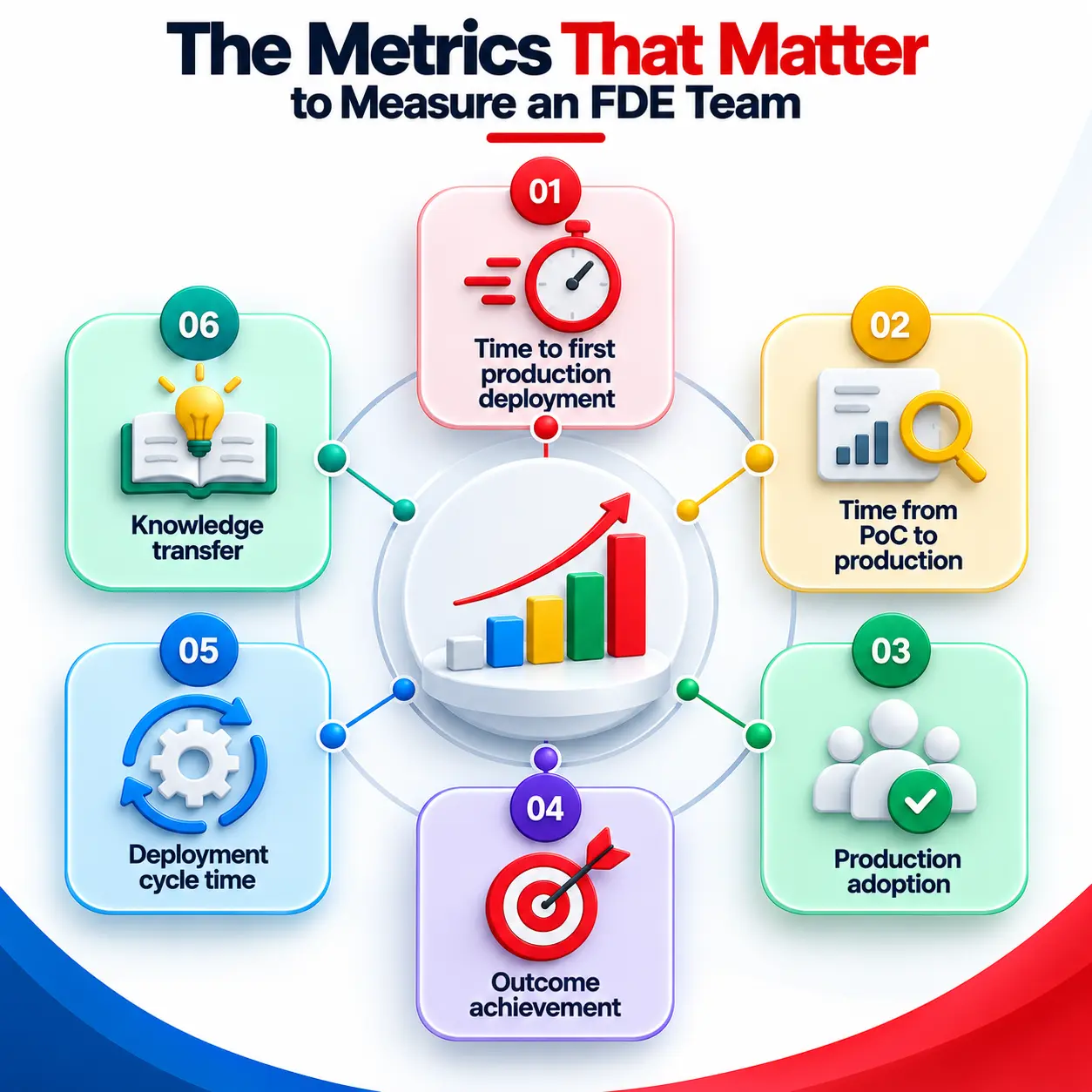
The wrong scorecard turns a strong FDE team into a bllable-hours machine. Track these instead:
Utilization, engineering speed, and raw lines of code should never be the top metrics. For those interested we’ve actually dived into that in detail in our article on FDE metrics.
Not every AI problem needs an embedded team. A single, well-defined use case, with clean data and no cross-system mess, is often better served by a scoped project.
A basic contractor can handle it too. Building or hiring a full pod for a one-off task wastes money. It also leaves a team with nothing to do once the job ends.
Threads on r/cscareerquestions show engineers frustrated by FDE titles with no real code authority. They get stuck in an endless loop of slide decks and disconnected systems. That is the exact failure mode this section warns against.
Entrans is built to work inside the hybrid model. It does not replace your in-house team. The process runs in a clear order. A named pod embeds first and delivers the first live results.
In one recent project, an embedded Entrans pod automated 70% of a client's manual workflow. It did this within the first live sprint, well ahead of the 18-to-24-month industry average for AI projects to reach production.
This is the outcome the partner-then-hire model is built to produce.
Want to know what Entrans developers can do for your team?
Book a free consultation call!
Start with a clear, well-defined problem. Staff a small, senior pod. Give that pod production access and a reporting line into Engineering, not Sales. Most strong teams start with one senior FDE before growing into a bigger pod.
One senior FDE is enough for most 8-to-16-week projects. Complex, multi-system work usually needs a three-to-five-person unit. That means a lead engineer, one or two production engineers, and a data engineer.
Build if the need is long-term and you can wait months for hiring. Partner if you need a live result inside one quarter. Also partner if the problem is not yet clear enough to hand to a contractor.
Into core Engineering, Product, or a dedicated AI Center of Excellence. Reporting into Sales or a revenue team shifts the goal toward flashy demos, not working, lasting systems.
Hiring in-house often takes four to nine months before the first live result. Partnering with an embedded team can bring a live build in weeks, with in-house skill growing at the same time.
Knowledge stuck in one person's head. A single senior FDE holding all the context can stall a whole project if they leave. Always plan a documented handover, even for a small pod.


-1.svg)