Learn how to implement agentic AI security to protect autonomous agents, manage identities, control tool access, and prevent real-world system attacks.

Agentic Unconference 2026 - September 19, Chennai
View Event →


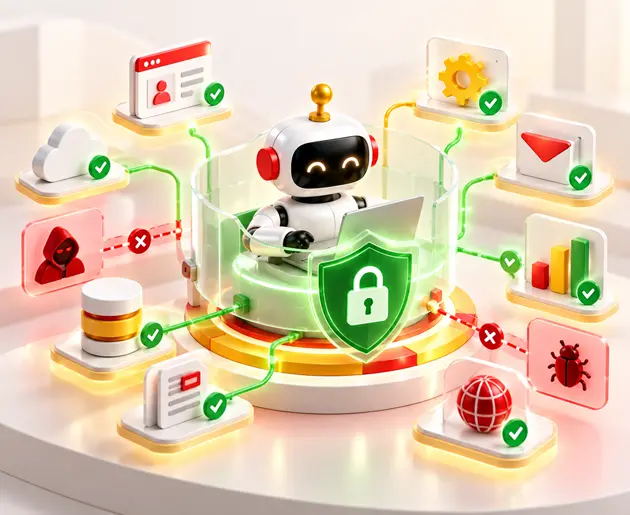


What if the AI not only provides answers to queries but takes control and executes the actions itself? This is what Agentic AI Security is all about. It requires a totally new approach to protect such dynamically oriented AI systems.
Agentic AI security assists organizations in dealing with such challenges by means of access controls, identity management, continuous monitoring, and human intervention before any serious incident occurs.
This blog describes the security issues that organizations have to deal with and how to protect AI agents.
Agentic AI security is focused on ensuring the action-level security of the AI agent. This is about determining the capabilities and permissions of an AI agent concerning what it is allowed to see, decide, and do using APIs, system utilities, memory, and other sub-agents.
Generative AI transformed our way of synthesizing knowledge, but autonomous agents transform the process of work itself. From one moment to the next, when an AI begins to not only generate text but also perform actions, the nature of its security moves from text filtration to action regulation.
The issue is that agents now have live credentials and perform multiple steps of workflows with no human review of individual outputs.
While generative AI security focuses on threat prevention concerning prompts, generated data, and sensitive information, AI agent security encompasses a broader scope of attacks due to the potential ability of agents to interface with business processes and perform actions.
Managing the risk associated with agentic AI necessitates going beyond mere prompting restrictions. By putting in place an effective agentic AI security protocol, organizations will be able to unleash the true power of the agentic AI processes.
Credentials and the execution of tasks in such a manner that no human needs to verify the outputs are becoming common for AI agents, which necessitates tight security.
But nowadays, the AI assistants are not limited only to responding to queries or generating content; rather, they can go inside the databases of companies, work using their credentials, update records, and do jobs, all without much human involvement.
These automated helpers operate independently, without the requirement of manual validation for each micro-decision. The issue of agentic AI security has become a high-level matter directly within executive boardrooms. Nevertheless, the rising need requires an appropriate owner.
Several analyst forecasts and vendor surveys show why businesses can no longer treat agent security as an IT-only concern.
The above-mentioned data is based on predictions made by analysts and sponsored studies by vendors; it is not a universal statistic of breach occurrences. All of the information presented above constitutes a convincing argument for implementing proper controls at the board level, for ensuring proper identification of agents, and for securing agentic AI.
To properly secure agentic AI, you have to stop seeing the AI agent as just one single language model. It is an interconnected ecosystem and a dynamic system in which reasoning engines, third-party tools, memory stacks, and credentials all interact.
Since the agent operates at multiple levels, the attack surface of an autonomous agent is much larger than that of traditional software. These are the six most critical failure points of AI agent security.
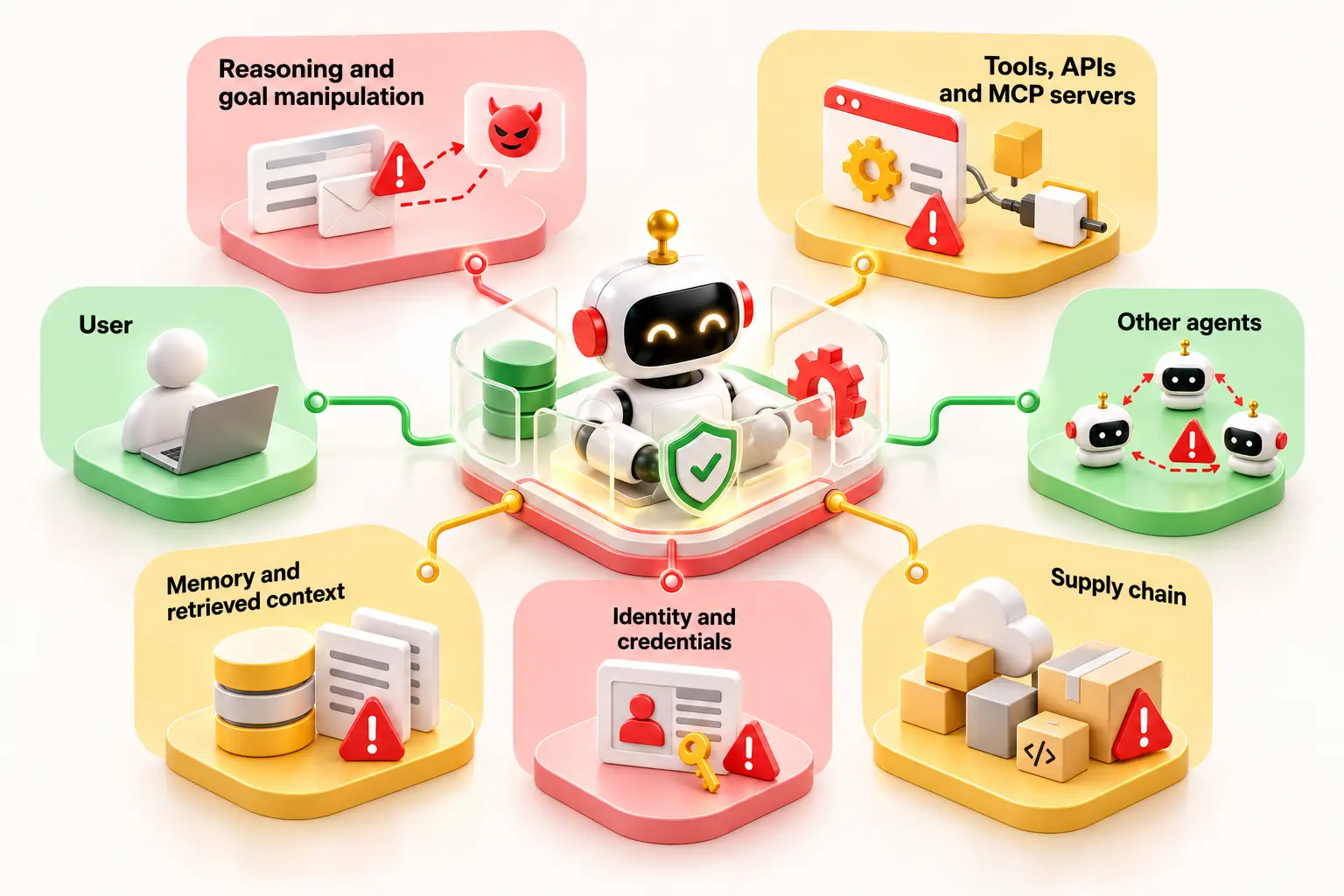
The attacker does not have to attack the firewall of the system but can confuse the planner into making wrong decisions. The attack is carried out using prompt injection attacks. The plan agent can be induced into carrying out a task by providing commands embedded in emails, uploaded PDFs, or scraped web pages.
The planner may be instructed to start extracting data instead of summarizing documents.
For instance, when an agent is handling incoming emails, it can encounter concealed commands within the email itself commanding it to send confidential files.
After the validity of this command is accepted by the agent, it will be motivated to perform work that even falls outside its core mandate. For the guardrails of the AI agent to function properly, they need to discern between trusted and untrusted information.
Agents rely on tools to interact with the real world. But too wide a scope for these tools, incorrect parameters, and unvalidated write actions can lead to large-scale vulnerabilities.
In case an agent establishes a connection to MCP servers or API databases without parameter validation, the security of MCP will be breached, allowing attackers to initiate inappropriate actions such as deleting production tables and making unauthorized wire transfers.
Secure endpoint implementation can be helped by reviewing a practical MCP server development guide to avoid exposed tool interfaces.
An agent's long-term memory and RAG (Retrieval-Augmented Generation) pipelines are vulnerable to memory poisoning. If corrupt or unauthorized documents slip into the vector store, the agent can retain compromised instructions indefinitely. This can lead to cross-user context leakage, where confidential data meant for one user surfaces in another user’s session.
A major challenge in securing AI agents is managing the privileges they hold. Many organizations improperly assign long-lived keys or share human service accounts with digital assistants.
In fact, Gartner found that 54% of organizations have no defined approach to limiting agent access or simply rely on predefined human access levels (Gartner survey, Sep 2026). Without a dedicated framework for non-human identity and AI agent identity, an agent inherits far too much power, turning a minor mistake into an enterprise-wide compromise.
In multi-agent systems, as their size increases, they start to delegate sub-tasks to each other. The lack of authentication at this point makes it easy for spoof agents and system breakdowns to occur. In the case where a bad agent pretends to be a trusted one, it will succeed in making downstream agents execute privileged instructions.
However, AI agents rely not only on the models that they use. Supply chains of these systems can involve the use of third-party MCP servers, software, prompts, plugins, and even agent skills. Use of these parts without any examination of their origin and permissions is very dangerous.
In addition, a third-party agent capability may include some harmful code or require access to confidential information. The company must check any dependencies, look at the publishers, scan the packages, and keep track of any updates.
The six topics listed above prove that an agentic AI security framework should include protection of all components that an agent interacts with. The protection of only the model would be insufficient to ensure that an autonomous agent operates in accordance with the approved limitations.
OWASP Top 10 for Agentic Applications (2026) provides business organizations with a viable framework to identify potential vulnerabilities in autonomous artificial intelligence applications. OWASP GenAI Security Project provides the framework in December 2025. It is focused on ten risks relating to agents’ behavior, tools, identities, memories, and communications.
The above examples are anonymized scenarios for workflow attacks rather than reports of verified security events. These are based on enterprise process patterns applicable to the Entrans delivery experience, such as invoice-GRN reconciliation, insurance emails processing, and prior authorization automation. Below are some other possible attack scenarios for the mentioned OWASP threats.
The critical point to remember here is that agency-based AI security requires joint ownership. AI engineers, IAM teams, application owners, and executives need to cooperate. A documented control will only be helpful if there is an owner of the control who monitors it and takes action.
Security researcher Simon Willison introduced the concept of the lethal trifecta that mainly explains how AI agents can expose sensitive business data. Martin Fowler's article on agentic AI security also discusses this risk and ways to address it.
The pattern involves three capabilities coming together:
To ensure effective security for AI, it is important to interrupt at least one of the components of the trident:
Following these security best practices for agentic AIs will ensure that even if the agent is exposed to malicious input, the agent can't cause any damage.
The agentic AI should be able to determine whether its own behavior is safe without relying on the model itself. AWS Security suggests in April 2026 that one should start with deterministic external control, which consists of identity, access policy, execution, and network control.
The guardrails based on LLMs could be useful for spotting any suspicious instruction or request, but this tool must complement security measures rather than substitute them. In other words, the model may identify a suspicious attempt to obtain access to a customer's data as a restricted one. Nevertheless, the decision whether the user is permitted should be made independently.
This is made possible through a layered AI security framework that is agentic. Different layers of the framework control the actions of the agent in a certain way.
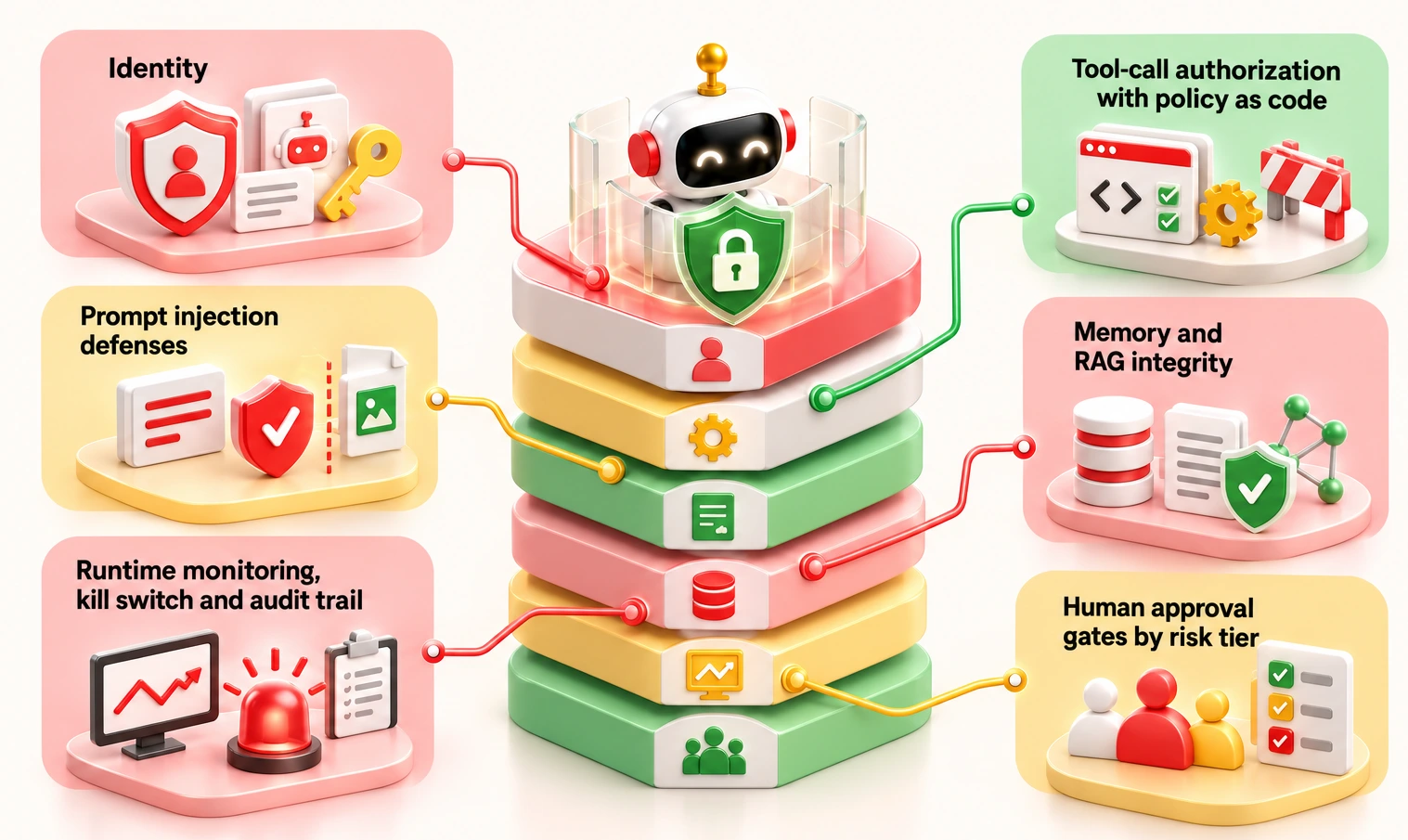
Every AI agent should have a separate identity rather than sharing a common service. Enforce just-in-time privilege escalation so digital workers never hold standing access.
Maintaining a comprehensive non-human identity inventory ensures every agent’s actions map back to an accountable system owner, a key focus for platforms like Infisign when managing enterprise-wide non-human identities. account.
Prohibit unapproved tool execution using policy-as-code allowlists. Verify all parameters for each tool input and implement rate limiting and automated approval rules depending on the transaction value or data sensitivity level. This will be the key to securing the MCP from malicious attacks during agent server communication.
A prompt injection may be used to manipulate an agent through malicious instructions that could be embedded in emails, PDFs, and web pages. Ensure separation between trusted and untrusted instructions by using provenance tagging. Validate output against a schema and filter outbounds.
This will prevent the agent from interpreting content as a directive to perform prohibited operations.
Protect agent memory layers via permission-based recall. Ensure that the RAG pipelines only use cryptographically signed sources and have automatic policies for expiring contexts to prevent context poisoning.
Capture structured, action-level logs across every decision step. Configure real-time anomaly detection to spot rogue behavior and maintain a fully tested, automated kill switch to immediately freeze compromised agents.
Keep logs at the action level, have alerts to flag anomalies in activity, and test a kill switch in case of emergencies to disable agents and credentials. Maintain an audit trail of tool usage, permissions, denied actions, and actions taken.
For additional guidance, see Entrans' Enterprise Workflow Mapping for AI Automation, which discusses execution tracing, exception tracking, and monitoring agent workflows.
Deterministic controls should enforce human intervention whenever an action exceeds defined risk limits.
Adopting this multi-layered agentic AI security framework ensures that your organization can deploy autonomous workflows at scale. By embedding rigid AI agent guardrails at the identity, tool, and runtime layers, you effectively reduce AI agent security risks while keeping critical infrastructure fully protected.
MCP security and A2A controls will help avoid any unauthorized access and communication among the agents. Here are some tips:
The above list of agentic AI security best practices will enable enterprises to secure their connected systems.
AI agent protection should not be limited to a one-off effort before deployment. Security tests must go through every stage of agent delivery, from initial agent design discussions through to production patches.
An effective model for agentic AI security involves having different security gates at different stages of development. It allows the team to identify any security flaws at an early stage.
The matrix below maps critical agentic AI security best practices directly across each development phase:
Binding controls to delivery stages will make sure securing AI agents is a continuous process. Re-testing the agents each time there is any change to the tools or prompts will keep the autonomous workflow safe.
AI agents should be tested not only for providing wrong information. The reason is that such agents have access to company information and can make calls and take actions.
Therefore, any security issue may cause a violation of data. The red teaming method assists in identifying security threats in advance and before AI agents start working. It is a component of the agentic AI security framework, which may be implemented within two weeks.
The AI security team must take charge of conducting the tests, assisted by the application security, IAM, and engineering teams. It is important to have pass/fail criteria before conducting any tests.
The agent passes the test if it successfully prevents any forbidden activity, restricts access to confidential data, and follows approval policies. Document all discoveries along with the severity of the issue, the element that is affected, and what needs to be done about it.
Re-run the test to confirm resolution. Also, include all discovered problems in the automatic testing tool for the future model or prompt modification to run the same tests.
The compliance section needs to separate evidence of the management system, technical security controls, and legal requirements. While these regulations relate to different risks, they do not replace each other.
Its NCCoE concept paper discusses software and AI agent identification, authorization, auditing, and non-repudiation. The security of AI agents requires identification, authorization, access, and owner accountability for each agent. Establishing consistent controls across these lifecycles can be improved by aligning team procedures with an enterprise-ready AI risk management framework.
Documentation of the approval of the AI agent, its scope of access, and review of actions is necessary. Meeting these documentation standards can be helped through proactive cross-functional AI security governance that oversees model operations.
The deadline for high-risk provisions in sectors like employment is set for December 2, 2027, whereas the deadline for qualified AI systems integrated into products that fall under regulatory regimes is set for August 2, 2028.
Security for agentic AI systems should be strong enough to clearly define ownership. The RACI matrix can help with this process.
RACI Control Matrix: Establishing clear operational ownership is critical when adopting an agentic AI security framework:
Basic controls such as rate limiting, token logging, and simple AI agent identity management can be done by native cloud agent service providers or security platforms.
However, custom engineering and specific partner involvement will be necessary when dealing with legacy integration, strictly regulated data, or complex multi-vendor agent environments. Using such agentic AI security best practices ensures that your company remains secure and fast. Managing these complex integrations can be helped by bringing on a dedicated AI security engineer to build custom guardrails.
The security of agentic AIs can be undermined when teams think of it as a single task instead of an ongoing process. Beware of the following pitfalls:
Long-term system resilience can be improved by integrating end-to-end cybersecurity and compliance protocols across every deployment phase.
Building an AI agent is merely a beginning step. The hard part comes when it is interfaced with business applications, works with sensitive information, and takes action. Entrans integrates security in this process from design through deployment.
Our forward-deployed engineering pods work alongside client teams and build around their existing systems and business processes. Security is part of the engineering plan, not a final check before launch.
Each engagement can include a threat model that maps agent identities, permissions, connected tools, data access, and possible attack paths. Red-team testing checks for prompt injection, unauthorized tool use, privilege escalation, and unsafe actions. Teams also set up AI agent guardrails, approval steps, access controls, and monitoring based on the workflow's risk.
We have delivered 150+ AI projects. Our related engineering work includes:
These projects show relevant experience in identity engineering and secure AI-enabled workflows, both important parts of agentic AI security.
Want to make AI agents powerful, proactive, completely secure, and work safely? Talk to Entrans.

Agentic AI security protects system action layers by governing what autonomous agents access, decide, and execute across software tools, memory, and APIs. It moves beyond filtering text output to enforce real-time runtime permissions, non-human identity limits, and system guardrails.
Secure agentic AI by using strong access controls, unique AI agent identities, and clear approval rules. Test agents for attacks, monitor their actions, and limit their permissions.
The OWASP Top 10 for agentic AI highlights risks like goal hijacking, tool misuse, privilege abuse, memory poisoning, and unverified inter-agent communications. It also covers supply chain flaws, unexpected code execution, cascading failures, human-trust exploitation, and rogue agents.
AI agents may expose private data, misuse tools, or take actions without approval. Weak agentic AI security can also let attackers exploit one agent to affect other systems.
Generative AI security mainly protects prompts, model outputs, and data. Agentic AI security also protects tool access, agent identities, memory, and actions taken across business systems.
A non-human identity is a dedicated digital persona that gives an autonomous agent scoped system credentials, API keys, and OAuth permissions. Establishing a unique AI agent identity ensures every automated action remains fully audited, traceable, and strictly limited to least-privilege boundaries.
Both teams should share responsibility. The CISO owns overall strategic risk, identity governance policies, and compliance oversight for all agentic AI security best practices. The AI engineering team works alongside platform engineers to build, configure, and maintain technical guardrails within application pipelines.