Learn how to build real-world AI security governance for autonomous agents. Control tool calls, limit blast radius, and secure actions before they go live.

Agentic Unconference 2026 - September 19, Chennai
View Event →


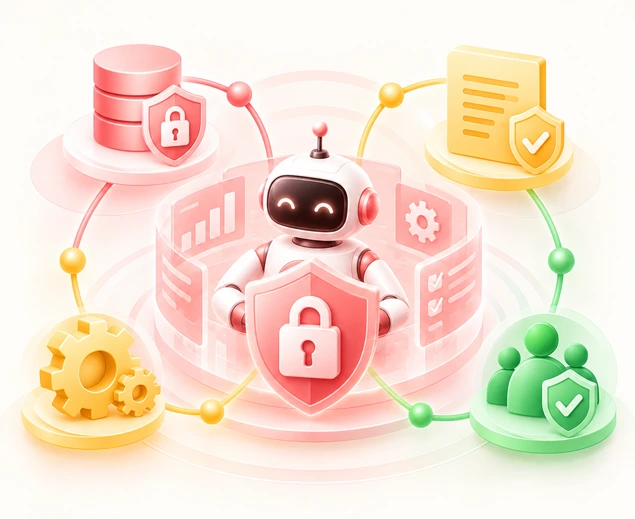


Imagine your AI agent stops giving answers and starts taking action? That is where governance gets harder. AI agents are capable of invoking services, accessing data, manipulating records, invoking processes, and making decisions without having to wait for a human to do each step. Developing AI security governance in the contemporary setting entails going beyond monitoring to enforcement.
This blog explains the security and operational controls needed to keep autonomous systems useful without leaving their actions unchecked.
A model generates a prediction. The decision to use that prediction to drive an action lies with the human being. The agent acts. One small difference means that the requirements for governance change.
Traditional AI governance revolves around the process of interpreting an output: the prediction generated by the model, its evaluation, and its compliance with policy. These controls, however, do not constitute authorization to perform an action.
AI security governance for agents is the control set that authorizes and bounds the actions an autonomous system can take, as distinct from explaining the outputs a model produces. Its main focus is to cover agent identity, permissions, tool access, action limits, monitoring, and audit records.
Traditional governance was built for a simpler era of machine learning. They focus entirely on explaining an output but are not designed to authorize an action. When an agent executes multi-step tasks across enterprise systems, the fundamental control problem changes. Modern agentic AI governance must address four immediate shifts:
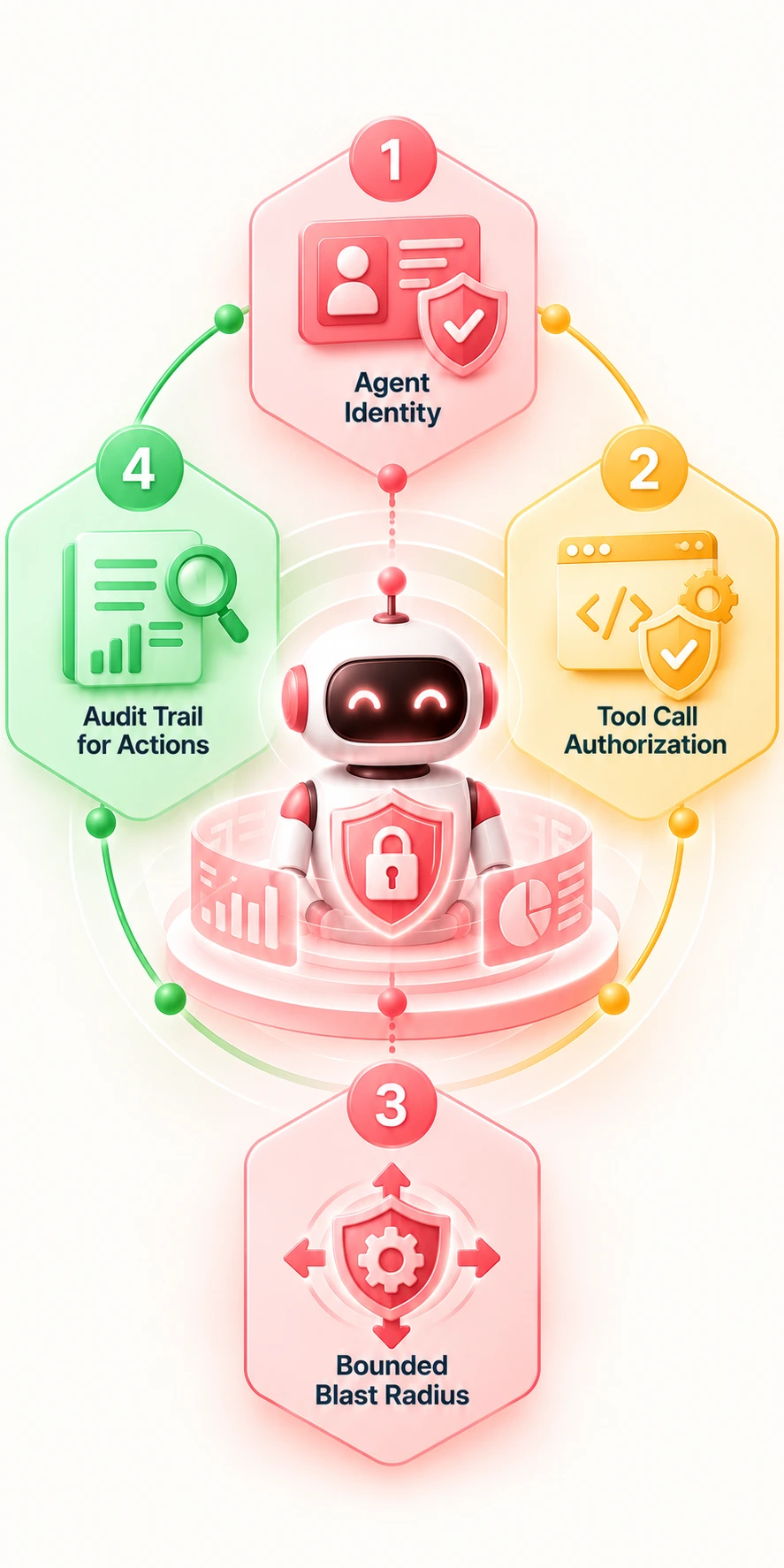
An AI agent needs its own verified identity to operate within network boundaries. It cannot operate as an unnamed process or borrow a human identity and needs agent identities, ownership, lifecycle controls, and access governance.
API invocation, modification of records, messaging, and data access will need permission. Access control for AI agents will have to ensure that it defines both the scope of access and the capabilities of the agent.
The boundaries of AI governance must restrict how far an agent can go once something goes wrong. Least-privilege access, tool restrictions, and limitations on actions become part of AI operational governance.
Agent Audit Trail should include Identification of the Agent, Tool Used by the Agent, resources accessed by the Agent, and changes made by the Agent, rather than predictions made by the Model.
This is already a live governance issue. OWASP published its State of Agentic AI Security and Governance in June 2026, while Microsoft has dedicated guidance for securing agents. Forbes also covered agent behavior as an emerging governance challenge in August 2026.
Agent identity is the first control area in agentic AI governance, and it is also the most skipped. Many agents are deployed as part of an existing application and simply inherit that application's service account. It works from a technical standpoint, but from day one, it poses a governance issue.
To prevent over-privileged execution, AI operational governance requires identity architectures tailored specifically to autonomous workers rather than static software applications:
A significant architectural issue for AI security governance in the contemporary world is the ability to address the issue of delegation, which is whether an agent performs tasks under its identity or by impersonating the user.
Whereas an agent performing tasks on behalf of a user is authorized at the user level, distinguishing the point where the user's intention stops and autonomous decision-making commences is challenging.
Conversely, if the agent acts strictly as its own entity, access management becomes clearer, but cross-system permissioning becomes difficult to coordinate. The industry has not yet settled on a unified standard for user-to-agent identity propagation, making this one of the most active design challenges in enterprise deployments.
Shifting away from shared-service accounts will help enterprise security groups retain full control over their autonomous activities. It is through the development of unique identities, dynamic authorization systems, and AI governance controls that enterprises can give agents the liberty to perform complex processes without endangering the entire environment with unrestricted access.
Tool-call Authorization is the second control area in agentic AI governance. The real-world capabilities of an agent depend not on its language model architecture but rather on the set of tools it can use.
That makes the tool registry a governance surface and a key part of AI agent access control. Governance of this layer involves going beyond content filtering and establishing active control over each function call.
A useful agentic AI governance setup starts with an explicit allowlist for each agent. Rather than giving every agent access to an open tool registry, define exactly which tools it can call and what each call is allowed to contain. Effective agentic AI governance relies on precise tool-level constraints to prevent unauthorized execution:
Separating read operations from write operations delivers significant risk reduction with minimal implementation overhead. Both read and write tools should be treated differently. For example, reading a customer record is different from deleting one, sending an external message, or changing a financial record.
Treating write operations with elevated AI agent access control ensures sensitive environments remain protected.
Addressing prompt injection only as a problem of content filtering is overlooking the essence of the problem. In the case where a document causes a model to perform a harmful action, there is a violation at the level of authorization.
This way, by maintaining the boundary enforcement policy and logging the execution of tools in the agent's audit log, any untrusted input will be harmless.
Blast radius is the third control area, and this is where AI governance guardrails become an engineering design question. Rather than applying broad blanket policies, effective AI operational governance categorizes actions by their inherent reversibility fully reversible, reversible with cost, and irreversible and assigns controls based on those classes.
Managing operational risk requires strict AI governance guardrails tied to action impact:
Start by classifying actions into three groups:
The controls need to be set for each category of actions rather than being imposed equally on the whole agent. It becomes much easier to govern the operations of AI if the control can be applied according to the potential effect of the action.
Implement strict transaction value limits or record limits. Implement incremental implementation of the agent actions by initially limiting the scope of actions. Implement dry runs which allow the effects of the intended changes to be viewed without any action actually taking place. For the actions that can be reversed with some cost, implement the reversal steps first.
Focusing exclusively on single actions misses the danger of cascading failures. A sequence of individually low-risk tool calls such as modifying several small user permissions in a row can compound into a high-risk system compromise.
To combat this, AI agent access control must enforce session-level limits alongside single-call restrictions. Monitoring multi-step execution flows and capturing every state transition in a comprehensive agent audit trail prevents agents from subtly exceeding safe operational parameters during complex tasks. This architectural approach keeps modern agentic AI governance proactive, resilient, and anchored in practical safety.
Human-in-the-loop is the fourth control area and this is where agentic AI governance faces its practical tension in agentic AI governance: an agent that requires approval for every single action is just a slow, over-engineered workflow.
To preserve operational velocity while maintaining AI security governance, approval gates must be placed selectively based on action risk rather than applied uniformly across every step.
AI governance guardrails should place checkpoints around specific action classes and high-risk operational thresholds. Useful triggers include:
This keeps AI operational governance tied to actual risk. Low-risk actions can continue without interruption, while higher-impact actions pause for review.
Over-gating creates severe failure modes. Constant notifications lead to approval fatigue, resulting in blind rubber-stamping, a scenario worse than having no gates, as it populates the agent audit trail with false records of human review.
To keep AI operational governance effective, batch routine approvals into consolidated digests, present reviewers with clear context highlighting the specific action and its reversibility, and enforce strict AI agent access control with a default-deny policy whenever an approval window times out.
Traditional modeling logging revolves around inputs and outputs. Agent auditing is the fifth control area that must dig deeper when this happens. If an agent invokes tools, alters logs, communicates with systems, or initiates workflows, there must be proof of both the decision and its impact on the process.
An agent audit trail should record enough detail to reconstruct what happened without relying on the agent's final response. At a minimum, it must capture the complete operational sequence:
This creates a usable evidence trail for AI security governance. Recent agent governance guidance also calls for action-level logs that capture decisions, traces, and human interventions.
Preserving full reasoning traces creates a difficult privacy challenge. Unfiltered execution logs often capture sensitive customer data, API tokens, or proprietary context.
Teams must implement automated redaction pipelines and zero-knowledge logging frameworks so that AI governance guardrails do not inadvertently create security or compliance liabilities.
There is also a gap worth calling out in the current AI governance audit landscape. Guidance for general auditing mentions AI logs, but documentation regarding action logs pertaining to individual agents is still not as well covered as documentation on the inputs and outputs of models.
This raises an issue of practical importance for teams working with agents: Is there any way to prove what actions each agent performed?
Building an AI agent is just the beginning. Once it enters production, AI operational governance becomes necessary to manage how it behaves, responds to incidents, and changes over time.
Traditional AI governance often centers on model performance and compliance. Agents add another layer: ongoing control over actions that may already affect real systems.
Model drift could indicate changes in the performance of the model. In addition, behavioral drift must be detected for agentic AI governance.
The agent can start using more tools, accessing new types of records, trying to redo previous steps that have failed, or following a longer path to achieve the goal. All of this is possible without any modifications in the underlying model.
In other words, there are guardrails for AI governance that must detect action patterns, tool use, requests for approval, and out-of-scope activity.
The problem becomes even more difficult to deal with if the incident itself is not an incorrect prediction, but an action that was performed in advance of any realization that there was a problem.
The production agent may have already sent out messages, made changes to records, or initiated further workflow processes.
Agentic AI governance is in the development phase only, so it will not have clean answers. A useful AI security governance program should acknowledge these gaps instead of treating every problem as something that can be solved with another policy or guardrail. The main reasons are discussed below.
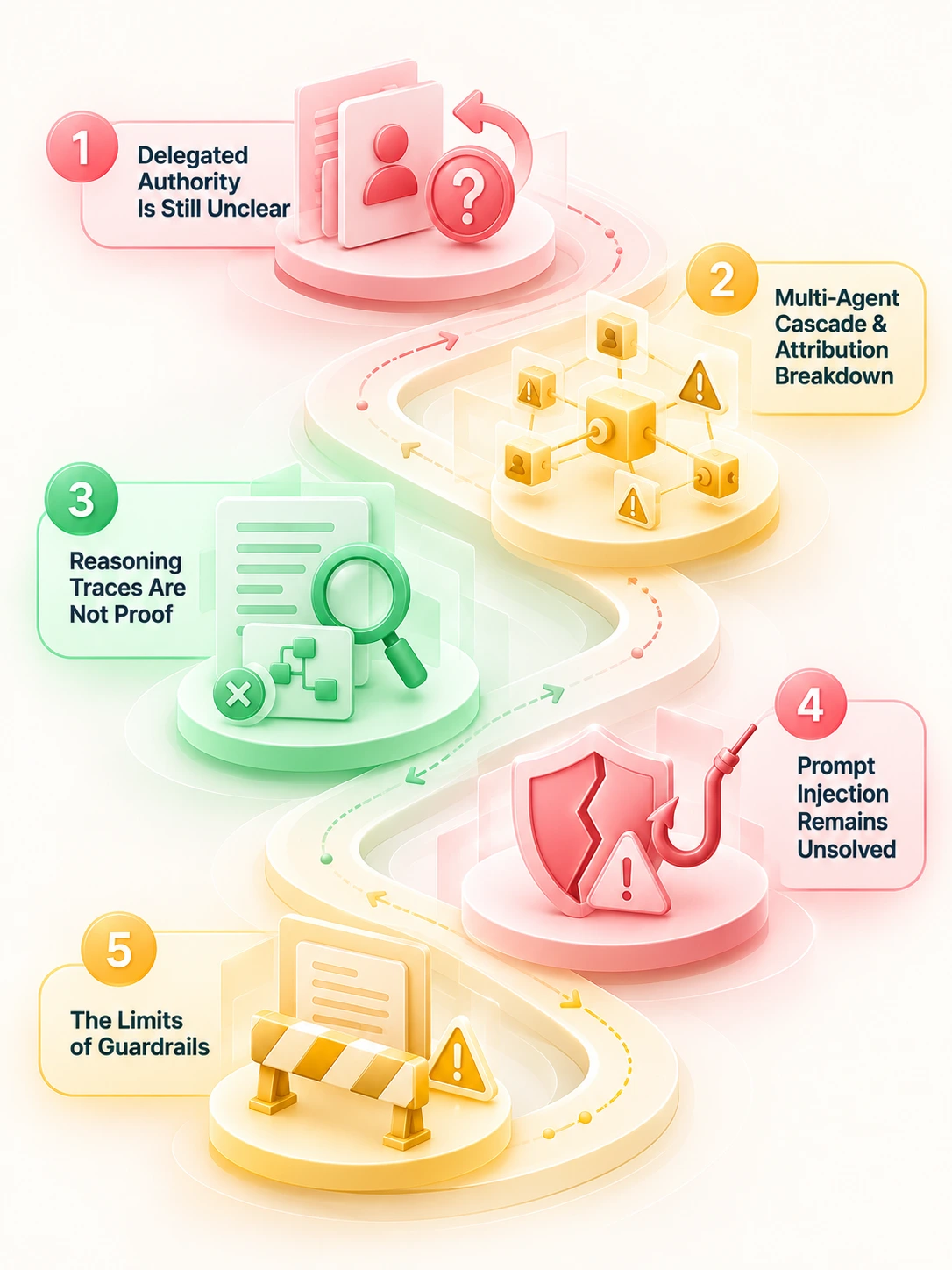
There is no settled industry answer on whether an agent should act as its own identity or act on behalf of a user. Both models create permission challenges. AI agent access control has to account for what the agent can do independently and what it can do under delegated authority.
When agents delegate tasks to sub-agents, action attribution collapses. Tracking context, permission inheritance, and blast radius across multi-agent handoffs stretches existing AI agent access control architectures to their breaking points.
A reasoning trace can show what an agent reported about its process, but it should not automatically be treated as a reliable explanation of why the system behaved as it did. Using the trace as definitive evidence can create false confidence in an audit trail.
Indirect prompt injection cannot be completely prevented at the model layer. Modern AI security governance must treat injection as an inevitability using strict execution boundaries and structural limits to contain potential damage rather than assuming the input can be perfectly sanitized.
Programmatic constraints cannot eliminate risk. For high-consequence, irreversible actions, the only honest solution today is enforced human approval, not relying on complex AI governance guardrails.
Understanding these limitations allows security architects to build practical AI operational governance frameworks that account for known edge cases while managing autonomous systems safely.
When reviewing client agent architectures, Entrans focuses on practical execution rather than high-level policy. We take a live or pilot agent often evaluated through our Agentic AI Framework Integration and map every tool function it can invoke, evaluating four core criteria:
The output is a control gap list for that agent, a remediation sequence, and a reversibility classification for its action set. This gives AI security governance a practical starting point rather than a broad policy exercise.
Across agent reviews, one recurring observation is a shared service identity. When an agent runs under the application's identity, least-privilege access becomes difficult, and the agent audit trail cannot clearly attribute actions to that agent.
The review uses a forward-deployed engineering model so the controls can be tested in the production workflow, not just documented separately. We work alongside client development teams to remediate these identity gaps, embed real-time AI governance guardrails, and establish sustainable AI operational governance directly in production.
Deploying AI agents doesn't mean choosing between rapid innovation and ironclad security. Learn how we help you scale autonomous systems safely without getting slowed down by administrative friction. Book a consultation call with us.

AI security governance is the set of framework rules, access policies, and guardrails that define how an AI system operates safely within an enterprise environment. On the whole, it covers identity, permissions, action limits, approvals, monitoring, and audit trails.
Conventional models merely generate predictions or text for a human to review, whereas AI agents independently execute multi-step actions across external databases and APIs. That means governance must control not just what the AI says, but what it is allowed to do.
Yes. Giving each agent a distinct identity makes it easier to apply least-privilege access and track its actions. Using a shared application identity can make it difficult to know which agent performed a specific action.
Limit an agent's reach by implementing strict tool allowlists, enforcing parameter-level constraints, setting rate limits, and categorizing actions by their reversibility. Placing hard quantitative caps on transactions and requiring approval for high-risk operations prevents runaway execution.
Prompt injection cannot be completely prevented at the model level; it must be treated as an authorization challenge. Authorization controls can limit what the agent is allowed to access or do if an injection attempt succeeds.
Human approval makes sense for irreversible actions, high-value transactions, new counterparties, or other actions with significant consequences. Placing approval at specific risk points helps avoid approval fatigue while keeping routine tasks autonomous.
An agent audit log should capture the agent identity, trigger, tool calls and parameters, results, state changes, and any human approvals.
No. Questions around delegated authority, multi-agent attribution, reasoning traces, and prompt injection are still developing. For high-consequence irreversible actions, human approval remains an important control while agent governance matures.

-1.svg)