> Blog >
Vector Database Use Cases: 15 Real-World Applications and Examples
Explore 15 vector database use cases, real-world examples, tools, performance results, and practical guidance for choosing the right vector database.

Vector Database Use Cases: 15 Real-World Applications and Examples

4 mins
October 1, 2026
Author
Arunachalam
Talk To Our Experts
TL;DR
  • Vector databases power semantic search by storing embeddings and using ANN indexes like HNSW and IVF to find meaning-based matches across massive datasets.
  • Real-world uses span RAG, AI agent memory, recommendations, visual search, fraud detection, anomaly detection, duplicate detection, and enterprise search.
  • Production results can be significant: examples in the research include sub-20ms retrieval across 400M+ vectors, 12% higher search accuracy, 40% lower costs, and 77–97% lower infrastructure costs.
  • Vector databases aren't always the right choice: exact-match queries, tiny datasets, and heavily transactional workloads may be better served by SQL, keyword search, FAISS, or other existing systems.
  • CustomGPT.ai searches over 400 million vectors in under 20 milliseconds. 

    ZoomInfo cut its search costs by 77-97%. Vanguard raised its search accuracy by more than 12%. These are big wins for teams that build AI products.

    But here’s the catch - Vector search is not the right fit for every job. The wrong setup gives you slow queries, empty results, or a shock bill.

    This guide covers 15 use cases and the companies that run them. You'll also see which tools fit each job and when to skip vectors entirely.

    Table of Contents ▾

      What Is a Vector Database Used For?

      A vector database stores embeddings. An embedding is a list of numbers that captures meaning. An embedding model creates these lists from text, images, or audio. Similar items end up with similar numbers.

      This lets you run vector search by meaning instead of exact words. A search for "red leather jacket" can return a "scarlet biker coat." The words differ, but the meaning matches. This is natural language search at work.

      Here's the hard part. Exact nearest neighbor search compares your query to every stored vector. Each vector may hold 768 or 1,536 numbers. At scale, that is far too slow for a live app.

      So vector databases use approximate nearest neighbor search, or ANN. Two common methods are HNSW graphs and IVF indexes. They skip most of the data and check only the likely matches. You give up a tiny bit of recall. You gain a huge boost in speed.

      Here's how the two database types compare.

      Feature Traditional database Vector database
      Search type Exact match, keywords, BM25 Similarity by meaning
      Example query "SKU-4471" "warm jacket for rain"
      Data stored Rows, columns, text Embeddings of text, images, audio
      Strength Exact, predictable results Bridges vocabulary gaps
      Weak spot Misses synonyms Weak on exact IDs and codes
      Index type B-tree, inverted index HNSW, IVF

      Most teams end up using both types. The vector database handles meaning. The traditional database handles facts, orders, and payments.

      Vector Database Use Cases by Business Area

      Most teams start in one of four areas. Each area solves a different problem. The 15 use cases below are grouped by who benefits. Many rely on semantic search, document retrieval, and hybrid search. Some add personalization.
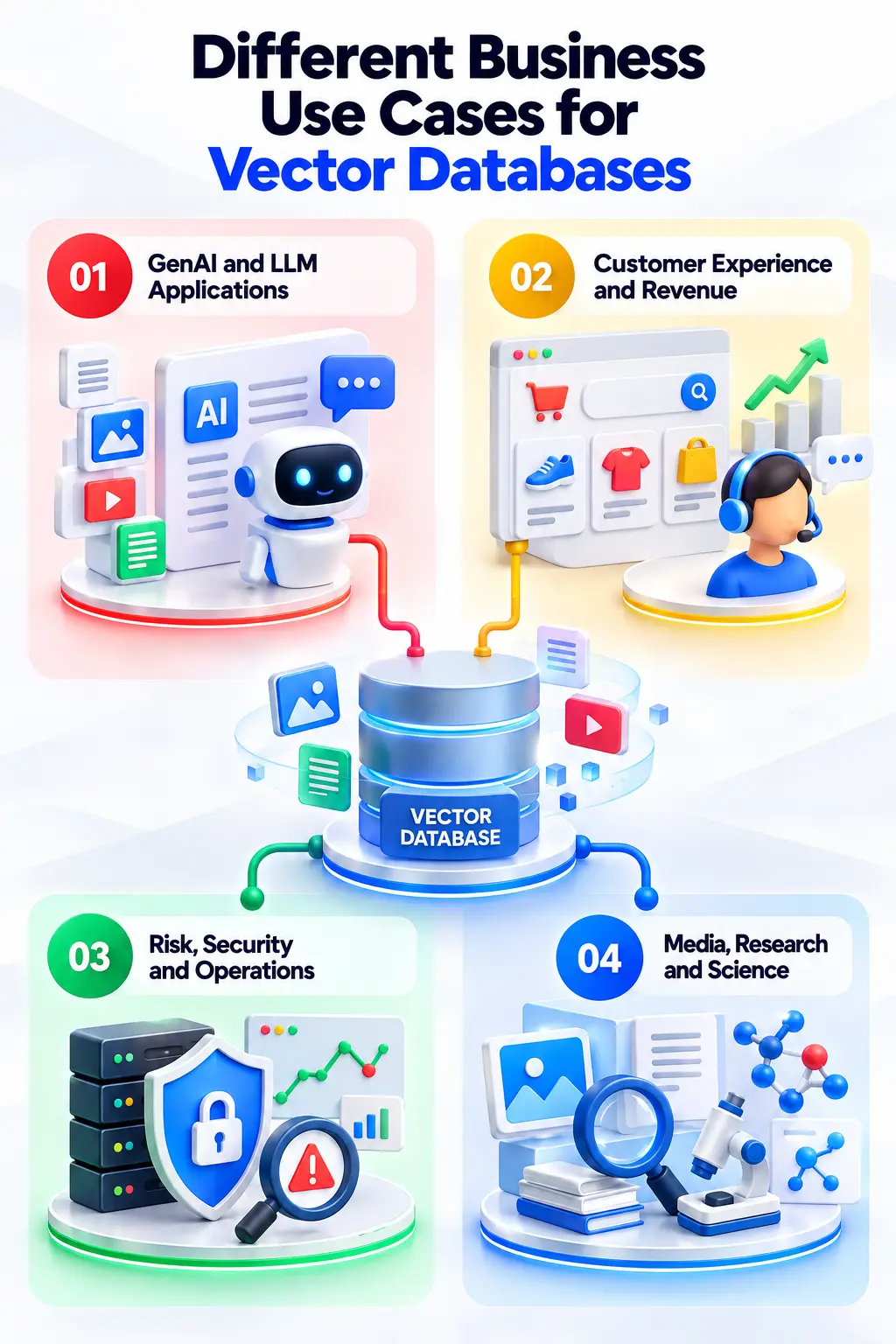
      Vector database use cases by business area

      1. GenAI and LLM Applications

      These are vector database use cases where growth is fastest. The goal is to ground a model in your own data. The database finds the right context. The model then writes the answer.

      1. Retrieval-augmented generation (RAG): The database returns relevant documents. The model answers from them. That cuts hallucinations. Delphi and CustomGPT.ai run on this pattern.
      2. AI agent memory: Agents need long-term AI memory to recall past chats. Weaviate's Engram handles memory in the background. Replies stay fast.
      3. Question answering: Staff ask in plain English. The system finds the right passage in the knowledge base. Vanguard's Agent Assist works this way.

      2. Customer Experience and Revenue

      Here, vector search ties to sales and support costs. Shoppers don't know your catalog terms. Vector search reads their intent instead.

      1. Semantic site search: Shoppers find products without exact keywords. Fewer searches end in dead ends.
      2. Recommendation systems: Milvus supports multi-vector search and reranking. Teams pull candidates fast. Then a heavier model ranks them.
      3. Support ticket matching: New tickets match past fixes. Sprinklr uses this to help its support agents.
      4. Personalization: Delphi's agents answer from a creator's own articles, podcasts, and courses.
      5. Billion-scale B2B search: ZoomInfo searches over a billion vectors of company data.

      4. Risk, Security and Operations

      Here, the goal of these vector database use cases is to spot what doesn't belong. Teams embed events. Then they look for outliers with nearest neighbor search.

      1. Fraud detection: Rule-based checks are slow and flag too many good users. Vector search can catch new fraud patterns that rules miss.
      2. Anomaly detection: Embed logs, transactions, or network events. An event far from the normal clusters gets flagged.
      3. Duplicate detection: Similarity search finds near-copies of records, even when the wording differs.

      4. Media, Research and Science

      A regular database can't read an image. One major vector database use case is that a vector database can compare one image to millions of others.

      1. Visual product search: Nyris lets users find industrial spare parts by photo.
      2. Multimodal search: Users search with images, text, or both in one system.
      3. Scientific literature retrieval: Bayer runs searches over 135 million points of research and enterprise documents.
      4. Molecular similarity search: Teams match chemical structures to speed up drug discovery.

      Vector Database Use Cases by Industry

      Every industry has its own limits. Banks worry about compliance. Retailers worry about speed. SaaS firms worry about serving many tenants at once.

      The table below maps the top vector database use cases to each industry, along with what gets embedded and what gets in the way.

      Industry Top use cases What gets embedded Key constraint KPI
      SaaS and AI RAG, agent memory, knowledge retrieval Company documents, podcast transcripts Tenant isolation, bursty traffic 100ms P95 on 100M+ vectors (Delphi)
      Financial services Support search, fraud detection Regulatory documents, transaction logs Strict compliance filters 12% better accuracy (Vanguard)
      Telecom Service retrieval, chatbot knowledge Call logs, help articles, manuals Many users at once, high uptime 92% rise in engaged customers ([Chunghwa Telecom)](https://www.mongodb.com/blog/post/chunghwa-telecom-reinvents-customer-service-atlas-performance-soars-cn)
      Retail and e-commerce Visual search, recommendations Product images, descriptions High traffic, exact filters like stock status Sub-second visual search (Nyris)
      B2B data Billion-scale enterprise search Lead data, company profiles Usage-based pricing at steady traffic 77-97% lower cost (ZoomInfo)
      Customer experience Ticket similarity, conversation analysis Support cases, chats, emails Live ingestion, low tail latency 250 RPS at 20ms P99 (Sprinklr)
      Life sciences Literature retrieval, molecular similarity Research papers, chemical structures Huge collections across nodes 135M points queried (Bayer)
      Gaming State management, player analysis Player states, inventory, game logs Fast reads and writes, changing schemas Live QPS visibility (NetEase Games)

      Look at the constraint column first. In vector database use cases, this tells the real story. Most pain comes from filtering, tenancy, and cost. The search idea itself rarely fails. That's why one tool can win in one industry and struggle in another.

      Also note the KPI column. Each number comes from a company or a vendor. Treat them as signals, not guarantees. Your data and your hardware will change the result.

      Real-World Vector Database Examples

      These vector database use cases or deployments cover RAG, semantic search, and anomaly detection.

      Some also touch recommendations, agent memory, and multimodal search. Every number below comes from the vendor or the company itself.

      Company Use case What is embedded Reported outcome
      CustomGPT.ai RAG for custom agents Customer knowledge bases 400M+ vectors, under 20ms P50, 99.95% uptime
      Delphi Conversational agents Articles, podcasts, course videos 100M+ vectors, 100ms P95
      Vanguard Agent Assist search Regulatory and internal documents 12%+ accuracy gain from hybrid search
      ZoomInfo Billion-scale B2B search Business data 77-97% lower cost, 31ms p50
      GlassDollar Startup sourcing Company profiles 40% lower cost after leaving Elasticsearch
      Dust Multi-tenant AI agents 5,000+ data sources Queries fell from 5-10s to under 1s
      Sprinklr Support case search Customer cases 250 RPS versus 100, 30% lower cost
      Nyris Visual product search Spare part images Sub-second responses
      Bayer Research retrieval Scientific and enterprise documents 135M points, seven collections
      Chunghwa Telecom Customer service chatbot Support interactions 92% rise in engaged customers
      Financial firm (via Weaviate) Fraud and anomaly detection Card activity, travel history, transactions Caught unknown fraud methods in real time
      • Scale is real. CustomGPT.ai and ZoomInfo run at hundreds of millions to billions of vectors.
      • Cost drives many moves. ZoomInfo, GlassDollar, and Sprinklr all led with savings.
      • Read claims closely. Chunghwa's 92% has no stated baseline. Sprinklr's test doesn't list its hardware.
      • Agent memory is newer. Public numbers are rare. Weaviate's Engram is one early sign of where the field is going.

      Vector Database Examples: Which Tool Fits Which Use Case

      When it comes to tools for vector database use cases or examples, the market has three groups. Some tools are managed services. Some are open-source engines.

      Others are older databases with vector indexes added on top. All of them use ANN search. They differ in filtering, hybrid search, memory use, and cost.

      Tool Category Commonly used for Consider when
      Pinecone Managed service RAG and support search You want no ops work
      Weaviate Open-source Agent memory, multi-tenant SaaS Memory is tight
      Qdrant Open-source, Rust Filtered search, multi-tenant RAG Metadata filtering matters most
      Milvus (Zilliz) Open-source, managed cloud Billion-scale search, recommenders You need huge scale and reranking
      pgvector Postgres extension Small to mid RAG You run Postgres and want SQL joins
      Elasticsearch Search engine Text-heavy hybrid search You need BM25 and vectors together
      MongoDB Atlas Vector Search Document database Fast-changing apps like games You want no sync pipeline
      Chroma Lightweight open-source Prototypes, small RAG You want a quick start

      A few select tools for vector database use cases can tip the choice.

      • Pinecone: It splits compute from storage, so bursty traffic stays cheap. For steady heavy traffic, Dedicated Read Nodes swap per-query fees for fixed hourly cost. ZoomInfo saw 31ms p50 latency this way.
      • Qdrant: Its scalar quantization keeps vectors in memory. That turned multi-second queries into sub-second ones for Dust. Its FineWeb-10B benchmark hit 90% recall@10 at billion scale.
      • Weaviate: Binary quantization cuts memory by 32x. Its ACORN strategy speeds up filtered search.
      • Elasticsearch: Version 8.16 added a compression method that cut RAM use by 95%. Recall stayed above 90%.
      • Milvus: Zilliz Cloud offers a fast tier serving 1,000+ QPS from memory. A cheaper tier handles batch work.

      Do You Need a Dedicated Vector Database? A Decision Framework

      To implement, vector database use cases don't start with the tool. Start with the workload. Six factors decide most cases. Score your project on each one, then read across the row.

      Factor Existing database is enough Go dedicated
      Vector count and growth Under 1-5 million vectors Above 5 million, or growing fast
      Latency and concurrency target Low traffic, relaxed targets Sub-100ms with many users
      Hybrid search and metadata filtering Simple filters Strict filters on large data
      Multi-tenancy and access control A few tenants Thousands of tenants
      Existing stack and team skills Team knows Postgres or Elasticsearch Team can run a new system, or buy managed
      Cost and ops overhead One system to run More systems, less index tuning

      Here's a simple rule. Are you under a few million vectors, and already on Postgres? Start with pgvector.

      One Hacker News developer called it a "great YAGNI solution" for 100,000 vectors. Data locality is the big win. One SQL query can join business data with vector similarity inside a single ACID transaction.

      Timescale's pgvectorscale stretches that range further. It searches vectors straight from SSDs, which eases memory limits.

      Past that range, dedicated engines pull ahead. Qdrant and Pinecone handle updates without locking reads. They also isolate tenants more cleanly. And they spare you from tuning memory. In pgvector, building an index for millions of vectors needs a large maintenance_work_mem setting. If memory runs short, the build can take hours or fail.
      Open Popup

      When a Vector Database Is the Wrong Tool

      Vector search finds similar things. It does not find exact things. That gap tells you when to skip it. Here are four cases where a simpler tool wins.

      1. You need exact matches. Embeddings blur fine details into one pooled set of numbers. That hurts when you must find an exact SKU, patient ID, or error code. A BM25 index or a relational query is faster and more precise. One practitioner put it plainly: "Just do a keyword deterministic retrieval instead."
      2. Your data changes all the time. HNSW graphs are costly to update. Heavy inserts, updates, and deletes can fragment memory. In pgvector, they can also leave dead tuples in the graph. Recall then drops until you run maintenance. Busy transactional systems are a poor match.
      3. Your dataset is tiny. Under 100,000 documents, a full vector database is overkill. Many teams load raw vectors into memory with FAISS or NumPy. A brute-force scan still returns results in milliseconds. You skip the ANN index and the extra service.
      4. Your current index already works. If pgvector meets your recall and latency goals, stay put. Moving to a new system adds cost and risk. Wait for real strain before you switch.

      When in doubt, test the simple option first. A keyword index or a SQL query costs less to run. If it hits your targets, stop there.

      Vector Database Challenges, Governance and Cost

      Demos hide problems that production exposes. Most of them trace back to memory, filtering, and cost. Here's what to watch for.
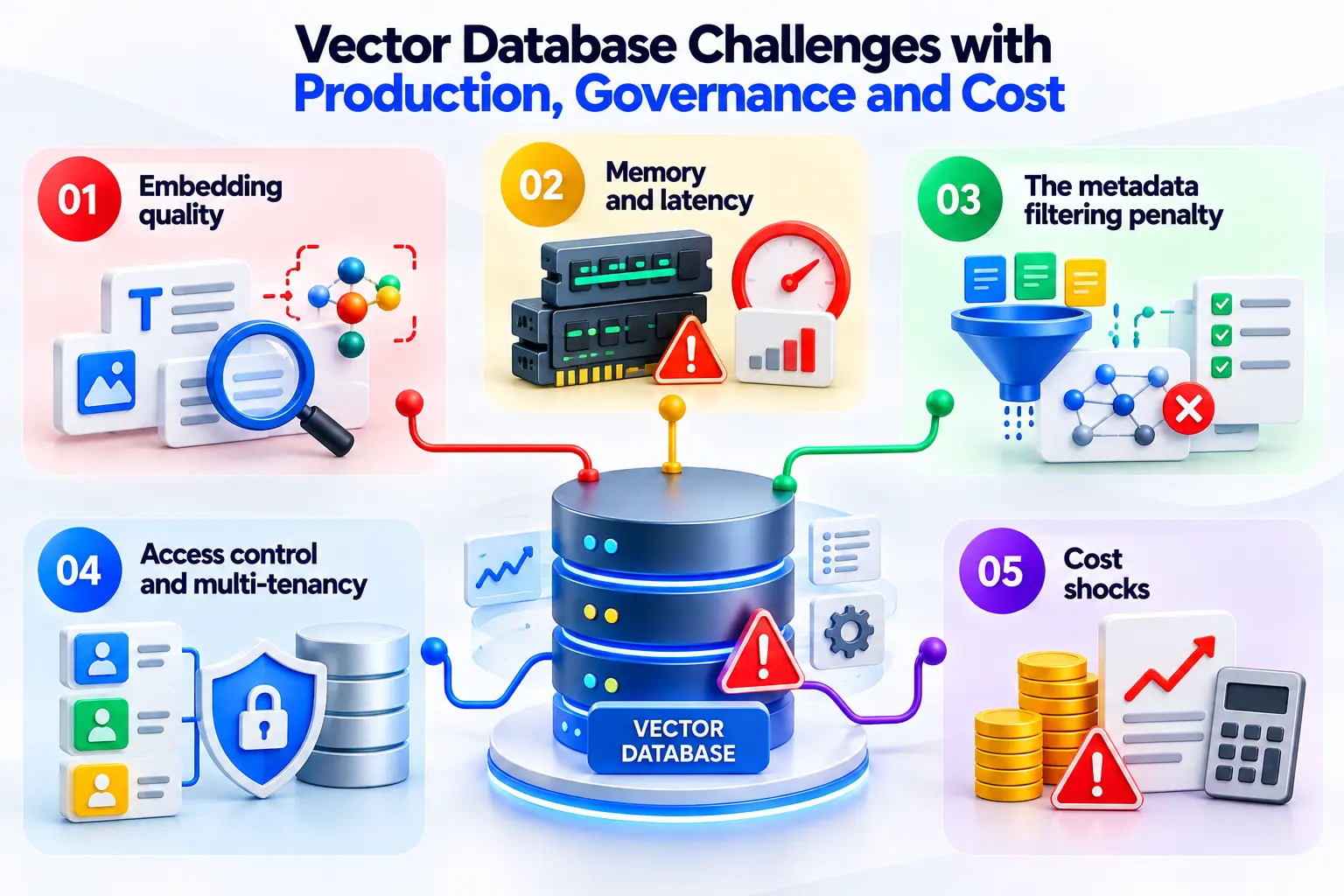
      Vector database challenges, governance, and cost

      Technical challenges

      1. Embedding quality

      Embeddings average out fine details. Chunk size and formatting also change your similarity scores. One practitioner noted that plain English alone can produce a 40% cosine match.

      So test your embeddings on real user queries. Then add hybrid search for exact terms. Vanguard's hybrid setup beat dense retrieval by over 12%.

      2. Memory and latency

      HNSW is fast only when its graph fits in RAM. One developer indexed 20 million vectors of 1,200 dimensions.

      The index grew to about 89 GiB. It overflowed the cache, and queries took 30 seconds. Quantization is the usual fix. Weaviate's binary quantization shrinks memory by 32x.

      3. The metadata filtering penalty

      Filters clash with graph search. Pre-filtering breaks the links in the graph. Post-filtering can throw away every result.

      One pgvector user raised scan settings to recover recall. But query time rose from 229ms to over 3 seconds. Weaviate's ACORN strategy was built to ease this problem.

      Governance and cost

      4. Access control and multi-tenancy

      Giving each tenant its own graph wastes memory on idle indexes. Putting all tenants in one graph needs filters, which slow queries.

      Row-level security in Postgres can add more drag. Dedicated engines isolate tenants natively. Dust moved to shared collections in Qdrant. Its query times fell from 5-10 seconds to under 1 second.

      5. Cost shocks

      Usage-based pricing can surprise you. One older Reddit thread described a $123 bill on a $70 plan. The index held 3,000 products, and the user ran nine test queries.

      At steady high traffic, ZoomInfo moved to fixed hourly nodes and saved 77-97%. Also budget for people. Tuning memory and running VACUUM in Postgres takes real engineering time.

      How to Prioritize Vector Database Use Cases

      Every vector project trades accuracy, latency, and cost. You can't max out all three. Some tools let you tune the trade-off per query.

      Weaviate's effort setting is one example. On hard, multi-step questions, more effort gave up to 7x better accuracy. The price was extra delay and extra tokens.

      Use these six checks to rank your vector database use case:

      1. Search intent: Does matching meaning lead to sales? Semantic site search often does. Shoppers who find the right product are more likely to buy it.
      2. Retrieval quality: Can you measure it? Set a baseline before you build. Vendor claims often skip this, so you can't check their math.
      3. Labor saved: Vanguard's Agent Assist helps reps answer calls faster. Anything that cuts handling time has a clear payoff.
      4. Personalization value: Delphi's agents answer from one creator's own content. That makes each agent hard to copy.
      5. Data volume: Past 1-5 million vectors, simple in-memory tools strain. Dedicated engines start to earn their cost.
      6. Latency and KPI impact: Tie each use case to one number. GenAI chat needs sub-100ms retrieval to feel fluid. Pick the case with the clearest win.

      Start with one use case. Prove it against your baseline. Then expand to the next.

      How Entrans Helps You Put Vector Search Into Production

      Going from demo to production takes more than a database - You need clean vector embeddings and tuned semantic search.

      You need a RAG pipeline that stays accurate over time. You also need hybrid search for exact terms and enterprise search that respects access rules.

      Entrans Technologies brings AI-first engineering to each step. Our clients include Fortune 100 retailers. Our own enterprise AI solution is ISO 42001 certified.

      Want to see how we can build the vector database use cases you want to try out?

      Book a free consultation call!

      Share :
      Link copied to clipboard !!
      Put Vector Database Use Cases Into Production
      Build production-ready vector search, RAG, and retrieval systems around your data and business needs.
      20+ Years of Industry Experience
      500+ Successful Projects
      50+ Global Clients including Fortune 500s
      100% On-Time Delivery
      Thank you! Your submission has been received!
      Oops! Something went wrong while submitting the form.

      FAQs

      1. What Is a Vector Database Used For?

      It powers search by meaning. Common vector database use cases include RAG, semantic search, and recommendations. It also supports AI agent memory, anomaly detection, and multimodal search. The database stores embeddings and finds the closest matches fast, even across millions of records.

      2. What Is an Example of a Vector Database?

      Pinecone, Weaviate, Milvus, Qdrant, and Chroma are purpose-built options. Others add vector search to existing systems. These include pgvector, MongoDB Atlas Vector Search, and Elasticsearch. Delphi and CustomGPT.ai both use Pinecone. Dust and Sprinklr use Qdrant.

      3. What Are the Top Vector Databases?

      There's no single winner. Pinecone is fully managed. Weaviate offers strong compression and filtering. Qdrant is known for payload filtering. Milvus targets billion-scale search. Compare them on ANN speed, HNSW memory use, hybrid search, metadata filtering, and deployment model.

      4. Are Vector Databases Still Relevant?

      Yes. RAG and AI agents both need fast retrieval by meaning. Postgres and Elasticsearch now offer vector search too. So a separate product isn't always required. But the retrieval role stays vital in modern AI architectures.

      5. Is SQL a Vector Database?

      No. SQL is a query language, and relational databases store rows. The pgvector extension adds vector types and indexes to PostgreSQL. That gives you similarity search inside a familiar database. It is a vector capability, not a dedicated vector database.

      6. Can a Vector Database Replace a Traditional Database?

      Rarely. Vector databases suit similarity search. They struggle with heavy transactions and exact lookups. Most teams pair the two. The relational store keeps the facts. The vector store handles meaning. Metadata filtering links the two sides.

      7. Do I Need a Vector Database for RAG?

      Not always. Under 100,000 documents, FAISS or NumPy can do the job. Up to a few million vectors, pgvector often works. Keyword search can also serve RAG. Past that size, or with many tenants, go dedicated.

      8. What Is the Difference Between a Vector Index and a Vector Database?

      A vector index is the structure that speeds up ANN search. HNSW and IVF are examples. A vector database wraps that index with storage, metadata, filtering, updates, and access control. It also manages the whole system for you.

      Hire Vector Database Developers
      Build scalable vector search, RAG, semantic search, and AI retrieval systems with experienced engineers.
      Free Project Consultation
      Trusted by Enterprises & Startups
      Top 1% Industry Experts
      Flexible Contracts & Transparent Pricing
      50+ Successful Enterprise Deployments
      Arunachalam
      Author
      Arun S is co-founder and CIO of Entrans, with over 20 years of experience in IT innovation. He holds deep expertise in Agile/Scrum, product strategy, large-scale project delivery, and mobile applications. Arun has championed technical delivery for 100+ clients, delivered over 100 mobile apps, and mentored large, successful teams.

      Related Blogs

      Vector Database Use Cases: 15 Real-World Applications and Examples

      Explore 15 vector database use cases, real-world examples, tools, performance results, and practical guidance for choosing the right vector database.
      Read More ↗

      AI Automation Examples: 25 Real-World Use Cases Across the Enterprise (With Results)

      Explore 25 enterprise AI automation examples across 9 functions with real performance results, 3 end-to-end workflow breakdowns, and a quick-win framework.
      Read More ↗

      Top 10 AI Governance Consulting Firms in 2026

      Discover the top 10 AI governance consulting firms in 2026, along with their services, costs, and expertise to assist you in selecting the right one.
      Read More ↗