Learn how a healthcare data warehouse works, its architecture, top data models, vendors, HIPAA rules, and real build costs to unify patient and billing data.

Agentic Unconference 2026 - September 19, Chennai
View Event →





Isn't it great if all the information that one needs on patients, services provided to them, costs incurred, and performance measures can be viewed at a glance? That is exactly what the idea of a healthcare data warehouse is all about.
A healthcare data warehouse collects all sorts of data and provides meaning to it. How is that done? Which type of architecture should be used for this? What would it cost?
This blog post gives the solution to these questions: architecture, data models, vendors, and the cost of implementing a healthcare data warehouse.
A Healthcare Data Warehouse refers to a unified information system in which data is retrieved from various sources within the hospital, including patient records, billing records, and laboratory records. The data is stored in a single database. This data is analyzed through cleaning and processing.
Think about this: the individual makes frequent visits to the hospital. With every visit, new data becomes available:
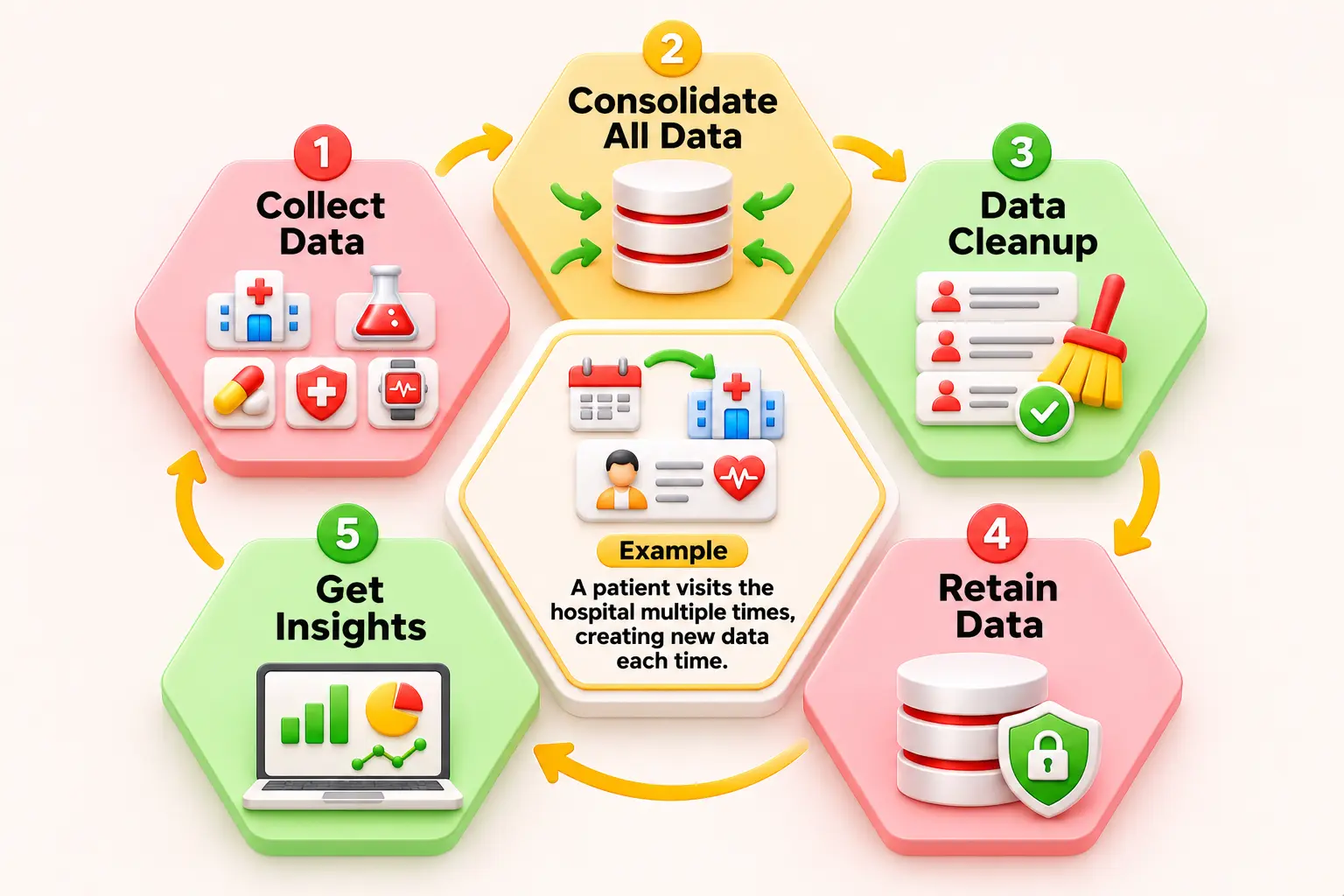
It has been found by organizations that the very process of analyzing the flow of reporting in a healthcare data analytics framework may open up avenues for improvement. This has been found by many data engineers while talking about healthcare SQL and data modeling, as aligning the disjointed patient IDs from old EHR systems is one of the most important parts of analytics.
Let us assume a hospital needs to calculate the number of diabetes patients who have been admitted in the past six months. In the absence of a data warehouse, the hospital staff would have had to manually search for all the information from various hospital files, laboratories, and accounting software.
A healthcare data warehouse can help a hospital make reports such as:
All four store hospital data; they serve completely different parts of a hospital or health system's technology ecosystem.
In short
The design of the effective healthcare data warehouse in the contemporary world should be such that it is able to combine the complexities of the input side of data with the simplicity of the output side of data. The design of an effective healthcare data warehouse is like a pipeline.
There are several layers in a healthcare data warehouse model. Each layer has its own roles to play.
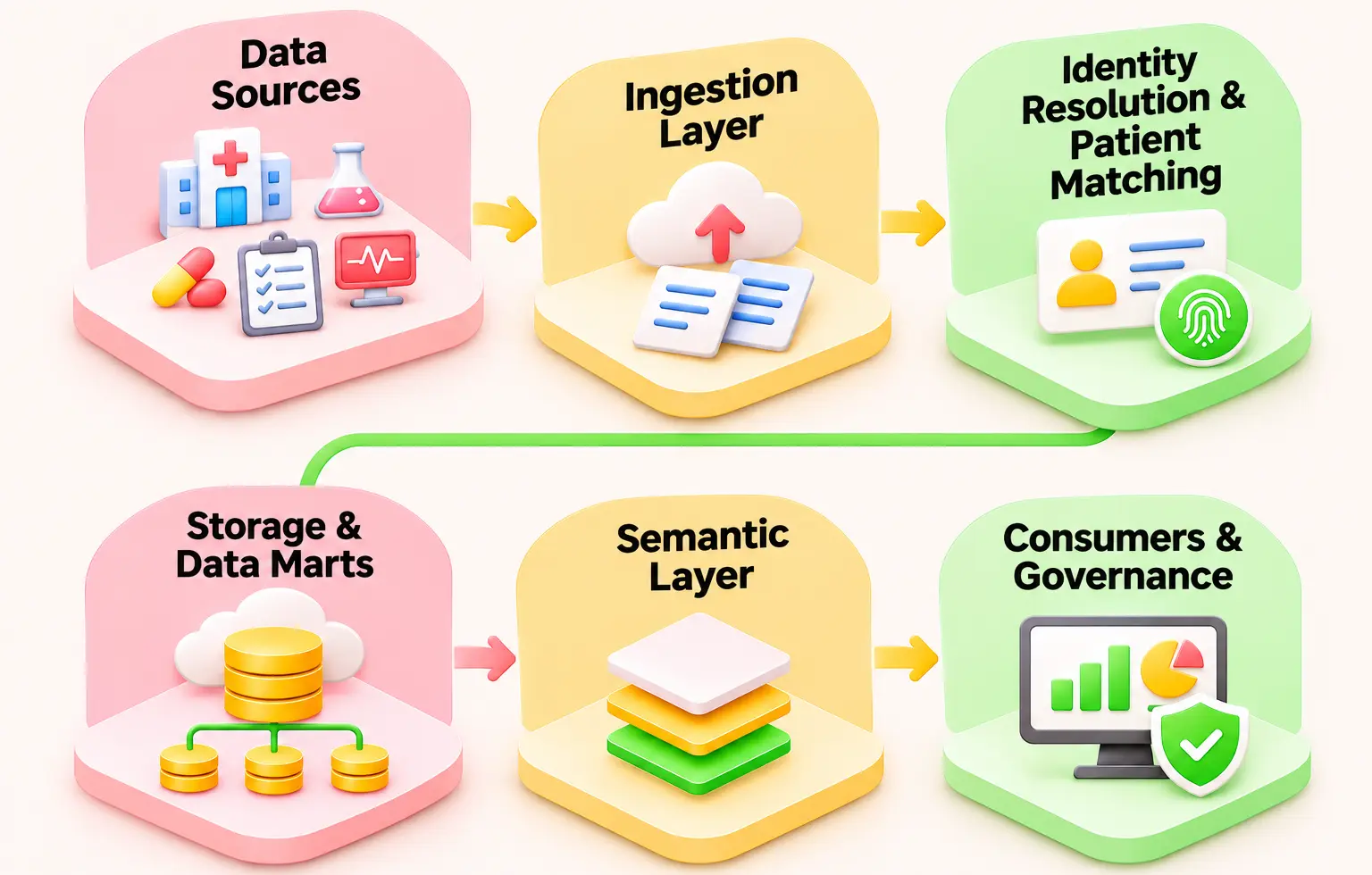
The data is gathered from EHRs, claims management systems, lab feeds, pharmacy systems, ERP systems, medical IoT, and other such systems.
The ingestion layer ingests data from the source using HL7v2 Messaging, FHIR API, Bulk FHIR, flat file, and many others.
The ID of patients differs from system to system. With the help of the MPI (Master Patient Index), we can have patient records related to one person. It is very important not to have any duplicate entries.
This is the storage level, where the data is kept. In this case, there is a clinical data warehouse, which contains information on the patients and their treatment process. Furthermore, there are data marts, which have data for financial purposes, claims, and quality reporting.
It is at this layer that meaning will be derived from the information. For instance, in this case, the organization will derive meaning from the readmission rates, patient volumes, and claim costs.
The data will be useful in the dashboards and in the AI models, while governance will take care of matters of privacy and compliance.
In this case, if everything is favorable, then the healthcare data warehouse will turn all the collected data into the energy of the entire healthcare process cycle. The moment you want to streamline your process pipeline, you need to look at data engineering.
There will be a need for an effective data model that will be able to cater to the needs of that specific data warehouse. This model will be extremely vital in deciding how the team will handle data storage, its relationships with each other, reporting, and future projects.
Below is a table comparison of the five most common models within health care data warehouses.
As part of multi-center research, the OHDSI OMOP Common Data Model performs over 3,500 automated checks to maintain consistency in the use of medical vocabulary.
In order to develop a healthcare data warehouse that will work properly, it will be necessary to develop ingestion pipelines that know how to speak the language of healthcare. If the interoperability rules are not understood, then the pipelines developed will be flaky, and a lot of rework will be required because of regulatory changes.
These standards require more than just basic data transfer processes. A healthcare data warehouse needs to be able to parse HL7 messages, connect to FHIR APIs, match patients, map terminologies, and validate data. In addition, it needs to monitor evolving changes in data and API definitions.
TEFCA provides a national-level standard for the safe exchange of health information. CMS requirements apply to particular payers and providers, and therefore you need to find out which requirements apply to your organization. Adopting cloud-native FHIR for healthcare interoperability illustrates how cross-system data exchange can be improved across modern hospital environments.
A healthcare data warehouse stores sensitive patient and business information. Between 2009 and 2026, more than 7,670 large healthcare data breaches were logged on the HHS Office for Civil Rights Breach Portal, underscoring why strict security and privacy controls must be built in from day one. Use this checklist when planning a data warehouse in healthcare.
By following all these controls, patient privacy and HIPAA compliance can be achieved in a healthcare data warehouse.
The ability to store and report data is essential in a cost-effective healthcare data warehouse, but apart from that, it needs to be able to handle sensitive patient data, integration into the clinical system, and reporting. Think about the characteristics that will solve current needs and will be scalable.
However, not all projects require all these capabilities from the very beginning. The initial step is to determine the data sources, target users, reporting needs, and compliance. The next step is to verify the support provided by each platform for the selected healthcare data warehouse model.
The challenge lies in striking a balance between pre-packaged healthcare intelligence and infrastructure flexibility. The market largely breaks up into two camps:
Many organizations utilize hyperscale cloud foundations while building or licensing healthcare-native semantic layers on top to get the best of both worlds.
The cost of a healthcare data warehouse depends on the number of data sources, data volume, security needs, integrations, and reporting requirements. It is easier and faster to build a data mart in a particular department than it is to implement an EDW in healthcare enterprises. You need to include data migration, testing, governance, cloud, and maintenance costs in your budget as well.
Your actual timeline will stretch or shrink based on how clean your source data is. Getting your clinical data storage right from day one prevents costly rework later.
Building a successful healthcare data warehouse requires a disciplined, phased rollout. Jumping straight into massive data migrations without a clear plan is the fastest way to blow your budget and alienate your clinicians.
Here is a practical, step-by-step roadmap to guide your journey from whiteboard to production:
Before developing solutions, state what you want to achieve with your project. Are you addressing issues that arise during your organization’s revenue cycle? Is it a problem related to patient population health reporting?
List all source systems such as EHRs, billing, labs, and pharmacy. Develop your Master Patient Index (MPI) approach early to understand how you will link patients from different sources.
Select the basis. Whether you go with a Kimball star schema approach or a flexible healthcare data warehouse approach, make sure that your ingestion pipelines can process HL7 feeds and FHIR APIs.
Start small with a high-impact, low-risk project such as automated quality reporting or basic readmission analytics. Prove value quickly to secure buy-in.
After you launch your MVP, gradually add the rest of the data sources, create your semantic layer, and give secure access to the larger BI and AI teams.
Steady-state operations transition. Continuously monitor your healthcare data storage pipelines, adhere to HIPAA compliance, and audit permissions to ensure patient information remains protected.
Taking a measured approach ensures your healthcare data warehousing initiative delivers real clinical value without overwhelming your engineering team.
A healthcare data warehouse is not always the right starting point. Some healthcare organizations will be able to fulfill their reporting and analytics requirements using systems they currently have in place. Think about using these less robust solutions first.
A healthcare data warehouse can be used in an AI project if it contains reliable data. In applying clinical data to AI applications, you may want to take into account the following points:
Before scaling these models, infrastructure gaps and data maturity can be addressed through an AI readiness assessment tailored to your organization's capabilities.
Building a reliable healthcare data warehouse requires deep clinical domain knowledge alongside modern cloud engineering. At Entrans, we take a security-first, incremental approach to turning fragmented hospital systems into unified, AI-ready healthcare data storage.
The above case studies show how Entrans is working on designing healthcare data platforms to cater to various analytics and AI applications.
Ready to build healthcare data platforms that are ready for today's needs and tomorrow's AI opportunities. Book a consultation call with us to know more about.

A healthcare data warehouse is a central, governed store that combines clinical, financial, and operational data from EHRs, claims, labs, pharmacy, and other systems, so organizations can analyze quality, cost, and outcomes across patients and time without slowing operational systems.
EHR stores information about patients on an individual basis, including their diagnosis, prescriptions, tests conducted, and medical history. A healthcare data warehouse combines the data of several systems into one place.
A clinical data warehouse is used for storing and analyzing data associated with patient care information, such as lab reports and diagnoses. An enterprise data warehouse involves all types of data – clinical, finance, operations, and administrative – in the health care setting.
Yes, if your hospital uses only one vendor and has simple reporting needs. But an enterprise data warehouse healthcare setup is necessary once you need to combine data from multiple hospital systems.
A small data mart for a department will require 2 to 4 months, whereas a medium-sized one will require 5 to 9 months. An enterprise healthcare data warehouse will require 9 to 18 months or even more.
HIPAA-compliant cloud services from AWS, Microsoft Azure, and Google Cloud are available when properly configured. However, HIPAA compliance will also depend on a BAA agreement, access control, encryption, and how you handle your healthcare data.
Yes. Legacy data warehousing systems may be moved to cloud/lakehouse platforms, including Snowflake, Databricks, and Microsoft Fabric. It is an approach that may increase the efficiency of data accessibility, performance, scalability, and AI-based analysis of the data.