Learn how industry rules reshape your AI readiness assessment for healthcare data systems, banking, and manufacturing, from risk factors to scoring models.

Agentic Unconference 2026 - September 19, Chennai
View Event →


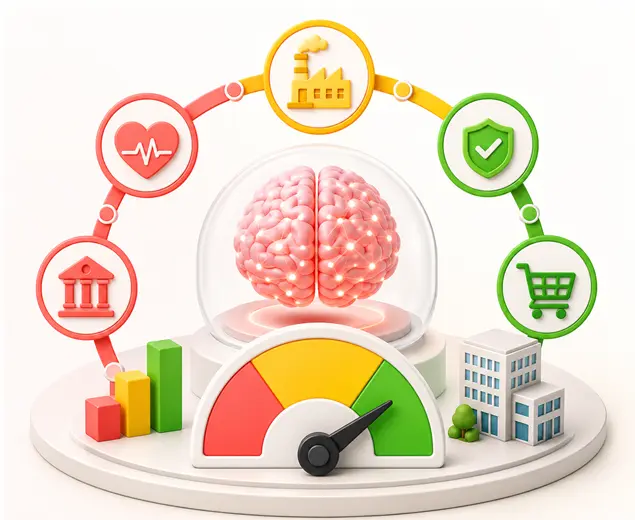


Do you wonder why AI models with 98% accuracy in the sandbox consistently fail when deployed in live business operations? The exact answer is the hidden friction of industry context. Doing a generic assessment for each enterprise won’t work, as it varies widely by sector.
Whether configuring an AI readiness assessment for healthcare data systems bound by stringent HIPAA standards or conducting an AI readiness assessment for financial services under strict SR 11-7 model risk rules, sector constraints completely rewrite the rules of evaluation.
In this blog, we will see how sector-specific constraints fundamentally change the final score.
AI readiness varies by industry. So we need to look into what the enterprise is prepared for, and within what constraints.
An industry-based AI readiness evaluation framework utilizes the very same key factors as any other, including strategy, data, infrastructure, governance, security, talent, and operating models. Still, it modifies the weights, standards, and regulatory requirements based on the actual production risks of each industry. Organizations seeking step-by-step guidance can explore an AI readiness assessment guide to structure their initial evaluation.
As the major constraint preventing production implementation varies across industries, industry-based evaluations focus on unique industry challenges to establish true maturity levels.
The dimensions do not change; the weights and the evidence bar do. Understanding these structural shifts can be helped by reviewing an AI readiness assessment framework comparison across major industries.
Across all sectors, the assessment framework stays consistent. What changes is where the scoring pressure sits and what evidence is required to move a workload from pilot to production. Large organizations navigating these complex environments can be improved by establishing a formal enterprise AI readiness assessment strategy.
Assessing healthcare AI readiness does not depend on the functionality of the algorithm. What makes things challenging is the readiness of data, processes, privacy, validation, and accountability around the algorithm for it to function safely in reality. This is where healthcare scoring starts to differ from a generic AI readiness assessment.
We need to address the line between administrative operations and direct patient care.
This distinction should shape the assessment from the start. When Entrans transformed revenue cycle management (RCM) for a leading healthcare network, the team prioritized administrative readiness: automated claim extraction, payer-rule verification, and zero-trust HIPAA compliance. By automating pre-authorization check loops and claim reconciliation within existing billing systems, Entrans cut claim denial rates significantly without triggering clinical compliance delays—demonstrating how tailored administrative readiness delivers immediate operational impact.
The main pillars of healthcare AI readiness are described below.
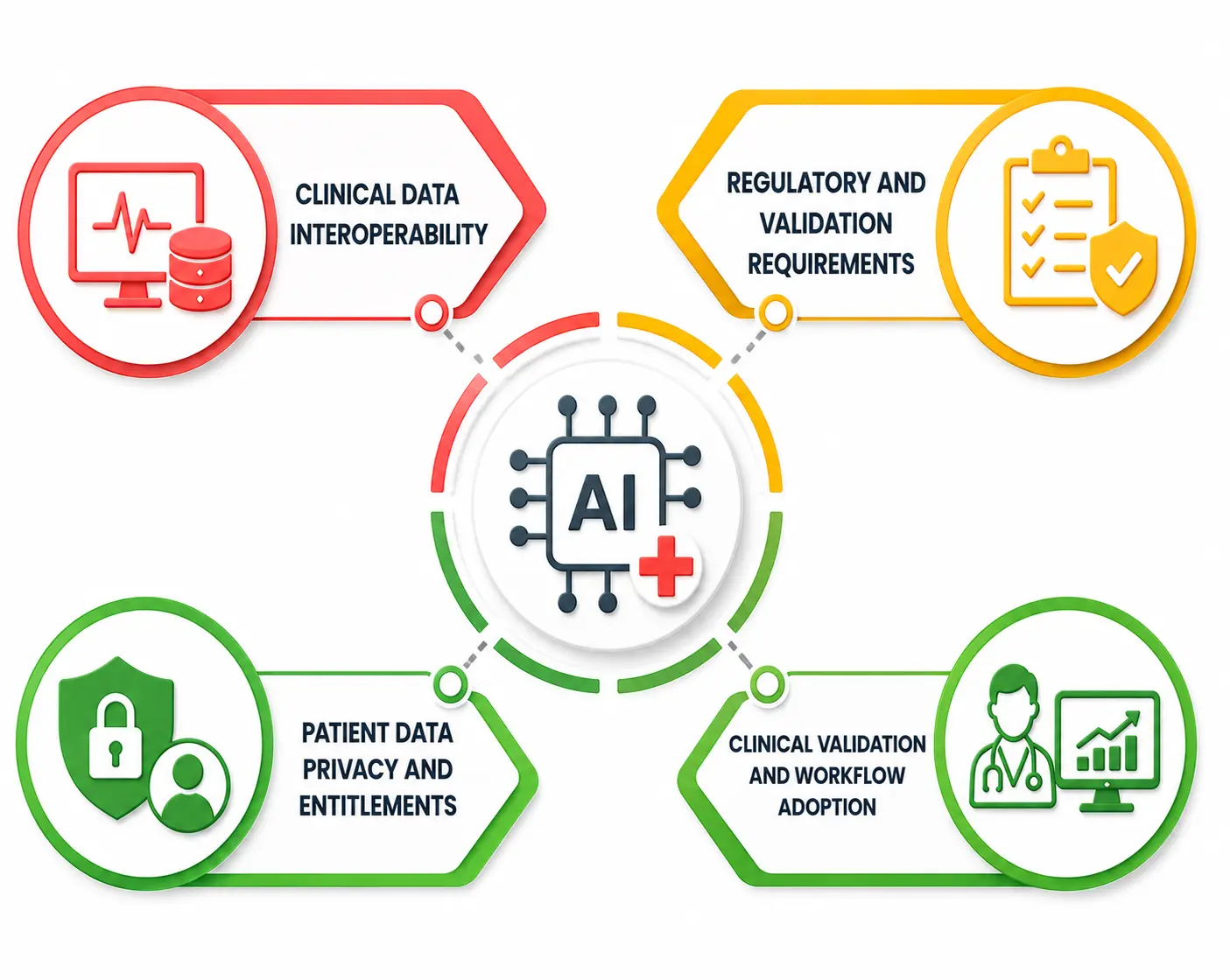
Clinical AI requires a much higher evidence bar. The assessment needs to consider clinical oversight, validation, intended use, monitoring, and potential medical-device implications before development moves too far ahead.
Data may be sitting in an EHR and do not necessarily constitute usable data for the purposes of an AI application. It would be advisable to evaluate the HL7/FHIR capability, EHR integration level, data consistency, and amount of work needed to compile data for particular applications. Overall model accuracy can be improved by conducting a rigorous AI data readiness assessment before feeding unstructured records into pipelines.
One such approach could simply be: How much data can be gathered using current interfaces, and how much needs to be manually matched and extracted?
In certain cases, some of the uses of AI in healthcare may be considered medical devices, depending on the use and the function they perform. This is why classification is an early consideration, not a decision that can be made after developing the technology.
One should determine whether a use case qualifies as Software as a Medical Device (SaMD) or dynamic clinical decision support. There is also the need for clinical AI to have oversight throughout its lifecycle. Navigating these complex requirements can be helped by working alongside dedicated AI readiness assessment consulting firms during the planning phase.
Healthcare data brings with it a set of challenges including HIPAA compliance, minimum necessary access, de-identification, and third-party data handling. On top of that, using AI technology presents yet another challenge in terms of ensuring proper permissions during data retrieval, processing, and movement within the system. System integrity can be improved by embedding robust cybersecurity and compliance controls into the underlying data access architecture.
Ensure zero-trust access control, minimum necessary data exposure under HIPAA, good de-identification pipelines, and clear BAAs with the model providers.
High statistical accuracy in isolation guarantees nothing. Clinician trust, contextual explanation, and frictionless EHR embedding dictate actual usage.
Accuracy is not sufficient for an AI tool to be considered clinical-ready. A technically excellent tool might ultimately prove ineffective if clinicians are unable to trust it or its outputs, or find its outputs challenging to integrate into workflows.
To achieve readiness, one should consider having a prospective validation plan, metrics, workflow, and clinical owner(s). This is to ensure that not only the technical performance of the tool is understood but also whether the outputs are usable.
An AI readiness assessment for a financial services audit faces a unique paradox. The risk landscape of banking AI preparedness is unique compared to other industries. Even when a model does well during its testing phase, there may be serious concerns regarding the explainability, fairness, accountability, or regulatory compliance of that particular model. This becomes particularly pertinent as banks transition to generative and agentic systems. In complex financial environments, institutional preparation can be helped by performing a comprehensive Gen AI readiness assessment before deploying large language models.
Traditional Model Risk Management (MRM) frameworks built around supervisory guidelines like SR 11-7 were designed for deterministic, mathematically predictable models used in credit underwriting, AML monitoring, and stress testing.
The main pillars of financial services AI readiness are described below.
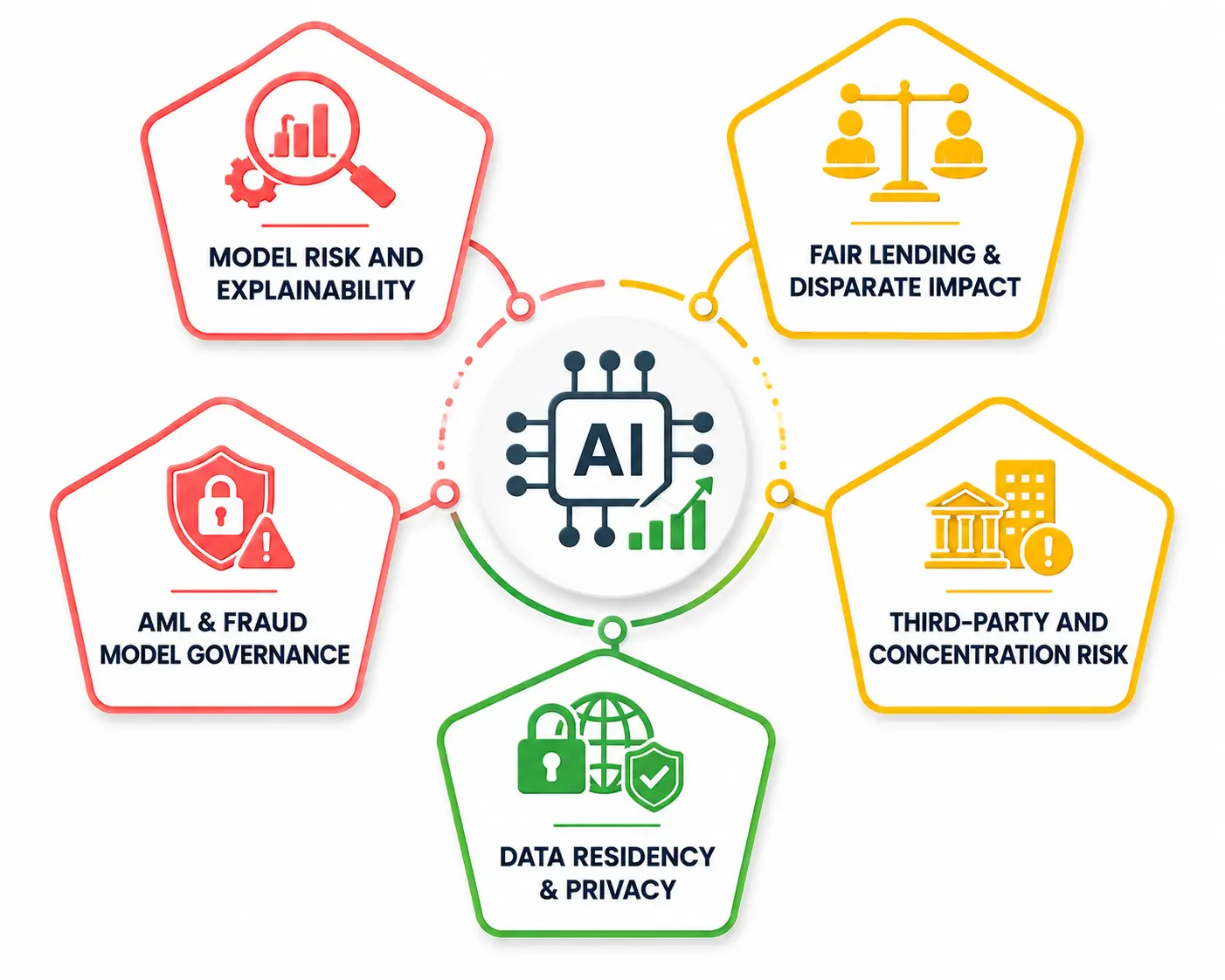
It is vital that financial organizations implement effective model risk management at each stage of the AI process. Where lending is concerned, explainability becomes crucial because of the need for adverse action explanations.
AI models used in underwriting or fraud scoring must undergo continuous testing to detect unintended proxy variables that trigger disparate impact across protected classes.
However, there are separate governance requirements for AML models and fraud models, such as validation, monitoring, threshold management, and ownership documentation.
Generative models complicate the matter further since their outcomes may be affected by the environment differently compared to those produced by other kinds of models. Financial data architecture can be improved by building a scalable data lakehouse for banking to centralize telemetric audit trails.
External dependence on foundational models from other vendors poses the risk of vendor consolidation. Evaluations should ensure the viability of model fallback arrangements, data-sharing limits, and systemic risks.
Training pipelines and retrieval systems must ensure that financial telemetry data does not leave jurisdictional borders or become exposed in publicly available LLM training datasets.
To pass a regulatory-grade assessment, financial institutions must provide two non-negotiable proof points:
An AI readiness assessment for manufacturers reveals a distinct operational pattern: It depends on more than having connected machines or a modern cloud platform.
In manufacturing, there is usually good physical process documentation but poor data consolidation. There is usually a very good understanding of how each line, machine, and control process operates, while there may be a lack of consolidation of all the information from the sensors and telemetric data on various PLCs, SCADA, historians, and legacy control systems. Data consolidation can be improved by leveraging enterprise data engineering & advanced analytics solutions to bridge OT and IT systems.
AI readiness should examine sensor data quality, telemetry coverage, legacy system connectivity, and the OT-IT boundary. Teams also need to decide where inference belongs. Cloud inference may suit workloads that can tolerate higher latency, while edge inference can make more sense when decisions must happen within tight plant-floor latency limits.
The evidence threshold is thus to be assessed based on an individual asset rather than the whole plant. The telemetry baseline that each production line or class of assets is expected to have should demonstrate what data is available, its quality and frequency, and whether it is good enough for use by the AI.
Unlike heavily regulated sectors, an AI readiness assessment for revenue operations doesn’t face strict compliance hurdles. The risks are different, but readiness can still break down when customer data is fragmented across marketing, sales, CRM, billing, and finance systems. Pipeline efficiency can be improved by implementing automated data platform modernization & pipelines to resolve cross-system data silos.
The main challenge lies more in the area of identity resolution than data size. The enterprise may have lots of information about the customer, but since the same customer has been recorded under various names or IDs, an AI system could develop an incorrect context. For this reason, the readiness aspect must consider the CRM data quality, duplication of data, match rates, and provenance of customer attributes.
AI cannot intelligently predict churn or score leads if "Acme Corp" in HubSpot exists as three distinct accounts in Salesforce and a different entity in Stripe.
Accurate predictive modeling requires clean, end-to-end event mapping from top-of-funnel marketing clicks through sales conversations down to final invoice payments.
AI agents generating outbound communications must adhere to data access boundaries and comply with email privacy regulations (CAN-SPAM, GDPR).
For this layer, Entrans’s role is focused on data integration and identity resolution rather than revenue operations consulting. The goal is to connect relevant systems, reconcile customer identities, and create a reliable data foundation that AI workflows can work from.
Production clearance requires an audit of system-wide duplicate and match rates, alongside a documented, single source of truth for every core customer attribute.
An AI readiness assessment for mid-sized companies requires a fundamentally different lens than an enterprise audit. Mid-sized companies have fewer systems, fewer layers of approval, and less governance overhead.
However, they also lack dedicated data engineering teams, specialized AI platform engineers, and the organizational bandwidth to absorb sweeping operational change.
This calls for an alteration of the approach to readiness assessment. Instead of assessing all technology capabilities of an organization, begin by looking at one particular AI application.
Focus on the data involved, the applications it affects, the operators of the AI, and the obstacles that can inhibit its deployment. This way, it provides leadership with a realistic view of how to change things without transforming the assessment process.
Evaluating mid-sized readiness isn't about scoring multi-cloud data meshes or complex internal model-hosting infrastructure. Instead, the evaluation shifts toward pragmatic resource constraints:
Rather than requiring complex enterprise data governance blueprints, production readiness hinges on a clear resource commitment matrix: identifying named business owners, a validated managed platform architecture, and a realistic ROI threshold for a single, focused deployment.
The seven-dimension model stays the same across industries: Business Strategy, Data Foundations, Infrastructure, Governance & Compliance, Operating Model, Talent & Skills, and Security. What changes is the weightage placed on each dimension.
Standard assessment models evaluate seven core pillars using equal default weightings. To prevent distorted readiness scores, organizations must adjust these weights based on sectors.
These adaptations serve as points of departure rather than universal standards. For a healthcare organization evaluating its clinical decision support solution, even more emphasis must be placed on validation and governance, whereas for the administrative healthcare workload, emphasis must shift to readiness in terms of data and workflows. Similarly, for a manufacturer implementing edge AI, more emphasis needs to be placed on latency and connectivity.
While sector constraints alter weights, evidence baselines, and risk profiles, the core architectural foundation of enterprise AI maturity remains constant. Whether an AI system supports a hospital, bank, factory, or revenue team, four foundations should always be present:
The adaptations mentioned above are merely starting points and are not necessarily benchmarks for all organizations. Validation and governance are especially important factors in the evaluation of clinical decision support by a healthcare organization, whereas an administrative healthcare workload will place even more emphasis on data and process readiness.
Similarly, edge AI in a manufacturing environment will emphasize different aspects from the industry average.
At Entrans, we approach regulated AI readiness by grounding the assessment in real workflows rather than treating compliance just as a checklist. Organizations looking for tailored evaluation frameworks can be helped by reviewing our specialized AI readiness assessment solutions.
Our experience spans across healthcare delivery, including revenue cycle management, banking workflows, and manufacturing and supply chain engagements.
In banks, this has included things like 45% faster loan processing time, indicating how readiness work can translate to tangible results.
The process becomes different in situations where the volume of work is taking place within a regulated environment. The bar is raised for proof, as teams need to explain the way that data is collected, accessed, analyzed, monitored, and governed. Approvals also go beyond IT and data teams to include all necessary compliance, risk, security, and business people.
Data classification is determined prior to systems being designed, rather than having this happen after the fact when systems are already in place. This allows teams to determine proper validation, governance, access, and monitoring requirements in advance.
This is the same philosophy no matter what industry you work in. Assess the use case and its associated risk and then set the evidence bar appropriately.
Learn more about how we assess the actual use case, identify its risk profile, and set the evidence bar accordingly. Book a consultation call with us.

An AI readiness assessment applies the same foundational dimensions across sectors. But the weightings, evidence bars, and regulatory overlays vary based on each industry’s bottleneck. For example, healthcare prioritizes validation, banking gives more model governance, and manufacturing focuses on OT/IT connectivity.
Healthcare AI must account for clinical validation, patient privacy, data interoperability, and clear ownership of AI-supported decisions. Clinical use cases also require a higher evidence bar than administrative workflows such as revenue cycle management.
Banks must bridge the gap between static model risk rules (like SR 11-7) and non-deterministic AI outputs. They also need to confirm that generative AI systems are included in the model inventory and have a documented governance position.
Manufacturing flips the typical service-sector pattern: factories have strong physical process documentation but weak cloud data centralization. Technical readiness lives on the plant floor, requiring sub-millisecond edge inference, legacy PLC/SCADA network integration, and safety-critical overrides.
Yes. A mid-sized company can start with one high-value use case instead of assessing its entire technology estate. This assessment adds more weight to available talent and operating capacity. With fewer legacy hurdles but limited internal engineering capacity, the assessment should weight team bandwidth, change readiness, and managed cloud solutions over custom platform builds.
No. Regulated industries don’t need a new framework. A regulated workload simply needs stronger evidence in the areas where failure could create clinical, financial, legal, or operational consequences.

-1.svg)