Explore 30 AI agents examples across business functions and industries, with real-world results, practical use cases, and tips to choose your first project.

Agentic Unconference 2026 - September 19, Chennai
View Event →




Is your head spinning looking at AI agent launches, and not sure which ones are the real deal?
The vast majority of these lists blend actual implementations with slick marketing demonstrations.
What that means is that it becomes difficult to decide what to test first.
That’s exactly why, in this article, we’ll cover 30 AI agent examples implemented through real-life deployment and come with quantifiable outcomes. Here’s what you need to know.
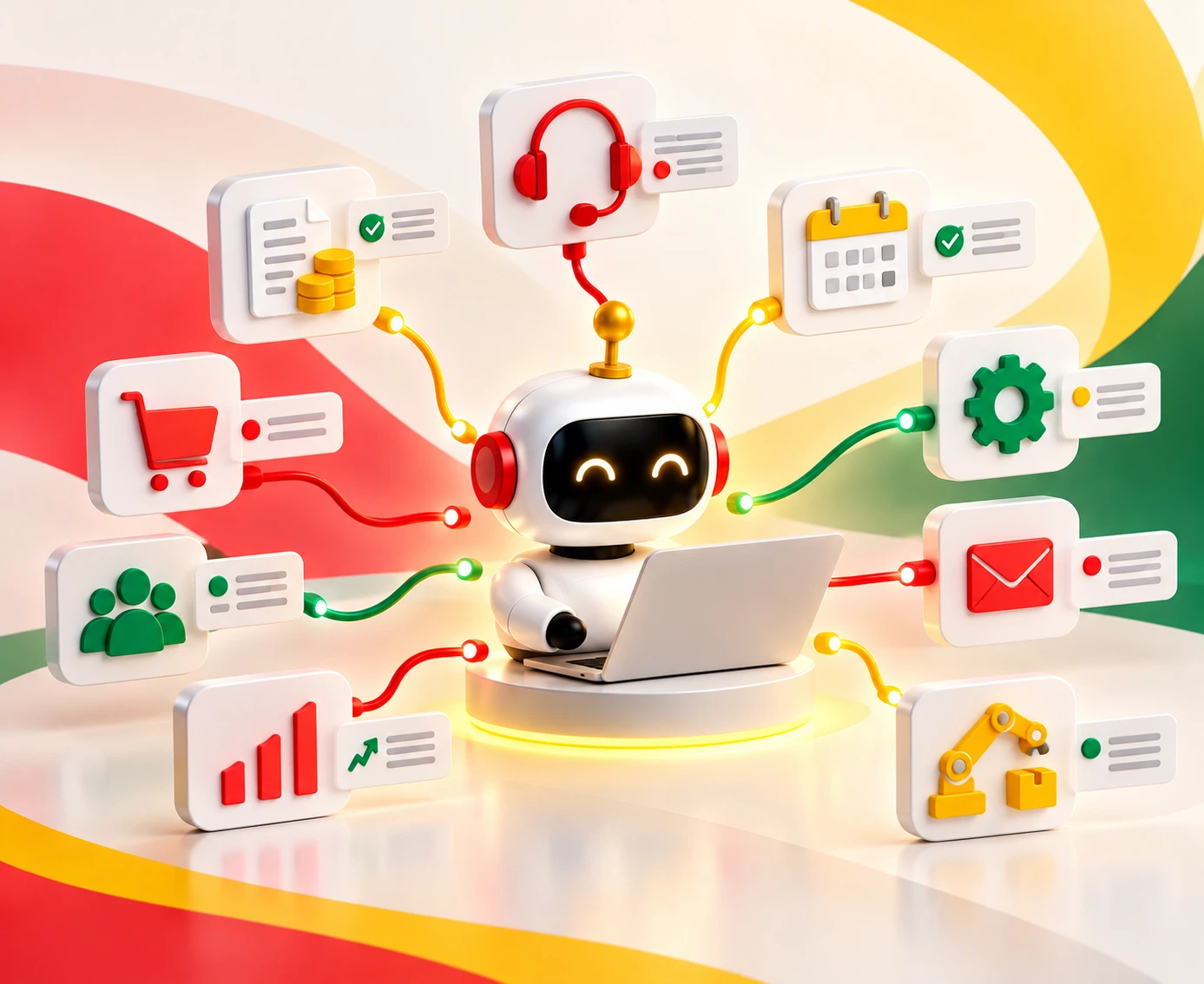
An AI agent is software that works toward a goal instead of just answering a prompt. The agent thinks through the task and picks the right tools, such as a CRM, a database, or a code repository.
The agent then executes several actions and retains a history of what was done up to this point.
Generally, the agent behaves like a team member who monitors the task.
After every action, the agent receives feedback in the form of output, e.g., the result of a database query that produces an error message, and makes decisions about future actions without any human input.
In platform documentation provided by Google Cloud and Anthropic, this is described as a loop of planning, acting, and receiving feedback.
These three are easily confused with each other. In other words, they are considered one tool while being different in how they deal with unorganized data and abrupt changes.
To weigh platforms, check out an n8n vs Zapier vs Make vs Workato comparison. Why pick a tool before you know the job? But by doing this research up front, you skip costly detours.
That said, these may need more technical and professional automation workflows for consistency
The table below sums up all 30 examples of using AI agents by function, trigger, agent actions, connected systems, autonomy, evidence status, and reported outcome.
Below are 20 workflows grouped by business function. Each follows the same path: a trigger, agent actions, connected systems, and an approval step wherever risk runs high. In doing so, the pattern gets easy to copy. Once you spot the shape, copying it takes little effort.
AI agents for customer service handle repetitive, well-documented questions without queue time. Human agents then pick up the cases that need judgment. But by doing this, teams also cut wait times for simple questions.
When the diner wants to modify their reservation, the agent gathers the information from the FAQ, checks for availability, and modifies the reservation in Service Cloud.
Out-of-the-norm requests are referred to a person. This way, guests get immediate responses, and people deal with special cases.
Practical AI agent examples, like how Fisher & Paykel was able to use Agentforce’s structure, show you the benefits with an increase in self-service for appliances from 40% to 70%. Or even how OpenTable used AI agents to manage thousands of reservation modification conversations.
In this AI agent use case, an incoming ticket comes in any language. The agent recognizes intent, conducts a search in overlapping policies, translates, and responds. The escalation logic directs difficult tickets to people.
Overall, the teams working on the ServiceNow or Microsoft service desk use the same logic.
In the case of DBS, Google Cloud voice agents helped reduce the time for call handling by 20%. And reMarkable processed 18,000 conversations within three weeks.
AI sales agent examples show how reps can take their selling time back by taking over research and CRM upkeep. In the grand scheme, that means more calls and fewer spreadsheets.
When a sales rep requests a brief. The agent combines CRM data with external sources to then create the brief and propose an outreach angle.
Lumen’s take, created using Microsoft Copilot, took four hours down to 15 minutes.
Translation: The person still does the sending. Wouldn’t you prefer being prepared for your call than spending your morning pasting information?
For instance, when a lead comes in, the agent asks qualifying questions, updates the CRM database, and then sends the lead to the appropriate representative.
In Salesforce Agentforce implementations, there are improved conversions, but there is no publicly available number for that.
At the same time, the teams developing their custom agents rely on OpenAI models for writing outreach emails, while the CRM system remains the system of record.
The outreach will always be gated by approval, meaning that nothing will ever reach the prospect without the reps' approval.
AI agents for marketing test more variants in less time, so teams spend their effort on big-picture planning. But by doing this, teams stop waiting weeks for fresh creative.
Whenever an ad-copy brief is received by the AI agent, he examines the data on the audience and creates different versions of campaigns for further checking.
The process of creating these variants was reduced by Kraft Heinz from eight weeks to eight hours with the help of Google Cloud AI.
However, marketers still NEED to check the finalized copies themselves.
The Radisson Hotel Group personalized ad placement using Gemini training models on BigQuery datasets.
The group has indicated a 50% productivity increase in the ad team and a 20% revenue increase through AI-powered ads.
All the companies listed above Adobe, Salesforce, and Google Cloud have agent tools for segmentation and attribution.
Overall, all the outcomes can be attributed to the audience generating them.
Financial workflows demand precision, so most agents here search or draft while people keep approval power. Money tasks leave little room for guesswork. Humans sign off on anything that moves funds. In the grand scheme, that split keeps speed high and risk low.
Where an AP clerk seeks invoice information, the agent queries ERP ledgers for this data. This is illustrated by SAP through Joule Studio.
The process continues to cover invoice extraction, three-way matching, and exception identification, and people on Oracle or Microsoft finance systems may implement it as well.
Hence, you must see the gains as vendor-proven, seeing that SAP does not provide specific accuracy numbers.
After a client call ends, the agent reads the transcript, formats a summary, and uploads it to the CRM.
Deutsche Bank cut admin time for advisory calls by 66% using Google Cloud AI. Similarly, United Wholesale Mortgage more than doubled underwriter output with AI-assisted document review. In doing so, both teams moved routine paperwork off human desks.
HR agents shield staff from repetitive questions and guard employee privacy. Humans still decide anything sensitive. Who wants to answer the same leave question fifty times? But by doing this, HR teams gain time for real people work.
An employee asks about leave or benefits in chat. The agent pulls the current policy, answers, and opens a ticket if needed.
Microsoft Copilot Studio supports this pattern and cuts manual HR requests, with access limited to approved documents. With this, staff get answers at any hour.
When a candidate is shortlisted, the agent matches calendars and drafts invitations, while Workday or ServiceNow routes other requests.
Any screening call needs human review to guard against bias. On the whole, response times drop while sensitive choices stay with people.
IT agents keep tickets moving and employees working without a wait in the queue. Engineers have better things to do than sort tickets. Agents take the routine ones off that plate. In the grand scheme, engineers spend more time on hard problems.
A new ticket arrives, and the agent reads it, sorts the issue, and decides where it goes. West Sussex County's Google Cloud setup, built on Contact Center AI, uses this method, though no outcome numbers are public.
ITSM platforms such as ServiceNow and Atlassian's Jira Service Management hold the tickets. Meaning, the agent updates them directly.
For a reset request, the agent checks identity, triggers the reset through the identity system, and logs the result in the ticket. For deeper incidents, the agent reads logs, finds the cause, and suggests a fix that an engineer approves.
Resets are easy to undo, so the risk stays low. In doing so, the agent keeps a clean trail of every step.
AI coding agent usage is the proving ground for high autonomy. The key split is between suggested changes and autonomous repo actions. But by doing this, teams keep code safe while still moving fast.
Each day, GitHub Copilot looks over open Dependabot pull requests, groups them by risk, checks CI status, and sums up the safe patches.
Developers move from reviewer to final approver. Who wants routine patches breaking up deep work? With this, GitHub documents the feature but shares no independent business metric.
A reviewer mentions @copilot in a pull request, and the agent reads the comments, writes a fix, and commits it to the branch. GitHub tracks median minutes to merge for Copilot-reviewed pull requests against a human baseline.
Anthropic's text editor tool shows the mechanics: the agent views directories, reads files, and runs string replacements, then tests check the result. On the whole, OpenAI ships comparable coding agents. Every change stays a suggestion until a human merges it.
Data agents let business users ask questions in plain language without waiting for an analyst. Teams get answers in minutes. In the grand scheme, analysts shift from report requests to deeper work.
Etsy uses Gemini inside Google Sheets to query raw support data, spot trends, and sum up findings.
Work that once took two to four hours now takes five to six minutes. Nobody has to file a request with the data team. Meaning, answers show up while the question is still fresh.
General Mills lets employees query structured data through BigQuery and Vertex AI and reports savings above $100 million.
The agent writes SQL, checks it against governed semantic layers, and respects access permissions. Databricks and Snowflake sell comparable governed-data agents. In doing so, accuracy still depends on validation checks and clear data lineage.
Supply chain agents watch data streams too big for manual oversight and flag problems early. Buyers get warnings before a shortage hits.
Planners can then act, not react. But by doing this, teams avoid costly rush orders.
When a pending order meets set criteria, the agent checks parameters, stock, and policy, and then releases the order.
SAP Joule shows this and reports faster production starts. No accuracy rates or zero-human-commit figures are published. With this, many teams keep a human approval step for high-value orders.
When stock falls below a threshold or a shipment runs late, the agent flags the risk, drafts supplier messages, and preps a purchase order for approval. Google Cloud, SAP, and Oracle platforms hold the demand and logistics data. Demand monitoring and shipment disruption management follow the same trigger-and-escalate pattern.
Legal, Risk and Compliance (2 examples)
Made-up answers carry real costs here, so retrieval from approved sources, audit trails, and human review are a must. Lawyers stay in charge. Agents do the digging. In the grand scheme, that division of labor protects the firm.
As described above, the Agentforce workflow drafts appeal language from past wins, and a person checks it before submission.
That approval step helped lift team uptake to 100%. Don't staff trust what they can review? Meaning, a human check can speed up buy-in rather than slow it.
When a contract is uploaded, the agent pulls relevant policy clauses, flags missing terms, collects evidence, and writes an audit trail.
A lawyer makes every final call. Microsoft, IBM, and Anthropic platforms support the retrieval, logging, and access controls this needs. In doing so, they give legal teams a record they can defend.
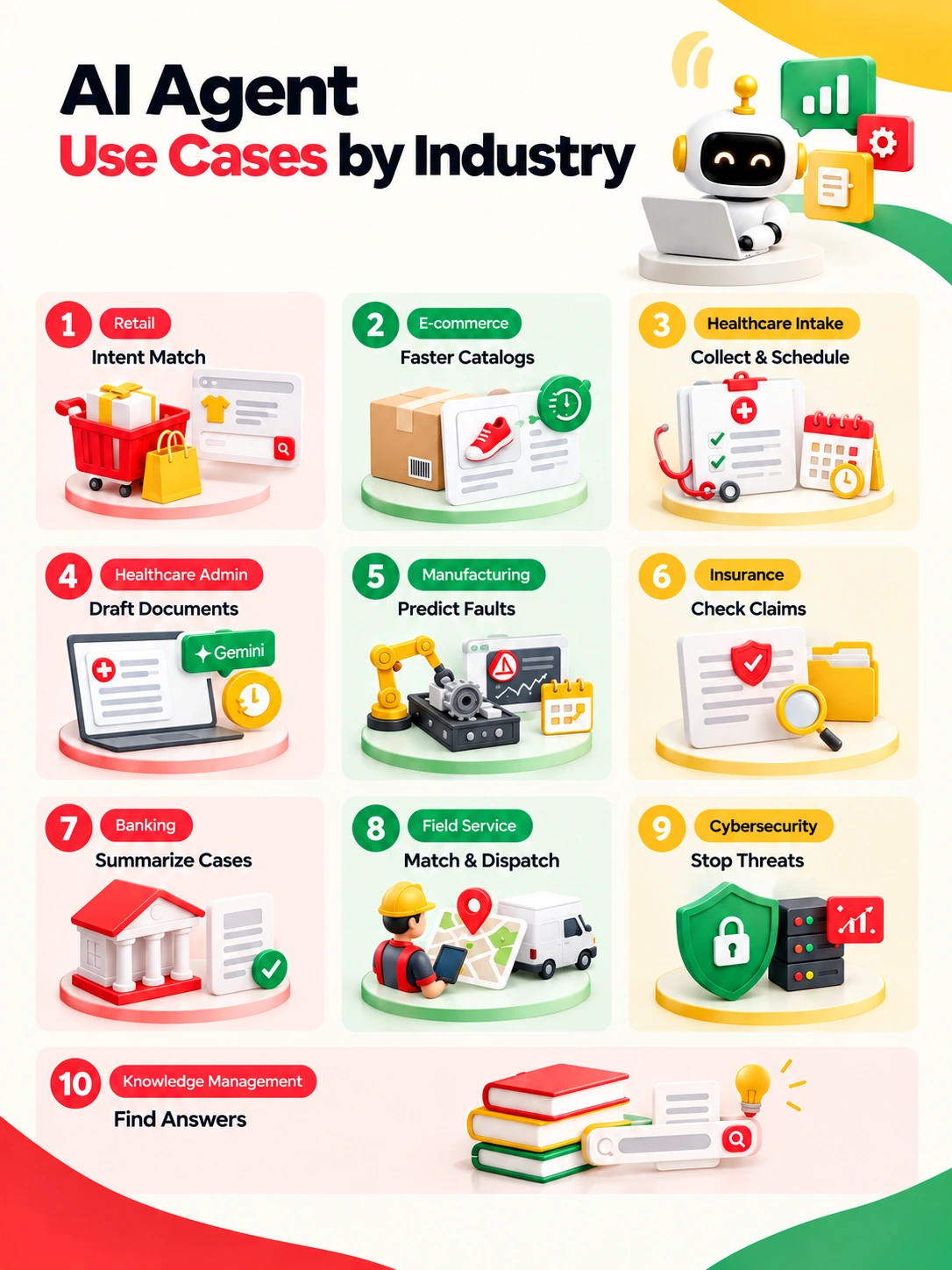
Examples 21 to 30 move from offices to clinics, factory floors, and customer sites. Industry rules shape each approval step, and vendors such as NVIDIA, SAP, Oracle, Microsoft, and IBM supply many of the platforms. But by doing this, each item keeps admin help apart from clinical, financial, or physical action.
Mercado Libre uses Vertex AI Search to match intent across about 150 million items and reports millions of dollars in added revenue (an estimate).
Wayfair's agent reads product images and text, then fills missing catalog fields four times faster.
In healthcare, AI agents are used to collect intake details and propose appointment slots. With this, the work stays admin-only, and privacy rules such as HIPAA apply where relevant
MEDITECH saves seven hours per employee each week by using Workspace with Gemini to draft documents, and clinicians review everything.
Here the AI agent example is how it reads machine telemetry, spots likely faults, and drafts maintenance schedules. Physical work needs technician approval.
In this industry, the AI agent use cases can be how it pulls claim fields and checks documents, while adjusters decide payouts under insurance rules.
An AI agent pulls transaction history and writes a case summary, and analysts decide whether to report.
An AI agent matches technicians to jobs and checks parts stock, and dispatchers confirm.
Vertiv used Google Security Operations to take in 22 times more log data and close investigations 50% faster, with response actions approved.
Here the AI agent is used to search internal sources and answer with citations so staff can check them.
Complex jobs are more and more split among specialist agents rather than one model doing everything.
Multi-agent designs suit complex, high-value workflows, while a single agent is usually enough for a first pilot. But by doing this, you keep early risk small.
The best first project sits where manual volume is high and mistakes are easy to undo. Follow this order:
Avoid workflows that demand perfect, rule-exact precision. Thomson Reuters unlocked skills ten times faster by picking document workflows suited to large context windows. Microsoft, ServiceNow, UiPath, and SAP can all host a pilot, so start where your data already lives.
In the grand scheme, a quick win builds trust. A quick win also shows leaders real numbers before you ask for a larger budget. To pick your first workflow, look at how teams build AI agents to automate workflows in n8n.
Agents fail in predictable ways. Meaning, you can plan for most failures before launch.
They make up tool schemas, send bad arguments to APIs, lose context during long loops, act on bad data, or follow hidden orders in untrusted content, known as prompt injection.
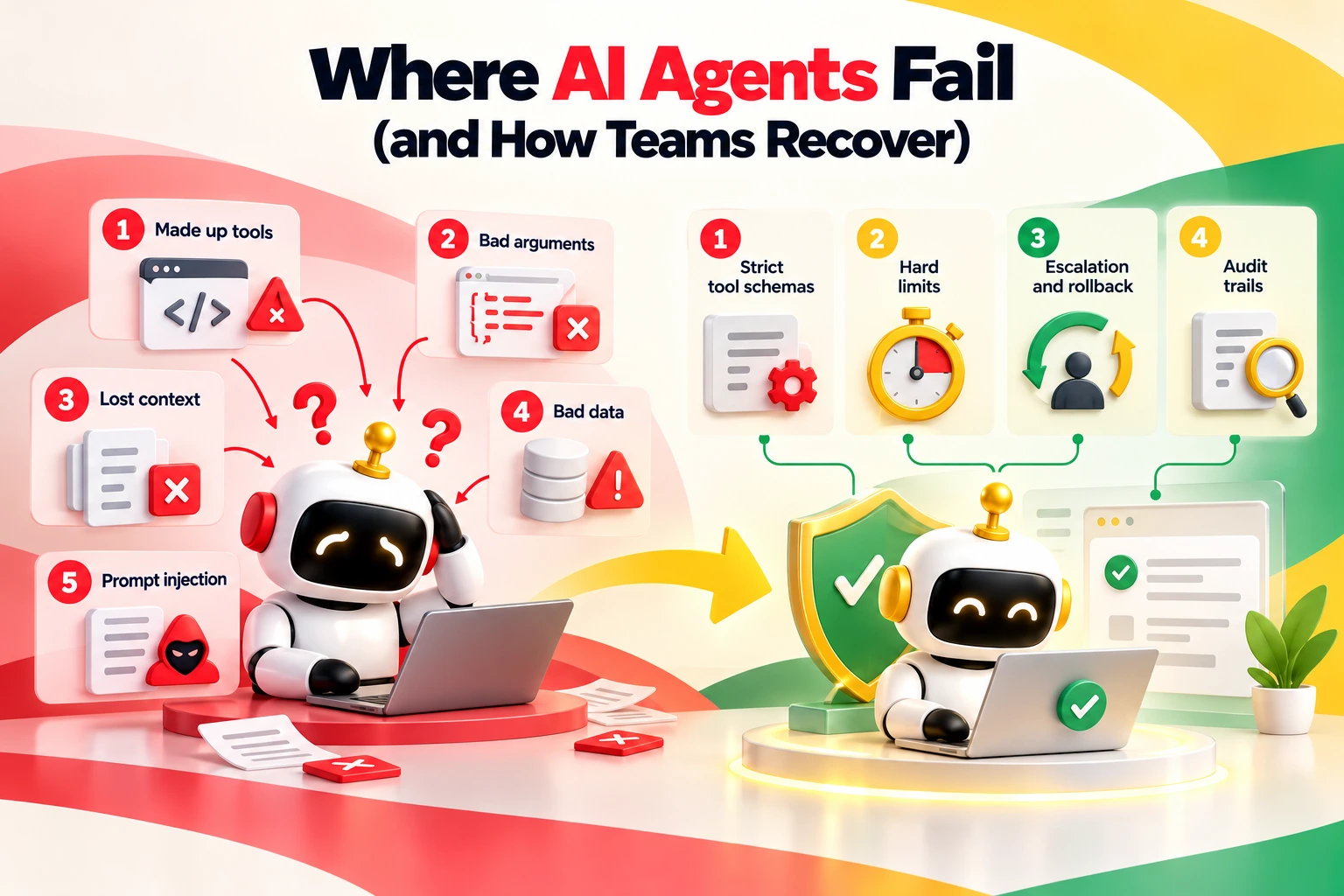
A missing escalation path turns a small error into a customer problem. Recovery starts with constraints.
But by doing this, teams catch errors early. OpenAI, Anthropic, and Microsoft guidance all stress least-privilege access and human review for risky actions.
Headcount cuts are a poor yardstick. Measure throughput and cycle time instead, using this math:
Track completion rate, resolution time, error rate, escalation rate, and cost per task against a baseline set before launch, then work out payback period.
Governance must outpace skill. The voluntary NIST AI Risk Management Framework groups work into Map, Measure, Manage, and Govern.
This frame is a solid anchor, though following it does not grant legal immunity. In doing so, pair it with the controls below. Microsoft, Google Cloud, and Anthropic each publish guidance on them.
Strong controls don't slow agents down. On the whole, they give security and compliance teams the confidence to approve wider rollouts.
Entrans is an AI-first digital engineering firm and the creator of Thunai.ai, built around agentic AI frameworks, enterprise connectors, and legacy modernization.
Entrans also delivers zero-defect modules for fintech lenders through automated QA testing.
Why not tie each build to a result you can measure, such as cycle time or cost per task?
Microsoft and OpenAI models can be connected where the use case fits.
To kick off an agent project, explore an n8n workflow automation framework. Meaning, you can book a consultation call with us.

Here are direct answers to the questions teams ask most about AI agent examples.
GitHub Copilot triaging Dependabot pull requests is one. The agent runs on a schedule, groups requests by risk, checks CI status, and sums up safe patches, so developers approve instead of sorting. In doing so, Salesforce and ServiceNow agents take the same load off service desks.
In its standard chat interface, ChatGPT is a conversational assistant. ChatGPT turns agentic only when OpenAI's tools or your own setup add outside tools, memory, browsing, computer use, and the power to run multi-step tasks. That shift is what makes it an agent. But by doing this, you also take on more risk, so add approval gates.
The classic list, used by IBM and Google Cloud, names simple reflex, model-based reflex, goal-based, utility-based, and learning agents. Modern enterprise agents usually mix goal-based planning, learning, and tool use rather than fit one type. Real products blur these lines. With this, the labels work best as a teaching tool.
The answer depends on the function. Microsoft Copilot Studio, Salesforce Agentforce, ServiceNow, SAP Joule, GitHub Copilot, and agents built on OpenAI, Anthropic, or Google Cloud models each lead in different areas. Compare connectors, governance controls, pricing, and verified results. On the whole, no single tool wins every job.
They take over repetitive, high-volume workflows that span several systems, such as support, research, reconciliation, and triage. The payoff is faster cycle times. Humans keep oversight of big steps. In the grand scheme, start with one measurable, reversible workflow and grow from there.

-1.svg)