Build an AI implementation roadmap that moves projects from idea to production with a step-by-step guide, timelines, costs, and measurable business results.

Agentic Unconference 2026 - September 19, Chennai
View Event →





What happens when your greatest challenge during digital transformation isn’t poor technology but an approach that promises everything and delivers nothing? The AI implementation roadmap is the answer. Not only will it give your team something concrete to work on, but it will also guarantee that everybody is focusing on one thing at a time:
What business result will this AI solution deliver?
In this blog, we will explore how to move an idea to production without getting lost in endless planning, testing, and presentations.
AI Implementation Roadmap is described as the process in which a systematic process that moves from the chosen business use case through implementation to ownership.
These milestones will be set up by technology, data, and operations, with stringent gates at each phase to ensure proper risk management and return on investment assessment.
The precise distinction between AI Implementation Roadmap, AI Strategy, and Project Plan is that
An AI implementation roadmap can be very impressive on paper yet lack business impact. This happens because some firms have difficulty planning and controlling their projects after implementation.
The three structural reasons where AI implementation roadmaps stall are
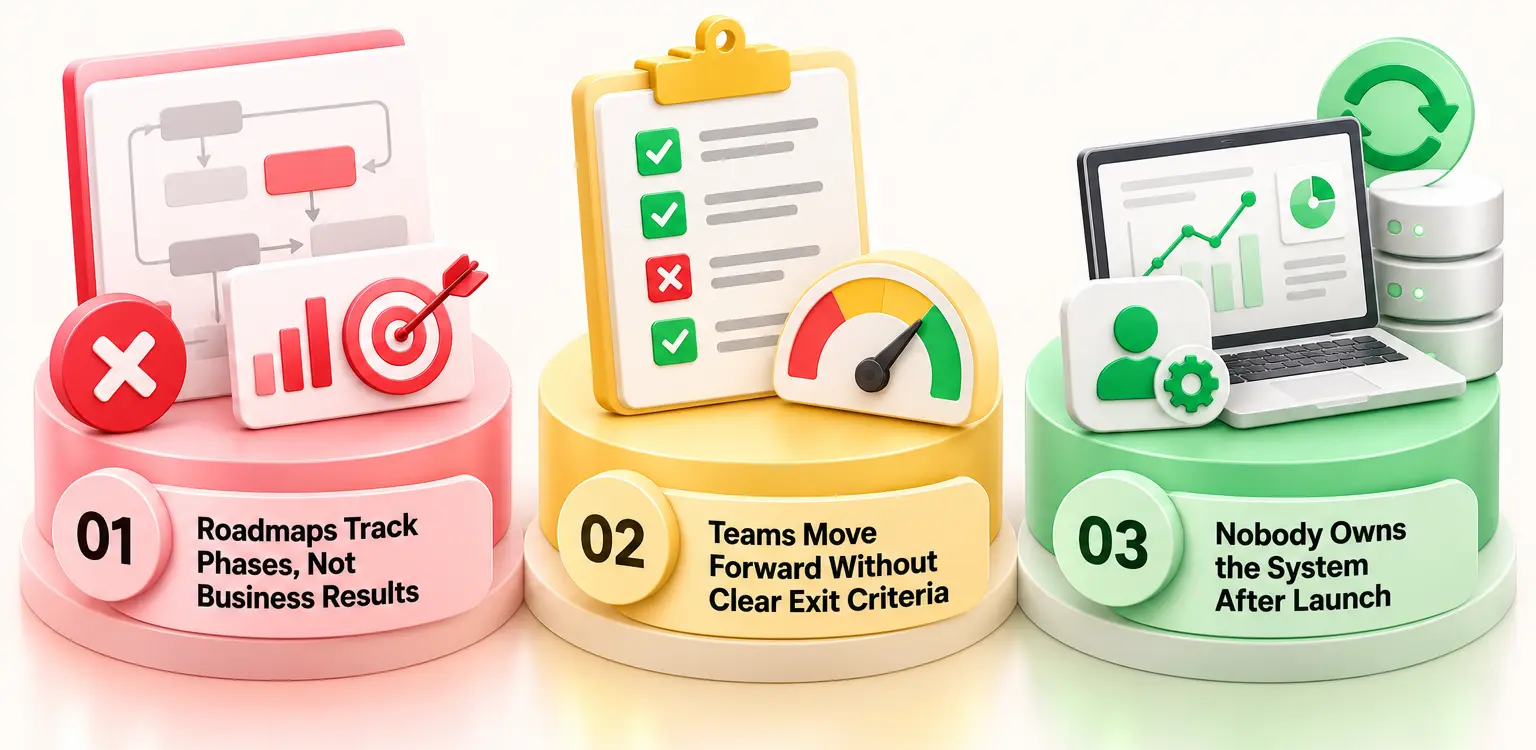
Most groups have plans for discovery, development, testing, and deployment without defining any business objective. The optimal approach to the adoption of AI technology involves setting up a measurable goal, for instance, quicker processing of claims or reduced errors in invoicing.
A roadmap needs to have some measures that must be put into place at each stage. There is a need to ensure that agreement is reached on the measures of accuracy, security, costs, and acceptance, among others, before going into the production stage.
Production is not the last phase. It is important to keep track of performance, to control costs, to understand errors, and to modify the system according to the needs of the firm. An unnamed owner may lead to the depreciation of even a successful launch.
The numbers reflect this gap. According to Boston Consulting Group (Oct 2024), 74% of companies have yet to show tangible value from AI, with only 4% deriving substantial returns. Further, Gartner research indicates that at least 30% of GenAI projects will be abandoned after proof of concept by the end of 2025 (Jul 2024).
Moreover, Gartner also indicates that over 40% of agentic AI projects will be canceled by the end of 2027 (Jun 2025). If your team is already stuck in proof-of-concept paralysis, read our guide on moving from AI pilot to production to restart your AI implementation strategy.
You will need an approach to manage your costs in implementing your AI solution. See below for the copyable AI implementation roadmap template intended for engineers, data scientists, and executives interested in learning about AI implementation within business.
This can serve as a model to follow in your AI roadmap template implementation. You can vary the number of weeks and exit criteria according to your own style of work.
First of all, you need to choose one workflow, which will be associated with one key KPI and has a dedicated business owner who is going to approve the outcome after analyzing production data.
The project you take up should be one where there is data available in production (such as invoices, customer details, tickets, etc.). The second step would involve mapping out the systems behind the processes (ERP, CRM, ticketing systems, or document management systems).
Measure existing performance before beginning construction. There is no way to prove that there has been any effect from AI without a baseline.
Begin the security review process, data access, and evaluation criterion approval on day one. Putting it off until the construction begins will delay the project.
A specific business owner, a measured baseline, validated data access, and signed evaluation criteria before construction.
Integrate the AI solution within the existing systems of your team, rather than having it isolated in the sandbox environment. Link typed tools and APIs, including MCP servers when required, to approved business systems. Base the model’s answers on reliable data sources and include human intervention when necessary.
Perform work in weekly cycles. Test against real processes, get feedback, and address problems before implementing new functionality.
In developing workflows for autonomous agents, construct strong governance right from the get-go:
Verification of the golden dataset is completed; all objectives of accuracy, latency, and cost per transaction are met; security and compliance approval gained.
The assessment of the AI project needs to be continuous not just in its development stage but also in case the AI solution is implemented and put into use. The AI project that works perfectly on demonstration will definitely collapse if it gets some strange input from the user side.
Design a golden dataset based on production cases and failure cases. Evaluate if the new version passes the standard you have agreed upon. Using LLMs to judge large amounts of responses could be helpful here, but human experts need to examine some of the responses anyway.
Consider different models with the same test data. Consider accuracy, latency, and cost per transaction instead of choosing a model according to its response quality. A model may have high accuracy, but it could be costly and have latency in its response; thus, the company needs to consider this.
Integrate test evaluations in your CI/CD pipeline. Every release must undergo regression testing before moving forward. Results need to be tracked on dashboards for the team to detect any decline in quality, increased costs, and increased latency.
At Entrans, our core principle for AI implementation strategy is simple: "If it isn't measured, it isn't shipped."
Every release passes the agreed evaluation thresholds, and test results are recorded for review.
Only proceed with adjacent workflows once the first use case has been proven to be reliable. To avoid a failure after the product launch, knowledge transfer must begin from the very first week to end up with:
Operational responsibility is taken by the receiving party, responsibilities are assigned for support activities, and performance and costs are controlled.
The ownership should be determined for the AI Implementation roadmap at all stages. The lack of a person to take care of the tasks results in the development process stalling as it moves from the pilot phase to the full-scale project phase. For your implementation plan to succeed, there should be someone to take responsibility for it.
A possible staff structure to achieve one business result would be a forward-deployed engineering team in the same way as Entrans, which can be made up of one delivery lead responsible for the business result, two to four senior engineers from agents, data, and platform areas, and one evaluator.
This way of working allows for small teams that include owners in all the important roles. This depends on the process itself, its risks, and the procedures. All that counts here is that everybody should know who makes the decisions, performs the work, and owns the project afterwards.
AI adoption timeliness issues often emerge in industry search results due to confusion between individual projects and enterprise-wide implementations of the technology.
The cost associated with deploying AI is dependent upon the type of AI that one wishes to create and what other systems they plan on incorporating, along with deployment efforts required. Instead of considering the cost estimate in broad terms, first of all, plan your AI deployment strategy and know the cost factors involved.
According to Gartner (Jul 2024), enterprise-wide implementations of GenAI cost between $5 million and $20 million. However, this is the cost of an organization-wide transformation of multiple systems, not the cost of delivering one specific use case.
When partnering with an AI implementation partner, organizations typically choose between four delivery models:
For a detailed breakdown of engagement structures, rates, and team shapes, explore our guide on Forward-Deployed Engineering Costs.
AI initiatives often fall through because of the challenges that arise too late. There can be issues with the quality of the data when the application is live, despite it performing well during demos. The business need might not be very clear, or there could be an increase in cost as users begin interacting with the AI model.
Establishing these strict validation gates ensures your AI implementation strategy produces predictable, enterprise-ready software at every milestone.
Use this table as part of your AI implementation roadmap template. The goal is simple: catch problems early, make decisions with evidence, and move toward production with fewer surprises.
A practical AI implementation roadmap should address governance from the start, not just before launch. The NIST AI Risk Management Framework offers four functions:
Map them to ownership, risk reviews, testing, and ongoing monitoring across your AI implementation plan.
Selecting the right AI implementation partner determines whether your initiative ships or stalls. Ask these key questions to evaluate potential vendors:
Outsourcing centers on deliverables, staff augmentation on hours, and a forward-deployed engineering pod on solving a business problem. Read how to choose a forward-deployed engineering company for more details. Delivery models can be improved by leveraging Forward-Deployed Engineering as a Service to bridge technical execution with business outcomes.
An AI implementation roadmap does not fit for every scenario. In some cases, the groundwork needs to come first.
Beginning too soon can increase costs for AI implementations as well as necessitate rework. Identify these problems first, and then leverage an AI implementation plan to make your way to production.
An AI implementation roadmap needs more than a plan. Teams must build, test, and run the solution in the environment where people will use it. Entrans uses Forward Deployed Engineers (FDEs) to work alongside client teams and move AI projects from early ideas to production. Project speed can be helped by embedding a forward-deployed team directly alongside internal engineers to solve deployment hurdles.
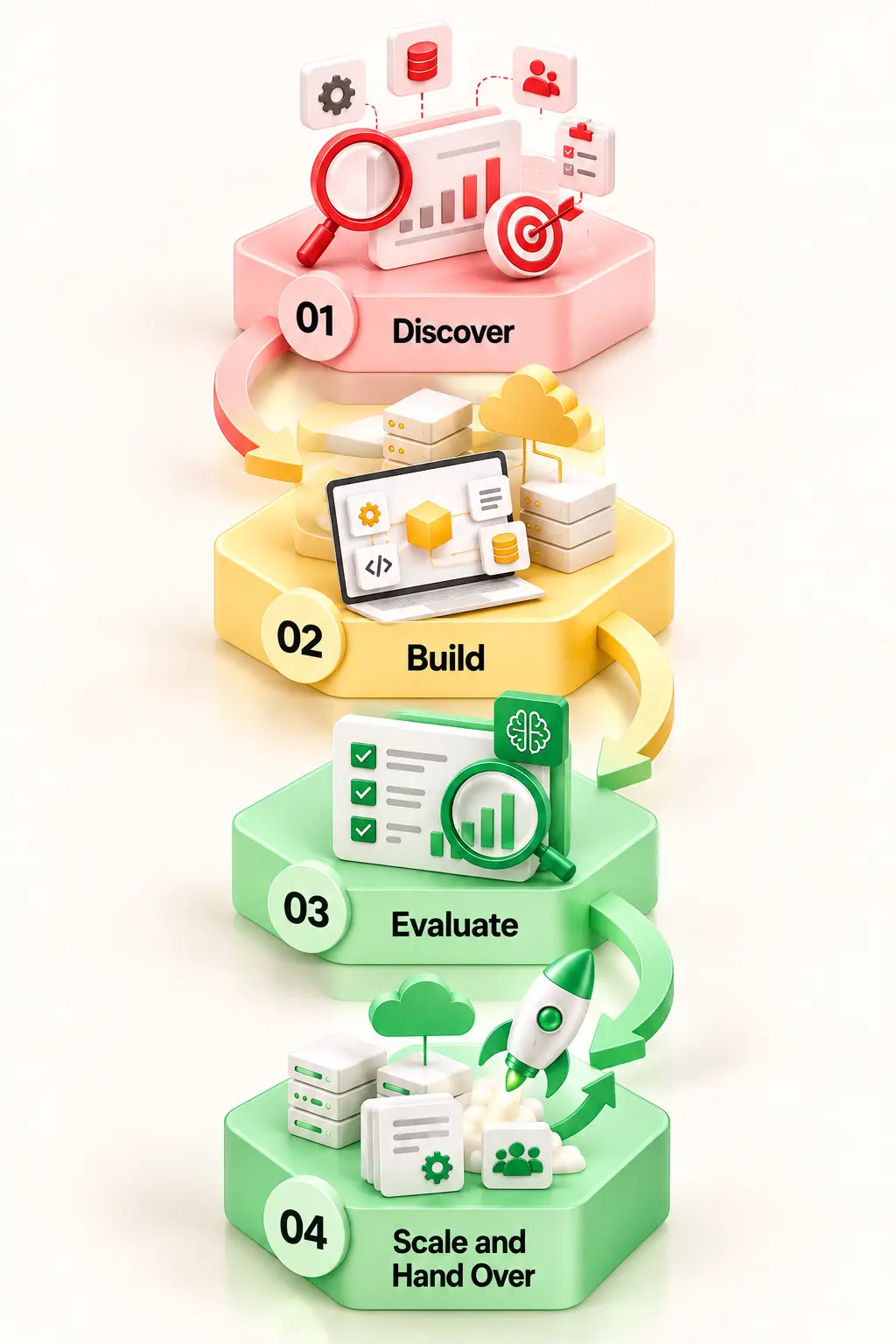
We deliver the four core stages of our AI implementation roadmap in disciplined, production-focused iterations:
In one enterprise finance use case, Entrans used LLM extraction on AWS Bedrock to support invoice and goods receipt note (GRN) reconciliation against a legacy ERP. The result was an 80% reduction in manual reconciliation effort and 2X faster payment clearance. Check out the GRM reconciliation case study.
This example shows how an AI implementation strategy can tie technical work to measurable business results.
A roadmap only matters when it delivers results in production. Ready to turn your AI roadmap into working results? Book a consultation call.

The four core stages are: Discover (mapping data and selecting one KPI), Build (integrating directly into existing software), Evaluate (testing against a golden benchmark), and Scale (expanding to adjacent processes and handing off runbooks).
The 10-20-70 rule suggests that AI success depends on 10% algorithms, 20% technology, and 70% people and process changes. The exact split is a guiding principle, not a fixed rule.
The 30% rule often refers to the estimate that at least 30% of generative AI projects may be abandoned after proof-of-concept stages. The figure comes from Gartner's 2024 forecast, not a universal rule for every AI project.
A focused deployment for a single use case takes 6 to 8 weeks in an agile sprint. Enterprise pilots take an average of 8 months to reach production, while scaling across an entire organization takes 12 to 18 months.
Costs depend on the use case, team size, data preparation, system connections, model usage, and ongoing support. A small project may cost far less than a large enterprise rollout.
An AI strategy sets the business goals and explains where AI can help. An AI implementation roadmap lays out the steps, owners, timelines, and checks needed to reach those goals.
An AI implementation partner helps plan, build, test, and launch AI solutions that fit business needs. The partner may also support staff training, monitoring, and handover.
Track business results, such as time saved, accuracy, cost per task, and user adoption. Set targets before development and check them again after launch.

-1.svg)