Learn how to scale up AI enterprise governance from one business unit to another. Discover how to create scalable AI governance without compromising on speed of development.

Agentic Unconference 2026 - September 19, Chennai
View Event →





What happens when AI governance leaves one team and enters the rest of the enterprise? This is because most organizations treat AI enterprise governance as a policy exercise, which causes friction with existing GRC functions.
When US state laws, EU mandates, and internal audit functions pull in different directions, generic templates fail. Regardless of the region, AI enterprise governance requires an operating model that fits your engineering stack.
This blog explains how to map AI controls directly into your existing GRC framework, and what practical enterprise AI governance looks like in production.
Enterprise AI governance is the practice of operating one AI control set across business units that don't report to each other, in multiple regulatory jurisdictions, alongside an existing risk and compliance function. Designing an effective framework can be helped by following a structured AI governance guide to align organizational priorities.
The controls are the same at any scale. What changes is ownership, consistency, and approval volume.
Governance that succeeds inside a single business unit predictably collapses when forced to scale across the modern enterprise. The four main structural issues that make enterprise governance harder are
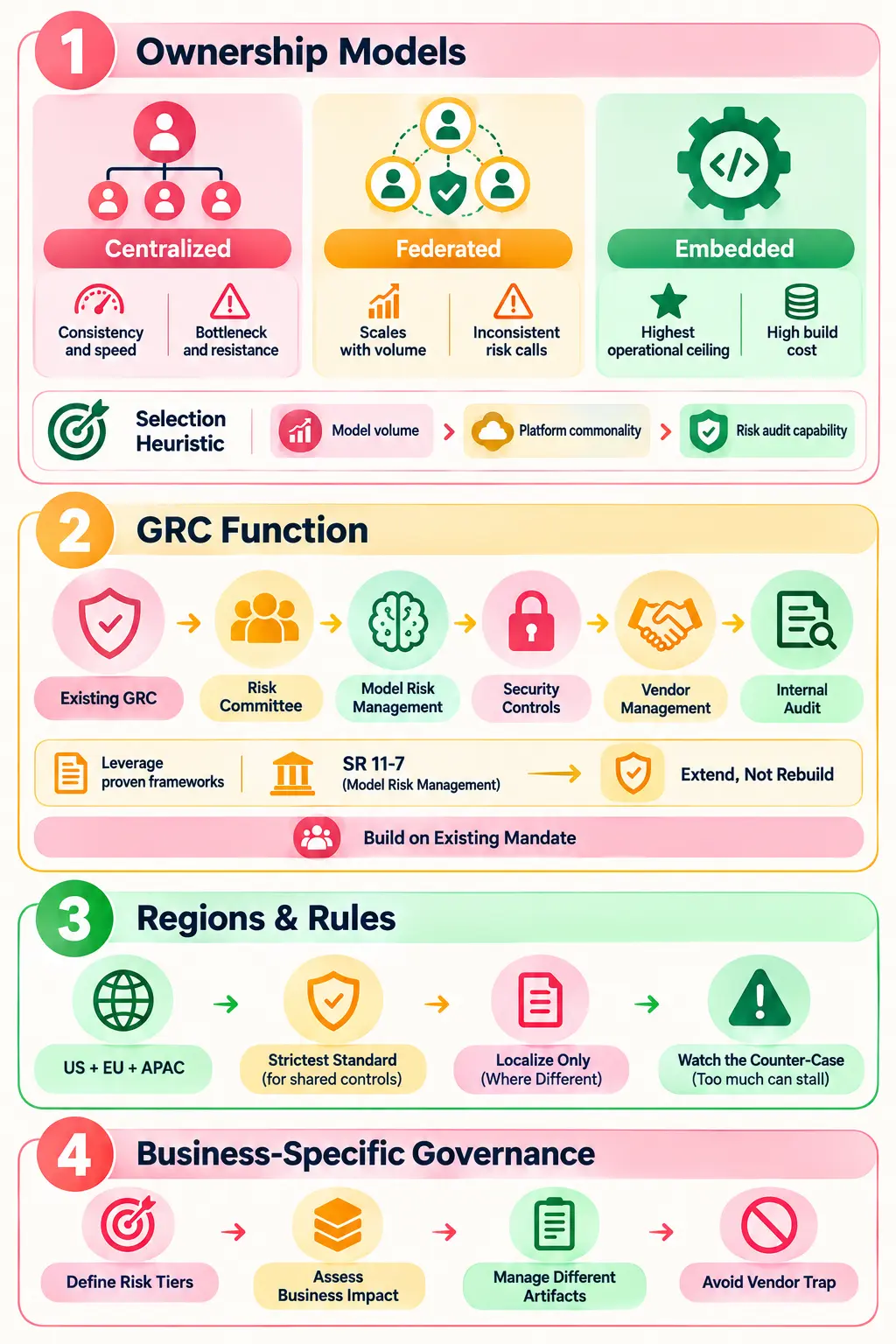
The central AI function might implement a policy, but individual business groups will still be responsible for making technology decisions on their own. What is acceptable to apply in one region will require different treatment somewhere else due to varying regulatory standards. On the other hand, AI governance should not be isolated from other functions, such as law, security, and others.
The four scale problems are discussed one by one, and let’s find what makes that difficult and what enterprises need to account for when governance moves beyond a single team.
Ownership in enterprise governance is not about a person. It is about choosing a successful operating model. The harder question is who makes decisions when an AI use case crosses business units, technology teams, and risk functions. This makes ownership an operating model decision and not simply AI governance roles and their responsibilities. Enterprise AI governance strategy hinges on three primary models.
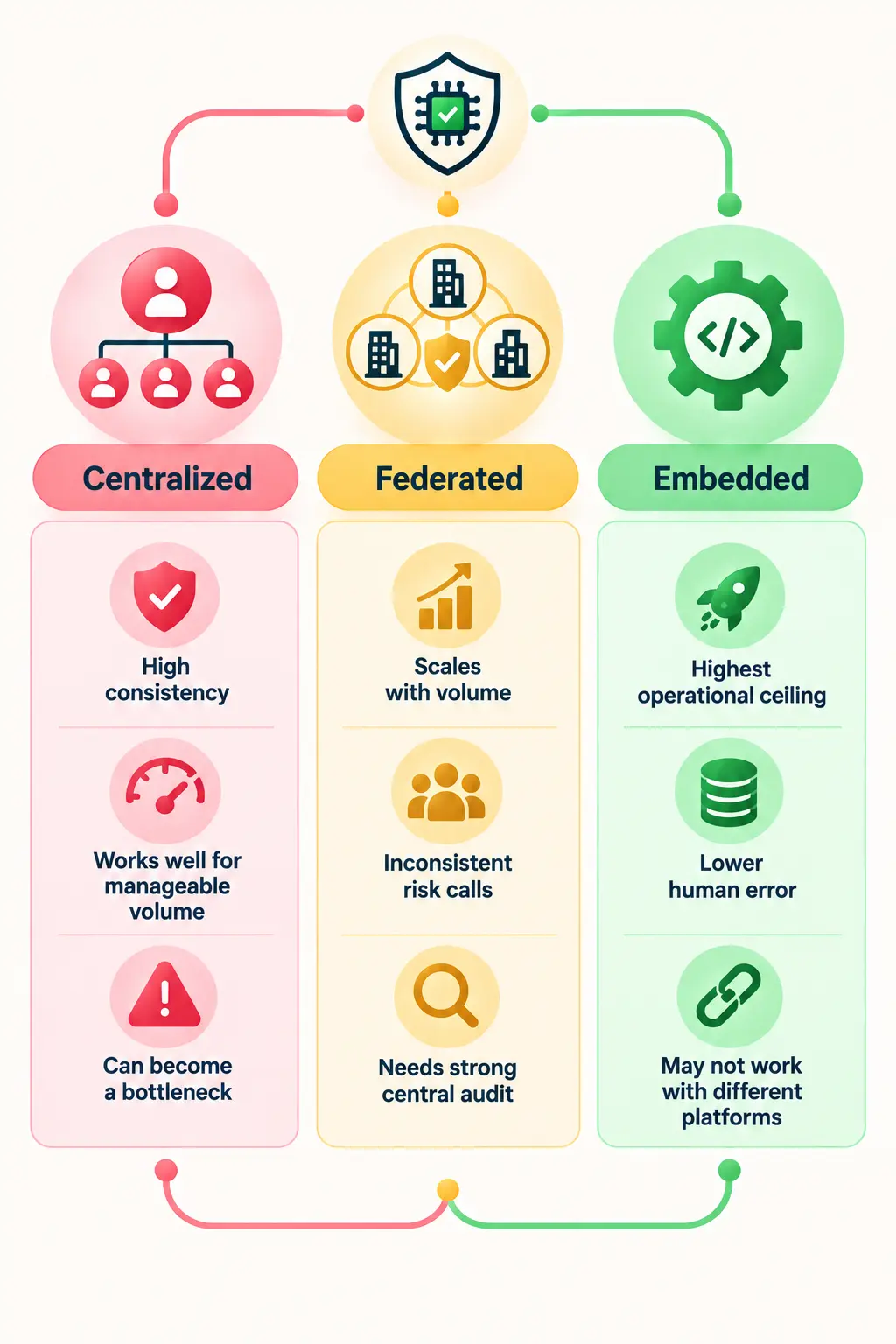
A single dedicated team that handles risk classification and approval across the enterprise. This works well when AI volume is still manageable, and consistency matters most.
The trade-off manifests itself as more usage takes place. The core team becomes a bottleneck for all projects to go through, while delivery teams can view governance as an impediment to releasing their products.
Against a common standard, the AI use cases are classified by the business units. This approach scales seamlessly with volume, but it naturally yields inconsistent risk calls across regions and requires a mature central audit function to ensure compliance remains consistent.
A federated model therefore needs a strong central audit capability to review those decisions and spot where local judgment is drifting.
Governance rules are codified directly into a shared engineering platform, automated via deployment pipelines. This offers the highest operational ceiling and minimizes human error. It takes more time to build, but it also breaks down when business units use different engineering platforms that cannot apply the same controls.
The right model depends on how the enterprise actually operates. The choice comes down to three questions:
According to the latest research, more than 74% of companies intend to deploy AI models; however, over 88% of all AI pilot projects do not make it to production.
Regardless of your chosen structure, AI governance in organizations requires four distinct roles to operate effectively:
This clear distribution of roles can be essential. Studies show that 66% of corporate boards currently possess limited-to-no knowledge of AI governance and risk exposure.
Entrans perspective: Across enterprise engagements Entrans has run, the business unit requesting an AI use case is frequently not the one whose data estate can support it. A governance question then becomes a cross-unit data ownership question that nobody has the authority to settle.
The question every large enterprise asks:
Does AI governance sit inside existing Governance, Risk and Compliance (GRC) or beside it?
For most enterprises, creating a separate structure is the wrong starting point. A practical enterprise AI governance strategy should map AI controls onto structures that already have authority.
Creating an independent governance group for AI that overlaps with existing risk remits results in an instant political defeat. This approach will cause internal conflicts, delay the process, and trigger governance fatigue.
AI governance in the enterprise should be aligned with the current organizational structure:
Extending existing frameworks rather than rebuilding them can be guided by established bank regulation like Federal Reserve SR 11-7 Guidance on Model Risk Management, which provides a battle-tested blueprint for governing probabilistic models.
For US financial institutions, this mapping is already half-built. Banks have operated under SR 11-7 (Guidance on Model Risk Management) for over a decade. Rather than building a parallel universe for generative models, mature BFSI organizations simply extend SR 11-7 validation, governance, and inventory requirements to include probabilistic AI. Build a second system from scratch.
That distinction matters in AI governance in organizations. A new AI governance committee that duplicates the risk committee's remit will quickly run into resistance. Business leaders will ask who actually owns the decision, while existing risk teams will question why another group has been created.
For AI enterprise governance, the more robust approach is often rather clear: leverage what already exists in a mandate where one has been made to cover the risk. Only create where there is an obvious gap.
A US enterprise can run the same AI platform across US, Europe, and APAC. But for every region, the rules differ example, the EU AI Act enforces strict regulatory classification, APAC emphasizes flexible innovation frameworks, and US states pass fragmented privacy laws. That creates a problem for enterprise AI governance. However, blanket enforcement of EU high-risk obligations onto benign, US-only internal tools stalls innovation and overwhelms risk teams with unnecessary paperwork.
Instead, a scalable enterprise AI governance strategy uses a dual-layer approach:
By decoupling core platform controls from regional regulatory tiers, AI governance in organizations remains rigorous where required without needlessly paralyzing low-risk business operations elsewhere.
The first step will be to use the highest standard in the case of shared controls on the platform. The control elements for access, logging, change models, testing, and monitoring can use the high standard where the controls are shared regionally. Only localize those areas where there are differences, such as risk classifications, regulatory records, disclosures, and approvals.
However, there is one vital issue to consider. While governing everything based on the highest standards appears secure, it may produce additional workload. There is no need for an application restricted to use in the United States to adopt all high-risk practices required in Europe just because the same organization uses them there.
The better AI governance for enterprise model separates shared controls from local obligations. Maintain a consistent technical minimum for the joint infrastructure, and have local teams address the localized aspects where needed.
Off-the-shelf templates treat every AI model the same, but generic frameworks fail because real-world operational risk depends on context. Effective enterprise AI governance strategy requires AI business-specific governance, calibrating controls to your unique industry impact rather than adopting generic severity labels.
Consider two high-impact use cases. A retail pricing model can affect product prices, margins, promotions, and customer demand. Pricing guidelines, approval process documentation, test results on different product lines and demographics, and documentation of who has the authority to modify the model may be necessary for its governance.
Now consider a lending credit model. A poor decision will result in a possible failure to get the person credit and might have regulatory and customer implications. The information will rather require decision logic, data provenance, testing for fairness, adverse action notices, model validation, and evidence of exception handling.
A retail pricing algorithm and a bank credit-scoring model might both carry "high" impact scores, yet they demand entirely different compliance evidence. For example, in Entrans’s core sectors:
Whereas the control space could be identical model testing and approvals the data supporting such control will certainly be different.
That is where most enterprise AI governance efforts get lost. Enterprise AI governance should take into account the way decisions are made by the business, the areas of decision-making that expose risks, and what evidence different stakeholders require.
And there is always a pitfall: adopting the risk taxonomy from a vendor, lock-stock-and-barrel. Not only will you be buying their taxonomy. You are also buying their view on what is important.
An improved enterprise AI governance approach begins with business risks and then aligns governance controls with those risks.
Scaling enterprise AI governance should not start with an enterprise-wide policy launch. We should start with one business unit and one production use case, prove that controls work, then expand them across the organization.
Track the following metrics
The above metrics tell you whether AI governance for enterprise is actually scaling. The number of policies published does not say anything about scaling enterprise AI governance.
Growth inherently triggers operational shifts. The moment approval requests exceed what a central team can review within a normal release cycle, your enterprise AI governance strategy must evolve from centralized reviews to federated or embedded models. For a step-by-step 90-day implementation roadmap, explore our complete operational playbook for Enterprise AI Governance.
This operational shift can be supported by evaluating your organization through an enterprise AI readiness assessment.
Implementing enterprise AI governance brings underlying organizational friction to light. Identifying these bottlenecks early can be helped by analyzing common AI governance challenges experienced during cross-departmental rollouts. At scale, programs typically stall due to four specific failure modes:
Entrans starts with two business units, not an enterprise-wide policy exercise. The team inventories the AI use cases actually in flight, then scores the six governance dimensions for each unit. This shows where the real gaps sit before anyone decides what the enterprise operating model should look like.
The tailored enterprise AI governance strategy is then designed directly from actual deployment volumes and platform commonality. This approach prevents the central review bottlenecks that delivery teams typically bypass.
The output is an operating-model recommendation with named owners for each AI governance role and responsibility, along with a costed remediation backlog for each business unit.
It also takes care of another scaling issue, namely that of the center being a bottleneck. This is so because of the fact that the model is based on real-world approval volume and platform commonality, and hence governance does not automatically put every decision with the center.
This solution also takes into account the cross-regional and cross-business unit nature of things. Entrans has performed well across different offices in the US, UK, UAE, and India, while its connection with JSW covers different sites.
Through dedicated Cybersecurity and Compliance Services, we establish sustainable AI business-specific governance that embeds control into existing delivery pipelines without slowing innovation. Organizations looking to accelerate this operational transformation can be helped by selecting a dedicated AI governance partner to guide implementation.
Learn how we turn complex multi-jurisdictional compliance into automated, pipeline-embedded controls that protect your brand and empower your business units to deliver safely at speed. Book a consultation call with us to learn more.

Choosing the primary model depends on three things: how many models you have in production, how common your engineering platform is across units, and whether your risk function has real audit capability. Centralized works until approval volume exceeds capacity, while a federated model can scale but drifts without central audit.
Yes. In most AI governance for enterprises, it extends existing GRC functions instead of creating a separate team. This prevents duplicating effort, avoids internal political turf wars, and utilizes the audit structures your organization already relies on.
AI governance shouldn't belong to a single owner; it is best co-owned by an Executive Sponsor (CRO/CAIO) who sets policy and risk appetite, working along with Engineering and GRC teams.
Use common AI governance controls across countries, while adapting risk classification, regulatory requirements, and record-keeping to each region. Then, decouple compliance by applying localized risk classifications and record-keeping rules based solely on the user's specific jurisdiction, such as EU high-risk obligations or APAC frameworks.
Define risk tiers against impact that is specific to your business rather than adopting a vendor's generic severity labels. A retail pricing model and a lending credit decision model are both high-impact and need materially different evidence. Buying a taxonomy wholesale means inheriting someone else's assumptions about what matters.
Start by inventorying active AI use cases inside a single business unit and embedding automated controls into one production pipeline. Once the model works, expand it based on AI volume, shared platforms, and the existing GRC structure rather than launching an enterprise-wide policy first.
Track metrics such as approval cycle time, the percentage of the AI estate, and evidence completeness across AI use cases. The number of policies published is not a measure of anything.

-1.svg)