Moving from an AI pilot to enterprise scale? Discover how to evaluate enterprise AI readiness, build a shared AI operating model, and scale ROI.

Agentic Unconference 2026 - September 19, Chennai
View Event →




Your AI pilot succeeded. So what’s next? The real transition from AI experimentation to enterprise adoption is a big achievement. Most C-suite leaders are misled by metrics that claim an organization is 60% ready for digital transformation. Assessing enterprise readiness for AI adoption at scale requires abandoning the search for a unified score and stepping into portfolio diagnostics. Performing an enterprise AI readiness assessment allows leaders to map the true variance across their organization's infrastructure, talent, and governance layers.
In this blog, we will see how to assess enterprise AI readiness at scale and identify the constraints that slow down AI adoption.
Enterprise AI readiness at Scale is an organization’s ability to deploy, manage, and optimize artificial intelligence across multiple business units and data estates under a shared operating model. Broadening your capabilities can be improved by leveraging comprehensive artificial intelligence services tailored for high-scale enterprise environments. This is achieved through consistent governance, platform scalability, and readiness scores that are comparable between units.
Most enterprise AI readiness models do not work because they attempt to distill complex enterprises into a single overall percentage or maturity rating. In large enterprises, enterprise AI readiness cannot be viewed as a single measure but as a portfolio problem. Organizations looking to evaluate their current standing can be helped by reviewing an AI readiness assessment framework to establish baseline capabilities across different teams.
A single enterprise-wide number can hide major differences between business units, data estates, and workloads- the variance that actually determines where to invest, what to fix first, and which units are ready to move into production.
To better understand how these evaluations are structured, you can explore what an AI readiness assessment is and how it helps prepare organizations for adoption.
Running a pilot program ensures technical feasibility, but an enterprise readiness assessment requires operational repeatability across diverse environments. When moving past a single proof of concept, four distinct operational friction points break down:
In large-scale AI, a need for a shared AI operating model, reusable platform patterns, managed access to the data, and an assessment of multi-business unit AI preparedness arises.
Evaluating enterprise AI readiness requires scoring every business unit on a single, standardized rubric and analyzing the resulting matrix rather than relying on an enterprise average. Requirements often vary significantly depending on the sector, which can be improved by looking at an AI readiness assessment by industry breakdown to address specific compliance and operational needs.
The enterprise AI readiness assessment does not end with one enterprise score. We need to score each business unit against the same 1-5 rubric, then plot readiness against business value to see where investment should go.
Gartner research reinforces why portfolio scoring is non-negotiable: while 72% of enterprises report running GenAI pilots, fewer than 20% believe their workforce and data architecture are actually production-ready
The matrix preserves signals that an average destroys. Three ready units should not offset one unready unit handling regulated data; that unit may need controls, access changes, or remediation before moving ahead.
In Entrans portfolio assessments, a consistent pattern emerges: the business unit requesting the largest AI budget is frequently not the readiest. Uncovering this divergence prevents premature capital deployment and fundamentally shifts enterprise roadmap sequencing toward business units equipped for immediate execution.
The AI Operating Model goes beyond just selecting models and platforms. It includes decision-making processes, data and governance ownership, capability sharing between teams, and the pace at which new use cases progress. Defining your long-term vision can be improved by establishing an enterprise AI strategy framework that aligns technical roadmaps with core business outcomes. Three structures are common:
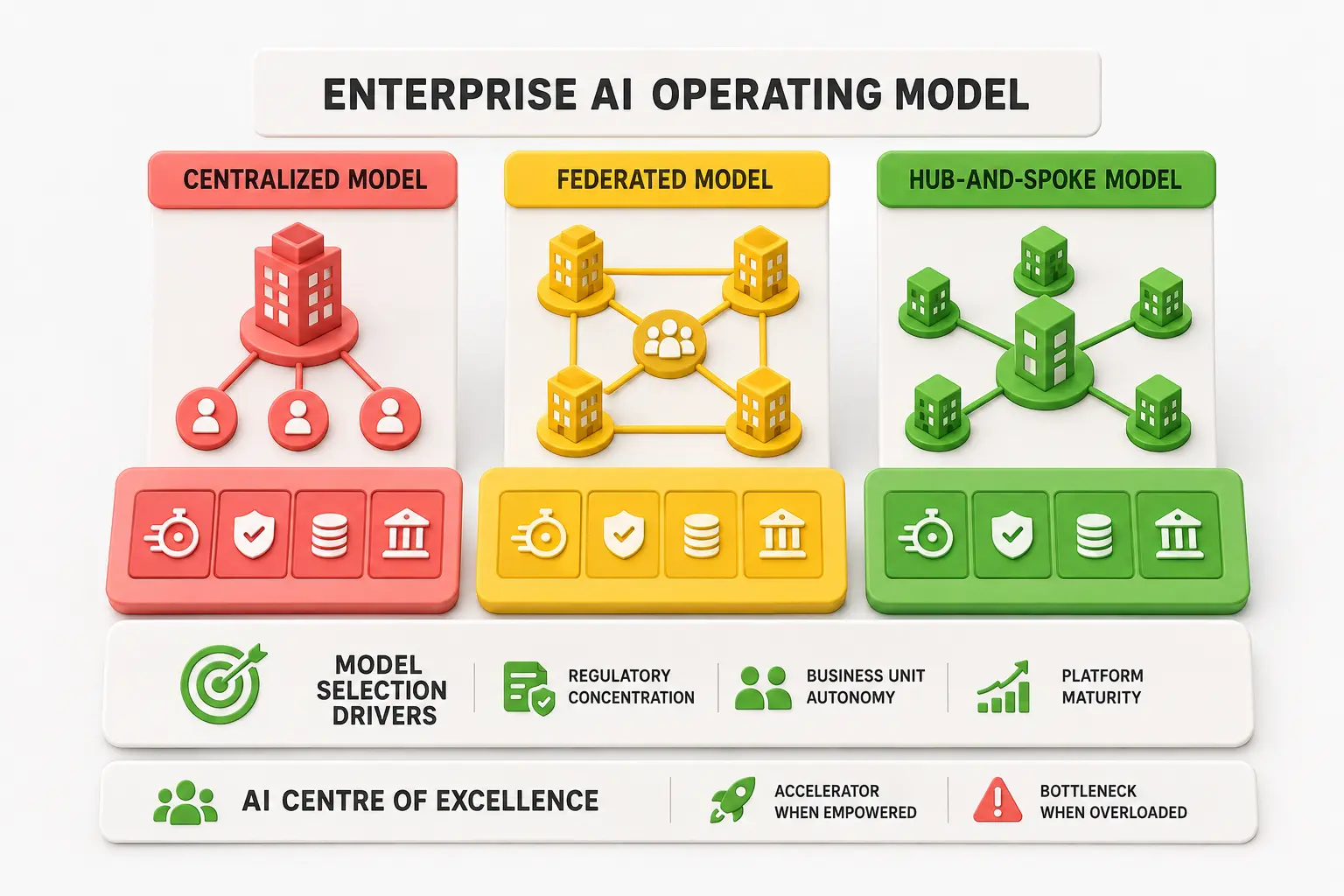
Choosing the model is dependent on three primary factors:
A centralized AI Center of Excellence (CoE) performs best by enabling access to shared tooling and APIs. But centralization has a limit. When every use case needs CoE approval, architecture review, data clearance, and model review before work can move forward, the CoE becomes a queue rather than an accelerator.
One way to look at this is to consolidate those aspects of an AI initiative that need consistency, including platform standards, risk management, reusable building blocks, models, and expertise, while leaving business judgment close to those who know the use cases well. Hence, the correct enterprise AI readiness model is not the one that is highly centralized but rather one that offers just the right amount of control.
Federated governance works when central teams set the guardrails. It balances enterprise control with local speed by dividing decision-making.
A shared control structure may be related to NIST AI RMF, ISO/IEC 42001, and the EU AI Act where appropriate, but more controls can be applied to riskier use cases. Protecting enterprise assets can be helped by integrating robust cybersecurity and compliance protocols directly into the deployment pipeline. This allows for consistency in governance without a one-size-fits-all approach to every organization. Governance usually emerges as the issue that hinders enterprise AI, but insufficient governance will never save time when it comes to dealing with incidents.
Building core infrastructure from scratch for every business unit drains budgets and creates fragmented environments. Evaluating hardware and compute requirements can be improved with an AI infrastructure readiness assessment to avoid costly capacity bottlenecks. Maximizing ROI requires centralizing baseline capabilities while preserving local agility.
The Genuine Reuse Test: A capability is only shared if a second business unit adopts and deploys it without requiring the original engineering team to rewrite or refactor code. If Unit B needs Unit A's developers to alter core APIs or pipeline code to make it work, you have built a custom project—not a reusable enterprise platform.
Through single-unit evaluations, we can test model performance. The problem arises when scaling AI is introduced. This raises new questions that come up with single-unit assessment may never reveal
That last point says a lot about enterprise AI readiness. Mature teams not only know how to launch AI. They know when to stop funding something that is not working. The ability to decommission a failed use case without creating operational or compliance problems is a practical marker of AI readiness at scale.
Enterprise deployment of AI requires an execution process that is disciplined and phased:
The most common rollout mistake is following enthusiasm rather than evidence. The loudest business unit may ask for AI first, but the readiest unit is usually the better place to scale next. That distinction can save time, cost, and unnecessary rework.
Measuring whether enterprise AI is actually scaling comes down to: activity metrics vs. scaling metrics. Counting AI use cases can look impressive, but it does not tell you whether the enterprise is actually getting better at scaling AI. Tracking overall impact can be helped by learning how to measure the business value of AI through clear return-on-investment metrics. The number of live use cases is an activity metric. More useful scaling metrics show how quickly teams can move, how much they can reuse, and whether the model works consistently across business units.
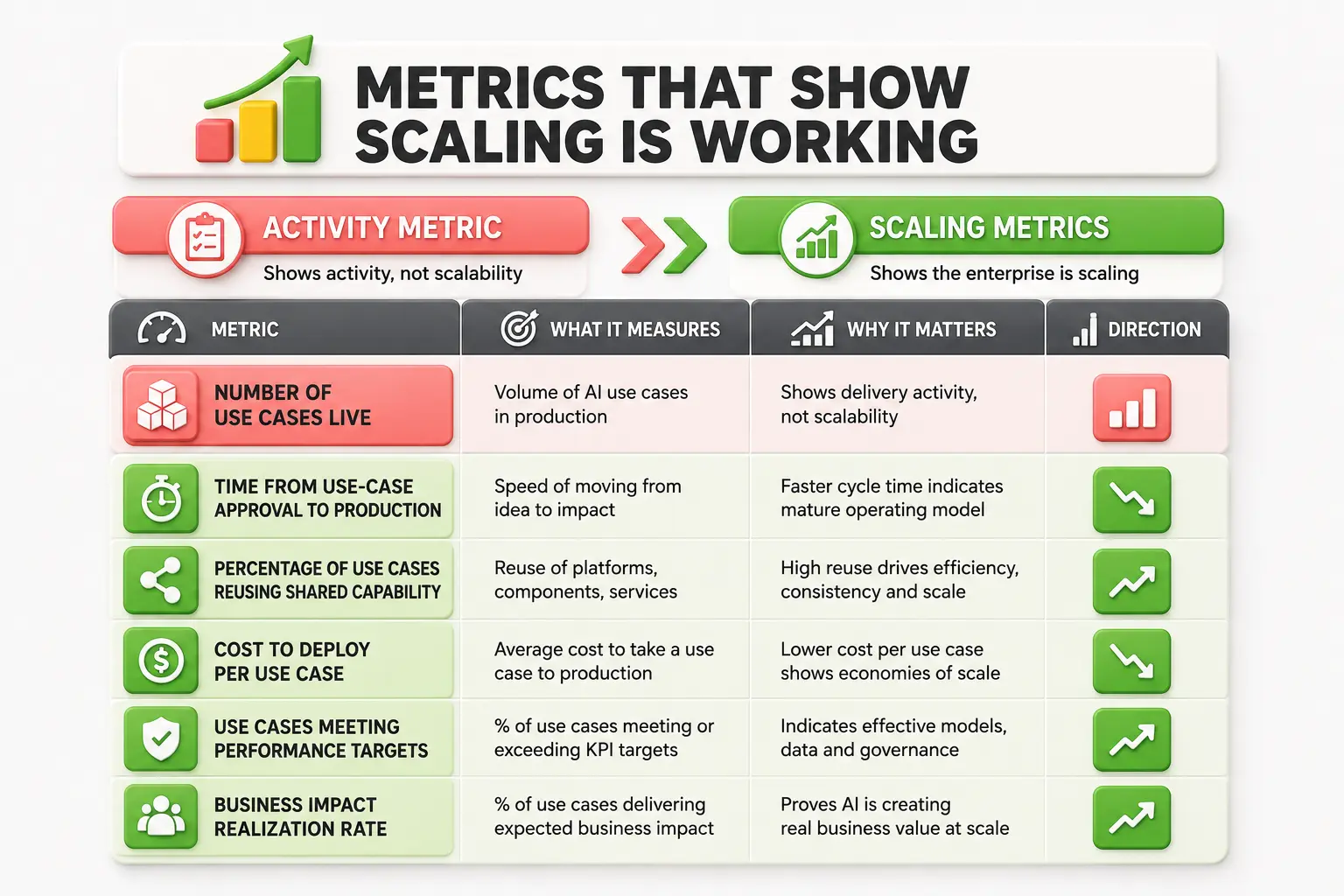
Tracking these metrics gives leadership an honest view of enterprise performance. When time-to-production shrinks and capability reuse rises, you know the operating model is actually working.
Pausing an enterprise rollout is a calculated risk management decision. Sometimes the best decision is to hold, fix the gaps, and then move forward. A few warning signs are serious enough to pause expansion:
A holding decision does not indicate failure of the AI program. Holding is just a decision. A good enterprise AI readiness assessment would make this decision more straightforward by providing information on where to fix things, who has ownership over them, and under what conditions scaling can resume. When selecting external guidance, finding a top AI readiness assessment partner can be helped by evaluating their past implementation experience across similar enterprise architectures.
Entrans runs a portfolio enterprise AI readiness assessment by applying a single evidence-based rubric across every business unit. Choosing the right external partner can be helped by evaluating AI readiness assessment providers for enterprises to ensure seamless portfolio-wide execution.
Learn more about how we provide enterprise AI readiness assessment focused on evidence, cross-unit comparison, reuse, and portfolio. Book a consultation call with us.

Score every unit against one rubric with the same evidence standard, then plot readiness against business value rather than averaging. The matrix produces four plays: scale now, remediate then scale, contain, and deprioritize. Averaging hides the variance that determines where investment actually belongs.
There are no right operating models. This is because they depend on the regulatory need, business unit, autonomy, and maturity of the platform. The hub-and-spoke operating model is normally very effective in governing central platforms.
Pilots often rely on team-specific data access, tools, governance, and manual workarounds that do not carry over to other business units. Scaling requires repeatable governance, shared capabilities, consistent data access, and a clear AI operating model.
For most large enterprises, it is primarily a governance and operating-model problem. Technology gaps are visible, solvable, but more costly. Governance gaps, particularly inconsistent entitlements and unclear accountability across business units, are the ones that stop production deployment and that no amount of platform investment resolves.
Prove the pattern in one business unit, extract the reusable capability such as retrieval, evaluation, and guardrails, standardize governance across units, then expand in order of assessed readiness rather than in order of enthusiasm. Expanding to the loudest unit rather than the readiest one is the most common and most expensive sequencing error.
Track time from use-case approval to production, the percentage of use cases reusing shared platform capability, cost per transaction trend, the proportion of units above a defined readiness band, and the number of use cases decommissioned. Counting live use cases measures activity, not scale.

-1.svg)