Discover how an AI infrastructure readiness assessment stops expensive scale-up failures in terms of storage, security, and AI processing workloads.

Agentic Unconference 2026 - September 19, Chennai
View Event →


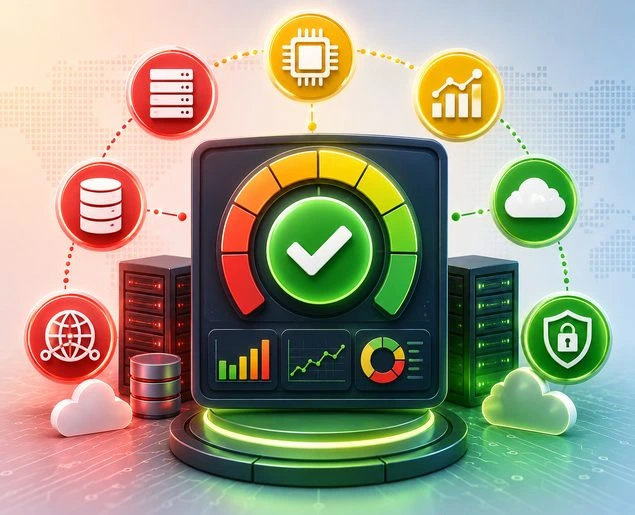


Do you know why some successful AI pilots vanish the second they go live? It's because the digital engine room simply can’t handle the load. An AI infrastructure readiness assessment helps uncover these issues before you commit capital. Skipping this leaves your organization vulnerable to unexpected crashes and massive cost overruns. AI infrastructure readiness shows whether your technical foundation can support production AI at the scale and cost you expect.
This blog helps determine whether the environment is ready for the next stage by doing an AI infrastructure readiness assessment.
AI Infrastructure Readiness Assessment is an evaluation of whether compute, storage, networking, deployment pipelines, model operations, observability, and security controls can support AI workloads in production at expected scale and cost.
The basic difference between AI Readiness Assessment and AI Infrastructure Readiness Assessment is explained below.
AI infrastructure readiness is the ultimate quiet blocker because it stays hidden during early experimentation. Research shows that roughly 90 percent of organizations report legacy infrastructure is actively holding back effective AI use. Overall business alignment can be improved through an AI readiness assessment guide to ensure technical capability matches organizational vision.
Only 45% of organizations have assessed their future infrastructure needs for GenAI. The real cost appears when teams discover these gaps after significant time and capital have already been committed. Infrastructure rarely prevents a project from starting—it simply makes scaling prohibitively expensive and technically disruptive when addressed late. Executing this evaluation efficiently can be helped by an AI readiness assessment engagement to reveal operational bottlenecks early.
AI infrastructure readiness is not just about having enough GPUs or picking a cloud platform. Below is the structural breakdown of the 7 Infrastructure Readiness Dimensions; they define what to measure, evidence, and failure signals.
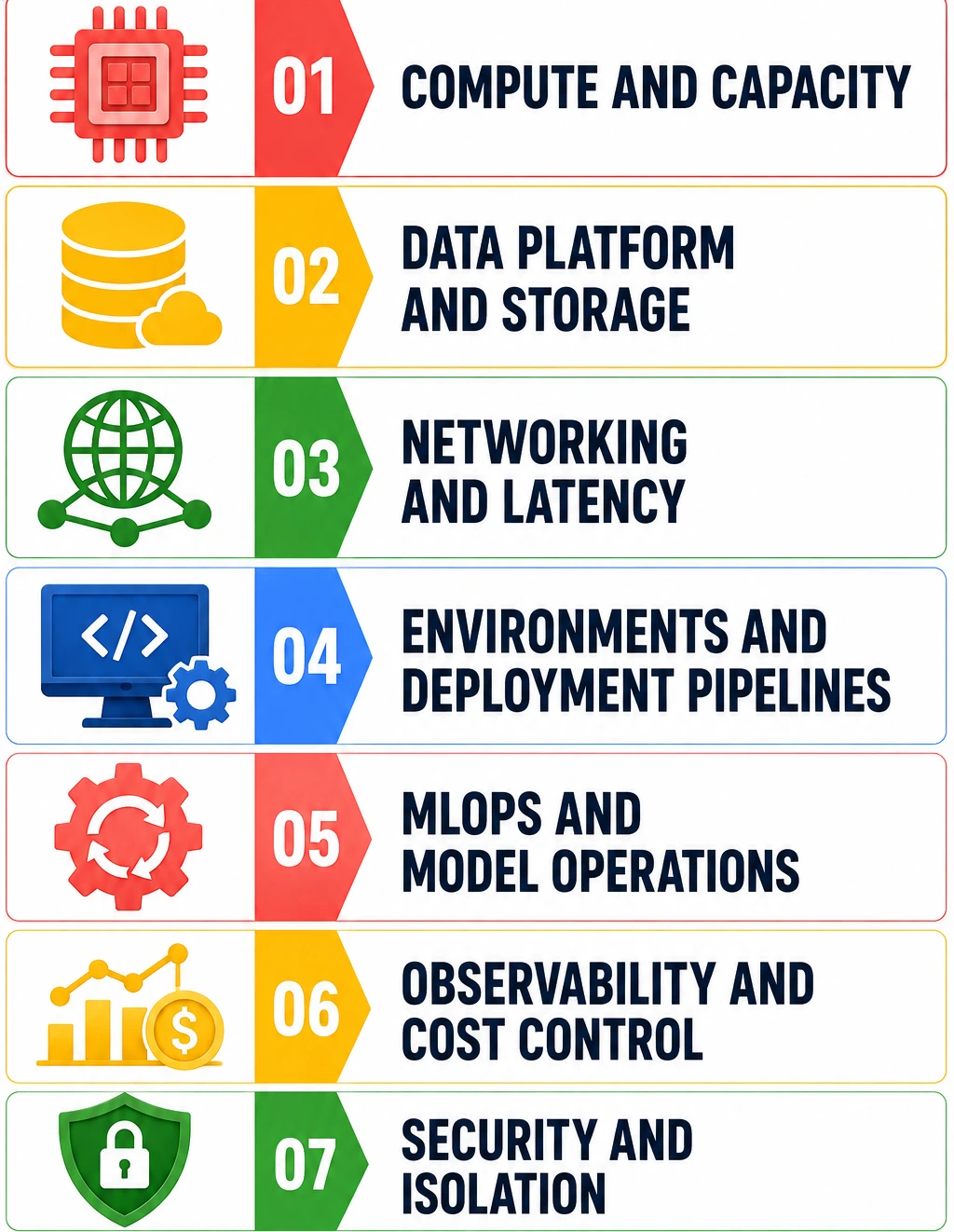
Try to find an answer to this question: Can the current compute setup handle the AI workloads you actually plan to run?
Consider the strategy in relation to the GPU and accelerators, such as whether to buy capacity, reserve it, or purchase it as needed. Consider the quotas currently in place, available headroom, and projections for both training and inference. The training process may generate spikes in usage, but the inference process may lead to more consistent use.
Capacity model mapping peak concurrent inference requests, hardware reservation contracts (reserved instances, baseline compute agreements), and quota expansion approvals across cloud providers or hardware vendors.
Capacity is meticulously planned and allocated for training cycles, but there is no model or provisioned budget for steady-state inference load once models reach production.
AI applications could present entirely different requirements for data platforms when compared with conventional applications. For this reason, an assessment needs to consider the speed at which data is ingested in training and retrieval processes, how that data is stored, and how much it will cost to manage and transfer. Pipeline capabilities can be improved using an AI data readiness assessment to verify data quality and access speed before expanding workloads.
Consider the storage tiers, vector databases, data locality, retrieval efficiency, and distance between data and computing resources. Specifically, take note of cross-regional transfers and network egress fees because these costs might affect the economics of an AI workload.
Architecture diagrams showing data proximity to compute clusters, benchmark metrics for vector indices under concurrent load, and documented data storage/retention policies with automated lifecycle rules.
Egress fees and cross-region or cross-cloud transfer costs are discovered only after the system architecture and data storage locations have been locked down.
Typically, artificial intelligence applications may be quite specific regarding how fast data transfer and communication should occur between applications and infrastructure components. Architectural efficiency can be helped by leveraging enterprise cloud solutions to reduce transit bottlenecks across hybrid environments.
Assess the bandwidth capacity for distributed training, set reasonable latency targets for real-time inference, and measure the connectivity from on-premises data stores to cloud computing platforms. It is crucial to measure the entire path instead of making assumptions regarding individual components.
Distributed benchmark logs, network link saturation limits, direct connect or private link setup validation, and an explicit, validated latency budget allocation breakdown across network hops.
A defined latency budget exists on paper, but no team has actually measured or stress-tested it end-to-end under realistic load.
It is imperative that there is a safe environment in which AI systems can test their model, prompts, processes, and autonomous agents before any of those things go into production. Delivery consistency can be improved by adopting DevOps quality engineering practices that automate testing and guard staging environments.
Examine how well the environments of development, testing, staging, and production are segregated. See if your builds are reproducible, if your models can be versioned, and if previous versions can be rolled back if an issue arises.
CI/CD pipeline definitions for model deployment, artifact repository configs, deterministic build manifests, and an isolated, sandbox environment specifically configured for testing autonomous agent execution.
The organization lacks a dedicated, isolated environment where autonomous agents can execute actions without risking impact to live business operations.
Taking a model to production is just the start. What do you use to keep track of models, assess their performance, detect any change in behavior, and know when a model needs updating or retiring? Lifecycle management can be helped with dedicated dataops MLOps services to streamline drift detection and model retraining.
Evaluate the model registry, model assessment, drift detection, retraining triggers, and release approvals. Find out the owner of the production model and the baseline used to determine if it is better.
Active model registry with assigned ownership metadata, continuous evaluation harness outputs, automated drift detection alerts, and a documented release governance workflow.
Models are running in production environments with no designated owner, no ongoing evaluation pipeline, and no established baseline to measure performance degradation.
It becomes increasingly difficult to monitor the costs of AI once you have multiple models, apps, teams, and workloads using the same environment.
In evaluating the costs, trace the inference and token costs down to the workloads or use case.
This includes latency, error rates, request volume, prompt/response tracing, and model use. We need to find out what our AI costs are and what workloads are causing those costs.
FinOps tagging strategy enforcing cost attribution by workload/team, operational dashboards tracking request paths end-to-end, and automated budget threshold alerts.
Receiving an aggregate monthly AI bill that no engineering or finance team can break down or attribute to specific use cases or business units.
AI introduces additional security concerns around models, prompts, data flows, credentials, and external model providers. Robust protection can be improved through comprehensive cybersecurity and compliance measures designed to isolate endpoints and preserve privacy.
Check tenant isolation, secrets management, access controls, prompt and model injection defenses, outbound traffic restrictions, and how third-party model endpoints are reviewed. External models should have clear rules around what data can be sent to them and under what conditions.
Network policy definitions, Data Loss Prevention (DLP) controls on model outputs, third-party model vendor security reviews, and secret store access logs.
Production data or proprietary user queries flow directly to external model endpoints without prior security architecture review or formal enterprise data protection agreements.
Choosing an AI capacity model requires evaluating trade-offs across financial structure, control, deployment speed, and vendor lock-in. Compare four options:
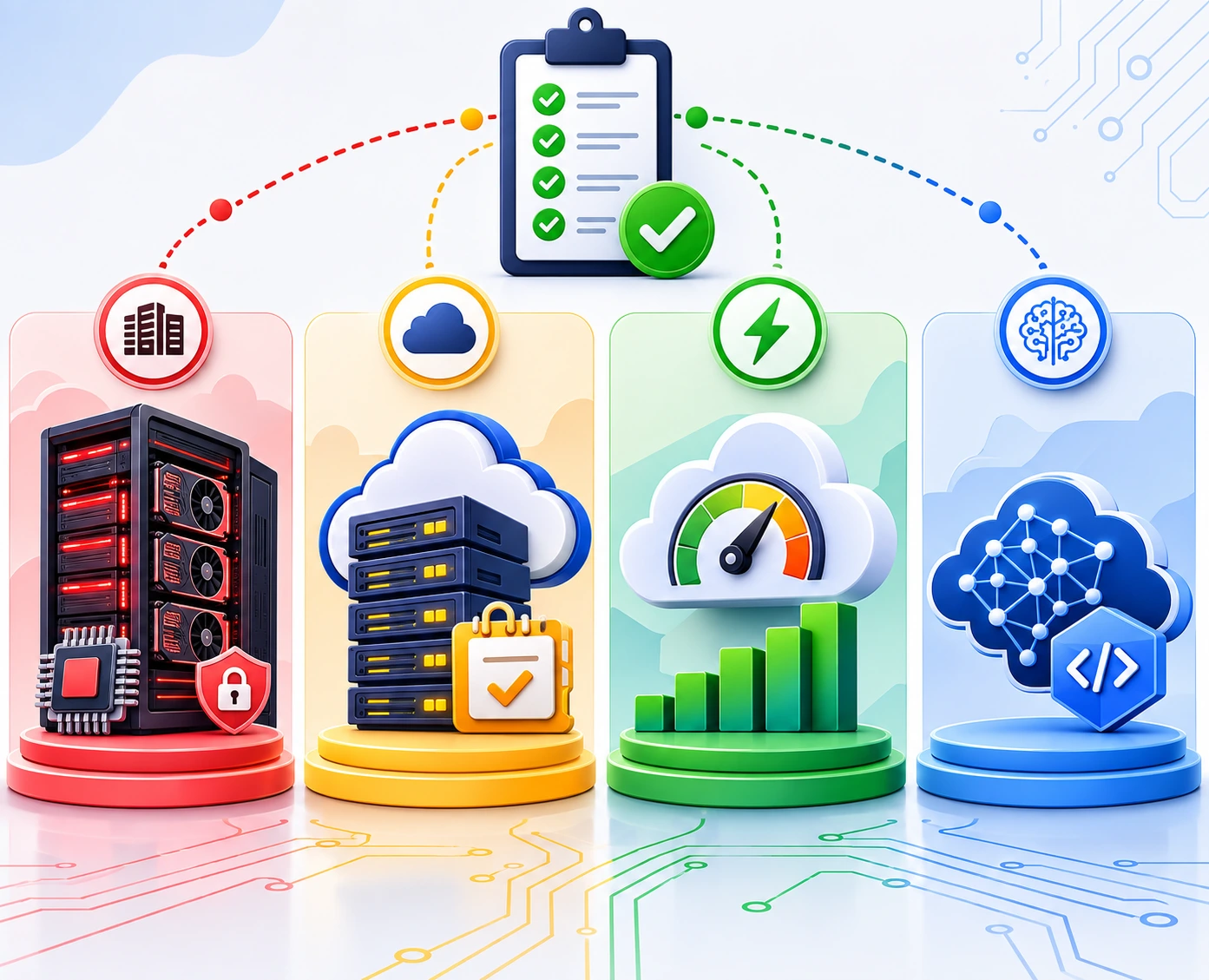
It offers the most control and makes economic sense for workloads that keep accelerators highly utilized, but it also brings capacity planning, power, cooling, operations, and hardware refresh cycles.
It trades some flexibility for more predictable access and lower unit economics when demand is steady.
It usually reaches value faster and suits variable workloads, but unused capacity can become expensive.
Next, we need to calculate utilization break-even by comparing the fully loaded hourly cost of owned hardware. But if the use is sufficient to recoup the fixed costs, then owning would be more sensible. In case there is intermittent usage, the cloud solution will continue to be more economical.
Since cloud pricing, hardware costs, and GPU availability fluctuate rapidly, model capacity should be estimated using live pricing data from primary sources such as AWS EC2 Pricing and Azure VM Pricing.
Managed inference APIs shift more operational work to the provider and can speed deployment, though they introduce greater provider dependency and data-handling considerations.
The budget is mainly oriented towards model training, but inference dominates steady-state AI expenditures. Inferences vary with every user interaction, API call, and background workflow.
When organizations track AI costs as a flat monthly cloud bill rather than a unit metric, successful pilots hit a scaling wall. Scaling a pilot without knowing your cost per transaction turns business growth into an unpredictable margin risk.
A better starting point is cost per transaction: how many requests arrive, and how many input and output tokens each request uses.
Determining the cost model for a practical model is simple:
Cost per transaction = model calls + input/output tokens + retrieval and tool overhead + infrastructure cost, adjusted for caching.
Once the number has been determined, one can test whether modifying the model, shortening prompts, increasing cache reuse, or modifying retrieval will actually impact unit economics. A technical proof-of-concept that hasn’t quantified its cost per transaction does not have any solid foundation to scale up.
Agentic AI systems transition infrastructure from passive response generation to autonomous execution. Preparing for probabilistic outputs can be helped by executing a gen AI readiness assessment to adapt controls specifically for large language models and autonomous agents. When systems take direct actions across enterprise applications, four critical infrastructure requirements change:
Actions should be designed so that repeating the same request does not create duplicate outcomes and changes can be reversed.
Every tool call, state change, and system interaction must be immutably logged. This makes incidents reconstructable rather than leaving teams to guess what happened.
Agents should maintain how many records they can modify. Which credentials they can use. Infrastructure must enforce strict per-agent execution limits, API call quotas, and permission boundaries. System safeguards must prevent looping behaviors and limit potential damage to connected production databases or external APIs.
Test environments must be used for testing agents as well as tooling and behavior before they can interact with production systems. All networking, computing, credentials, and data access must be contained in such test environments.
Rate each of the seven aspects using the scale of 1 to 5 and then multiply by the assigned weight. Evaluates maturity across dimensions on a 1to 5 scale using weighted bands.
A simple maturity model works well:
1 = absent or ad hoc
2 = emerging
3 = defined
4 = managed
5 = optimized
A critical failure (Level 1) in either Environment Separation or Security immediately caps the overall score at Level 2 max, regardless of high performance in other dimensions.
Use the weighted total to place the environment into readiness bands, for example: 1.0–1.9 Not Ready, 2.0–2.9 Developing, 3.0–3.9 Operationally Ready, and 4.0–5.0 Mature. Apply a capping rule as well: if either Environments and Deployment Pipelines or Security and Isolation scores 1 or 2, the overall result cannot exceed Developing, regardless of the weighted average.
Additional demand for AI doesn’t necessarily mean that you’ll need to increase your capacity. First, you must know whether the issue is elsewhere.
Before approving any capacity spend, measure the workload, establish the transaction, and prove that capacity.
Partnering with specialized AI readiness assessment consulting firms can be helped to gain neutral third-party expertise when evaluating multi-cloud environments. Entrans approaches AI platform readiness by focusing on the infrastructure capabilities that determine whether an AI workload can move safely from testing into production.
Book a consultation call to learn more.

Enterprise AI typically needs suitable compute, data, and storage platforms, and fast networking. A central model registry, prompt/weight versioning, and automated CI/CD pipelines for deployment. The right setup depends on workload size, latency, data location, and expected usage.
Evaluate whether the existing environment is able to cope with the compute, data, networking, deployment, model management, cost, and security demands. The assessment of AI infrastructure readiness gives ratings for these components based on actual data and not just architecture plans.
Base it on utilization and workload predictability. Owning accelerators makes sense at sustained high utilization with stable, long-lived workloads and data residency constraints. Reserved or on-demand cloud capacity suits variable demand, and managed inference APIs suit teams whose bottleneck is time to value rather than unit cost. Model cost per transaction before committing capital.
Training may be a recurring cost, whereas inference occurs continually as user requests come in. Once an AI workload goes into production, the ongoing costs of inference, tokens, retrievals, and calls to tools can be greater than the one-time training cost.
Agentic systems need safe sandboxes, action controls, audit trails, rate limits, rollback mechanisms, and tightly scoped permissions because they can take actions rather than simply return answers. The environment should let teams trace and reverse actions before agents are allowed to touch production systems.
The standard timeframe for an enterprise AI infrastructure readiness assessment is 4 to 8 weeks, based on the number of systems, workloads, and stakeholders involved. This is usually a period that includes discovery, assessment, scoring, gap analysis, and a remediation plan.

-1.svg)