> Blog >
Gen AI Readiness Assessment: What Generative and Agentic Workloads Actually Require
Move beyond AI pilots safely. Learn how a Gen AI readiness assessment uncovers hidden data risks, fixes permissions, and secures your systems for production.

Gen AI Readiness Assessment: What Generative and Agentic Workloads Actually Require

4 mins
September 4, 2026
Author
Aditya Santhanam
TL;DR
  • A Gen AI readiness assessment evaluates whether your business can safely deploy generative and agentic models into production beyond simple testing environments.
  • Gen AI readiness needs to verify 7 core dimensions. It requires auditing unstructured data, enforcement of access permissions at retrieval, continuous test harnesses, and strict action-safety controls.
  • Generative AI needs more than a capable model. Clean content, accurate retrieval, grounded responses, and clear access controls directly affect system quality and risk.
  • Readiness should be scored by workload, not as one company-wide number. A business may be ready for content generation while still lacking the controls needed for knowledge assistants or autonomous agents.
  • Building a successful generative strategy isn't about running pilots; it's about engineering production-grade safety. A Gen AI pilot worked, but what happens when real users, sensitive data, and business decisions enter the picture? 

    That is where a Gen AI readiness assessment plays a key role. A generative AI readiness assessment helps uncover whether your business is truly prepared to move beyond experimentation and into production. 

    In this blog, we will discuss how a generative AI readiness assessment ensures that your systems can safely handle the added risk of AI that can act.

    Table of Contents

      What Is a Gen AI Readiness Assessment?

      A GenAI readiness assessment evaluates whether an organization can deploy generative and agentic AI safely in production. It covers retrieval and entitlement controls, prompt and output governance, and evaluation capability.

      A GenAI readiness assessment differs from a general AI assessment because it focuses on unique risks and controls. A general AI assessment focuses primarily on structured data pipelines and predictive accuracy. GenAI readiness assessment provides controls for generative and agentic workloads.

      How GenAI Readiness Differs from Traditional AI Readiness

      Traditional readiness assessments focus on static dataset quality and model training infrastructure. But when we move on to generative and agentic deployments, understanding pattern recognition and unstructured synthesis is very important.

      To properly assess non-deterministic risks, organizations should align their frameworks with international standards like the NIST AI Risk Management Framework or ISO/IEC 42001 

      GenAI introduces different requirements around unstructured content, retrieval, grounding, safety, and human oversight. Understanding the difference between predictive AI, generative AI, and agentic AI readiness is very important.

      Capability Dimension Predictive AI (Traditional) Generative AI Agentic AI
      Data requirement Predictive AI requires labeled historical data evaluated on statistical accuracy. Generative AI demands governed unstructured content evaluated on groundedness and safety. Agentic AI relies on reversible tool usage evaluated on constrained task completion.
      Primary Risk Model bias, poor generalization, data drift, and inaccurate predictions Hallucination, unsafe content, data leakage, weak grounding, and unauthorized retrieval Unauthorized or incorrect actions, cascading errors, excessive autonomy, and uncontrolled tool use
      Evaluation method Accuracy, precision, recall, F1, AUC, calibration, and business-specific performance metrics Groundedness, factuality, relevance, toxicity, safety, and response quality Task completion under constraints, action accuracy, policy adherence, recovery behavior, and tool-use performance
      Governance Focus Data lineage, feature store maintenance, and model retraining cycles Input/output guardrails, retrieval entitlements, context window management, and prompt security Human-in-the-loop (HITL) checkpoints, execution boundaries, API scopes, and undo capability
      Failure Mode Inaccurate classification, false positives/negatives, or degraded predictive power Confident fabrication, IP infringement, context pollution, or toxic/harmful outputs Infinite loops, unauthorized system mutations (e.g., incorrect API writes), or goal drift

      It is important because GenAI readiness cannot be understood as just AI readiness plus an LLM. It must consider whether the data, retrieval function, evaluation, governance mechanisms, and human involvement are compatible with the nature of these systems.

      The 7 Dimensions of Gen AI Readiness

      Evaluating Gen AI readiness requires moving beyond traditional infrastructure checklists. The following framework outlines seven core dimensions necessary for secure, production-grade deployment.
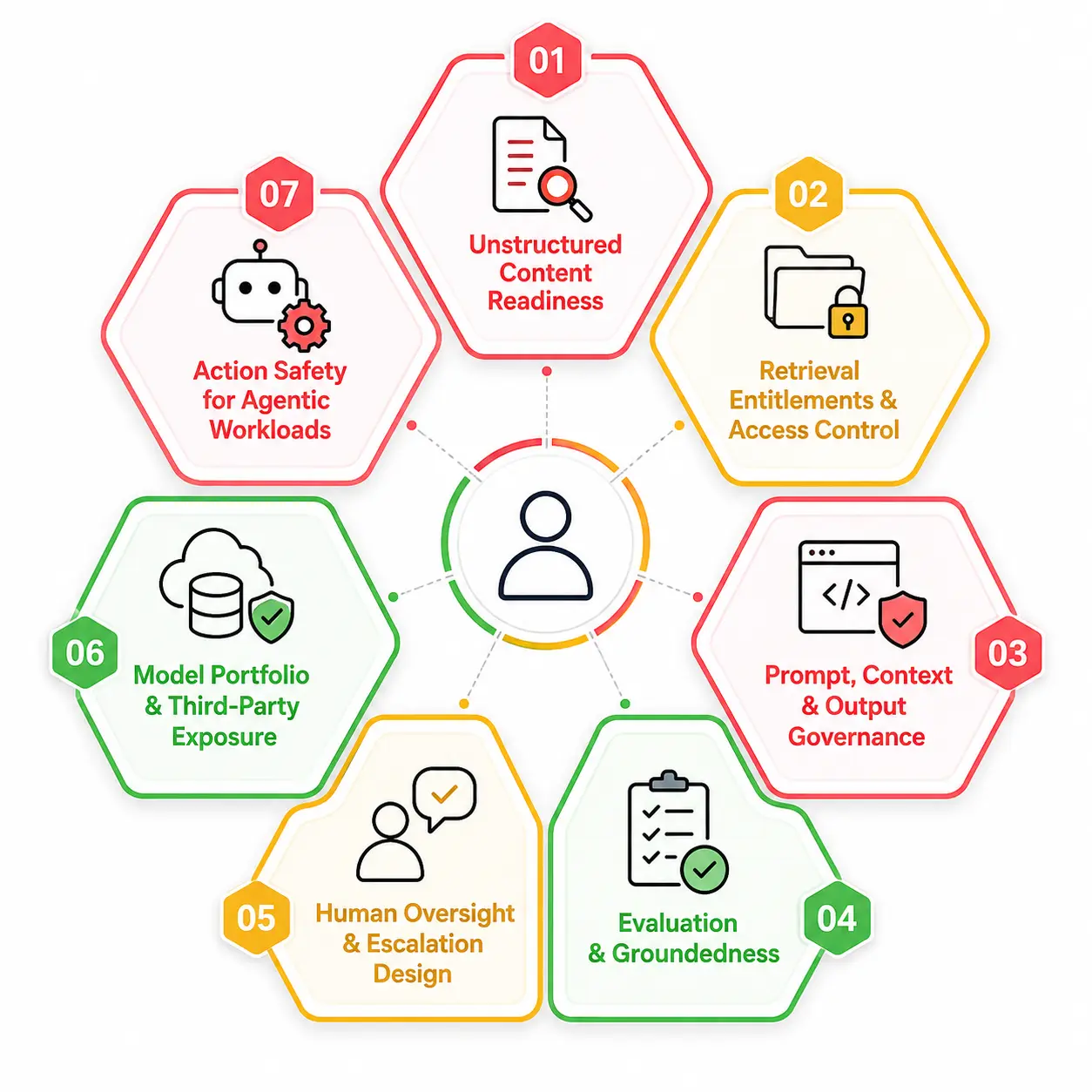
      Dimensions of Gen AI Readiness

      1. Unstructured Content Readiness

      Enterprise information exists in documents, PDFs, presentations, e-mails, reports, and other forms of content that were never intended to be used by AI. 

      Before using this content for your generative AI, analyze the accuracy of the extraction of information, the segmentation of the documents, the addition of metadata, the frequency at which the information becomes obsolete, and the removal of duplicates.

      Addressing unstructured content is critical given that IDC estimates over 80% of enterprise data is unstructured, yet less than 18% of enterprises systematically tag or govern these document estates. 

      • What to Measure: Extraction accuracy, chunking strategy efficiency, semantic metadata enrichment, source freshness, and corpus deduplication across all target document estates.
      • Evidence Required: Document parsing benchmarks, chunk-boundary validation tests, automated freshness tags, and deduplication audit logs.
      • Failure Signal: A retrieval corpus assembled directly from an unmanaged file share with no explicit document ownership or review schedule.

      2. Retrieval Entitlements and Access Control

      Permissions must be maintained when content is accessed by ensuring that the user is not provided with access to information the user would have been unable to access if accessing through the original system.

      According to McKinsey's survey on enterprise AI, over 60% of IT leaders cite unauthorized data access via RAG as their top risk; enforcing CISA Zero Trust Architecture guidelines at query time is necessary to prevent cross-tenant data leakage 

      • What to Measure: Real-time enforcement of source-system access control lists (ACLs) and security permissions at query time on a per-user, per-request basis.
      • Evidence Required: Dynamic entitlement-mapping policies, security boundary integration tests, and access enforcement logs across user roles.
      • Failure Signal: A system that surfaces indexed content or context snippets to a user who could not open the source document directly.

      3. Prompt, Context and Output Governance

      The behavior of Gen AI can be altered with changes in prompts, retrieved context, and output constraints. There should be documentation of the set of instructions used, the information added to the context, and the constraints set before the answer was produced.

      • What to Measure: Prompt version control, context injection validation, real-time input/output filtering, and comprehensive trace logging to reconstruct any decision or response.
      • Evidence Required: Version-controlled prompt repositories (e.g., Git history), boundary-guardrail configurations, context sanitization rules, and immutable audit logs.
      • Failure Signal: Production system prompts modified on the fly without formal review, rollback capability, or version history.

      4. Evaluation and Groundedness

      A good demonstration will not prove that Gen AI technology is production-ready. Testing must take into account real-world examples and determine if the answers received can be verified from reliable sources, will still be correct when changes occur, and will fall within a predetermined error rate.

      • What to Measure: Continuous automated evaluation using representative production queries, groundedness and citation validation, pre-release regression testing, and defined error budgets.
      • Evidence Required: Golden evaluation datasets, automated evaluation harness metrics (faithfulness, answer relevance), pre-deployment test runs, and explicit accuracy SLA thresholds.
      • Failure Signal: Application quality and launch readiness assessed via ad-hoc executive demos rather than a standardized evaluation harness.

      5. Human Oversight and Escalation Design

      Certain decisions made by Gen AI must never reach the user or be acted on until after some sort of human intervention. Readiness involves determining when human input is required, what information they will have available, and what happens if there is disagreement.

      • What to Measure: Explicit human-in-the-loop (HITL) approval gates, reviewer interface clarity, escalation workflow efficiency, and feedback loops for model tuning.
      • Evidence Required: Defined trigger criteria for human escalation, UI wireframes showing complete reviewer context, and feedback intake mechanisms integrated into the model lifecycle.
      • Failure Signal: An architecture claiming "human-in-the-loop" governance without dedicated reviewer staffing, budget, or workload allocation.

      6. Model Portfolio and Third-Party Exposure

      Models may possess varying abilities, costs, data handling terms, and geographical constraints. An assessment of Gen AI readiness must ensure mapping of models to data categories and business cases with a realistic path to switching to other models when necessary.

      • What to Measure: Model governance aligned with data classification tiers, vendor contractual data handling/retention terms, and architectural portability to switch providers.
      • Evidence Required: Model-to-data mapping matrices, vendor zero-data-retention (ZDR) agreements, abstract API wrapper architectures, and fallback model benchmarks.
      • Failure Signal: Mission-critical production workflows built entirely around a single proprietary model provider with no evaluated alternative or migration path.

      7. Action Safety for Agentic Workloads

      This kind of risk is brought about by the fact that this particular AI can perform certain actions rather than just giving out responses. All actions taken by the agent before it modifies any data, sends out messages, starts workflows, or makes use of business systems must be limited and have an escape route.

      • What to Measure: Action reversibility, API idempotency, strict blast-radius controls, real-time action auditing, and dedicated sandbox environments mirroring production.
      • Evidence Required: Action validation schemas, dry-run simulation capability, scoped API keys, automated rollback protocols, and production-like test sandbox environments.
      • Failure Signal: Autonomous agents granted direct write or delete permissions on core systems of record before a robust rollback or undo mechanism exists.
      Dimension Key Evaluation focus Target State
      Unstructured Content Extraction, chunking, metadata, freshness Governed, deduplicated, and continually updated corpus
      Retrieval Entitlements Source-system ACL enforcement at retrieval Zero-trust access matching user source entitlements
      Prompt & Output Governance Version control, filtering, trace audit logging Immutable traces, versioned prompts, output filtering
      Evaluation & Groundedness Continuous harness testing, error budgeting Automated evaluation benchmark suite + continuous testing
      Human Oversight Approval workflows, feedback loops, reviewer context Staffed HITL gates for high-risk operations with feedback loop
      Model Portfolio Data safety policies, vendor terms, portability Portable model architecture with approved ZDR vendor terms
      Agentic Action Safety Reversibility, idempotency, blast-radius limits Sandboxed execution, API write limits, rollback mechanisms

      Gen AI readiness assessment must determine if AI can be shifted from the demo environment to the actual business operations without any blind spots regarding data, access, quality, accountability, or autonomy. 

      Agentic AI Readiness: The Higher Bar

      The agentic AI readiness equation hits different because they just don’t answer; they act. When a standard chatbot misunderstands context, you get a poor response. When an agentic system misunderstands context, you get an operational incident. 

      The challenge goes beyond data and model quality. Agents need process knowledge, which includes approval thresholds, escalation rules, exception handling, and dependencies. 

      For example, consider an accounts-payable agent that receives an invoice without knowing that certain vendors require manual approval. The agent could approve and process a payment that should have been held. A customer-service agent might issue a refund without knowing that high-value refunds require supervisor approval. A procurement agent could place an order without recognizing that a contract has expired or that a purchase exceeds an employee's authority. In each case, the problem is not simply that the model gave the wrong answer. The system took the wrong action. 

      It is for this reason that agent preparedness for agentic AI involves knowing the agent's knowledge, what it is entitled to do, when it should stop doing so, and if it can undo its actions. What an agent requires before going into production mode is context in terms of process, permission boundaries, escalation procedures, audit trail, and recoverability.

      Scoring Gen AI Readiness

      The readiness score requires rating on a 1-to-5 capability scale mapped across the 7 dimensions. They are weighted according to the workload being assessed. A single enterprise-wide score can hide important gaps, so the assessment should reflect what the AI system will actually do.

      Score Readiness level Meaning
      1 Ad-Hoc Unmanaged risk, zero auditability, manual process
      2 Emerging Basic controls drafted; reliant on ad-hoc testing and reactive fixes.
      3 Defined Formalized guardrails, structured evaluation datasets, initial production monitoring.
      4 Managed Continuous automated evaluation, enforced SLA gates, active access control integrations.
      5 Optimized Adaptive evaluation, self-healing agent boundaries, zero-trust dynamic entitlements.

      Workload-Specific Weighting

      Dimension Content Generation Knowledge Assistant Agentic AI
      Unstructured Content Readiness 20% 25% 15%
      Retrieval Entitlements and Access Control 10% 20% 15%
      Prompt, Context & Output Governance 25% 15% 15%
      Evaluation & Groundedness 20% 20% 15%
      Human Oversight & Escalation 10% 5% 15%
      Model Portfolio & Third-Party Exposure 15% 10% 10%
      Action Safety 0% 5% 15%
      TOTAL 100% 100% 100%

      Overall Maturity Bands

      • 1.0–1.9: Unready
      • 2.0–2.9: Emerging
      • 3.0–3.6: Defined
      • 3.7–4.4: Production Ready
      • 4.5–5.0: Advanced

      The Capping Rule

      A high average must never mask any critical issue in access or control of actions. In the case of Retrieval Entitlements & Access Control scoring a 1, the readiness band is confined to Emerging irrespective of the weighted score.

      In the case of agentic workload, the same principle applies if Action Safety scores a 1. Such an agent, which can access protected data or execute non-reversible actions without the necessary controls, cannot be termed production-ready despite other scores.

      Thus, the generative AI readiness assessment becomes workload-specific and not model-specific. The organization can be ready for content generation and yet not be ready for a knowledge assistant or an autonomous agent.

      Common Gen AI Readiness Gaps

      Across Gen AI programs, the same readiness gaps tend to spike.

      • Strong Model Access, Weak Content Governance: Businesses are generally able to get production access to the highest quality of foundation models, yet plug them directly into unindexed, unclassified, or outdated repositories of documents. Model intelligence will not save them from lack of metadata, inadequate chunking, and mismanaged source files.
      • Enthusiasm for Autonomous Agents Without Rollback Paths: Businesses are generally able to get production access to the highest quality of foundation models, yet plug them directly into unindexed, unclassified, or outdated repositories of documents. Model intelligence will not save them from lack of metadata, inadequate chunking, and mismanaged source files.
      • Pilots Evaluated by Impression Rather Than Test Harnesses: Businesses are generally able to get production access to the highest quality of foundation models, yet plug them directly into unindexed, unclassified, or outdated repositories of documents. Model intelligence will not save them from lack of metadata, inadequate chunking, and mismanaged source files.
      • Absence of Unit Economics and Cost Attribution: Businesses are generally able to get production access to the highest quality of foundation models, yet plug them directly into unindexed, unclassified, or outdated repositories of documents. Model intelligence will not save them from lack of metadata, inadequate chunking, and mismanaged source files.
      • Post-Launch Ownership Void: Organizations establish project teams to deploy the initial model, but fail to assign a long-term business owner responsible for monitoring prompt drift, updating context sources, and auditing response quality post-launch.

      The gap Entrans encounters most often: retrieval entitlements and access control are frequently treated as a technical detail rather than a readiness requirement. Teams can emphasize making the content discoverable while failing to show that the AI has the ability to enforce the permissions as the source system does. 

      The final gap includes the capping rule for a very good reason: If a Gen AI system can retrieve the information for which the requesting user is not permitted, then no matter what high scores the system has in the areas of evaluation, content quality, or model performance, the workload will be unprepared for production. The Retrieval Entitlement Gap score of 1 sets the limit for the readiness band at the Emerging level, and the same holds for agentic workloads in Action Safety.

      From Experiment to Production: A 90-Day Path

      Moving from pilot experiment to production deployment requires a governed sequence. Each phase should address its specific readiness gaps before moving on to the next phase with risks.
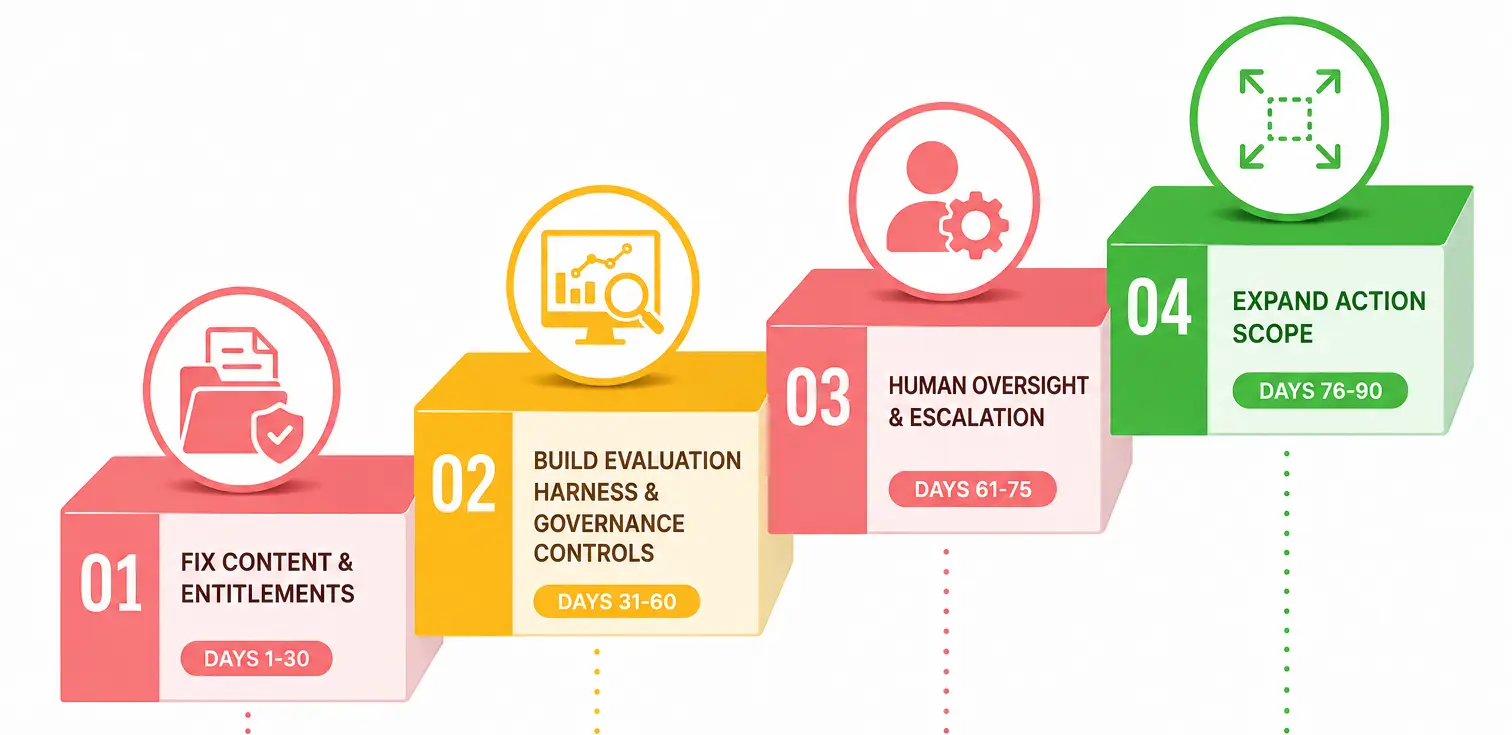
      Experiment to Production

      Fix Content and Entitlements (Days 1-30)

      Start with the foundations. Audit unstructured document estates, clean source metadata, and map fine-grained access control lists (ACLs). Clean up the content that will feed the system, remove duplicates, establish ownership and review dates, and map source-system permissions into retrieval. Test whether different users receive only the information they are authorized to access.

      • Checkpoint: Zero cross-tenant data leakages during synthetic security testing. 

      Build the Evaluation Harness and Governance controls (Days 31-60)

      Go beyond demo-based validation. Generate your test set using actual user queries and test for groundedness, citation quality, factual correctness, safety, and consistency of responses. Always perform regression testing each time you update prompts, models, retrieval mechanisms, or source documents.

      • Checkpoint: Groundedness score ≥ 90% across your 100-query golden evaluation dataset. 

      Human oversight and escalation (Days 61-75)

      Establish the need for human approval, the reviewers' views, situations of case escalation, and how disputes are noted. Assign ownership of post-launch quality control on prompts and outputs.

      • Checkpoint: Every high-risk decision has a named owner, clear escalation path, and planned reviewer capacity.

      Expand Action Scope (Days 76-90)

      When dealing with agentic workloads, begin with least risky and reversible activities. Check permissions, idempotency, rate limits, audits, and recovery in case of failures before being able to work with critical systems.

      • Checkpoint: 100% success rate on rollback simulations for failed API write actions. 

      Where GenAI Readiness Assessments Mislead

      Readiness score may not give accurate answers while answering the wrong question. Several common approaches create a false sense of confidence.

      • Assessing organizational readiness in the abstract: Evaluating an enterprise's overall AI readiness as a single blanket metric is ineffective. GenAI Readiness depends on what the system needs to access, generate, decide, and do. A knowledge assistant has different requirements from an autonomous agent. 
      • Treating model choice as the Primary decision: Audits often focus heavily on benchmark comparisons between foundational models. They spend time on content, retrieval permissions, evaluation process, and governance controls. A stronger model cannot fix poorly governed source content or incorrect access rules.
      • Scoring Readiness Without a Defined Error Budget: Readiness levels will not have much meaning until there has been some consensus established regarding an acceptable error rate. A system with an accuracy level of 95 percent could be good enough to draft internal memos but not to make financial decisions.
      • Using one score for every workload: The company-wide number can conceal some important differences between use cases. High readiness for low-risk content creation does not imply that all the necessary controls are applicable to autonomous actions.

      Readiness to work as a drafting assistant is different from readiness to work as an issuing agent responsible for customer refunds. Every task requires its own criteria of risk, evidence, control, evaluation, and approval.

      How Entrans Assesses GenAI and Agentic Readiness

      At Entrans, we start the GenAI readiness assessment with a use case and not according to the model. We evaluate GenAI and agentic readiness through a 5-step engineering methodology:

      1. Use-Case Scoping: We define failure modes and error budgets per target workload, delivering a Workload Risk Classification Sheet.
      2. Content Estate Sampling: We audit unstructured document stores for parsing accuracy, metadata depth, and chunking performance, producing a Corpus Quality Benchmark Report.
      3. Retrieval Entitlement Testing: We execute automated, role-based query suites across vectors and indexes to verify ACL enforcement at runtime, generating a Zero-Trust Access Audit Matrix.
      4. Evaluation Harness Review: We benchmark system outputs against target datasets for groundedness, faithfulness, and citation integrity, yielding an Evaluation Suite & Error Budget Report.
      5. Agentic Action-Safety Review: For agentic workloads, assess permissions, approval gates, idempotency, rollback, audit trails, rate limits, and sandbox testing. Our Gen AI engineers bring in their delivery experience integrating agentic frameworks into enterprise workflows to evaluate how these controls behave in practice. 

      These artifacts map directly to our 7-dimension scorecard by replacing generic AI readiness claims with workload-specific verification.

      Learn more about how we build a resilient zero-trust foundation. Book a consultation call with us.

      Share :
      Link copied to clipboard !!
      Assess Your Gen AI Readiness for Production
      Identify data, access, governance, and safety gaps before moving Gen AI workloads into production.

      FAQs

      1. How is GenAI readiness different from AI readiness?

      Traditional AI readiness evaluates historical datasets, model training pipelines, and prediction accuracy, whereas GenAI readiness focuses on creating structured content, non-deterministic outputs, and mitigating hallucination risks.

      2. What data do you need for generative AI?

      GenAI requires governed unstructured content (such as PDFs, enterprise documentation, and internal knowledge bases) paired with rich metadata. For RAG and agentic systems, content also needs clear ownership, freshness, provenance, and access controls.

      3. What makes an enterprise ready for agentic AI?

      An enterprise needs trusted data, defined processes, bounded permissions, human approval points, and clear escalation paths. Agents also need reversible actions, audit trails, sandbox testing, and recovery mechanisms before they can act independently. 

      4. How do you evaluate generative AI quality before deployment?

      Build a test set from real queries, measure groundedness and citation accuracy rather than fluency, run regression tests before each release, and agree on an explicit error budget with the business owner. Systems are continuously scored against standardized metrics for faithfulness, answer relevance, groundedness, and hallucination rates before meeting defined error budget thresholds.

      5. What are the biggest risks when deploying generative AI in an enterprise?

      Key challenges include hallucinations, unauthorized data retrieval, sensitive information exposure, poor content quality, unsafe outputs, and unclear accountability. Agentic workloads add the risk of incorrect or irreversible actions across business systems.

      6. How long does a GenAI readiness assessment take?

      A focused GenAI readiness assessment typically takes three to six weeks. It depends on the number of use cases, data sources, and systems involved. A comprehensive, multi-department enterprise assessment takes around 4 to 8 weeks, depending on data estates, agentic tool safety, and evaluation harness.

      Hire GenAI Developers for Production-Ready AI
      Build secure, scalable GenAI solutions with vetted developers experienced in enterprise AI workloads.
      20+ Years of Industry Experience
      500+ Successful Projects
      50+ Global Clients including Fortune 500s
      100% On-Time Delivery
      Thank you! Your submission has been received!
      Oops! Something went wrong while submitting the form.
      Free Project Consultation
      Trusted by Enterprises & Startups
      Top 1% Industry Experts
      Flexible Contracts & Transparent Pricing
      50+ Successful Enterprise Deployments
      Aditya Santhanam
      Author
      Aditya Santhanam is the Co-founder and CTO of Entrans, leveraging over 13 years of experience in the technology sector. With a deep passion for AI, Data Engineering, Blockchain, and IT Services, he has been instrumental in spearheading innovative digital solutions for the evolving landscape at Entrans. Currently, his focus is on Thunai, an advanced AI agent designed to transform how businesses utilize their data across critical functions such as sales, client onboarding, and customer support

      Related Blogs

      How Forward-Deployed Engineers Deploy AI Agents in Enterprise Systems

      How forward-deployed engineers deploy AI agents in enterprise systems using secure integrations, MCP, GraphRAG, testing, and production controls.
      Read More

      Forward Deployed Engineer Metrics: How to Measure FDE Performance and ROI

      FDE metrics help measure Time-to-Value, deployment success, customer adoption, and ROI. Learn which benchmarks matter for high-performing FDE teams.
      Read More

      AI Readiness Assessment by Industry: How Sector Constraints Change the Score

      Learn how industry rules reshape your AI readiness assessment for healthcare data systems, banking, and manufacturing, from risk factors to scoring models.
      Read More